
Summarize with AI


The best subscription design agencies for Series B AI startups in 2026 are Studio Maydit, BX Studio, Lighthouse Digital, Phantom, Lazarev, Kvalifik, Feely Studio, Foundey, Trueform, and Fantasy. Studio Maydit and Lazarev lead for this brief, because both have published AI client work and both can hold a standing commitment alongside a company that already employs designers. Lighthouse Digital and Trueform are the wrong fit here, since one publishes no AI client work at all and the other is a Framer website studio, and at this stage the recurring need is product surfaces rather than pages.
By Series B the design problem has changed shape, and most companies keep buying for the problem they used to have.
You are not short of designers any more. There are two or three, possibly four, and they are good. There is a design system, or at least a component library that people mostly use. There is a brand somebody paid for. On paper this is a solved function.
What is actually short is a specific kind of capacity. Two product lines now, plus a marketing site, plus whatever the enterprise deals require, plus the thing sales promised at a conference. The in-house team can absorb about sixty percent of that. The rest gets triaged, and triaged work at this stage is not small work. It is a pricing change, a second onboarding path, a partner portal.
So a subscription looks like the obvious answer, and it often is. But at this size it fails differently than it does at seed. It fails through drift. Outside designers ship good work in their own files, using their own patterns, at a slightly different standard, and nobody notices for two quarters. Then somebody opens the product and finds three versions of the same table.
There is also a harder question underneath, and it deserves a straight answer before any money moves. A subscription is sometimes a way to avoid a headcount conversation that finance has already lost. That can be a perfectly good decision. It is a bad one to make accidentally.
What follows is ten studios, ordered by how well they work beside a design team that already exists.

How we picked these agencies
Five checks, all of them answerable from published work before a first call:
- Platform depth. Can the studio work on product surfaces, or is the recurring offer really page production with a monthly invoice attached?
- Proof at scale-up size. Is there published work for companies that already had a design system and a team, rather than only for startups that had neither?
- Pricing. Is a starting figure public, which matters more on a standing commitment than on a project?
- Team shape. Do you get the same senior people every month, or whoever is between projects?
- Their own site. Does it hold one standard across every page, since consistency across surfaces is the exact thing you are buying?
The second check is the one that separates this list from a general subscription list. Working with a company that has no designers is mostly a question of taste and speed. Working beside three good designers who have their own opinions, their own file structure, and a system they built is a different job, and it is largely a diplomatic one. Studios that have not done it tend to arrive with a better idea about everything.
Facts in the tables come from what each studio publishes about itself. Where nothing has been published, the row says nothing rather than filling in an estimate.
What goes wrong with design subscriptions at Series B
Three failures, and they all take about two quarters to become visible.
The subscription is bought to avoid a headcount conversation. Hiring is slow, the requisition is frozen, and a monthly arrangement can start in a fortnight without anybody signing off on a permanent role. That is sometimes exactly right, and it is worth naming out loud when it is happening, because the two purchases behave differently over a year. A hire accumulates context, argues in planning, and is there when a decision made in spring has to be defended in autumn. A subscription resets some of that every month. Buy it deliberately as capacity, not quietly as a substitute for a person you actually need.
The design system drifts because nobody owns contributions. External designers work fast, which means they build what they need rather than waiting for a component that does not exist yet. Multiply that by six months and you have parallel patterns, three button variants, and two ideas about what an empty state looks like. The rule that prevents it is dull and takes one afternoon to write. Anything new goes into the system or gets explicitly marked as an exception with a date on it, and one named person on your side reviews that weekly. Without it, you are paying monthly to accumulate inconsistency.
The work arrives without the history that would have made it right. A Series B product has a past. Something was tried eighteen months ago, it did not work, and the reason lives in the head of a designer who has since moved to another team. Outside designers cannot know this, so they propose it again, confidently, and either it ships and fails a second time or somebody senior kills it after two weeks of work. Keep a short written record of what has been tried and what happened. It is the highest-value document in a subscription arrangement and almost nobody has one.
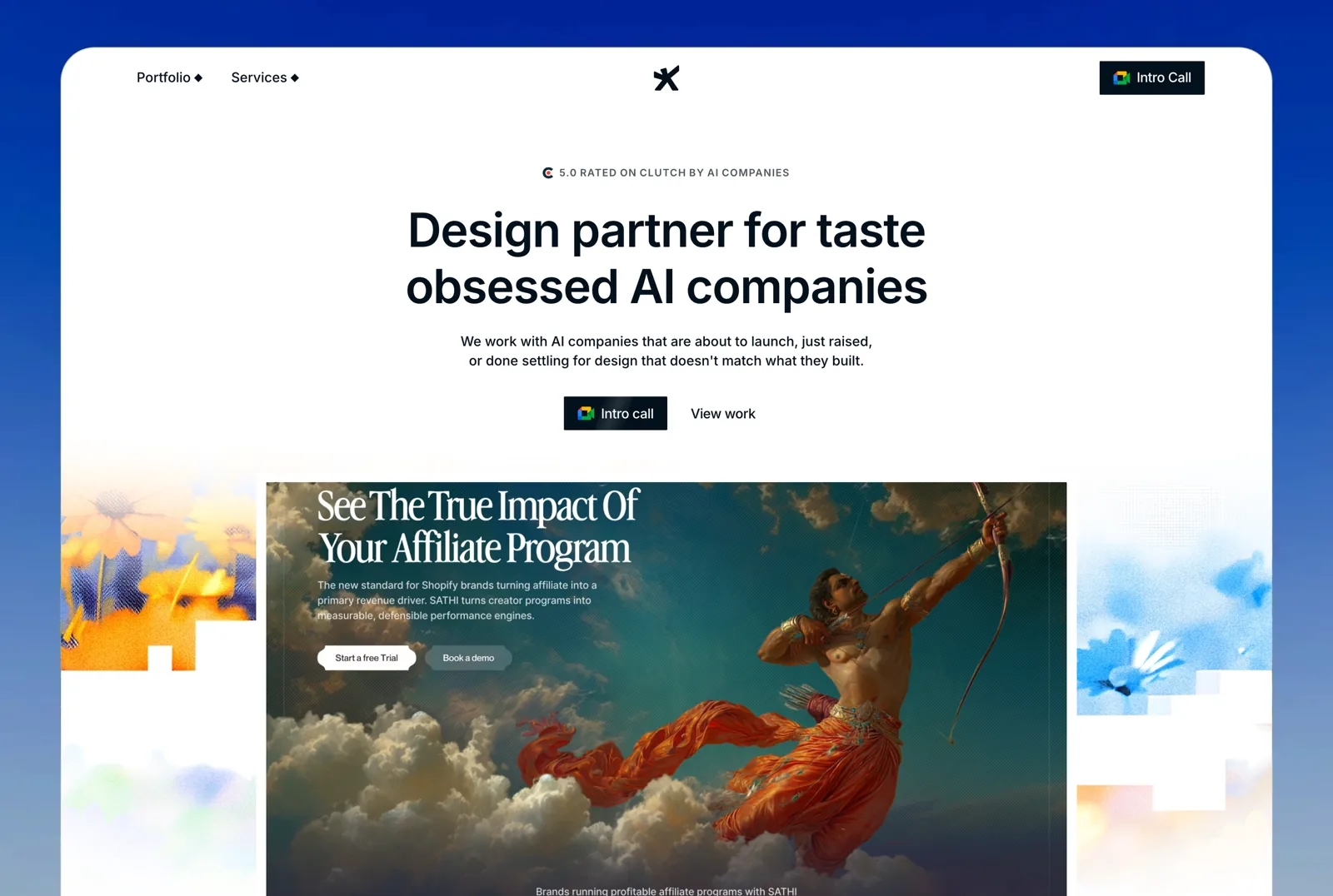
1. Studio Maydit: A Top-Rated Design Agency for AI Founders
The monthly retainer is the relevant product for a company at this stage. It covers new pages, campaigns, and product design, with no long lock-in, and no long lock-in matters more here than at seed, because a company with its own design team should be able to stop when the internal hire finally lands. Where the need is one defined thing instead, a fixed scope of three to four weeks is the alternative, and it closes with a diagnosis of what is leaking in the product rather than a handover.
Studio Maydit is a web and product design studio. Its clients are AI founders, working across the US, UK, and Europe. Framer, Webflow, and custom code are all available as build routes, the team is founder-led and senior, and the work continues into product design after a site ships, which is why the marketing surface and the product surface end up making the same argument rather than drifting apart.
One outcome sits in the public record and it is worth reading as a positioning result rather than a design one. Dualite changed who it was for, the design was rebuilt on that repositioned ICP, and 100,000+ users arrived across the next seven months. Recent clients include Wave, PixelFlow, Mi-VAD, and 15 other AI and SaaS teams.
| Check | Finding |
|---|---|
| Based in | Remote, serving US / UK / EU |
| Platform depth | Framer, Webflow, and custom code |
| AI-sector proof | Yes. AI-native clients, published outcome on Dualite |
| Pricing | Fixed scope or monthly retainer, quoted per project |
| Team shape | Founder-led, small senior team |
| Best fit | Companies with designers who are two people short |
Worth a call if your design queue is longer than your roadmap. Book a 30-minute call.

2. BX Studio
BX Studio is a New York team of 11 to 50 working in Webflow, with a published minimum, published AI client work, and Reddit, Headspace, ASAPP, and Verifone named. Every company on that list had an internal design team when the work happened, which is direct evidence of the specific skill this brief needs.
They publish no founding year, and Webflow is a website platform, so the product surfaces that generate most of the overflow at Series B would need a separate arrangement.
| Check | Finding |
|---|---|
| Based in | New York, USA |
| Founded | Not published |
| Team size | 11-50 |
| Primary platform | Webflow |
| AI-sector proof | Yes. Published AI client work |
| Named clients | Reddit, Headspace, ASAPP, Verifone |
| Pricing | Published minimum |
| Best fit | Companies whose marketing surface outgrew the in-house team |
3. Lighthouse Digital
Lighthouse Digital is a London studio working in Webflow, with a published minimum and HelloSelf, Freetrade, and IGN named. The published starting figure is genuinely useful on a recurring commitment, where a company needs to model the annual cost before it can get an approval.
They publish no AI client work, no founding year, and no team size, and a company at Series B is buying judgement rather than production, which is difficult to assess with that little in public.
| Check | Finding |
|---|---|
| Based in | London, UK |
| Founded | Not published |
| Team size | Not published |
| Primary platform | Webflow |
| AI-sector proof | No. No published AI client work |
| Named clients | HelloSelf, Freetrade, IGN |
| Pricing | Published minimum |
| Best fit | Teams who want predictable page output at a known cost |
4. Phantom
Phantom works from London and Auckland, founded in 2013, a team of 51 to 200 building in custom code, with published AI client work and Diageo, SAP, Financial Times, and Zendesk named. SAP and Zendesk both run large internal design organisations, so the studio is used to arriving as an addition rather than as the design function.
They publish no pricing, and a firm of that size prices and staffs around programmes, which fits a company with an annual plan better than one reprioritising every fortnight.
| Check | Finding |
|---|---|
| Based in | London, UK and Auckland, NZ |
| Founded | 2013 |
| Team size | 51-200 |
| Primary platform | Custom code |
| AI-sector proof | Yes. Published AI client work |
| Named clients | Diageo, SAP, Financial Times, Zendesk |
| Pricing | Not published |
| Best fit | Companies with an annual plan and stakeholders to satisfy |
5. Lazarev
Lazarev is a San Francisco studio of 51 to 200, founded in 2015, working across platforms, with a published minimum, published AI client work, and Payoneer, Peel, Elva, and Mozayix named. Working across platforms plus real headcount means the studio can take both a product flow and a campaign in the same month, which is the shape of the overflow at this stage.
At 51 to 200 people the designers assigned to you are chosen after the contract, and their published work leans towards conversion-led marketing rather than the dense internal screens a Series B product accumulates.
| Check | Finding |
|---|---|
| Based in | San Francisco, USA |
| Founded | 2015 |
| Team size | 51-200 |
| Primary platform | Mixed |
| AI-sector proof | Yes. Published AI client work |
| Named clients | Payoneer, Peel, Elva, Mozayix |
| Pricing | Published minimum |
| Best fit | Companies whose overflow spans product and marketing |
6. Kvalifik
Kvalifik is a Copenhagen team of 11 to 50, founded in 2015, working in Webflow, with published AI client work and Veo, Maersk, and Relesys named. Maersk is a large organisation with its own internal standards, so there is evidence of working inside somebody else's system rather than replacing it, which is the daily reality of a subscription at this stage.
They publish no pricing, Webflow limits the product side of the work, and Copenhagen hours overlap poorly with a company running its planning from the American west coast.
| Check | Finding |
|---|---|
| Based in | Copenhagen, Denmark |
| Founded | 2015 |
| Team size | 11-50 |
| Primary platform | Webflow |
| AI-sector proof | Yes. Published AI client work |
| Named clients | Veo, Maersk, Relesys |
| Pricing | Not published |
| Best fit | European companies wanting a studio inside their system |
7. Feely Studio
Feely Studio is a distributed European team of one to ten, working across platforms, with a published minimum, published AI client work, and Noxus, Mutiny, Luasai, and Basic Capital named. A team that small means the same two people every month, which is the single biggest predictor of whether a recurring arrangement accumulates context or resets.
They publish no founding year, and one to ten people cannot absorb the volume a Series B company generates in a busy quarter, so the arrangement works only if the scope stays narrow.
| Check | Finding |
|---|---|
| Based in | Distributed, Europe |
| Founded | Not published |
| Team size | 1-10 |
| Primary platform | Mixed |
| AI-sector proof | Yes. Published AI client work |
| Named clients | Noxus, Mutiny, Luasai, Basic Capital |
| Pricing | Published minimum |
| Best fit | Companies wanting the same two people every month |
8. Foundey
Foundey is a San Francisco studio founded in 2021 doing Figma-first product design, with published AI client work and DemandIQ, Traycer, and Sero AI named. Product design is the entire business, which matters when the recurring work is a second onboarding path or a permissions model rather than another landing page.
They publish no pricing and no team size, and Figma-only means the work stops at a file, so your engineering capacity has to absorb every piece of it.
| Check | Finding |
|---|---|
| Based in | San Francisco, USA |
| Founded | 2021 |
| Team size | Not published |
| Primary platform | Figma-only |
| AI-sector proof | Yes. Published AI client work |
| Named clients | DemandIQ, Traycer, Sero AI |
| Pricing | Not published |
| Best fit | Companies with engineers spare and product screens queued |
9. Trueform
Trueform is a Swiss studio founded in 2022 working in Framer, with a published minimum, published AI client work, and Miro, Morning Brew, Bilt Rewards, and Gather named. Miro is a mature product company with a substantial design team, and a studio that has worked alongside one has already met the coordination problem this article is about.
They publish no team size, they are young for a standing commitment, and Framer is a website tool, so the product half of a Series B design queue sits outside what they do.
| Check | Finding |
|---|---|
| Based in | Wil, Switzerland |
| Founded | 2022 |
| Team size | Not published |
| Primary platform | Framer |
| AI-sector proof | Yes. Published AI client work |
| Named clients | Miro, Morning Brew, Bilt Rewards, Gather |
| Pricing | Published minimum |
| Best fit | Companies whose recurring need is campaign pages |
10. Fantasy
Fantasy works from San Francisco and New York, founded in 1999, across platforms, with published AI client work. A firm that has run for that long has held long relationships with large clients, and a subscription is a long relationship rather than a project.
They name no clients, publish no pricing, and publish no team size, so a company trying to forecast an annual commitment has almost nothing public to work from.
| Check | Finding |
|---|---|
| Based in | San Francisco and New York, USA |
| Founded | 1999 |
| Team size | Not published |
| Primary platform | Mixed |
| AI-sector proof | Yes. Published AI client work |
| Named clients | Not published |
| Pricing | Not published |
| Best fit | Companies willing to run a full evaluation first |
How to choose between them
Sort by what the in-house team keeps having to drop.
Product screens are the backlog. Studio Maydit or Foundey.
Marketing pages are the backlog. BX Studio or Trueform.
Both, in volume, every month. Lazarev or Phantom.
You need the same faces and steady context. Feely Studio or Kvalifik.
One test before signing. Give a candidate one of your existing components and ask what they would do if the task in front of them needed a variant that does not exist. The answer you want describes a route: propose it, get it reviewed, add it to the system. An answer that starts with building something quickly and tidying it later is describing the drift that makes subscriptions expensive at this stage.