

Summarize with AI


The best subscription design agencies for non-technical founders in 2026 are Studio Maydit, Push Refresh, Edgar Allan, Flowout, Instrument, Finsweet, Digidop, Flow Ninja, 8020, and Refokus. Studio Maydit and Push Refresh lead for this brief, because both are small enough that you talk to the person doing the work and both make it easy to know what you are paying for, which matters most when you cannot audit the work yourself. Instrument and Refokus are the wrong fit here, since both are built for clients with in-house design leadership, and neither publishes pricing, so a founder without a designer has nothing to check the proposal against.
Buying design when you are not a designer has one uncomfortable feature that nobody says out loud. You cannot tell whether the work is good.
You can tell whether you like it. Those are different things, and the gap between them is where most of the money goes.
A technical founder buying engineering has the same problem in theory and much less of it in practice, because code produces obvious evidence. It works or it does not, it is fast or it is slow. Design produces something that looks finished either way, and looking finished is not a signal.
A subscription quietly makes this harder rather than easier. A project has an ending, and endings force a judgement, because somebody has to say whether the thing that arrived was worth what it cost.
A monthly arrangement has no such moment. It renews because nobody stopped it. Twelve months in you have spent a serious amount of money and never once had to decide whether it was working, which is not a failure of attention. It is what happens when nothing in the arrangement ever asks the question.
There is a third thing, smaller but corrosive. When something takes three weeks, you have no way of knowing whether three weeks was reasonable. So founders tend to settle into one of two habits, accepting every estimate or challenging all of them, and neither one gets you better work.
The ten studios below are ranked on how well they make themselves possible to evaluate.

How we picked these agencies
This is a teardown, not a directory listing. For each agency we read their own site and their public record, then checked five things you can verify yourself in an afternoon:
- Platform depth. Is one craft their real specialism, or one line on a long service menu?
- AI-sector proof. Named AI clients and published work, or just the word "AI" in the copy?
- Pricing. Do they publish a minimum at all, or keep it behind a call?
- Team shape. Who actually does the work, and how many clients are they carrying at once?
- Their own site. Distinctive, or the same template as everyone else on this list?
That last one gets skipped most often. An agency's own website is the only project where nobody overruled them. No client committee, no inherited brand book. If their own site is forgettable, you have found their ceiling.
Every fact below comes from the agency's own site or a public listing. Where a number is not public, we say so rather than guessing.
What goes wrong when the buyer cannot audit the work
Three failures repeat, and each one comes from the same gap between liking something and knowing it works.
Approval collapses into taste. Work arrives, the founder reacts to it, and the reaction is about preference because preference is the only instrument available. Blue rather than green. A different photograph. The result is a slow drift towards whatever the founder finds comfortable, which is frequently the opposite of what a stranger arriving cold needs. The way out is to stop reviewing on appearance entirely. Agree upfront what each piece of work is supposed to change, whether that is sign ups from one page, drop off at one step, or how long support takes to answer a particular question, and make the review a conversation about that number instead of about the design.
Nobody ever decides whether to continue. The invoice arrives, it gets paid, and the arrangement extends by default. This is the single most expensive habit in this article, because it can run for a year without anybody being negligent. Fix it before you start by putting a review date in the calendar at month three and month six, and by writing down now what you would expect to be true by then. A partner who is confident will happily agree to that. One who becomes uneasy about a scheduled review has told you something useful for free.
Slow and hard look identical from outside. A request takes three weeks, and you have no reference point for whether that is fair. Founders who assume the best accept every timeline and lose months. Founders who assume the worst push back on everything and get worse work, because the studio starts protecting itself with padded estimates. The practical middle is to ask, before agreeing to anything, what makes this request slower than the last one. A good partner will explain it in ordinary language. A partner who answers with jargon is either hiding something or cannot teach, and both are problems when you are the client who needs teaching.
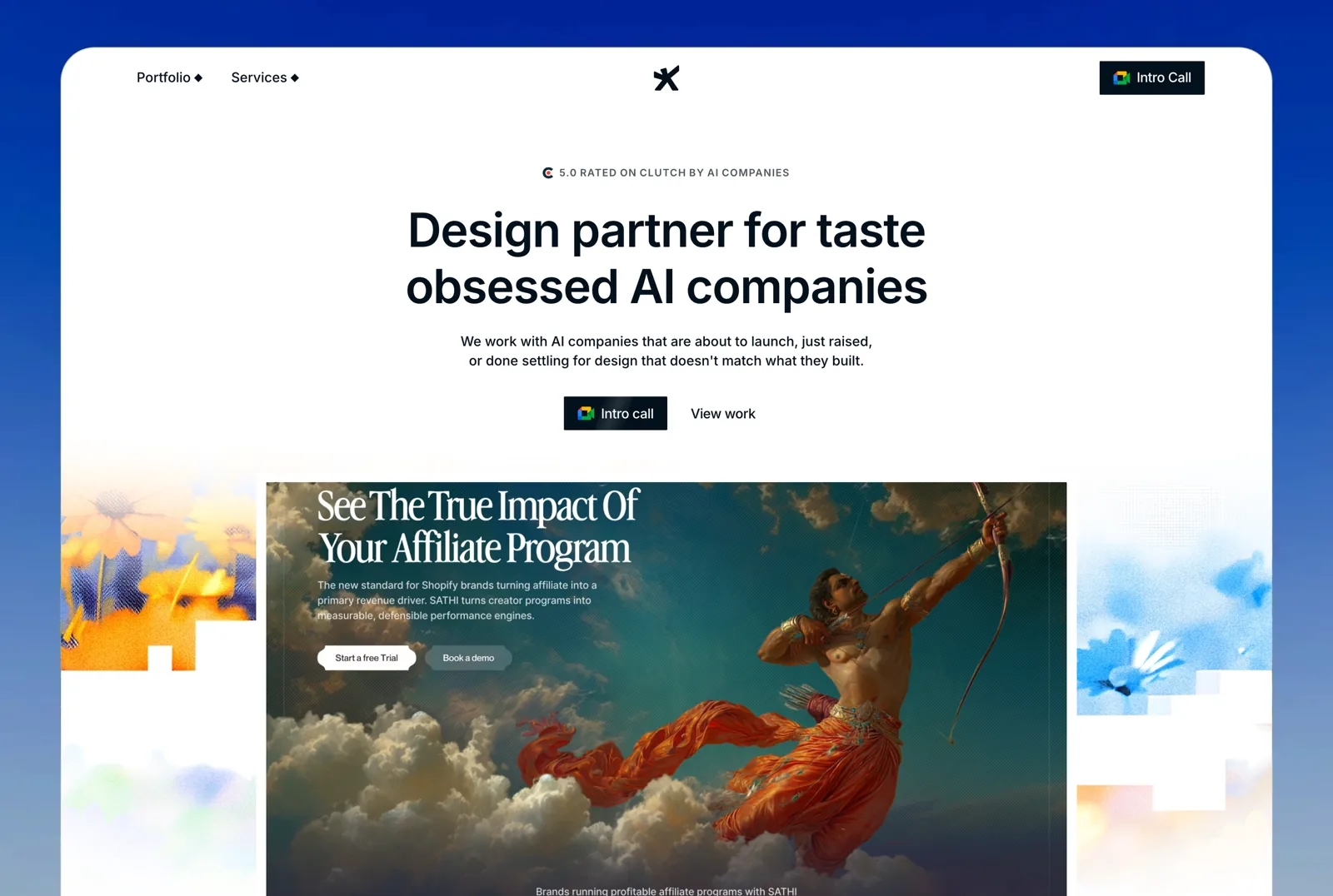
1. Studio Maydit: A Top-Rated Design Agency for AI Founders
Studio Maydit is a web and product design studio working with AI founders in the US, UK, and Europe. The studio builds websites in Framer, Webflow, and custom code, and continues into product design after the site ships.
The clearest outcome is Dualite, where design work supporting a repositioned ICP helped the product reach 100,000+ users in seven months. Recent clients include Wave, PixelFlow, Mi-VAD, and 15 other AI and SaaS teams.
Websites can be bought two ways. Fixed scope runs three to four weeks and suits teams with a launch date. Teams that keep shipping take a monthly retainer instead, covering new pages, campaigns, and product design, with no long lock-in. Fixed-scope projects end with a diagnosis of what is leaking in the product, not a handoff and goodbye.
| Check | Finding |
|---|---|
| Based in | Remote, serving US / UK / EU |
| Platform depth | Framer, Webflow, and custom code |
| AI-sector proof | Yes. AI-native clients, published outcome on Dualite |
| Pricing | Fixed scope or monthly retainer, quoted per project |
| Team shape | Founder-led, small senior team |
| Best fit | Founders who need the work explained, not just delivered |
Maydit is the right call if you are paying every month and have never had a way to check whether it is working. Book a 30-minute call.

2. Push Refresh
Push Refresh is a Dallas team of one to ten working in Framer, with a published minimum and SmithRx, Synonym, and Northern National named. Two things matter here for a founder who cannot audit design. The minimum is published, so you have a reference point before any call, and a team that small means the person explaining the work is the person who did it.
Their AI-sector proof is partial, they publish no founding year, and a team of one to ten has no cover, so a single person being unavailable is felt immediately in a monthly arrangement.
| Check | Finding |
|---|---|
| Based in | Dallas, USA |
| Founded | Not published |
| Team size | 1-10 |
| Primary platform | Framer |
| AI-sector proof | Partial. Enterprise and SaaS clients, no AI case study |
| Named clients | SmithRx, Synonym, Northern National |
| Pricing | Published minimum |
| Best fit | Founders who want to talk directly to whoever designs |
3. Edgar Allan
Edgar Allan is an Atlanta team of 51 to 200, founded in 2014, working in Webflow, with Porsche, Duracell, and NCR named. They treat writing and design as one job, which helps a non-technical founder considerably, since words are the part of the work you can genuinely judge, and a clear sentence is something you can argue with.
They publish no pricing, their AI-sector proof is partial, and a firm of that size assigns account contacts, so the person you speak to each month is unlikely to be the person making the work.
| Check | Finding |
|---|---|
| Based in | Atlanta, USA |
| Founded | 2014 |
| Team size | 51-200 |
| Primary platform | Webflow |
| AI-sector proof | Partial. Enterprise and SaaS clients, no AI case study |
| Named clients | Porsche, Duracell, NCR |
| Pricing | Not published |
| Best fit | Founders who judge words more confidently than visuals |
4. Flowout
Flowout is a distributed Webflow team with a published minimum and Jasper, Kajabi, Riverside, and Sendlane named. A published price and a defined request process remove most of the ambiguity that makes this purchase uncomfortable, because you know what a month costs and roughly what a month contains before you commit to anything.
They publish no founding year and no team size, their AI-sector proof is partial, and a queue model executes requests rather than questioning them, so it will not tell you when you are asking for the wrong thing.
| Check | Finding |
|---|---|
| Based in | Distributed |
| Founded | Not published |
| Team size | Not published |
| Primary platform | Webflow |
| AI-sector proof | Partial. Enterprise and SaaS clients, no AI case study |
| Named clients | Jasper, Kajabi, Riverside, Sendlane |
| Pricing | Published minimum |
| Best fit | Founders who want a fixed monthly cost and clear rules |
5. Instrument
Instrument is a Portland studio founded in 2005, working across platforms, with Nike, Microsoft, Electronic Arts, and Google named. Their depth is real and their record is long, which is reassurance a founder can verify from outside without needing to assess the craft itself.
They publish no pricing and no team size, their AI-sector proof is partial, and their engagements assume a client with design leadership in house, which is precisely the person a non-technical founder does not have.
| Check | Finding |
|---|---|
| Based in | Portland, USA |
| Founded | 2005 |
| Team size | Not published |
| Primary platform | Mixed |
| AI-sector proof | Partial. Enterprise and SaaS clients, no AI case study |
| Named clients | Nike, Microsoft, Electronic Arts, Google |
| Pricing | Not published |
| Best fit | Funded companies who already employ a design lead |
6. Finsweet
Finsweet is a distributed team of 51 to 200 based in Denver, founded in 2017, working in Webflow, with Dropbox, Clay, GitHub, and Steadily named. They publish a large amount of teaching material, and a studio that spends its time explaining its craft in public tends to explain it well in private, which is worth a lot when you are the one who needs explaining to.
They publish no pricing, their AI-sector proof is partial, and a deep platform specialist will expect a level of technical fluency in the conversation that a non-technical founder may find tiring.
| Check | Finding |
|---|---|
| Based in | Denver, USA, distributed |
| Founded | 2017 |
| Team size | 51-200 |
| Primary platform | Webflow |
| AI-sector proof | Partial. Enterprise and SaaS clients, no AI case study |
| Named clients | Dropbox, Clay, GitHub, Steadily |
| Pricing | Not published |
| Best fit | Founders who want to learn the craft while buying it |
7. Digidop
Digidop is a Paris team of one to ten, founded in 2021, working in Webflow, with a published minimum and TSE Energy, Ramify, and StreamNative named. A published minimum plus a very small team is the most legible combination available to a founder buying blind, since you know the price and you know exactly who is accountable for the work.
Their AI-sector proof is partial, a team that size can hold few monthly clients before things slow, and Paris hours mean a question asked in the US afternoon waits until the next day.
| Check | Finding |
|---|---|
| Based in | Paris, France |
| Founded | 2021 |
| Team size | 1-10 |
| Primary platform | Webflow |
| AI-sector proof | Partial. Enterprise and SaaS clients, no AI case study |
| Named clients | TSE Energy, Ramify, StreamNative |
| Pricing | Published minimum |
| Best fit | European founders who want price and accountability clear |
8. Flow Ninja
Flow Ninja is a Belgrade team of 11 to 50, founded in 2018, working in Webflow. They are organised around continuous work, with the reporting and process discipline that implies, and a documented process is a genuine advantage when you cannot evaluate the output, because you can at least evaluate whether the process was followed.
They publish no client names and no pricing, their AI-sector proof is partial, and a studio with no public client list gives a founder without industry contacts very little to check independently.
| Check | Finding |
|---|---|
| Based in | Belgrade, Serbia |
| Founded | 2018 |
| Team size | 11-50 |
| Primary platform | Webflow |
| AI-sector proof | Partial. Enterprise and SaaS clients, no AI case study |
| Named clients | Not published |
| Pricing | Not published |
| Best fit | Founders who want a documented process to hold onto |
9. 8020
8020 works from San Francisco and New York, founded in 2014, in Webflow, with Wave, Superlist, Pilot.com, Vanta, and Circle named. Their client list is full of companies that were once run by founders in exactly your position, and a studio used to that relationship tends to explain its reasoning rather than presenting work as a finished verdict.
They publish no pricing and no team size, their AI-sector proof is partial, and a Webflow studio will not help with the product screens, which for many founders is where the confusion is worst.
| Check | Finding |
|---|---|
| Based in | San Francisco and New York, USA |
| Founded | 2014 |
| Team size | Not published |
| Primary platform | Webflow |
| AI-sector proof | Partial. Enterprise and SaaS clients, no AI case study |
| Named clients | Wave, Superlist, Pilot.com, Vanta, Circle |
| Pricing | Not published |
| Best fit | Founders whose company is growing past their own expertise |
10. Refokus
Refokus is a remote German team of 11 to 50, founded in 2021, working in Webflow, with Mural, BASF, Spotify, Yahoo, and BCG named. Their work is visually ambitious and their client list is verifiable, which is one of the few quality signals available to somebody who cannot assess the craft directly.
They publish no pricing, their AI-sector proof is partial, and a studio with a strong signature is difficult for a non-technical founder to steer, because disagreeing with an expert about taste requires a confidence the arrangement does not give you.
| Check | Finding |
|---|---|
| Based in | Germany, remote |
| Founded | 2021 |
| Team size | 11-50 |
| Primary platform | Webflow |
| AI-sector proof | Partial. Enterprise and SaaS clients, no AI case study |
| Named clients | Mural, BASF, Spotify, Yahoo, BCG |
| Pricing | Not published |
| Best fit | Founders happy to hand creative direction over entirely |
How to choose between them
Sort by what makes you uneasy about buying.
You want to talk to whoever actually does the work. Studio Maydit or Push Refresh.
You need the cost to be knowable before a call. Digidop or Flowout.
You want the reasoning explained, not just the result. Finsweet or 8020.
Words are what you can judge, so lead with those. Edgar Allan or Flow Ninja.
One test before signing. Ask them to explain a past project to you as though you know nothing about design, including what they changed and why. A studio worth your money will do this comfortably and without condescension, because they have to do it with every client. A studio that reaches for jargon or shows you the work and waits for a reaction has told you what the next twelve months will feel like, and you will be the one doing the translating.