
Summarize with AI


The best subscription design agencies for product studios in 2026 are Studio Maydit, Digidop, Edgar Allan, Refokus, Flow Ninja, 8020, Push Refresh, Finsweet, Flowout, and Foundey. Studio Maydit and Foundey lead for this brief, because both have published AI product work and both operate at a seniority that suits a client whose own team already knows what good looks like. Flow Ninja and Refokus are the wrong fit here, since one publishes no client names to assess and the other carries a strong visual signature, which works against a portfolio where each product needs its own character.
Buying design for one product is a scheduling problem. Buying it for six is a different discipline entirely.
Most subscription arrangements are built around a single roadmap. One product, one queue, one set of priorities, and a client who can rank their requests because everything belongs to the same thing.
A product studio cannot rank that way. The requests come from different products, at different stages, with different people making the case, and they are not comparable. A launch page for one and an onboarding rework for another are not competing for the same slot in any meaningful sense, but in a single queue they are.
Then there is the compounding question, which is where most of the money goes without anybody noticing. The point of running several products is that the second one should be cheaper than the first. If every engagement starts from a blank canvas, that never happens, and the tenth product costs the same as the first while the invoices have quietly grown to a serious annual number.
The last difference is the awkward one. Your team is not a group of people who need design explained to them. They have opinions, they have taste, and they have almost no free time, which turns out to be a harder client to serve than an uncertain one.
The ten studios below are ranked on how well they serve a portfolio rather than a product.

How we picked these agencies
Nothing here was influenced by the studios themselves. Each was assessed against public evidence, using five checks chosen for a buyer running several products at once:
- Platform depth. Is there a craft they clearly own, or a wide list of services with thin evidence for any of them?
- Proof across multiple products. Have they worked with clients running more than one product, where the work has to transfer between contexts rather than serve a single roadmap?
- Pricing. Is a starting figure published, or does every enquiry require a call before any number exists?
- Team shape. How many people, and can capacity flex when two of your products need attention in the same fortnight?
- Their own site. Distinctive and current, or the same layout as the rest of the field?
That last check is worth more than it sounds for this brief in particular. A studio that reuses one template for its own work will tend to reuse one approach across your portfolio, and a portfolio is precisely where sameness costs you.
Every fact in the tables is public, drawn mostly from each studio's own website. Where something is not published, we record it as unpublished rather than filling the gap.
What goes wrong when one subscription serves many products
Three failures repeat in portfolio arrangements, and each one comes from applying a single-product model to a situation that is not single-product.
Nothing compounds. Each product gets its own components, its own patterns, and its own decisions, made fresh, because that is what a request queue naturally produces. Two years in there is no shared foundation, no reusable library, and no accumulated knowledge, so the newest product costs exactly what the first one did. The correction is to buy a foundation deliberately rather than hoping one emerges. Commission the shared system as its own piece of work, keep it owned by somebody specific, and require that new product work either uses it or explains why not. A queue optimises for the next ticket, and a foundation is never the next ticket.
The queue cannot absorb a spike. Portfolio demand is not smooth. Two products reach launch in the same fortnight, a third has a customer commitment, and a single-track subscription serialises all of it, so somebody waits weeks. This is not a failure of effort, it is arithmetic, and it should be addressed in the agreement rather than in an apologetic message later. Ask candidates directly what happens when you need double the throughput for three weeks, and get the answer before signing. A studio that has served portfolios has a mechanism. A studio that has not will say it will do its best, which is a description of the problem rather than a solution.
Your own people become the bottleneck. A product studio is staffed with capable, opinionated, extremely busy operators, and every piece of work needs one of them to look at it. Production stops being the constraint within a month and review takes over, with work sitting finished and unapproved while the person who must see it is occupied elsewhere. The fix is unglamorous. Name one reviewer per product, give them a standing slot rather than an open invitation, and grant the studio explicit permission to proceed on anything not answered within an agreed window. Studios that hold work indefinitely waiting for perfect feedback are not being careful, they are being expensive.
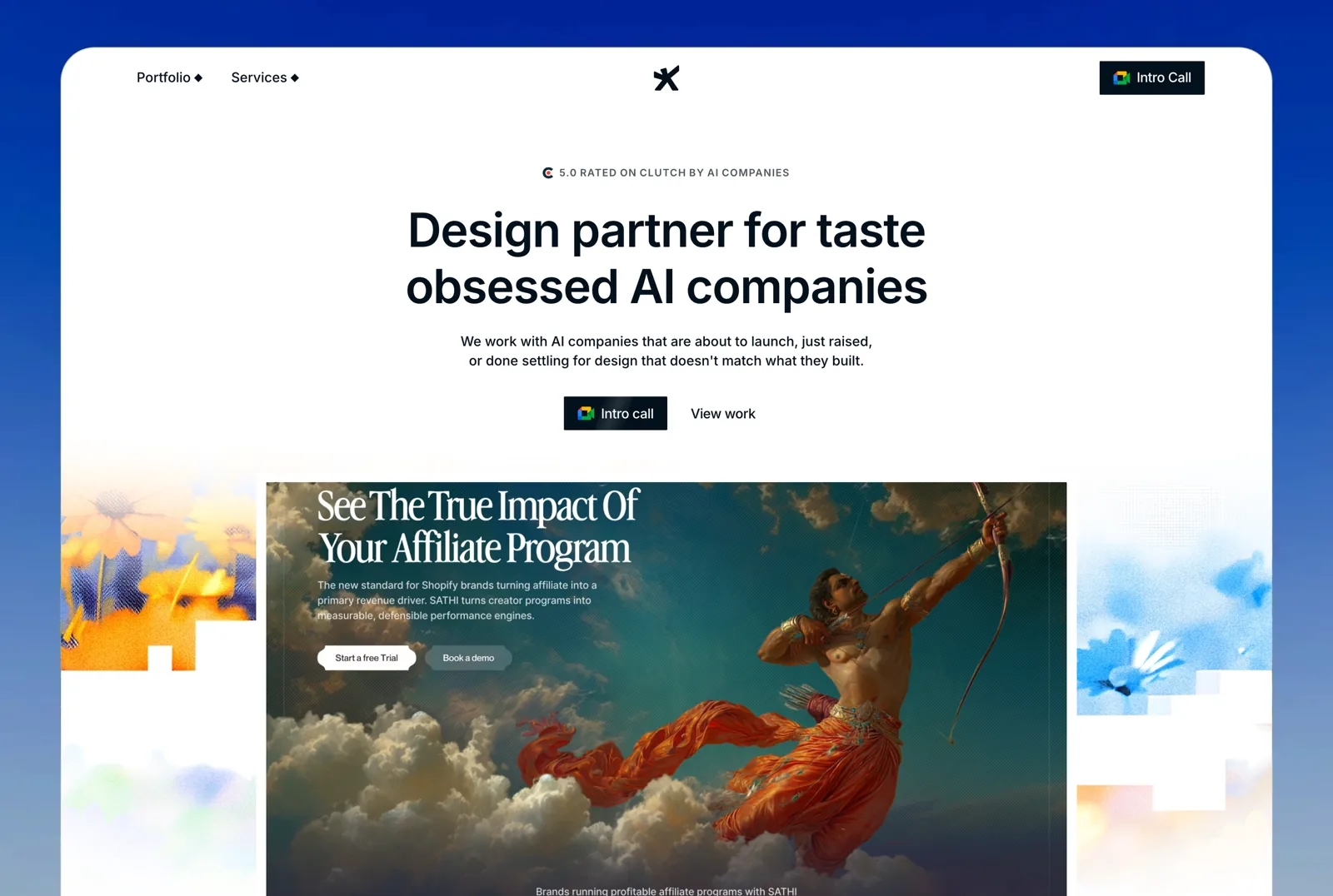
1. Studio Maydit: A Top-Rated Design Agency for AI Founders
A product studio buying design is buying senior judgement rather than hands, and that is the case for Studio Maydit. It is founder-led with a small senior team, a web and product design studio working with AI founders in the US, UK, and Europe, which means the person reviewing your portfolio work is the person doing it.
Its breadth suits a portfolio. The studio builds in Framer, Webflow, and custom code, so different products can sit on different platforms without changing supplier, and it continues into product design after a site ships rather than stopping at the marketing surface.
Its one published outcome sits with Dualite, a product that got to 100,000+ users inside seven months on the back of design work supporting a repositioned ICP. The wider list runs to Wave, PixelFlow, Mi-VAD, and 15 other AI and SaaS teams.
For a portfolio the retainer is usually the relevant shape. A monthly retainer covers new pages, campaigns, and product design with no long lock-in, which suits demand that moves between products. Where a single product has a hard date, a fixed scope runs three to four weeks and ends with a diagnosis of what is leaking in that product.
| Check | Finding |
|---|---|
| Based in | Remote, serving US / UK / EU |
| Platform depth | Framer, Webflow, and custom code |
| AI-sector proof | Yes. AI-native clients, published outcome on Dualite |
| Pricing | Fixed scope or monthly retainer, quoted per project |
| Team shape | Founder-led, small senior team |
| Best fit | Studios who want senior judgement across several products |
Worth a call if your fourth product is costing as much to design as your first. Book a 30-minute call.

2. Digidop
Digidop is a Paris team of one to ten, founded in 2021, working in Webflow, with a published minimum and TSE Energy, Ramify, and StreamNative named. Those three clients sit in completely different categories, which is evidence they can move between unrelated products without carrying one voice into all of them.
Their AI-sector proof is partial, and a team of one to ten has a hard ceiling on throughput, so a portfolio with several products moving at once will hit it.
| Check | Finding |
|---|---|
| Based in | Paris, France |
| Founded | 2021 |
| Team size | 1-10 |
| Primary platform | Webflow |
| AI-sector proof | Partial. Enterprise and SaaS clients, no AI case study |
| Named clients | TSE Energy, Ramify, StreamNative |
| Pricing | Published minimum |
| Best fit | Studios with two or three products, not ten |
3. Edgar Allan
Edgar Allan is an Atlanta team of 51 to 200, founded in 2014, working in Webflow, with Porsche, Duracell, and NCR named. Their combination of writing and design travels well across a portfolio, since each product needs its own argument and that is the part most studios treat as somebody else's job.
They publish no pricing, their AI-sector proof is partial, and a firm of that size works through account management, which adds a layer between your product leads and the people making the work.
| Check | Finding |
|---|---|
| Based in | Atlanta, USA |
| Founded | 2014 |
| Team size | 51-200 |
| Primary platform | Webflow |
| AI-sector proof | Partial. Enterprise and SaaS clients, no AI case study |
| Named clients | Porsche, Duracell, NCR |
| Pricing | Not published |
| Best fit | Studios who need positioning written per product |
4. Refokus
Refokus is a remote German team of 11 to 50, founded in 2021, working in Webflow, with Mural, BASF, Spotify, Yahoo, and BCG named. They handle visually ambitious work reliably, which is useful when one product in a portfolio needs to stand out rather than fit in.
They publish no pricing, their AI-sector proof is partial, and a studio with a recognisable signature risks making six different products look like the work of one agency, which is the opposite of what a portfolio needs.
| Check | Finding |
|---|---|
| Based in | Germany, remote |
| Founded | 2021 |
| Team size | 11-50 |
| Primary platform | Webflow |
| AI-sector proof | Partial. Enterprise and SaaS clients, no AI case study |
| Named clients | Mural, BASF, Spotify, Yahoo, BCG |
| Pricing | Not published |
| Best fit | Studios with one flagship product needing standout work |
5. Flow Ninja
Flow Ninja is a Belgrade team of 11 to 50, founded in 2018, working in Webflow. They are organised around continuous delivery with documented process, and process discipline matters more than usual when several products share one arrangement and work has to be tracked across them.
They publish no client names and no pricing, so a portfolio buyer making a multi-year commitment has almost nothing to verify before signing.
| Check | Finding |
|---|---|
| Based in | Belgrade, Serbia |
| Founded | 2018 |
| Team size | 11-50 |
| Primary platform | Webflow |
| AI-sector proof | Partial. Enterprise and SaaS clients, no AI case study |
| Named clients | Not published |
| Pricing | Not published |
| Best fit | Studios who prioritise tracking over verifiable work |
6. 8020
8020 works from San Francisco and New York, founded in 2014, in Webflow, with Wave, Superlist, Pilot.com, Vanta, and Circle named. Five named venture-backed clients across different categories is the strongest evidence here of a studio that can hold several distinct products in mind at once.
They publish no pricing and no team size, their AI-sector proof is partial, and Webflow alone does not reach the product interfaces where a studio's portfolio work eventually concentrates.
| Check | Finding |
|---|---|
| Based in | San Francisco and New York, USA |
| Founded | 2014 |
| Team size | Not published |
| Primary platform | Webflow |
| AI-sector proof | Partial. Enterprise and SaaS clients, no AI case study |
| Named clients | Wave, Superlist, Pilot.com, Vanta, Circle |
| Pricing | Not published |
| Best fit | Studios whose portfolio is mostly marketing surfaces |
7. Push Refresh
Push Refresh is a Dallas team of one to ten working in Framer, with a published minimum and SmithRx, Synonym, and Northern National named. Framer lets each product team make small changes without going back to the queue, which relieves exactly the congestion that portfolio arrangements suffer from.
Their AI-sector proof is partial, they publish no founding year, and a team of one to ten cannot flex to meet two simultaneous launches.
| Check | Finding |
|---|---|
| Based in | Dallas, USA |
| Founded | Not published |
| Team size | 1-10 |
| Primary platform | Framer |
| AI-sector proof | Partial. Enterprise and SaaS clients, no AI case study |
| Named clients | SmithRx, Synonym, Northern National |
| Pricing | Published minimum |
| Best fit | Studios who want product teams editing their own pages |
8. Finsweet
Finsweet is a distributed team of 51 to 200 based in Denver, founded in 2017, working in Webflow, with Dropbox, Clay, GitHub, and Steadily named. They build reusable systems as a matter of practice and publish their methods, which is directly aligned with the compounding problem a portfolio needs solved.
They publish no pricing, their AI-sector proof is partial, and their depth is in Webflow engineering rather than the product design work a studio's portfolio usually needs most.
| Check | Finding |
|---|---|
| Based in | Denver, USA, distributed |
| Founded | 2017 |
| Team size | 51-200 |
| Primary platform | Webflow |
| AI-sector proof | Partial. Enterprise and SaaS clients, no AI case study |
| Named clients | Dropbox, Clay, GitHub, Steadily |
| Pricing | Not published |
| Best fit | Studios who want a shared system built properly once |
9. Flowout
Flowout is a distributed Webflow team with a published minimum and Jasper, Kajabi, Riverside, and Sendlane named. Their model is built for continuous volume with a known monthly cost, which makes budgeting across a portfolio straightforward in a way most arrangements are not.
They publish no founding year and no team size, their AI-sector proof is partial, and a queue executes requests rather than deciding which product deserves attention this month, which is judgement a portfolio needs.
| Check | Finding |
|---|---|
| Based in | Distributed |
| Founded | Not published |
| Team size | Not published |
| Primary platform | Webflow |
| AI-sector proof | Partial. Enterprise and SaaS clients, no AI case study |
| Named clients | Jasper, Kajabi, Riverside, Sendlane |
| Pricing | Published minimum |
| Best fit | Studios with steady volume and their own prioritisation |
10. Foundey
Foundey is a San Francisco studio founded in 2021 working in Figma, with DemandIQ, Traycer, and Sero AI named. Three named early AI products is exactly the profile a studio launching new things repeatedly wants to see, since the work is done at the stage where nothing is settled yet.
They publish no pricing and no team size, and Figma-only means each product team still needs build capacity of its own, which for a studio running several products multiplies rather than adds.
| Check | Finding |
|---|---|
| Based in | San Francisco, USA |
| Founded | 2021 |
| Team size | Not published |
| Primary platform | Figma-only |
| AI-sector proof | Yes. Published AI client work |
| Named clients | DemandIQ, Traycer, Sero AI |
| Pricing | Not published |
| Best fit | Studios with engineers ready to build what is designed |
How to choose between them
Sort by what the portfolio actually lacks.
Nothing is compounding between products. Studio Maydit or Finsweet.
You launch new products constantly. Foundey or 8020.
Each product needs its own argument. Edgar Allan.
You want predictable monthly volume. Flowout or Push Refresh.
One test before you commit. Describe two of your products, one mature and one three weeks old, and ask how the studio would split a month between them. A partner who understands portfolios will start asking about stage, who decides, and what can be shared between the two, because that is the actual work. One who answers by describing their request process has told you they run a single queue, and a single queue is what turns your portfolio into a waiting list.