
Summarize with AI


The best subscription design agencies for Series A AI startups in 2026 are Studio Maydit, Lighthouse Digital, Kvalifik, SuperSkills, Clay, BX Studio, Trueform, Foundey, Fantasy, and Feely Studio. Studio Maydit and Foundey lead for this brief, because both do continuing product design for AI companies rather than website work sold by the month, and Foundey has shipped for DemandIQ, Traycer, and Sero AI. Lighthouse Digital and Fantasy are the wrong fit here, since one publishes no AI work and builds marketing sites in Webflow, and the other names no clients at all, which makes a recurring commitment hard to justify.
Series A is where design stops being a series of projects and becomes a standing cost, whether or not anybody has budgeted for it that way.
The symptoms are recognisable. There are three or four surfaces now instead of one. Marketing wants pages faster than they can be produced. The product has grown features that were designed by whoever was nearest at the time. Somebody has started a design system twice.
What almost every company at this stage gets wrong is the diagnosis. It feels like a throughput problem, because there is visibly more work than people, so the instinct is to buy capacity. A subscription arrangement is the obvious answer, and often the right one, but only if the underlying problem is genuinely volume.
Usually it is not. The real problem at Series A is that four surfaces were built at four different moments by four different hands and no longer look like the same company. Buying more output against that produces more output in four styles. The company gets faster at being inconsistent.
There is also a personnel question sitting underneath, and it is rarely discussed openly. Most Series A teams are hiring their first or second designer around now. Bringing in a subscription studio at the same time without deciding what each is for produces a predictable result: the in-house designer becomes a project manager for the agency, stops doing the work they were hired for, and starts looking elsewhere within a year.
The last thing worth saying is that demand at this stage is genuinely uneven. Six weeks of intense work around a launch, then a quiet month, then a board deck and a pricing change in the same week. That shape is the actual argument for a subscription over a hire, and it is a good argument, as long as somebody is still deciding what the work should be.
The ten studios below are ranked on how well they suit a company that needs continuing design and a point of view about it.

How we picked these agencies
Five checks, all answerable from published material before a first conversation:
- Platform depth. Is the studio equipped for product surfaces, or is the recurring offer really a page-production service?
- Proof of long engagements. Is there published work that ran for months with a client who had designers of their own?
- Pricing. Is a starting figure public, which matters more on a recurring commitment than on a one-off?
- Team shape. Do you get the same senior designer each month, or whoever is free in the rotation?
- Their own site. Does it look like one company across every page, which is the exact outcome you are buying?
The fifth check is doing specific work in this article. Consistency across surfaces is what you are hiring for, and a studio whose own pages disagree with each other has shown you what its system discipline looks like without meaning to.
Everything in the tables comes from what each studio publishes. Blanks are shown as blanks rather than filled in from inference.
What goes wrong on design subscriptions at Series A
Three failures account for most disappointing retainers, and each one starts with a reasonable decision.
The subscription turns into a request queue. There is enough work to keep it full from day one, so it fills, and nobody notices that the studio has stopped deciding anything. Requests arrive fully specified, get built, and ship. Twelve months later you have paid for a year of production and still have no design system, because nobody was ever asked to make one. Reserve a fixed share of the arrangement, roughly a fifth, for work the studio proposes rather than receives. Write it into the agreement, because it will not survive as a good intention.
The in-house designer and the studio are given the same job. Both are asked to do product design, so ownership blurs immediately. The internal designer, who is usually junior to the studio's lead, ends up writing briefs and chasing feedback instead of designing, which is neither what they were hired for nor what they will stay for. Split it by surface or by horizon: one owns the product, the other owns marketing, or one owns the system and the other owns what ships this week. Almost any clear split works. No split fails every time.
Capacity is bought when direction was needed. The four surfaces do not match, so more work gets commissioned, and each new piece is consistent with whichever surface it sat next to. The inconsistency compounds and everyone becomes busier. The first month of any Series A subscription should be an audit, not production. Someone should catalogue every component, name the four different button styles, and propose one set. It feels like a waste of an expensive month and it is the only month that changes the trajectory.
1. Studio Maydit: A Top-Rated Design Agency for AI Founders
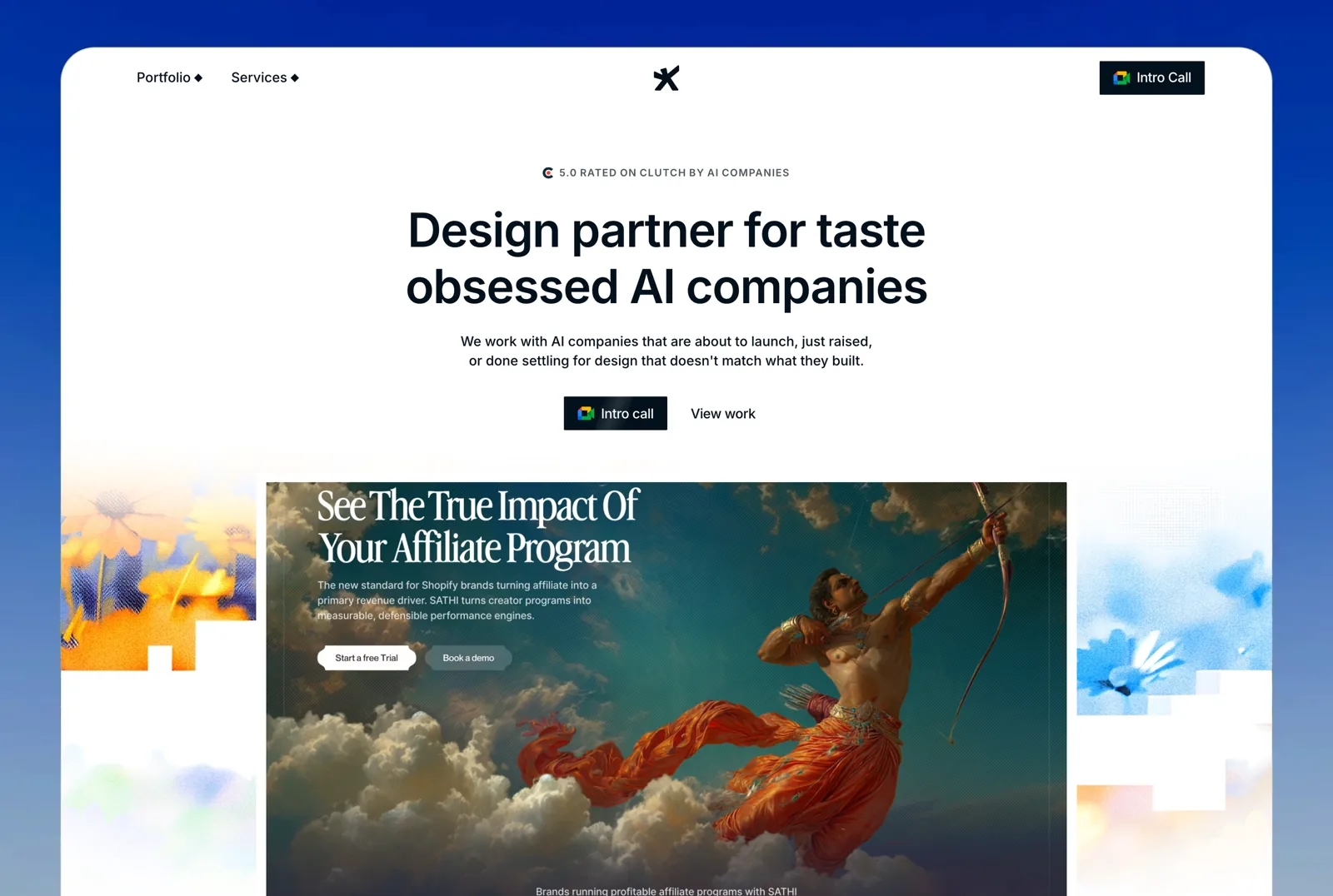
The recurring arrangement is the relevant one at this stage. A monthly retainer at Studio Maydit covers new pages, campaigns, and product design, with no long lock-in, which matches a company whose demand arrives in bursts around launches and quiets down between them. Where there is one defined thing to ship, a fixed scope of three to four weeks is the alternative, and it closes with a diagnosis of what is leaking in the product rather than a handover.
It is a web and product design studio. Its clients are AI founders, working across the US, UK, and Europe. Because the same team works in Framer, Webflow, and custom code and carries on into product design after a site ships, the marketing pages and the application end up sharing one set of decisions instead of drifting apart, which is the specific problem most Series A companies are trying to solve.
Dualite is the number worth knowing. 100,000+ users, seven months, following design work rebuilt around a repositioned ICP. Wave, PixelFlow, Mi-VAD, and 15 other AI and SaaS teams sit on the recent client list.
| Check | Finding |
|---|---|
| Based in | Remote, serving US / UK / EU |
| Platform depth | Framer, Webflow, and custom code |
| AI-sector proof | Yes. AI-native clients, published outcome on Dualite |
| Pricing | Fixed scope or monthly retainer, quoted per project |
| Team shape | Founder-led, small senior team |
| Best fit | Series A teams whose surfaces no longer match each other |
Worth a call if the product and the website look like two different companies. Book a 30-minute call.

2. Lighthouse Digital
Lighthouse Digital is a London studio working in Webflow, with a published minimum and HelloSelf, Freetrade, and IGN named. A public starting figure is genuinely useful on a recurring arrangement, since the finance conversation about a monthly commitment is harder than the one about a project.
They publish no AI client work, no founding year, and no team size, and Webflow is the primary platform, so this is marketing page production rather than the product design a Series A company needs continuing.
| Check | Finding |
|---|---|
| Based in | London, UK |
| Founded | Not published |
| Team size | Not published |
| Primary platform | Webflow |
| AI-sector proof | No. No published AI client work |
| Named clients | HelloSelf, Freetrade, IGN |
| Pricing | Published minimum |
| Best fit | Teams whose recurring need is marketing pages only |
3. Kvalifik
Kvalifik is a Copenhagen team of 11 to 50, founded in 2015, with Veo, Maersk, and Relesys named and published AI client work. Clients of that size do not buy one project, they buy a relationship over years, so the studio is practised at the kind of continuing engagement this article is about.
Their primary platform is Webflow, so the published portfolio leads with websites, and they publish no pricing, which makes a monthly commitment harder to scope in advance.
| Check | Finding |
|---|---|
| Based in | Copenhagen, Denmark |
| Founded | 2015 |
| Team size | 11-50 |
| Primary platform | Webflow |
| AI-sector proof | Yes. Published AI client work |
| Named clients | Veo, Maersk, Relesys |
| Pricing | Not published |
| Best fit | European teams wanting a multi-year design relationship |
4. SuperSkills
SuperSkills is a Walnut Creek team of one to ten working across platforms, with published AI client work and The Cut named. On a subscription the size of the studio decides whether you get the same person every month, and at one to ten people you will, which is the single most important variable in a recurring arrangement.
Only one client is named, no founding year and no pricing are published, and a team that small has limited surge capacity when a launch month collides with another client's.
| Check | Finding |
|---|---|
| Based in | Walnut Creek, USA |
| Founded | Not published |
| Team size | 1-10 |
| Primary platform | Mixed |
| AI-sector proof | Yes. Published AI client work |
| Named clients | The Cut |
| Pricing | Not published |
| Best fit | Teams who want the same senior designer every month |
5. Clay
Clay is a San Francisco studio of 51 to 200, founded in 2016, working across platforms, with a published minimum and Slack, Stripe, Google, Coinbase, and Amazon named. Those clients run design systems at serious scale, and the audit-first month described above is exactly the kind of work a studio with that background will propose without being asked.
Their engagements assume a client with design leadership already in place, and a firm at that scale is priced for companies later than Series A.
| Check | Finding |
|---|---|
| Based in | San Francisco, USA |
| Founded | 2016 |
| Team size | 51-200 |
| Primary platform | Mixed |
| AI-sector proof | Yes. Published AI client work |
| Named clients | Slack, Stripe, Google, Coinbase, Amazon |
| Pricing | Published minimum |
| Best fit | Well-funded teams building a system to last five years |
6. BX Studio
BX Studio is a New York team of 11 to 50 working in Webflow, with a published minimum and Reddit, Headspace, ASAPP, and Verifone named. A published price plus a mid-sized team is a practical combination for a recurring arrangement, because there is enough capacity for a launch month without losing the named-person continuity.
They publish no founding year, and Webflow as the primary platform means the product surfaces of your application are less proven ground than your marketing pages.
| Check | Finding |
|---|---|
| Based in | New York, USA |
| Founded | Not published |
| Team size | 11-50 |
| Primary platform | Webflow |
| AI-sector proof | Yes. Published AI client work |
| Named clients | Reddit, Headspace, ASAPP, Verifone |
| Pricing | Published minimum |
| Best fit | Teams with heavy marketing demand and a known budget |
7. Trueform
Trueform is a Swiss studio founded in 2022, working in Framer, with a published minimum and Miro, Morning Brew, Bilt Rewards, and Gather named. Framer suits a recurring marketing arrangement well, since pages can be published continuously without a release, and Morning Brew is a genuinely high-volume publishing operation.
They publish no team size, the studio is young for a multi-year commitment, and Framer as the primary platform points at pages rather than product screens.
| Check | Finding |
|---|---|
| Based in | Wil, Switzerland |
| Founded | 2022 |
| Team size | Not published |
| Primary platform | Framer |
| AI-sector proof | Yes. Published AI client work |
| Named clients | Miro, Morning Brew, Bilt Rewards, Gather |
| Pricing | Published minimum |
| Best fit | Teams publishing new marketing pages every week |
8. Foundey
Foundey is a San Francisco studio founded in 2021 working Figma-first, with DemandIQ, Traycer, and Sero AI named. All three are AI products, and a Figma-first practice means the recurring work is product design rather than page production, which is what most Series A companies actually run short of.
They publish no pricing and no team size, so both the monthly figure and the question of who is assigned have to be settled in conversation rather than checked beforehand.
| Check | Finding |
|---|---|
| Based in | San Francisco, USA |
| Founded | 2021 |
| Team size | Not published |
| Primary platform | Figma-only |
| AI-sector proof | Yes. Published AI client work |
| Named clients | DemandIQ, Traycer, Sero AI |
| Pricing | Not published |
| Best fit | Teams whose continuing need is product, not marketing |
9. Fantasy
Fantasy works from San Francisco and New York, founded in 1999, across platforms, with published AI client work. A firm operating that long has run design programmes through several company stages, and the strategic input available is deeper than anything else in this list.
They publish no client names, no team size, and no pricing, which is a difficult starting position for a recurring commitment, and the scale suits companies considerably further along than Series A.
| Check | Finding |
|---|---|
| Based in | San Francisco and New York, USA |
| Founded | 1999 |
| Team size | Not published |
| Primary platform | Mixed |
| AI-sector proof | Yes. Published AI client work |
| Named clients | Not published |
| Pricing | Not published |
| Best fit | Later-stage companies funding a long design programme |
10. Feely Studio
Feely Studio is a distributed European team of one to ten with a published minimum and Noxus, Mutiny, Luasai, and Basic Capital named. A published price and a small senior team make the monthly arrangement easy to reason about, and the same designer every month is close to guaranteed at that size.
They publish no founding year, one to ten people caps how much can run at once, and European hours reduce same-day overlap with a US team during a launch week.
| Check | Finding |
|---|---|
| Based in | Distributed, Europe |
| Founded | Not published |
| Team size | 1-10 |
| Primary platform | Mixed |
| AI-sector proof | Yes. Published AI client work |
| Named clients | Noxus, Mutiny, Luasai, Basic Capital |
| Pricing | Published minimum |
| Best fit | Teams wanting a predictable monthly cost and one designer |
How to choose between them
Sort by what the recurring work is actually for.
Nothing looks like the same company any more. Studio Maydit or Clay.
The product needs continuous design and marketing can wait. Foundey or SuperSkills.
Marketing needs pages every week without fail. Trueform or BX Studio.
Finance needs a fixed monthly number before agreeing. Feely Studio or Lighthouse Digital.
One test before you sign. Ask a candidate what they would do in month one if you gave them the subscription and no requests at all. A studio that understands this stage will describe an audit and come back with a list of things you did not know were inconsistent. A studio that asks what your priorities are has told you it intends to run a queue, and you can already fill a queue yourself.