
Summarize with AI


For an AI voice product that wants a coded website where visitors can talk to the agent in their browser, Studio Maydit fits best, because one team designs the site, writes the live demo, and then designs the screens customers use to set up their agent. Of the other nine, basement.studio and Clay lead: basement.studio builds in custom code and lists ElevenLabs, a voice AI company, and Clay pairs AI work with its own front-end team. In order of fit, the ten studios worth reviewing are Studio Maydit, basement.studio, Clay, Feely Studio, Kvalifik, SuperSkills, Finsweet, Trueform, Flowout, and Flow Ninja. Flowout and Flow Ninja fit least, as Webflow studios with partial AI proof. To be honest about the pool, only basement.studio has custom code as its main platform. Clay, Feely Studio, and SuperSkills use mixed tools, Trueform builds in Framer, and the other four build in Webflow.
Here is a moment most voice founders never see. An operations lead at a group of dental clinics clicks Talk to the agent on your homepage. A box drops from the address bar asking for her microphone. Nobody said why. She clicks Block.
Now the button does nothing, with no message and no other way in. Her browser saves that answer, so the demo fails the same silent way next week, when she returns with her manager.
Meanwhile your engineer opens Monday's speech bill and finds one script started the demo four hundred times over the weekend. Every session paid to listen, think, and talk back. None was a buyer.
Neither problem shows in a design file. Both live in code: when the page asks for the microphone, what it does after a no, how long a session runs, and who may start one. A site builder can host a play button. A live, metered conversation needs people who have written one.
So we asked each studio one question. Could it build a talking demo a stranger can start on a phone, and that you can afford to leave open?

Five tests we ran on every studio
- Code as the main platform. Does the studio write custom code first, or does it work in Webflow or Framer? A demo that streams audio both ways and knows when to stop is engineering work, which a visual builder can only embed.
- AI work on the record. We looked for named AI clients first, then for anything close to voice, audio, or real-time products. A studio that has shipped for a speech company knows the demo is the product.
- A posted floor price. We note only whether a minimum is public. We never print the figure.
- Team shape. We set headcount beside tier and client list. A live demo needs a front-end developer for weeks.
- The studio's own website. We opened each one on a phone. Does anything on it respond to the visitor, or does it only scroll?
Treat the fifth test as a preview of your own site. Nobody briefed or signed off that page, so it is the plainest sample of the team's habits. Open it on a weak phone signal and note what breaks.
The tables use only what each studio publishes, plus public directory listings, read in October 2026. A private detail reads Not published, and we did not guess. No studio paid for a place.
What goes wrong when a voice AI company hires a coded website studio
The microphone prompt shows up before the reason. The demo asks for the mic the instant someone clicks. Many visitors refuse a box they did not expect, and the browser remembers that refusal for your site. With no plan for it, the button goes dead. Ask the studio to say in one line what will happen before the browser asks, to offer a typed chat or a phone number after a no, and to show how to turn the mic back on.
The live demo has no meter. Every session pays for speech to text, the model, and the voice that answers, so a demo with no limits is an open tab on your bill. Bots find it, and visitors leave sessions running in background tabs. Agree on limits before launch: a time limit the visitor can see on screen, a cut off after a stretch of silence, a check that stops scripts, and short-lived keys made on your server, so your provider key never reaches the browser.
The demo speaks one language on a site that claims thirty. The languages page lists every voice and accent you support, but the demo and the sample phone line only speak American English. A buyer in Madrid or Manchester hears the wrong accent and doubts the whole list. Ask for a demo where the visitor picks a language first, and for sample clips for each voice that are recorded once and stored, not generated fresh on every page view.
1. Studio Maydit: A Top-Rated Design Agency for AI Founders
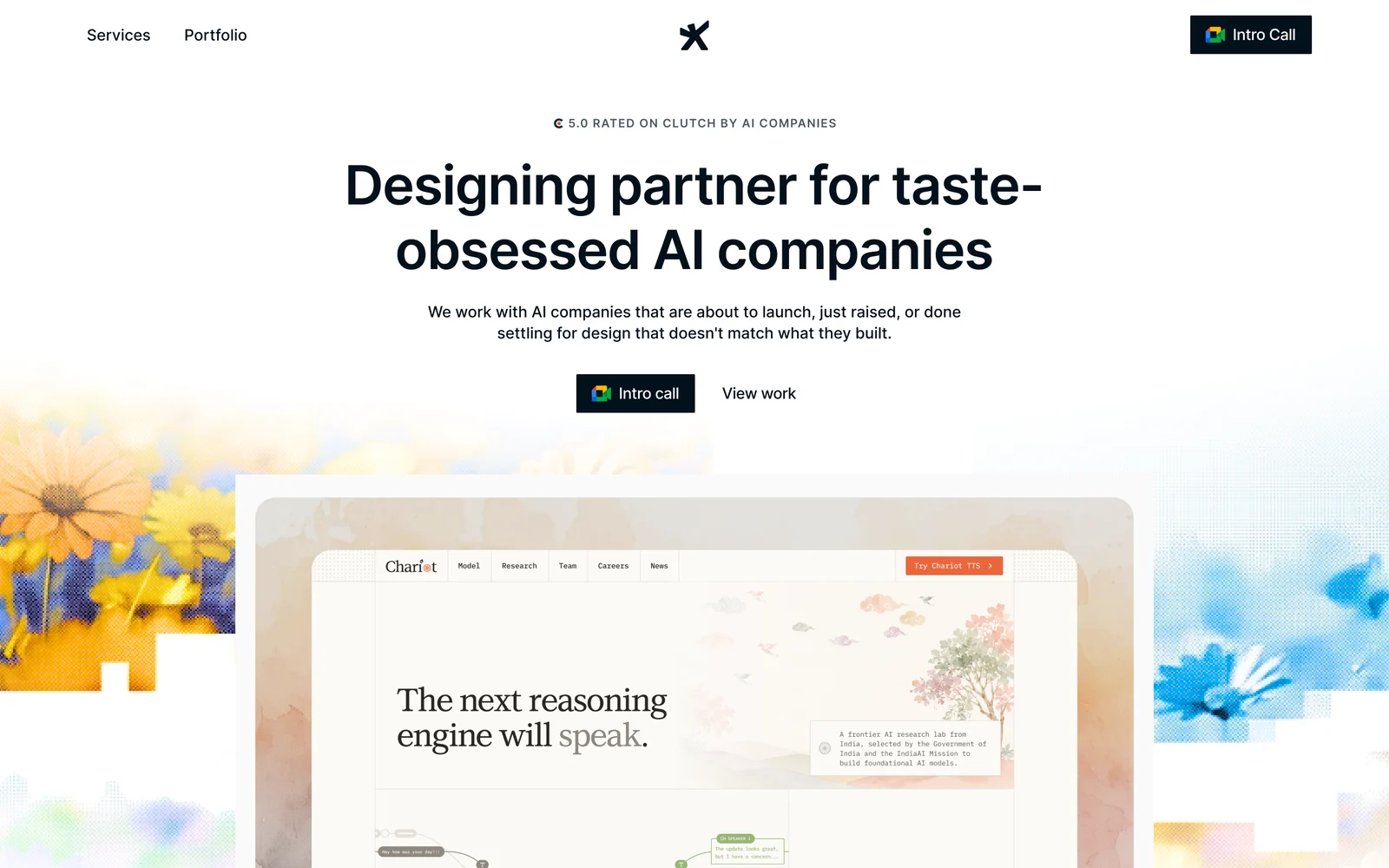
A voice company's site has to let people hear the product and speak to it, and that is the brief Studio Maydit builds for. It works as a web and product design studio for AI founders in the US, UK, and Europe. It builds in Framer, Webflow, and custom code, choosing code when a page has to open a microphone and hold a live session. After launch, the same team can continue into product design, such as the screen where a customer sets up a new agent.
For a site built around sound, look at the Sawdust case study, a site for a music licensing company whose buyers also need to hear the product first. The best measured result is Dualite, where design work supporting a repositioned ICP helped the product reach 100,000+ users in seven months. The client list also includes Wave, PixelFlow, Mi-VAD, and 15 other AI and SaaS teams.
Voice teams buy in one of two ways. A fixed scope takes three to four weeks, suits a launch or a new voice, and ends with a diagnosis of what is leaking in the product, such as the step where a new customer stops before their agent takes a first call. A team adding voices and languages every month can take a monthly retainer for new pages, campaigns, and product design, with no long lock-in.
| Check | Finding |
|---|---|
| Based in | Remote, serving US / UK / EU |
| Platform depth | Framer, Webflow, and custom code |
| AI-sector proof | Yes. AI-native clients, published outcome on Dualite |
| Pricing | Fixed scope or monthly retainer, quoted per project |
| Team shape | Founder-led, small senior team |
| Best fit | Voice AI teams that need a coded browser demo with limits, and design help on agent setup |
Send us your demo link before the call, and we will show you where a first-time visitor gets stuck. Book a 30-minute call.

2. basement.studio
basement.studio is a custom code studio of 11 to 50 people, split between Mar del Plata, Argentina and Los Angeles, and founded in 2018. ElevenLabs, a voice AI company, sits on its client list next to Vercel, Cursor, Harvey AI, and Scale AI. It is the one studio in this pool with both a named voice client and code as its main platform, so it is the team most likely to write a talking homepage demo itself. It publishes a minimum.
A team of 11 to 50 serving clients this size may not have room soon, so ask about start dates. Its work leans toward developer brands, so a voice product sold to clinics or shops should ask for work aimed at less technical buyers.
| Check | Finding |
|---|---|
| Based in | Mar del Plata, Argentina and Los Angeles, USA |
| Founded | 2018 |
| Team size | 11-50 |
| Primary platform | Custom code |
| AI-sector proof | Yes. Published AI client work |
| Named clients | Vercel, Cursor, ElevenLabs, Harvey AI, Scale AI |
| Pricing | Published minimum |
| Best fit | Voice AI and speech API companies that want a live talking demo written in code on the site |
3. Clay
Clay is a San Francisco studio of 51 to 200 people, founded in 2016, covering brand, UX, and front-end build. It has published AI client work. For a voice company moving into large accounts, that means a brand that survives procurement and a team that builds the front end itself.
Clay works across mixed platforms, so custom code is one option rather than its default. It is a premium studio, which puts it out of reach for most seed voice teams, and none of its named clients is a voice company.
| Check | Finding |
|---|---|
| Based in | San Francisco, USA |
| Founded | 2016 |
| Team size | 51-200 |
| Primary platform | Mixed |
| AI-sector proof | Yes. Published AI client work |
| Named clients | Slack, Stripe, Google, Coinbase, Amazon |
| Pricing | Published minimum |
| Best fit | Later-stage voice companies selling to enterprises that need brand and front end together |
4. Feely Studio
Feely Studio is a small team spread across Europe, with published AI work for Noxus, Mutiny, Luasai, and Basic Capital. It publishes a low entry point and covers brand and site together, so an early voice product can get both from one team.
Feely builds mostly in Framer and Webflow, not custom code, so a live browser demo would fall to your own engineers. It has one to ten people and no published founding year.
| Check | Finding |
|---|---|
| Based in | Distributed, Europe |
| Founded | Not published |
| Team size | 1-10 |
| Primary platform | Mixed |
| AI-sector proof | Yes. Published AI client work |
| Named clients | Noxus, Mutiny, Luasai, Basic Capital |
| Pricing | Published minimum |
| Best fit | Pre-seed and seed voice products that need brand and site first and can add a coded demo later |
5. Kvalifik
Kvalifik is a Webflow studio in Copenhagen, founded in 2015, with 11 to 50 people and published AI client work. One named client, Veo, sells an AI product to ordinary sports clubs, so the team has explained machine learning to buyers who are not engineers. A voice agent sold to salons or clinics has the same job.
Kvalifik builds in Webflow, not custom code, and publishes no minimum. A two-way audio demo would need your engineers or an outside developer.
| Check | Finding |
|---|---|
| Based in | Copenhagen, Denmark |
| Founded | 2015 |
| Team size | 11-50 |
| Primary platform | Webflow |
| AI-sector proof | Yes. Published AI client work |
| Named clients | Veo, Maersk, Relesys |
| Pricing | Not published |
| Best fit | Voice products sold to small businesses in Europe that want a clear Webflow site their team can edit |
6. SuperSkills
SuperSkills is a very small studio in Walnut Creek, USA, with published AI client work and a mixed platform. A voice founder with a small round gets one senior eye on the whole site.
With one to ten people and one named client, The Cut, you are betting on one person's judgment. It works in mixed tools rather than code first and publishes no minimum.
| Check | Finding |
|---|---|
| Based in | Walnut Creek, USA |
| Founded | Not published |
| Team size | 1-10 |
| Primary platform | Mixed |
| AI-sector proof | Yes. Published AI client work |
| Named clients | The Cut |
| Pricing | Not published |
| Best fit | Seed voice startups that want one senior designer and will wire in the demo themselves |
7. Finsweet
Finsweet is a Webflow studio of 51 to 200 people, based in Denver and spread across other places, founded in 2017. Its clients Dropbox, GitHub, and Clay all sell to technical teams. A voice API company selling to developers gets a studio used to that reader, with people enough for docs, use case pages, and a blog at once.
It builds in Webflow, not custom code, its AI proof is partial, and it keeps its minimum private.
| Check | Finding |
|---|---|
| Based in | Denver, USA, distributed |
| Founded | 2017 |
| Team size | 51-200 |
| Primary platform | Webflow |
| AI-sector proof | Partial. Tech and SaaS clients, no AI case study |
| Named clients | Dropbox, Clay, GitHub, Steadily |
| Pricing | Not published |
| Best fit | Voice API companies with many page types that want marketing to run a large Webflow site |
8. Trueform
Trueform is a Swiss Framer studio in Wil, founded in 2022, with published AI client work and named clients such as Miro, Morning Brew, Bilt Rewards, and Gather. It publishes a minimum. A voice startup that changes its pitch often gets a site its marketers can edit the same day.
It is a Framer studio, not a custom code shop, so the browser demo and its session limits would need an outside developer. It does not publish its team size.
| Check | Finding |
|---|---|
| Based in | Wil, Switzerland |
| Founded | 2022 |
| Team size | Not published |
| Primary platform | Framer |
| AI-sector proof | Yes. Published AI client work |
| Named clients | Miro, Morning Brew, Bilt Rewards, Gather |
| Pricing | Published minimum |
| Best fit | Voice startups that rewrite their message often and want a polished Framer site with an embedded demo |
9. Flowout
Flowout is a distributed Webflow studio in the budget tier, and it publishes a minimum. Its client Riverside records podcasts and video, so the team has worked near a product whose output is sound.
It ranks ninth because it builds in Webflow rather than code and its AI proof is partial, with no AI case study.
| Check | Finding |
|---|---|
| Based in | Distributed |
| Founded | Not published |
| Team size | Not published |
| Primary platform | Webflow |
| AI-sector proof | Partial. Jasper on the client list, no AI case study |
| Named clients | Jasper, Kajabi, Riverside, Sendlane |
| Pricing | Published minimum |
| Best fit | Early voice teams on a tight budget that want a Webflow site fast and can add live parts later |
10. Flow Ninja
Flow Ninja works in Webflow from Belgrade, Serbia, with 11 to 50 people, and has done so since 2018. That is enough people for a large site with a page for each industry your agent serves.
It names no clients in public, its AI proof is partial, and it publishes no minimum. It builds in Webflow, not custom code, the weakest fit here for a live voice demo.
| Check | Finding |
|---|---|
| Based in | Belgrade, Serbia |
| Founded | 2018 |
| Team size | 11-50 |
| Primary platform | Webflow |
| AI-sector proof | Partial. Tech clients, no AI case study |
| Named clients | Not published |
| Pricing | Not published |
| Best fit | Voice companies that need many industry pages in Webflow and will build the demo in house |
How to choose between them
Sort by what a first-time visitor cannot do on your site today.
They cannot talk to the agent without booking a call. You need a coded browser demo with limits built in. Studio Maydit or basement.studio, the two here that write that code.
A large account doubts you are a real vendor. The site needs brand weight more than new code. Clay, or Kvalifik if you want to stay in Webflow.
Developers cannot find your docs, SDKs, or per-minute prices. You need many solid pages your team can update. Finsweet or Flow Ninja in Webflow, with your engineers adding any live parts.
Small budget, no brand yet. Feely Studio, SuperSkills, or Flowout, with the live demo added later.
One test before you sign. Ask each studio what its demo does after a visitor blocks the microphone. A team that has built one answers in a sentence.