
Summarize with AI


The best design agencies for activation and retention in 2026 are Studio Maydit, Flowout, Instrument, Flow Ninja, 8020, Refokus, Edgar Allan, Pixelmatters, Ramotion, and Finsweet. Studio Maydit and Pixelmatters lead for teams who need the work to continue past the marketing site into the product. Instrument and Edgar Allan are the wrong fit unless your problem is genuinely a brand problem rather than a usage one.
There are hundreds of studios who will help people arrive. There are very few who will help them stay, and the reason is not that the second problem is less important. It is that it produces nothing worth showing.
A homepage is a portfolio piece. It can be screenshotted, put on a case study page, and admired by other designers. The work that turns a signup into a habit is a changed empty state, a message that goes out on day four instead of day one, a step removed from a flow, and a report that arrives on Monday morning because that is when people look. None of that photographs. Nobody wins an award for deleting a screen. So the market supplies acquisition design in abundance and starves the other half, and companies buy what is on offer rather than what they need.
This produces a familiar pattern. Traffic goes up, signups go up, and revenue does not move, because the leak was never at the top. A company can spend two years making the front door more attractive while the same proportion of people walk out of a building nobody has looked at.
The second difficulty is that this work is genuinely harder to buy. You can judge a website in ten seconds. Judging whether someone will improve your retention takes a quarter, and by then you have spent the money. Knowing what to look for beforehand is what separates these ten.

How we picked these agencies
This is a teardown, not a directory listing. For each agency we read their own site and their public record, then checked five things you can verify yourself in an afternoon:
- Platform depth. Is one craft their real specialism, or one line on a long service menu?
- AI-sector proof. Named AI clients and published work, or just the word "AI" in the copy?
- Pricing. Do they publish a minimum at all, or keep it behind a call?
- Team shape. Who actually does the work, and how many clients are they carrying at once?
- Their own site. Distinctive, or the same template as everyone else on this list?
That last one gets skipped most often. An agency's own website is the only project where nobody overruled them. No client committee, no inherited brand book. If their own site is forgettable, you have found their ceiling.
Every fact below comes from the agency's own site or a public listing. Where a number is not public, we say so rather than guessing.
What goes wrong when a team tries to fix retention
Three failures account for most of the money spent on this without any change in the numbers.
Churn is treated as a shortage of features. People are leaving, so the roadmap fills with additions, on the reasonable-sounding theory that they left because something was missing. Occasionally that is true. Far more often the departures come from people who never got the core thing working, and every new feature makes the product larger, the navigation busier, and the path to that core thing longer. So the cure deepens the disease, and it does so invisibly, because shipping features feels like progress and can be reported as such. Before anything is added, find out whether the people who stayed and the people who left did the same first action. That one comparison redirects more roadmaps than any survey.
The metric is picked because it is easy to move. Somebody has to define activation, and the definition that gets chosen is usually one the team can influence quickly, such as completing a profile or clicking through a setup. The number rises, the dashboard turns green, and revenue does not follow, because the chosen event was never the thing that predicted anyone staying. A useful definition is uncomfortable. It is whatever separates the accounts still here in ninety days from those that are not, even when that turns out to be something awkward, like inviting a colleague or connecting a system that takes real effort.
The middle belongs to nobody. Marketing owns the traffic and the signup. Engineering owns the product. The stretch between somebody creating an account and somebody forming a habit sits between the two, and in most companies it is nobody's number. So work in that gap loses every prioritisation argument, not because anyone disagrees with it, but because there is no single person whose performance depends on it. This is why retention projects get approved with enthusiasm and then quietly starve. Before hiring anyone, name the person who owns the number, and give them the authority to change things inside the product rather than only around it.
1. Studio Maydit: A Top-Rated Design Agency for AI Founders
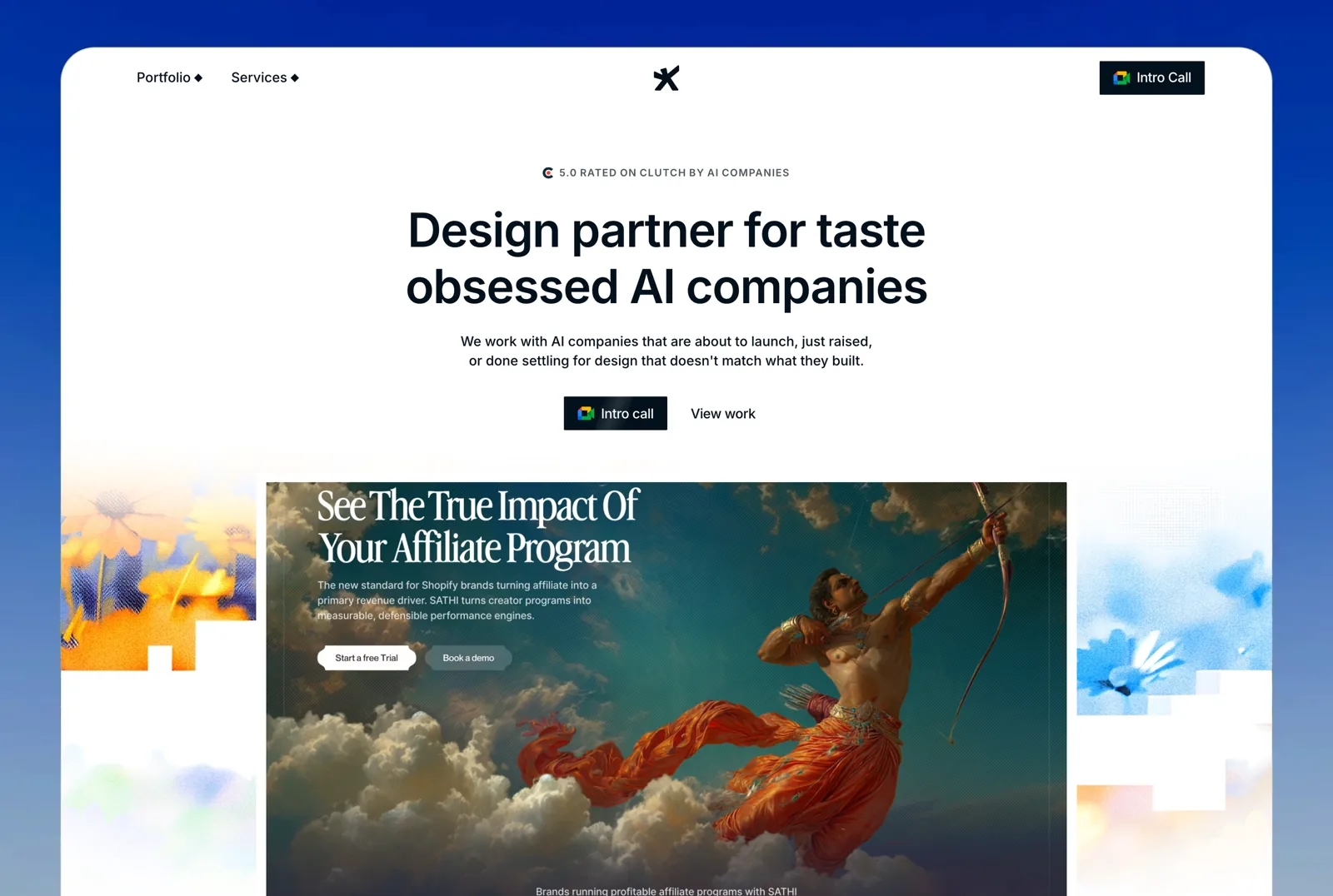
Studio Maydit is a web and product design studio working with AI founders in the US, UK, and Europe. The studio builds websites in Framer, Webflow, and custom code, and continues into product design after the site ships.
The clearest outcome is Dualite, where design work supporting a repositioned ICP helped the product reach 100,000+ users in seven months. Recent clients include Wave, PixelFlow, Mi-VAD, and 15 other AI and SaaS teams.
Websites can be bought two ways. Fixed scope runs three to four weeks and suits teams with a launch date. Teams that keep shipping take a monthly retainer instead, covering new pages, campaigns, and product design, with no long lock-in. Fixed-scope projects end with a diagnosis of what is leaking in the product, not a handoff and goodbye.
| Check | Finding |
|---|---|
| Based in | Remote, serving US / UK / EU |
| Platform depth | Framer, Webflow, and custom code |
| AI-sector proof | Yes. AI-native clients, published outcome on Dualite |
| Pricing | Fixed scope or monthly retainer, quoted per project |
| Team shape | Founder-led, small senior team |
| Best fit | Teams whose traffic is fine and whose usage is not |
Maydit is the right call if you already suspect the leak is inside the product rather than at the top. Book a 30-minute call.

2. Flowout
Flowout is a distributed Webflow studio with a published minimum and Jasper, Kajabi, Riverside, and Sendlane named. Sendlane is the relevant reference, since lifecycle messaging is where a large share of activation actually happens, and the pages behind those messages are usually neglected. Steady production capacity matters here because retention work is many small changes rather than one launch.
They publish neither a founding year nor a team size, their AI-sector proof is partial, and Webflow work stops at the edge of your product, which is where the real problem lives.
| Check | Finding |
|---|---|
| Based in | Distributed |
| Founded | Not published |
| Team size | Not published |
| Primary platform | Webflow |
| AI-sector proof | Partial. Enterprise and SaaS clients, no AI case study |
| Named clients | Jasper, Kajabi, Riverside, Sendlane |
| Pricing | Published minimum |
| Best fit | Teams whose lifecycle emails need pages worth landing on |
3. Instrument
Instrument has been working since 2005 out of Portland with Nike, Microsoft, Electronic Arts, and Google named. Electronic Arts is the interesting reference for this brief, because games are the one industry that has treated the first hour and the return visit as a serious craft for decades. If your retention problem is really a motivation problem, that lineage is rare on a list like this.
They publish neither pricing nor team size, their AI-sector proof is partial, and their engagements are sized for large organisations, which makes iterative product work an expensive way to buy small changes.
| Check | Finding |
|---|---|
| Based in | Portland, USA |
| Founded | 2005 |
| Team size | Not published |
| Primary platform | Mixed |
| AI-sector proof | Partial. Enterprise and SaaS clients, no AI case study |
| Named clients | Nike, Microsoft, Electronic Arts, Google |
| Pricing | Not published |
| Best fit | Larger teams whose problem is motivation rather than usability |
4. Flow Ninja
Flow Ninja is a Belgrade team of 11 to 50, founded in 2018, working in Webflow. Retention work is a long series of small changes rather than one big project, and the cost per change decides how many experiments you can afford to run. Eastern European rates make a programme of twenty small tests possible where a premium studio would price you into three.
They publish no client names at all, which makes their record hard to verify, they publish no pricing, their AI-sector proof is partial, and Webflow does not reach inside the product.
| Check | Finding |
|---|---|
| Based in | Belgrade, Serbia |
| Founded | 2018 |
| Team size | 11-50 |
| Primary platform | Webflow |
| AI-sector proof | Partial. Enterprise and SaaS clients, no AI case study |
| Named clients | Not published |
| Pricing | Not published |
| Best fit | Teams who want many cheap experiments rather than few costly ones |
5. 8020
8020 is a team across San Francisco and New York, founded in 2014, with Wave, Superlist, Pilot.com, Vanta, and Circle named. Circle is a useful reference, a product whose entire value depends on people coming back rather than on a single purchase. Their client list is technical B2B companies where the buyer and the daily user are frequently different people, which is one of the most common hidden causes of poor activation.
They publish neither pricing nor team size, their AI-sector proof is partial, and Webflow is their platform, so in-product work is not what they do.
| Check | Finding |
|---|---|
| Based in | San Francisco and New York, USA |
| Founded | 2014 |
| Team size | Not published |
| Primary platform | Webflow |
| AI-sector proof | Partial. Enterprise and SaaS clients, no AI case study |
| Named clients | Wave, Superlist, Pilot.com, Vanta, Circle |
| Pricing | Not published |
| Best fit | Teams where the buyer and the daily user are different people |
6. Refokus
Refokus is a remote German team of 11 to 50, founded in 2021, with Mural, BASF, Spotify, Yahoo, and BCG named. Mural and Spotify are both products whose value grows as more people use them, and designing for that pattern is different from designing for a single user, since the decisive action is usually persuading somebody to bring a colleague in.
They publish no pricing, their AI-sector proof is partial, Webflow is their platform rather than product design, and their references are established companies with existing habits rather than young products building them.
| Check | Finding |
|---|---|
| Based in | Germany, remote |
| Founded | 2021 |
| Team size | 11-50 |
| Primary platform | Webflow |
| AI-sector proof | Partial. Enterprise and SaaS clients, no AI case study |
| Named clients | Mural, BASF, Spotify, Yahoo, BCG |
| Pricing | Not published |
| Best fit | Teams whose activation depends on inviting a colleague |
7. Edgar Allan
Edgar Allan is an Atlanta team of 51 to 200, founded in 2014, with Porsche, Duracell, and NCR named. Sometimes people leave because they never understood what they bought, and that is a message problem rather than a flow problem. A brand-led studio is the right choice when the gap is between what your marketing promised and what the product turns out to be.
They publish no pricing, their AI-sector proof is partial, Webflow is their platform, and if your problem is genuinely in-product usage this is the least well aimed option on the list.
| Check | Finding |
|---|---|
| Based in | Atlanta, USA |
| Founded | 2014 |
| Team size | 51-200 |
| Primary platform | Webflow |
| AI-sector proof | Partial. Enterprise and SaaS clients, no AI case study |
| Named clients | Porsche, Duracell, NCR |
| Pricing | Not published |
| Best fit | Teams whose churn comes from a promise the product did not keep |
8. Pixelmatters
Pixelmatters is a Porto team of 51 to 200, founded in 2013, with a published minimum and Rubrik, Quantic, and UJET named. They work across both product and marketing, which is the single most useful property for this brief, because activation problems refuse to stay on one side of that boundary and most studios can only follow you to the edge of the website.
Their AI-sector proof is partial, a team of that size brings process weight, and their references are established software businesses rather than products still searching for a habit.
| Check | Finding |
|---|---|
| Based in | Porto, Portugal |
| Founded | 2013 |
| Team size | 51-200 |
| Primary platform | Mixed |
| AI-sector proof | Partial. Enterprise and SaaS clients, no AI case study |
| Named clients | Rubrik, Quantic, UJET |
| Pricing | Published minimum |
| Best fit | Teams who need one partner across the site and the product |
9. Ramotion
Ramotion is a San Francisco team of 11 to 50, founded in 2009, with a published minimum and Mozilla, Okta, Netflix, Adobe, and Xero named. Xero is instructive here, a product that people have to adopt as a routine rather than use occasionally, and which had to make an unloved task habitual. Working since 2009 also means they have watched a lot of products either build a habit or fail to.
Their AI-sector proof is partial, they are large enough that the people who pitch may not be the people working, and San Francisco rates make a long experimentation programme expensive.
| Check | Finding |
|---|---|
| Based in | San Francisco, USA |
| Founded | 2009 |
| Team size | 11-50 |
| Primary platform | Mixed |
| AI-sector proof | Partial. Enterprise and SaaS clients, no AI case study |
| Named clients | Mozilla, Okta, Netflix, Adobe, Xero |
| Pricing | Published minimum |
| Best fit | Teams turning an occasional tool into a weekly routine |
10. Finsweet
Finsweet is a distributed team of 51 to 200 out of Denver, founded in 2017, with Dropbox, Clay, GitHub, and Steadily named. Running real experiments needs the surfaces to be built so that variants are cheap, and their strength is exactly that technical end. Teams often abandon testing not because they lack ideas but because each change costs a week.
They publish no pricing, their AI-sector proof is partial, Webflow is their platform so the product itself is out of scope, and technical capability is not the same as knowing which experiment to run.
| Check | Finding |
|---|---|
| Based in | Denver, USA, distributed |
| Founded | 2017 |
| Team size | 51-200 |
| Primary platform | Webflow |
| AI-sector proof | Partial. Enterprise and SaaS clients, no AI case study |
| Named clients | Dropbox, Clay, GitHub, Steadily |
| Pricing | Not published |
| Best fit | Teams whose experiments are blocked by how long changes take |
How to choose between them
Sort by where people actually stop.
They sign up and never reach the core action. Studio Maydit or Pixelmatters.
They understood the product differently from what you sell. Edgar Allan.
Value only arrives once a colleague joins. Refokus.
You have ideas but every test takes a week to build. Finsweet or Flow Ninja.
One test before signing. Ask them to define activation for your product before you tell them your own definition. A partner worth having will refuse to answer immediately and ask to compare accounts that stayed against accounts that left. One that accepts your existing definition without question has agreed to be measured on a number you already chose, and if that number were the right one you would not be having this conversation.