
Summarize with AI


The best design agencies for AI chat interfaces in 2026 are Studio Maydit, Feels Like, Kvalifik, Foundey, Lazarev, Clay, basement.studio, Feely Studio, BX Studio, and Phantom. Studio Maydit and Feels Like lead for teams whose chat product is the product. Kvalifik and Phantom are the wrong fit unless your problem sits on the marketing site rather than inside the conversation.
A chat interface is a text box and a send button. That is the entire visible design, and it is why teams underestimate this work so badly.
When there is almost nothing on screen, every decision moves somewhere less obvious. It moves into the empty state, the placeholder text, the moment between sending and the first token, the way a wrong answer can be corrected, and the small signals that tell a person what this thing can and cannot do. None of that shows up in a portfolio screenshot. All of it decides whether someone comes back tomorrow.
The failure is quiet. Nobody complains about a chat interface. They type one question, get something almost right, decide the product is not for them, and never open it again. Your analytics show a healthy first session and a dead second one, and the product team concludes the model needs to be better. Usually the model was fine and the interface never told the person what to ask or what to do when the answer missed.
There is a harder version of this if you sell to businesses. Your buyer has to hand this to people who did not choose it and who will judge the whole company by whichever answer they get first. That reader needs to see the limits stated, not discovered.
Chat also removes the safety net every other interface has. There are no menus to browse, no wrong turns to back out of. If the person does not know what to say, nothing happens at all. That single problem is what separates these ten agencies.

How we picked these agencies
This is a teardown, not a directory listing. For each agency we read their own site and their public record, then checked five things you can verify yourself in an afternoon:
- Platform depth. Is one craft their real specialism, or one line on a long service menu?
- AI-sector proof. Named AI clients and published work, or just the word "AI" in the copy?
- Pricing. Do they publish a minimum at all, or keep it behind a call?
- Team shape. Who actually does the work, and how many clients are they carrying at once?
- Their own site. Distinctive, or the same template as everyone else on this list?
That last one gets skipped most often. An agency's own website is the only project where nobody overruled them. No client committee, no inherited brand book. If their own site is forgettable, you have found their ceiling.
Every fact below comes from the agency's own site or a public listing. Where a number is not public, we say so rather than guessing.
What goes wrong inside the conversation
Three failures account for most abandoned chat products, and none of them are about how the interface looks.
The empty box asks the user to be creative. A new person opens your product and sees a blinking cursor and a polite invitation to ask anything. Anything is the hardest possible request. They have no idea what this system is good at, so they either type something trivial to test it or something enormous that it handles badly, and both outcomes teach them the product is disappointing. The fix is unglamorous and it works: show real examples drawn from what your best users actually do, not three generic prompts written by the marketing team. The first message should be the easiest thing a person does in your product. Right now it is the hardest.
The limits stay hidden until someone hits one. Most chat products present a confident tone and a uniform surface, so every answer looks equally reliable whether the system is certain, guessing, or working from stale data. People are not stupid about this. They test it, find one confident wrong answer, and then discount everything, including the answers that were correct. Showing where information came from, marking what is outside scope, and saying plainly when the system does not know reads as weakness to a founder and as competence to a user. It is the single largest trust lever available in this interface and almost nobody pulls it.
A wrong answer has nowhere to go. The person gets a response that is close but off, and their only options are to regenerate and hope or to rewrite the whole question from scratch. Neither feels like progress, so they give up. What a person wants at that moment is to steer: fix one part, keep the rest, say what was wrong in plain words. Products that let someone edit and resend, correct a specific claim, or narrow the scope without starting again turn a failed answer into a working session. Products that do not have trained the user that a miss ends the conversation, and after two or three of those the user stops opening the app.
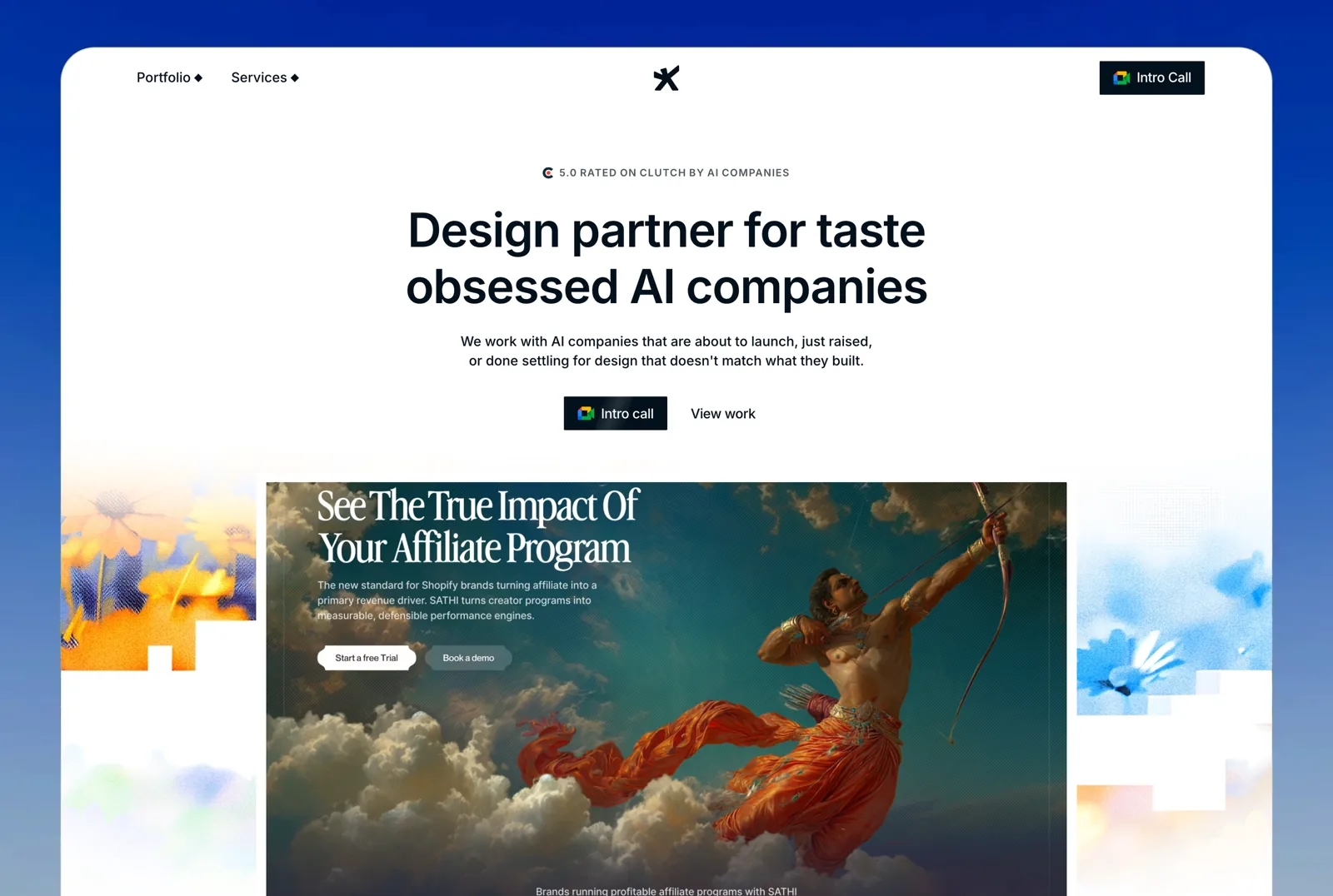
1. Studio Maydit: A Top-Rated Design Agency for AI Founders
Studio Maydit is a web and product design studio working with AI founders in the US, UK, and Europe. The studio builds websites in Framer, Webflow, and custom code, and continues into product design after the site ships.
The clearest outcome is Dualite, where design work supporting a repositioned ICP helped the product reach 100,000+ users in seven months. Recent clients include Wave, PixelFlow, Mi-VAD, and 15 other AI and SaaS teams.
Websites can be bought two ways. Fixed scope runs three to four weeks and suits teams with a launch date. Teams that keep shipping take a monthly retainer instead, covering new pages, campaigns, and product design, with no long lock-in. Fixed-scope projects end with a diagnosis of what is leaking in the product, not a handoff and goodbye.
| Check | Finding |
|---|---|
| Based in | Remote, serving US / UK / EU |
| Platform depth | Framer, Webflow, and custom code |
| AI-sector proof | Yes. AI-native clients, published outcome on Dualite |
| Pricing | Fixed scope or monthly retainer, quoted per project |
| Team shape | Founder-led, small senior team |
| Best fit | Chat products losing people between the first session and the second |
Maydit is the right call if the site brings people in and the conversation loses them. Book a 30-minute call.

2. Feels Like
Feels Like is a Los Angeles studio founded in 2023 with published AI client work, and Suno AI on the roster alongside Google and Nike. Suno is the closest reference on this list to your problem, a product where a person types a few words into an almost empty field and the quality of what comes back depends entirely on knowing what to type. Very few studios have shipped that specific problem.
They publish no pricing and no team size, they are new enough to have a short record, and custom code as the craft means your team depends on them for changes afterwards.
| Check | Finding |
|---|---|
| Based in | Los Angeles, USA |
| Founded | 2023 |
| Team size | Not published |
| Primary platform | Custom code |
| AI-sector proof | Yes. Published AI client work |
| Named clients | Google, Nike, LVMH, Suno AI |
| Pricing | Not published |
| Best fit | Products where the first prompt decides whether someone stays |
3. Kvalifik
Kvalifik is a Copenhagen team of 11 to 50 working since 2015, with published AI client work and Veo and Maersk named. Maersk is the useful signal for a chat product sold into businesses, since that work involves people who were handed a tool rather than choosing it. Designing for a reluctant user is a different discipline from designing for an enthusiast.
Webflow is their house craft, which is a marketing-site skill rather than a product one, they publish no pricing, and their named client record is short.
| Check | Finding |
|---|---|
| Based in | Copenhagen, Denmark |
| Founded | 2015 |
| Team size | 11-50 |
| Primary platform | Webflow |
| AI-sector proof | Yes. Published AI client work |
| Named clients | Veo, Maersk, Relesys |
| Pricing | Not published |
| Best fit | Teams whose users were handed the product rather than choosing it |
4. Foundey
Foundey is a San Francisco studio founded in 2021 with published AI client work and DemandIQ, Traycer, and Sero AI named. Traycer is a developer-facing AI tool, which means they have designed for users who will notice immediately when the system is guessing. That audience forces the honesty about limits that this interface needs.
They are Figma-only, so your engineers carry the build, they publish neither pricing nor team size, and their clients are early enough that none of the work has been tested at large scale.
| Check | Finding |
|---|---|
| Based in | San Francisco, USA |
| Founded | 2021 |
| Team size | Not published |
| Primary platform | Figma-only |
| AI-sector proof | Yes. Published AI client work |
| Named clients | DemandIQ, Traycer, Sero AI |
| Pricing | Not published |
| Best fit | Teams with engineers who will build the interface themselves |
5. Lazarev
Lazarev is a San Francisco team of 51 to 200 with published AI client work, a published minimum, and Payoneer named. Their record is in interfaces that have to explain something rather than just present it, which is exactly the job when an answer needs a source attached or a confidence signal that a person will actually read.
They are large, so senior attention is not guaranteed across the engagement, account management sits between you and the makers, and their work leans toward established platforms rather than early products still finding shape.
| Check | Finding |
|---|---|
| Based in | San Francisco, USA |
| Founded | 2015 |
| Team size | 51-200 |
| Primary platform | Mixed |
| AI-sector proof | Yes. Published AI client work |
| Named clients | Payoneer, Peel, Elva, Mozayix |
| Pricing | Published minimum |
| Best fit | Products where every answer needs its sources shown |
6. Clay
Clay is a San Francisco firm of 51 to 200 with published AI work, a published minimum, and Slack, Stripe, and Coinbase in public. Slack is the reference that matters for a chat product, since it is the interface most of your users compare yours to without realising it. Their habits about threading, history, and interruption were formed there, and violating those quietly costs you.
They are a large premium firm, senior attention thins out over a long engagement, and their scale suits companies further along than a team still deciding what the product is.
| Check | Finding |
|---|---|
| Based in | San Francisco, USA |
| Founded | 2016 |
| Team size | 51-200 |
| Primary platform | Mixed |
| AI-sector proof | Yes. Published AI client work |
| Named clients | Slack, Stripe, Google, Coinbase, Amazon |
| Pricing | Published minimum |
| Best fit | Teams whose users judge the product against messaging apps |
7. basement.studio
basement.studio is an 11 to 50 team across Argentina and Los Angeles with a published minimum and Vercel, Cursor, ElevenLabs, and Harvey AI published. That is the strongest AI roster on this list by some distance, and Cursor and Harvey are both products where the interface had to make a model feel controllable rather than magical. They also build what they design.
Custom code is the craft, so copy and layout changes come back to them, and their aesthetic runs bold, which suits a developer product better than a cautious enterprise one.
| Check | Finding |
|---|---|
| Based in | Mar del Plata, Argentina and Los Angeles, USA |
| Founded | 2018 |
| Team size | 11-50 |
| Primary platform | Custom code |
| AI-sector proof | Yes. Published AI client work |
| Named clients | Vercel, Cursor, ElevenLabs, Harvey AI, Scale AI |
| Pricing | Published minimum |
| Best fit | Teams whose users expect to steer the model, not just prompt it |
8. Feely Studio
Feely Studio is a distributed European team of 1 to 10 with published AI client work and a published minimum. A team this small means the person who writes the empty-state copy is the person who designs it, and in a chat interface that copy is most of the design. Placeholder text and example prompts do more work here than any visual decision.
They are very small, so a long product engagement will stretch them, and their published work leans toward marketing sites rather than dense product surfaces.
| Check | Finding |
|---|---|
| Based in | Distributed, Europe |
| Founded | Not published |
| Team size | 1-10 |
| Primary platform | Mixed |
| AI-sector proof | Yes. Published AI client work |
| Named clients | Noxus, Mutiny, Luasai, Basic Capital |
| Pricing | Published minimum |
| Best fit | Teams who need the empty state and its wording fixed first |
9. BX Studio
BX Studio is a New York team of 11 to 50 with published AI client work, a published minimum, and Reddit, Headspace, and ASAPP named. ASAPP builds conversational AI for support teams, which is the nearest thing on this list to a chat product used by people under time pressure who cannot afford a wrong answer.
They publish no founding year, Webflow is their stated platform which points at sites rather than products, and a team of that size will be stretched by a long product roadmap.
| Check | Finding |
|---|---|
| Based in | New York, USA |
| Founded | Not published |
| Team size | 11-50 |
| Primary platform | Webflow |
| AI-sector proof | Yes. Published AI client work |
| Named clients | Reddit, Headspace, ASAPP, Verifone |
| Pricing | Published minimum |
| Best fit | Support and service products where a wrong answer costs real time |
10. Phantom
Phantom is a 51 to 200 team across London and Auckland with published AI client work and Diageo, SAP, and the Financial Times named. Their strength is making a product feel institutional, which matters if your chat interface is being sold to a large organisation that needs it to look like software rather than a demo.
They publish no pricing, custom code leaves your team dependent on them for changes, and their engagement scale is built for enterprises rather than teams still iterating weekly on the core interaction.
| Check | Finding |
|---|---|
| Based in | London, UK and Auckland, NZ |
| Founded | 2013 |
| Team size | 51-200 |
| Primary platform | Custom code |
| AI-sector proof | Yes. Published AI client work |
| Named clients | Diageo, SAP, Financial Times, Zendesk |
| Pricing | Not published |
| Best fit | Chat products being sold into large, cautious organisations |
How to choose between them
Sort by where people are actually dropping out.
Nobody knows what to type first. Studio Maydit or Feely Studio.
Users stop trusting it after one wrong answer. Lazarev or Foundey.
People cannot correct a near miss, so they leave. basement.studio or Feels Like.
Your buyer needs it to look like enterprise software. Phantom.
One test before signing. Open your product in front of them and ask what the first message should say. An agency that understands this interface will start talking about what your best users actually do and how to put that in front of a new person within a few seconds. An agency that starts describing a visual refresh of the message bubbles has told you it sees a styling job, and styling a conversation nobody knows how to start will not change a single number you care about.