
Summarize with AI


The best design agencies for AI onboarding flows in 2026 are Studio Maydit, Kvalifik, Foundey, Lazarev, Clay, SuperSkills, Feely Studio, BX Studio, Digidop, and Flow Ninja. Studio Maydit and Foundey lead for teams whose signup numbers are healthy and whose second session never happens. Clay and BX Studio are the wrong fit unless you already carry the volume that justifies working at their scale.
A new user finishes signing up, lands on an empty text field with a blinking cursor, and has no idea what to type.
That pause is where most AI products lose the account. It is not a conversion problem in the usual sense, because the person already said yes. They created a password. They are willing. What they lack is a first thing to do, and the product has quietly handed them a blank page and asked them to invent one.
This is what makes AI onboarding different from every pattern that came before it. A project tool can assume the user arrived with a project. A payments tool can assume they arrived with something to charge for. An AI product often has no such anchor, because its range is the selling point, and range is exactly what makes the first move hard to choose.
The second difference is that the product can simply be wrong. A button either works or it is broken. A model can return something plausible, confident, and useless, and it will do that some percentage of the time no matter how good the system is. If that lands on a user in their first two minutes, they do not conclude that they phrased it badly. They conclude the product does not work, and they leave without filing a complaint you could read.
So the real brief is narrow and unglamorous. Get one person to one useful result before their patience runs out, and make the failure cases survivable. How well an agency understands that is what separates these ten.

How we picked these agencies
This is a teardown, not a directory listing. For each agency we read their own site and their public record, then checked five things you can verify yourself in an afternoon:
- Platform depth. Is one craft their real specialism, or one line on a long service menu?
- AI-sector proof. Named AI clients and published work, or just the word "AI" in the copy?
- Pricing. Do they publish a minimum at all, or keep it behind a call?
- Team shape. Who actually does the work, and how many clients are they carrying at once?
- Their own site. Distinctive, or the same template as everyone else on this list?
That last one gets skipped most often. An agency's own website is the only project where nobody overruled them. No client committee, no inherited brand book. If their own site is forgettable, you have found their ceiling.
Every fact below comes from the agency's own site or a public listing. Where a number is not public, we say so rather than guessing.
What goes wrong with AI onboarding
Three failures account for most of the gap between signups and habit, and none of them are visual.
The demo was tuned and the first run is not. Every team rehearses one input that makes the product look extraordinary, and that input ends up in the launch video, the sales call, and the investor deck. Then a real person arrives carrying their own messy situation, phrases it in their own words, and gets something ordinary back. Nothing is broken. The system simply performed at its average rather than its peak, and the user has no reference point telling them that average is still useful. Teams tend to respond by improving the model. The cheaper fix is usually to shape what the first request is, so that the opening result lands inside the range the product reliably hits.
The tour teaches the interface instead of the capability. Somebody adds a sequence of tooltips pointing at the sidebar, the settings icon, and the history panel, and it gets counted as onboarding because it is measurable and it ships. It teaches nothing that matters. Nobody churns because they could not find the settings icon. They churn because they never saw the product do the one thing that would make them come back on Tuesday. A tour is a substitute for a first result, and it is chosen because building a genuine first result requires deciding what the product is actually for, which is a harder conversation than picking tooltip copy.
Nobody designs the wrong answer. Almost every onboarding flow is drawn against the case where the model behaves, assuming a good response, a fast response, and a response in the expected shape. In production the user will meet a slow one, an empty one, or a confidently incorrect one within their first handful of attempts, and at that moment the interface has nothing prepared. No way to retry with more context, no way to signal that the answer looked wrong, no honest note about what the product is weak at. A first bad result with a graceful recovery costs you very little. The same result with a dead end costs you the account.
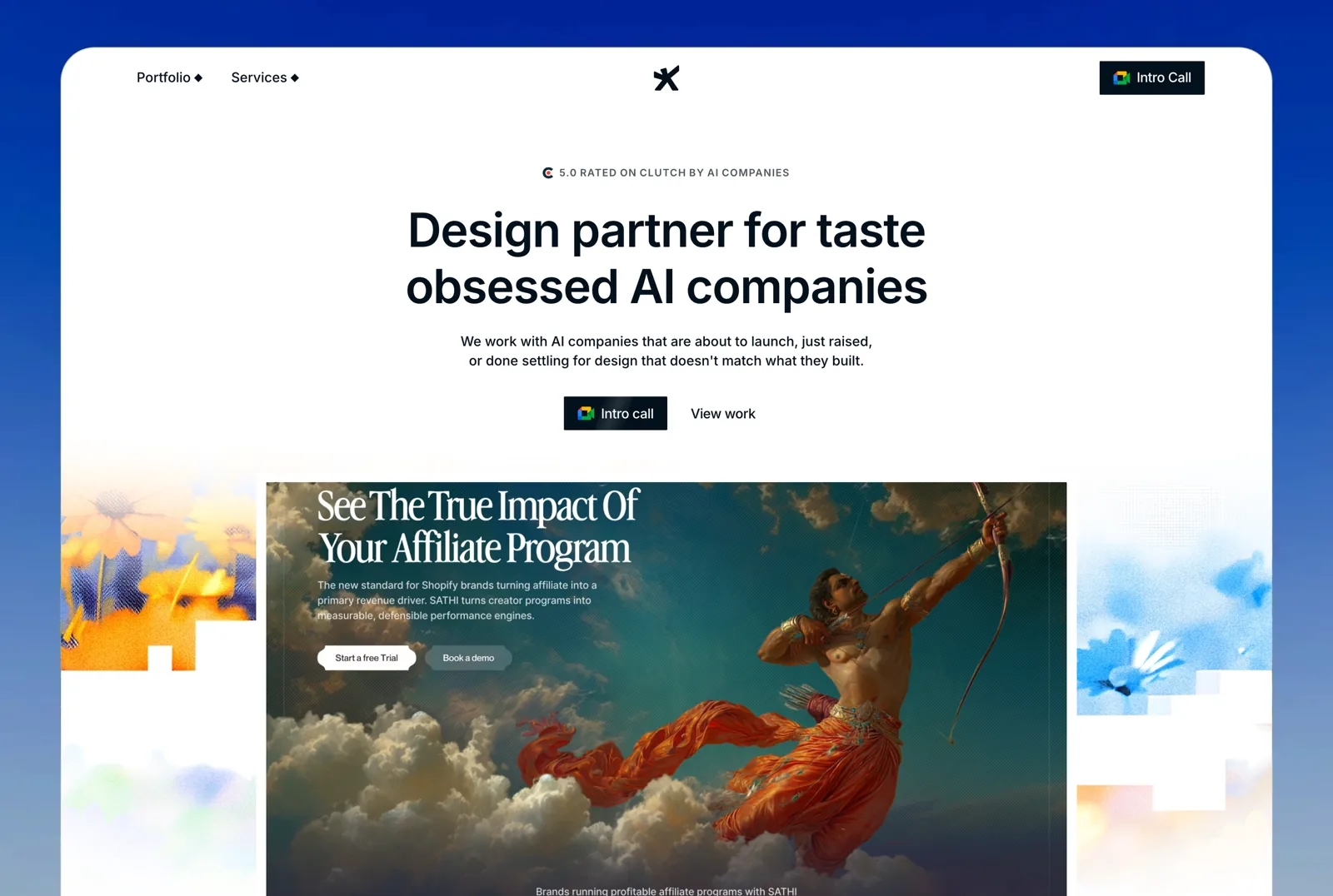
1. Studio Maydit: A Top-Rated Design Agency for AI Founders
Studio Maydit is a web and product design studio working with AI founders in the US, UK, and Europe. The studio builds websites in Framer, Webflow, and custom code, and continues into product design after the site ships.
The clearest outcome is Dualite, where design work supporting a repositioned ICP helped the product reach 100,000+ users in seven months. Recent clients include Wave, PixelFlow, Mi-VAD, and 15 other AI and SaaS teams.
Websites can be bought two ways. Fixed scope runs three to four weeks and suits teams with a launch date. Teams that keep shipping take a monthly retainer instead, covering new pages, campaigns, and product design, with no long lock-in. Fixed-scope projects end with a diagnosis of what is leaking in the product, not a handoff and goodbye.
| Check | Finding |
|---|---|
| Based in | Remote, serving US / UK / EU |
| Platform depth | Framer, Webflow, and custom code |
| AI-sector proof | Yes. AI-native clients, published outcome on Dualite |
| Pricing | Fixed scope or monthly retainer, quoted per project |
| Team shape | Founder-led, small senior team |
| Best fit | Teams whose signup numbers are fine and whose first session is not |
Maydit is the right call if people are leaving before they ever see what the product can do. Book a 30-minute call.

2. Kvalifik
Kvalifik is a Copenhagen team of 11 to 50, founded in 2015, with published AI client work and Veo, Maersk, and Relesys named. Veo is the useful reference here, a product where a non-technical customer has to reach a working setup alone, without a support call. That is structurally the same problem as a blank prompt field, and it is solved by research rather than taste.
They publish no pricing, Webflow is their stated platform while product onboarding lives inside your application, and a team this size will not run a long instrumentation programme alongside the design work.
| Check | Finding |
|---|---|
| Based in | Copenhagen, Denmark |
| Founded | 2015 |
| Team size | 11-50 |
| Primary platform | Webflow |
| AI-sector proof | Yes. Published AI client work |
| Named clients | Veo, Maersk, Relesys |
| Pricing | Not published |
| Best fit | Teams who want the first session researched before it is drawn |
3. Foundey
Foundey is a San Francisco studio founded in 2021 with published AI client work and DemandIQ, Traycer, and Sero AI named. Their client list is unusually current, which matters more here than a long history, because the conventions for opening an AI product are still being invented and the people writing them are doing it this year. A studio that has watched several early teams hit the same wall will recognise yours faster.
They are Figma-only, so your engineers own the build entirely, they publish neither pricing nor team size, and their named clients are young enough that there is limited evidence of these flows holding up at large volumes.
| Check | Finding |
|---|---|
| Based in | San Francisco, USA |
| Founded | 2021 |
| Team size | Not published |
| Primary platform | Figma-only |
| AI-sector proof | Yes. Published AI client work |
| Named clients | DemandIQ, Traycer, Sero AI |
| Pricing | Not published |
| Best fit | Teams with engineers ready to build the flow themselves |
4. Lazarev
Lazarev is a San Francisco team of 51 to 200, founded in 2015, with a published minimum, published AI client work, and Payoneer, Peel, Elva, and Mozayix named. Payoneer is the instructive one, because a regulated payments product has the least forgiving first run there is. Identity checks, waiting states, and rejections all have to be designed, and a team used to that will not be surprised by a model that takes eleven seconds to answer.
They are large enough that the people who win the work may not be the ones doing it, their process suits a full product engagement more than a single flow, and their strongest references sit outside AI.
| Check | Finding |
|---|---|
| Based in | San Francisco, USA |
| Founded | 2015 |
| Team size | 51-200 |
| Primary platform | Mixed |
| AI-sector proof | Yes. Published AI client work |
| Named clients | Payoneer, Peel, Elva, Mozayix |
| Pricing | Published minimum |
| Best fit | Teams whose onboarding has verification or long waiting states |
5. Clay
Clay is a San Francisco team of 51 to 200, founded in 2016, with a published minimum, published AI client work, and Slack, Stripe, Google, Coinbase, and Amazon named. Slack and Stripe both have opening experiences studied by other companies, and a studio working at that end of the market has seen first-run flows tested against volumes most startups never reach.
That scale is also the problem. Their engagements are sized for companies with existing traffic, the process is heavier than one onboarding flow warrants, and a team one round in will be their smallest client.
| Check | Finding |
|---|---|
| Based in | San Francisco, USA |
| Founded | 2016 |
| Team size | 51-200 |
| Primary platform | Mixed |
| AI-sector proof | Yes. Published AI client work |
| Named clients | Slack, Stripe, Google, Coinbase, Amazon |
| Pricing | Published minimum |
| Best fit | Later-stage teams with enough traffic to test properly |
6. SuperSkills
SuperSkills is a 1 to 10 team in Walnut Creek with published AI client work and The Cut named. A studio this small is worth considering for exactly this kind of brief, because an onboarding flow is a narrow, deep problem rather than a broad one, and the people you meet will be the people who draw it. There is no account layer between the decision and the work.
They name only one client, they publish neither pricing, a team size beyond the range, nor a founding year, and a team of this size has no capacity to absorb a scope that grows mid-project.
| Check | Finding |
|---|---|
| Based in | Walnut Creek, USA |
| Founded | Not published |
| Team size | 1-10 |
| Primary platform | Mixed |
| AI-sector proof | Yes. Published AI client work |
| Named clients | The Cut |
| Pricing | Not published |
| Best fit | Teams buying one focused flow, not a full product engagement |
7. Feely Studio
Feely Studio is a distributed 1 to 10 team across Europe with a published minimum, published AI client work, and Noxus, Mutiny, Luasai, and Basic Capital named. Mutiny is directly relevant, a product built around showing different people different things, which is the instinct a good AI first run needs. The opening should not be identical for a developer and a marketer.
They publish no founding year, the team is small enough that timelines depend on who else they have taken on, and their named clients skew toward marketing surfaces rather than deep in-product flows.
| Check | Finding |
|---|---|
| Based in | Distributed, Europe |
| Founded | Not published |
| Team size | 1-10 |
| Primary platform | Mixed |
| AI-sector proof | Yes. Published AI client work |
| Named clients | Noxus, Mutiny, Luasai, Basic Capital |
| Pricing | Published minimum |
| Best fit | Teams who want a different opening for each type of user |
8. BX Studio
BX Studio is a New York team of 11 to 50 with a published minimum, published AI client work, and Reddit, Headspace, ASAPP, and Verifone named. Headspace is the reference that earns its place here, because it is a product whose entire business depends on someone completing a first session and returning the next day. Habit formation is the actual goal of onboarding, and very few studios have shipped against it directly.
They publish no founding year, Webflow is their platform while the flow you need lives inside the product, and a consumer habit model does not transfer cleanly to a tool bought by a team.
| Check | Finding |
|---|---|
| Based in | New York, USA |
| Founded | Not published |
| Team size | 11-50 |
| Primary platform | Webflow |
| AI-sector proof | Yes. Published AI client work |
| Named clients | Reddit, Headspace, ASAPP, Verifone |
| Pricing | Published minimum |
| Best fit | Teams whose success measure is the second session, not the first |
9. Digidop
Digidop is a Paris studio of 1 to 10, founded in 2021, with a published minimum and TSE Energy, Ramify, and StreamNative named. Ramify is worth noting, a French investment product where a new user must be walked through a regulated signup without abandoning it halfway. Teams selling into Europe also get a partner already working in the local language and rules.
Their AI-sector proof is partial rather than published, the team is very small, and Webflow is a marketing-site platform that will not reach the in-product moment where your users are actually dropping.
| Check | Finding |
|---|---|
| Based in | Paris, France |
| Founded | 2021 |
| Team size | 1-10 |
| Primary platform | Webflow |
| AI-sector proof | Partial. Enterprise and SaaS clients, no AI case study |
| Named clients | TSE Energy, Ramify, StreamNative |
| Pricing | Published minimum |
| Best fit | European teams whose signup has regulatory steps in it |
10. Flow Ninja
Flow Ninja is a Belgrade team of 11 to 50, founded in 2018, working in Webflow. The part of onboarding that lives outside the product is real work and it is usually nobody's job. Setup guides, the first-week emails, the help pages a stuck user searches for at eleven at night. A production-oriented Webflow team can build that layer quickly and keep it current.
They publish no client names at all, which makes their record hard to check, their AI-sector proof is partial, and none of this touches the first-run screen itself.
| Check | Finding |
|---|---|
| Based in | Belgrade, Serbia |
| Founded | 2018 |
| Team size | 11-50 |
| Primary platform | Webflow |
| AI-sector proof | Partial. Enterprise and SaaS clients, no AI case study |
| Named clients | Not published |
| Pricing | Not published |
| Best fit | Teams who need the guides and help content around the flow |
How to choose between them
Sort by where people are actually dropping.
They sign up and never type anything. Studio Maydit or Foundey.
They type once, get a weak answer, and leave. Kvalifik or SuperSkills.
They finish the first session and never return. BX Studio.
The signup itself has verification or compliance steps. Lazarev or Digidop.
One test before signing. Ask them what the user should see when the model returns something wrong. An agency worth hiring treats that as a design question with a real answer, because it is the most common screen in your product that nobody has drawn. One that calls it an edge case has told you they intend to design the version of your product where everything works, which is not the version your users will meet.