Reading time:
13 min read
Last updated:
10 Best Design Agencies for AI Products Going to Market - September 2026
Going to market means writing for people who have never heard of you and do not want another tool. We checked 10 design agencies on five public criteria to see which ones handle that shift.


The best design agencies for AI products going to market in 2026 are Studio Maydit, Kvalifik, BX Studio, Finsweet, Flow Ninja, Flowout, Edgar Allan, 8020, Refokus, and Lighthouse Digital. Studio Maydit and BX Studio lead for teams who need a launch site and the pages that come after it. Edgar Allan and Finsweet are the wrong fit unless you already run a content operation at scale.
Everyone who used your product so far wanted to.
They found you in a thread, or a friend sent it, or they collect AI tools the way other people collect kitchen gadgets. They arrived curious. They forgave the confusing parts. They filled in the gaps themselves, and when they liked it they told you so in a way that felt like proof.
Going to market means the next thousand people are nothing like them.
They have not heard of you. They are not looking for a new tool, they are trying to finish something. They have been disappointed by three AI products this year and have quietly decided the category is overpromised. They will give your homepage about eight seconds, and they will not fill in a single gap for you.
That is the real transition, and it is a writing and design problem before it is a marketing one. The site that got you your first two hundred users was talking to people who already understood. The site that takes you to market has to work for someone who does not, will not ask, and is slightly suspicious of the whole category.

How we picked these agencies
This is a teardown, not a directory listing. For each agency we read their own site and their public record, then checked five things you can verify yourself in an afternoon:
Platform depth. Is there a main build tool they know deeply, or a long service menu?
AI-sector proof. Named AI clients and published work, or just the word "AI" in the copy?
Pricing. Do they publish a minimum at all, or keep it behind a call?
Team shape. Who actually does the work, and how many clients are they carrying at once?
Their own site. Distinctive, or the same template as everyone else on this list?
That last one gets skipped most often. An agency's own website is the only project where nobody overruled them. No client committee, no inherited brand book. If their own site is forgettable, you have found their ceiling.
Every fact below comes from the agency's own site or a public listing. Where a number is not public, we say so rather than guessing.
What goes wrong at the go-to-market moment
Three failures repeat, and all three come from writing for the audience you already have.
The site assumes context the market does not have. Every piece of feedback that shaped your copy came from people who already understood what you were building. So the homepage opens mid-conversation. It names your feature instead of the problem, it uses your internal word for the thing, and it explains how before it has established why. Your early users never flagged it because it read perfectly to them. The test is simple and slightly painful. Show it to someone in your target market who has never seen it, and ask them to say what it does. If they cannot, nothing else on the page matters.
The page ends without giving anyone a next step. Traffic arrives, reads, agrees, and then hits a wall. A waitlist with no explanation of what happens next. A book a demo button when the product is self-serve. Pricing that says contact us for a tool that costs less than a team lunch. Each of these is a decision somebody made quickly and never revisited, and together they undo the entire launch. If a reader is convinced, the next action should be obvious, immediate, and honest about what it costs.
The launch is planned as a day instead of a quarter. Everything gets aimed at one moment. The site ships, the posts go out, the number spikes, and then the traffic settles into a much smaller and far more valuable trickle of people evaluating you properly. Almost nothing is built for those people. The comparison page, the use case pages, the integration pages, the honest documentation. That is where go-to-market is actually won, and it is routinely left out of the scope because it is not exciting on launch day.
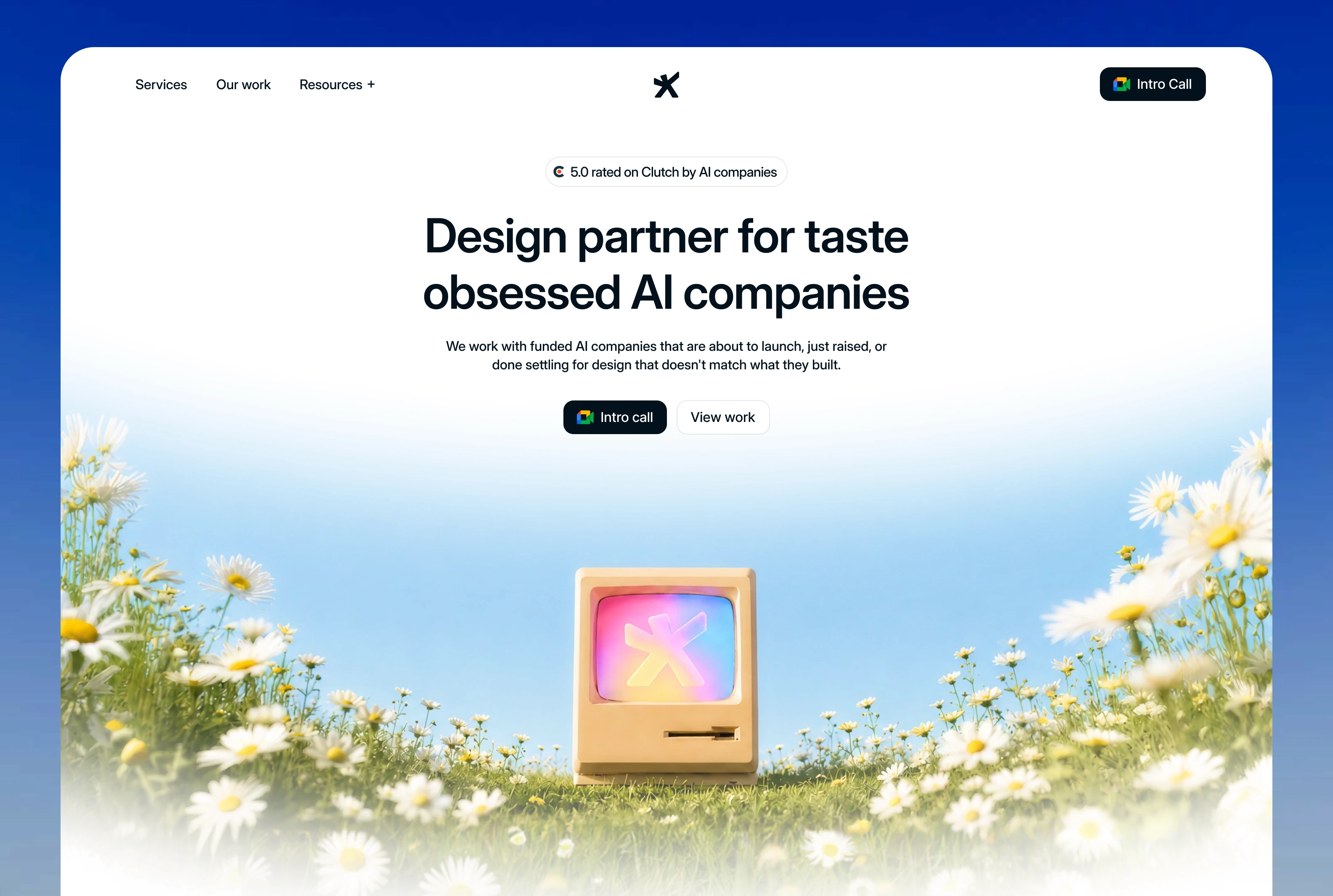
1. Studio Maydit: A Top-Rated Design Agency for AI Founders
Studio Maydit is a web and product design studio working with AI founders in the US, UK, and Europe. The studio builds websites in Framer, Webflow, and custom code, and continues into product design after the site ships.
The clearest outcome is Dualite, where design work supporting a repositioned ICP helped the product reach 100,000+ users in seven months. Recent clients include Wave, PixelFlow, Mi-VAD, and 15 other AI and SaaS teams.
Websites can be bought two ways. Fixed scope runs three to four weeks and suits teams with a launch date. Teams that keep shipping take a monthly retainer instead, covering new pages, campaigns, and product design, with no long lock-in. Fixed-scope projects end with a diagnosis of what is leaking in the product, not a handoff and goodbye.
Check | Finding |
|---|---|
Based in | Remote, serving US / UK / EU |
Platform depth | Framer, Webflow, and custom code |
AI-sector proof | Yes. AI-native clients, published outcome on Dualite |
Pricing | Fixed scope or monthly retainer, quoted per project |
Team shape | Founder-led, small senior team |
Best fit | Teams who need a launch site and the evaluation pages that decide the quarter after it |
Maydit is the right call if the product is ready and the explanation is not, and you want the same team on the pages that come after launch week. Book a 30-minute call.

2. Kvalifik
Kvalifik is a Copenhagen studio of 11 to 50 with published AI client work and clients including Veo and Maersk. What makes them useful at a go-to-market moment is that they have built for buyers who were not enthusiasts. A logistics company does not adopt something because it is novel, so the studio has practice making a case rather than making an announcement.
They are Webflow-first, so a heavily coded launch experience is outside their normal shape, and they do not publish pricing.
Check | Finding |
|---|---|
Based in | Copenhagen, Denmark |
Founded | 2015 |
Team size | 11-50 |
Primary platform | Webflow |
AI-sector proof | Yes. Published AI client work |
Named clients | Veo, Maersk, Relesys |
Pricing | Not published |
Best fit | European AI teams selling to buyers who need convincing rather than exciting |
3. BX Studio
BX Studio is a New York studio of 11 to 50 with published AI client work including ASAPP, plus content-heavy builds for Reddit and Headspace. The relevant strength for a launch is the part most teams underestimate. Going to market generates pages continuously, including use cases, comparisons, and integrations, and BX Studio builds sites where adding those is a routine task rather than a small project each time.
Webflow is their platform, so custom coded launch moments sit outside it, and their founding year is not published.
Check | Finding |
|---|---|
Based in | New York, USA |
Founded | Not published |
Team size | 11-50 |
Primary platform | Webflow |
AI-sector proof | Yes. Published AI client work |
Named clients | Reddit, Headspace, ASAPP, Verifone |
Pricing | Published minimum |
Best fit | AI teams who will add evaluation pages every week after launch |
4. Finsweet
Finsweet is a Denver-based distributed team of 51 to 200 that operates more like a Webflow engineering group than a design studio. They build the underlying components and structures many other agencies rely on, so if your launch plan involves programmatic pages or a large structured library, they solve that unusually well.
Their AI-sector work is partial, they do not publish pricing, and their centre of gravity is technical systems rather than the narrative work a first launch usually needs most.
Check | Finding |
|---|---|
Based in | Denver, USA, distributed |
Founded | 2017 |
Team size | 51-200 |
Primary platform | Webflow |
AI-sector proof | Partial. Enterprise and SaaS clients, no AI case study |
Named clients | Dropbox, Clay, GitHub, Steadily |
Pricing | Not published |
Best fit | AI teams whose launch plan depends on generating pages at scale |
5. Flow Ninja
Flow Ninja is a Belgrade studio of 11 to 50 running long-term Webflow engagements since 2018. A launch is rarely one delivery, and this is a team set up for the months either side of it rather than a single handoff. European hours suit a team selling into Europe.
They publish no client list and no pricing, and their AI-sector proof is partial, so you are buying delivery reliability rather than category insight.
Check | Finding |
|---|---|
Based in | Belgrade, Serbia |
Founded | 2018 |
Team size | 11-50 |
Primary platform | Webflow |
AI-sector proof | Partial. Tech and SaaS clients, no AI case study |
Named clients | Not published |
Pricing | Not published |
Best fit | AI teams who want steady delivery through a launch quarter and will bring the direction |

6. Flowout
Flowout is a distributed Webflow team on a subscription model with clients including Jasper and Riverside. Jasper is a genuine go-to-market reference, since it is an AI product that had to move from enthusiasts to a broad commercial audience. The subscription shape also suits the weeks after launch, when the work is many small pages rather than one big build.
Their AI proof is partial, they publish neither a founding year nor a team size, and a queue-based model gives you production capacity rather than someone challenging your positioning.
Check | Finding |
|---|---|
Based in | Distributed |
Founded | Not published |
Team size | Not published |
Primary platform | Webflow |
AI-sector proof | Partial. Tech and SaaS clients, no AI case study |
Named clients | Jasper, Kajabi, Riverside, Sendlane |
Pricing | Published minimum |
Best fit | AI teams with clear messaging who need consistent page output after launch |
7. Edgar Allan
Edgar Allan is an Atlanta studio of 51 to 200 running large Webflow programmes for clients including Porsche and NCR. They are built for sustained marketing operations, so a company with a real content team and a full launch calendar can hand them the whole surface without it becoming a bottleneck.
That scale is wrong for most teams at first launch. Engagements are large, the process is heavier than a small team needs, AI proof is partial, and pricing is not published.
Check | Finding |
|---|---|
Based in | Atlanta, USA |
Founded | 2014 |
Team size | 51-200 |
Primary platform | Webflow |
AI-sector proof | Partial. Enterprise and SaaS clients, no AI case study |
Named clients | Porsche, Duracell, NCR |
Pricing | Not published |
Best fit | Later stage AI companies launching with a full marketing team behind them |
8. 8020
8020 works across San Francisco and New York for companies including Vanta, Superlist, and Pilot.com. That is a list of products that went to market recently and did it well, which is the most relevant kind of experience on this page. They understand the standard shape of a modern software site, so less time goes into arguing about what a pricing page contains.
They publish no team size and no pricing, and their AI-sector proof is partial rather than a set of shipped AI products.
Check | Finding |
|---|---|
Based in | San Francisco and New York, USA |
Founded | 2014 |
Team size | Not published |
Primary platform | Webflow |
AI-sector proof | Partial. Tech and SaaS clients, no AI case study |
Named clients | Wave, Superlist, Pilot.com, Vanta, Circle |
Pricing | Not published |
Best fit | AI teams selling to software buyers who want a proven go-to-market site shape |
9. Refokus
Refokus is a German remote studio of 11 to 50 with work for Mural, Spotify, and BCG. Their approach is systematic, which pays off at launch in an unglamorous way. When you need six new pages in three weeks and they all have to look like they belong to the same company, a proper component system is what makes that possible.
Their AI-sector work is partial, they do not publish pricing, and a systems-led studio is more valuable once the message is settled than while you are still finding it.
Check | Finding |
|---|---|
Based in | Germany, remote |
Founded | 2021 |
Team size | 11-50 |
Primary platform | Webflow |
AI-sector proof | Partial. Enterprise and SaaS clients, no AI case study |
Named clients | Mural, BASF, Spotify, Yahoo, BCG |
Pricing | Not published |
Best fit | AI teams who will produce many pages fast and need them to stay consistent |
10. Lighthouse Digital
Lighthouse Digital is a London studio working with consumer and fintech products including Freetrade and HelloSelf. Consumer experience is genuinely useful at a go-to-market moment, because consumer teams cannot rely on a sales call to explain anything. The page has to do all of it, which is exactly the constraint a self-serve AI product has.
Their public record is thin, with no published founding year or team size, and there is no published AI client work.
Check | Finding |
|---|---|
Based in | London, UK |
Founded | Not published |
Team size | Not published |
Primary platform | Webflow |
AI-sector proof | No. No published AI client work |
Named clients | HelloSelf, Freetrade, IGN |
Pricing | Published minimum |
Best fit | Self-serve AI products who need a page that explains without a sales call |
How to choose between them
Sort by what is actually stopping the launch.
Nobody outside your circle understands what it does. That is a positioning and writing problem before it is a design one. Studio Maydit or Kvalifik.
You know the message and need many pages fast. BX Studio or Refokus.
Launch is one moment in a much longer content plan. Flowout for volume, Edgar Allan if you already operate at scale.
Your product sells itself and the page just has to explain it. 8020 or Lighthouse Digital.
One test before signing. Ask them to read your current homepage and tell you who they think it is written for. An agency that names a specific person and points at the sentence that gave it away is already doing the work. An agency that says it looks great and suggests a refresh has not read it properly.
What people mean by an AI design agency
Most of the searches that reach this page are shorter than its title. AI design agency, AI design company, AI design agencies. The phrase covers three different things, and the studios above are not interchangeable across them. Some agencies design the AI product itself, which means the chat surface, the outputs the model produces, and the moments where it gets something wrong. Some design the brand and the site that sells it. A few use AI tools internally to work faster, which is a claim about their process rather than about your product. Ask a candidate which of the three they mean before you compare prices, because the first is a product engagement and the second is a marketing one. Our guide to choosing a design agency for an AI startup goes through the questions that separate them.
If your launch is close and you are not sure which of the three you are buying, a 30 minute call will sort it faster than another round of proposals.

Need more info?
Can't find your answer? Book a call and let's talk.
Continue Reading
10 Best Framer Design Agencies for AI Agent Startups - September 2026
What is the best Framer agency for an AI agent startup? Ten Framer studios ranked for agent products, with pricing, team size and AI work compared.

Siddarth Ponangi
10 Best Framer Design Agencies for Newly Funded Startups - September 2026
Your funding announcement is the biggest traffic day you will have all year. We checked 10 Framer agencies on five public criteria to see which can hit that date.
Siddarth Ponangi
10 Best Custom Code Website Development Agencies for AI Agent Startups - September 2026
AI web development agencies for agent startups. Which teams build custom coded sites a small team can still update weekly after launch.
Siddarth Ponangi