
Summarize with AI


The best design agencies for companies launching a second product in 2026 are Studio Maydit, Lighthouse Digital, Flow Ninja, Refokus, Finsweet, Engine Digital, Edgar Allan, Pixelmatters, Instrument, and 8020. Studio Maydit and Refokus lead for teams who need the architecture decided before anything gets designed. Instrument and Engine Digital are the wrong fit unless you already have a marketing team to run the engagement.
The hardest question about your second product is where it goes in the navigation.
That sounds trivial. It is the whole strategy, compressed into one decision, and it is usually made in a fifteen-minute conversation by whoever happens to be editing the site that week. Put the second product in the top navigation next to the first and you have declared yourself a platform. Give it a subdomain and its own identity and you have declared two separate businesses that share a cap table. Bury it under a dropdown and you have declared it an experiment, which your customers will read correctly.
Every one of those can be the right answer. They are just extremely different answers, and each one commits you to a different homepage, a different sales motion, and a different story for the next funding conversation.
What actually happens is that the second product gets added where there was room. The engineering team ships it, someone writes a page, the page gets linked from the footer, and six months later the company cannot explain itself. Prospects ask what you do and get a pause. The homepage still describes product one because rewriting it feels risky. Meanwhile the sales team has quietly invented three different pitches depending on who they are talking to.
That is an architecture problem, not a visual one, and it is the thing to hire for. If you would rather work through the navigation, homepage and pricing changes yourself first, our guide to fixing a website built for one product covers them in order.

How we picked these agencies
This is a teardown, not a directory listing. For each agency we read their own site and their public record, then checked five things you can verify yourself in an afternoon:
- Platform depth. Is this their main craft, or one line on a long service menu?
- AI-sector proof. Named AI clients and published work, or just the word "AI" in the copy?
- Pricing. Do they publish a minimum at all, or keep it behind a call?
- Team shape. Who actually does the work, and how many clients are they carrying at once?
- Their own site. Distinctive, or the same template as everyone else on this list?
That last one gets skipped most often. An agency's own website is the only project where nobody overruled them. No client committee, no inherited brand book. If their own site is forgettable, you have found their ceiling.
Every fact below comes from the agency's own site or a public listing. Where a number is not public, we say so rather than guessing.
What goes wrong when the second product arrives
Three failures show up at almost every company doing this, and all three come from treating a strategy decision as a layout task.
The product gets added to the navigation and the decision is never actually made. Adding a link is a five-minute job, so nobody schedules the meeting where you decide whether you are now one company selling two things or two companies sharing an office. The link goes in, the site technically works, and the question stays open. It resurfaces later in expensive forms: a sales team that cannot agree on what to lead with, a pricing page that has to hold two incompatible models, an ad account bidding against itself. The site did not create those problems, but it was the last moment anyone was forced to state a position, and the moment passed quietly.
The homepage now has to introduce a company and it still introduces a product. A single-product homepage is a good homepage precisely because it is narrow. It names a problem and a solution and nothing else. The second product breaks that structure, because the page now has to say something true about both without becoming a list of features that describes nothing. Most teams handle this by adding a section, which is the worst option: the page loses its focus and gains no clarity. The rewrite required is at the top, in the first sentence, and it is genuinely hard, which is exactly why it keeps getting deferred to next quarter.
Your existing customers are the cheapest buyers for product two and the site treats them as strangers. Everyone building a second product plans to cross-sell, and almost nobody designs for it. The new product page is written for someone who has never heard of you, because that is the default audience for any page. So an existing customer arriving from an email lands on an introduction they do not need, with no answer to the only questions they actually have: does this work with what I already pay you for, is my data already in it, and what does it cost me on top. Those three answers, on their own page, routinely outperform the entire launch campaign.
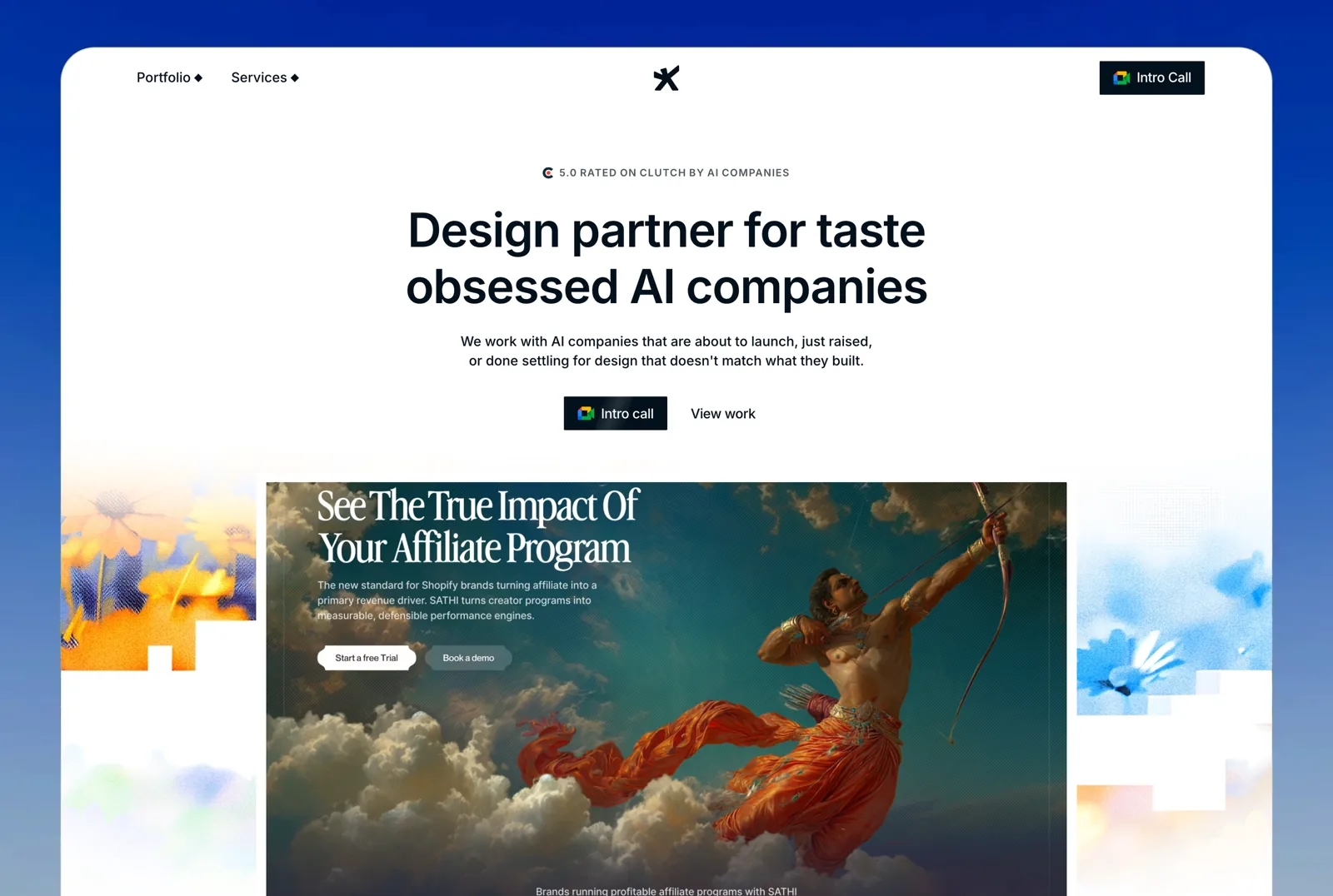
1. Studio Maydit: A Top-Rated Design Agency for AI Founders
Studio Maydit is a web and product design studio working with AI founders in the US, UK, and Europe. The studio builds websites in Framer, Webflow, and custom code, and continues into product design after the site ships.
The clearest outcome is Dualite, where design work supporting a repositioned ICP helped the product reach 100,000+ users in seven months. Recent clients include Wave, PixelFlow, Mi-VAD, and 15 other AI and SaaS teams.
Websites can be bought two ways. Fixed scope runs three to four weeks and suits teams with a launch date. Teams that keep shipping take a monthly retainer instead, covering new pages, campaigns, and product design, with no long lock-in. Fixed-scope projects end with a diagnosis of what is leaking in the product, not a handoff and goodbye.
| Check | Finding |
|---|---|
| Based in | Remote, serving US / UK / EU |
| Platform depth | Framer, Webflow, and custom code |
| AI-sector proof | Yes. AI-native clients, published outcome on Dualite |
| Pricing | Fixed scope or monthly retainer, quoted per project |
| Team shape | Founder-led, small senior team |
| Best fit | Companies who need the two-product architecture decided before design starts |
Maydit is the right call if nobody can yet say in one sentence what the company does now. Book a 30-minute call.

2. Lighthouse Digital
Lighthouse Digital is a London team with a published minimum and clients including Freetrade and HelloSelf. Regulated consumer products carry several offerings under one licensed brand, so this is a team used to keeping distinct propositions legible without letting them fragment the parent identity.
They have no published AI client work, they publish neither team size nor founding year, and their scope is website rather than product.
| Check | Finding |
|---|---|
| Based in | London, UK |
| Founded | Not published |
| Team size | Not published |
| Primary platform | Webflow |
| AI-sector proof | No. No published AI client work |
| Named clients | HelloSelf, Freetrade, IGN |
| Pricing | Published minimum |
| Best fit | UK companies holding two propositions under one brand with a known monthly figure |
3. Flow Ninja
Flow Ninja is a Belgrade studio of 11 to 50 built for continuous work. A second launch does not end on launch day, it generates months of follow-on pages, and a team structured around ongoing capacity handles that tail better than one structured around projects.
They publish neither client names nor pricing, their AI-sector proof is partial, and the strategic architecture question is not what they are known for.
| Check | Finding |
|---|---|
| Based in | Belgrade, Serbia |
| Founded | 2018 |
| Team size | 11-50 |
| Primary platform | Webflow |
| AI-sector proof | Partial. Enterprise and SaaS clients, no AI case study |
| Named clients | Not published |
| Pricing | Not published |
| Best fit | Teams who need sustained page output through and after a launch |
4. Refokus
Refokus is a remote German studio of 11 to 50 with work for Mural, Spotify, and BCG. Their published work is with organisations that carry many products under one identity, which is the exact structural problem a second launch creates, and they are used to solving it without discarding what already exists.
They publish no pricing, their AI-sector proof is partial, and their client scale is larger than most companies shipping a second product.
| Check | Finding |
|---|---|
| Based in | Germany, remote |
| Founded | 2021 |
| Team size | 11-50 |
| Primary platform | Webflow |
| AI-sector proof | Partial. Enterprise and SaaS clients, no AI case study |
| Named clients | Mural, BASF, Spotify, Yahoo, BCG |
| Pricing | Not published |
| Best fit | Companies who need a multi-product structure built on the identity they already have |
5. Finsweet
Finsweet is a distributed team of 51 to 200 out of Denver, as known for the tooling they publish as for work with Dropbox and GitHub. A two-product site needs shared components that behave consistently across both, and a systems-first team is the one most likely to leave that behind rather than two sets of pages that drift apart.
They are large, they publish no pricing, and their strength is the build rather than the positioning argument that has to happen first.
| Check | Finding |
|---|---|
| Based in | Denver, USA, distributed |
| Founded | 2017 |
| Team size | 51-200 |
| Primary platform | Webflow |
| AI-sector proof | Partial. Enterprise and SaaS clients, no AI case study |
| Named clients | Dropbox, Clay, GitHub, Steadily |
| Pricing | Not published |
| Best fit | Companies who want one system that both products share and neither breaks |
6. Engine Digital
Engine Digital has written custom code since 2002 out of Vancouver and New York for Adidas, Autodesk, and Goldman Sachs. Companies at that scale run large product portfolios, so the architecture question here is routine rather than novel, and their answers come from having made it many times.
They publish neither pricing nor team size, their AI-sector proof is partial, and the engagement assumes an internal marketing function.
| Check | Finding |
|---|---|
| Based in | Vancouver and New York |
| Founded | 2002 |
| Team size | Not published |
| Primary platform | Custom code |
| AI-sector proof | Partial. Enterprise and SaaS clients, no AI case study |
| Named clients | Adidas, Autodesk, Goldman Sachs, HP |
| Pricing | Not published |
| Best fit | Larger companies adding a product to an established portfolio |
7. Edgar Allan
Edgar Allan is an Atlanta team of 51 to 200 who work on language before layout, with clients including Porsche and NCR. The second-product problem is fundamentally a naming and hierarchy problem, and a team that argues about words first will get further than one that starts by drawing the navigation.
They publish no pricing, their AI-sector proof is partial, and they operate at a scale that suits companies with a marketing lead already in post.
| Check | Finding |
|---|---|
| Based in | Atlanta, USA |
| Founded | 2014 |
| Team size | 51-200 |
| Primary platform | Webflow |
| AI-sector proof | Partial. Enterprise and SaaS clients, no AI case study |
| Named clients | Porsche, Duracell, NCR |
| Pricing | Not published |
| Best fit | Companies who cannot yet name the two things without confusing people |
8. Pixelmatters
Pixelmatters is a Porto team of 51 to 200 working with Rubrik and UJET, and they publish a minimum. They cover product design alongside websites, which matters when the second product also has to be introduced inside the first one, since the in-app path is usually where the cross-sell actually happens.
Their AI-sector proof is partial, and they are a larger firm than the account size most second launches represent.
| Check | Finding |
|---|---|
| Based in | Porto, Portugal |
| Founded | 2013 |
| Team size | 51-200 |
| Primary platform | Mixed |
| AI-sector proof | Partial. Enterprise and SaaS clients, no AI case study |
| Named clients | Rubrik, Quantic, UJET |
| Pricing | Published minimum |
| Best fit | Companies whose second product must be introduced inside the first one |
9. Instrument
Instrument is a Portland studio founded in 2005 with work for Nike, Microsoft, and Google. Their strength is holding a single identity across an enormous portfolio, which is the mature version of the problem you are facing now, several products further along.
They publish neither pricing nor team size, their AI-sector proof is partial, and their engagements assume strategy is already settled before they begin.
| Check | Finding |
|---|---|
| Based in | Portland, USA |
| Founded | 2005 |
| Team size | Not published |
| Primary platform | Mixed |
| AI-sector proof | Partial. Enterprise and SaaS clients, no AI case study |
| Named clients | Nike, Microsoft, Electronic Arts, Google |
| Pricing | Not published |
| Best fit | Companies with the positioning already decided and budget to execute it fully |
10. 8020
8020 works across San Francisco and New York for Vanta, Pilot.com, and Circle. Those are companies that expanded from one product into a suite, so the pricing page and comparison content that a second product complicates are familiar territory here.
They publish neither pricing nor team size, their AI-sector proof is partial, and their published depth is marketing rather than in-product work.
| Check | Finding |
|---|---|
| Based in | San Francisco and New York, USA |
| Founded | 2014 |
| Team size | Not published |
| Primary platform | Webflow |
| AI-sector proof | Partial. Enterprise and SaaS clients, no AI case study |
| Named clients | Wave, Superlist, Pilot.com, Vanta, Circle |
| Pricing | Not published |
| Best fit | B2B companies whose pricing page has to hold two products at once |
How to choose between them
Sort by which part of the decision is still open.
Nobody has decided whether you are one company or two. Studio Maydit or Refokus.
You know the answer and cannot phrase it. Edgar Allan.
The pricing page is where it falls apart. 8020 or Pixelmatters.
You need the pages built and kept coming. Flow Ninja or Finsweet.
One test before signing. Ask them to sketch your navigation two ways, once as a single platform and once as two products, and to say which they would pick and why. An agency that has an opinion and defends it with a consequence, such as what happens to your pricing page or your sales pitch in each case, is thinking about the business. An agency that says both are viable and asks which you prefer has handed the hardest decision back to the person who hired them to make it.