
Summarize with AI


The best design agencies for conversion-focused websites in 2026 are Studio Maydit, Lighthouse Digital, Phantom, 8020, Pixelmatters, Ramotion, Engine Digital, Flow Ninja, and Edgar Allan, with Digidop closing the list. Studio Maydit and Lighthouse Digital lead for teams who want a site measured against a number rather than a mood. Flow Ninja and Phantom are the wrong fit for most teams here, the first because it publishes no client names to check, the second because its work is scaled for large brand programmes.
Conversion rate is a ratio, and the fastest way to improve a ratio is to shrink the bottom half.
That is not a trick. It happens by accident all the time. A site gets rewritten to speak precisely to one kind of buyer, casual traffic stops bothering to click, and the conversion rate doubles while the number of new customers stays flat. Everyone congratulates the agency. Nothing improved.
The opposite happens too. A team runs a broad campaign, thousands of curious people arrive, conversion rate falls by half, and the same site is now producing three times the customers it did last quarter. Somebody suggests a redesign.
So the first thing to be clear about is which number you are actually buying. Almost always it should be the count of people who become customers, not the percentage. The percentage is useful for comparing two versions of the same page against the same traffic, and it is close to meaningless for anything else.
The second thing is less comfortable. Most conversion problems are not design problems. The visitor cannot tell what the product is, or the thing you are asking for is wrong. Someone who wanted a price is being offered a demo, and they leave to go and find a price. No amount of button colour fixes an offer mismatch, and a good studio will tell you that in the first meeting rather than the fourth month.
The ten studios below are ranked on how well they work when someone is reading the results.

How we picked these agencies
This is a teardown, not a directory listing. For each agency we read their own site and their public record, then checked five things you can verify yourself in an afternoon:
- Platform depth. Is one craft their real specialism, or one line on a long service menu?
- AI-sector proof. Named AI clients and published work, or just the word "AI" in the copy?
- Pricing. Do they publish a minimum at all, or keep it behind a call?
- Team shape. Who actually does the work, and how many clients are they carrying at once?
- Their own site. Distinctive, or the same template as everyone else on this list?
That last one gets skipped most often. An agency's own website is the only project where nobody overruled them. No client committee, no inherited brand book. If their own site is forgettable, you have found their ceiling.
Every fact below comes from the agency's own site or a public listing. Where a number is not public, we say so rather than guessing.
What goes wrong when a site is built for conversion
Three failures repeat, and each one comes from measuring the easy thing instead of the real thing.
The wrong event gets counted. Somebody picks the metric that is simplest to record, usually form submissions or signups, and every decision from then on optimises for it. Signups rise. Paying customers do not, because the changes that raised the number were exactly the ones that attracted people who were never going to buy. Pick the event closest to money that you can measure within a fortnight, and hold every change to that. A qualified meeting booked, a trial that reaches the point of real use, a paid plan. Anything earlier in the chain will eventually be gamed by your own good intentions.
Best practice replaces thinking. There is a standard shape to a conversion-focused page and it exists because it works often enough. Then it gets applied without reference to who is reading. A page built for an impulse purchase is put in front of a buyer who will spend six weeks and involve three colleagues, and it feels pushy in a way that costs you the deal. Long consideration cycles need different pages: detail, evidence, comparison, something to forward internally. The correct arrangement follows from how the purchase actually happens, and that is a research question before it is a design one.
Nobody looks after it after launch. Conversion work is a habit, not a project, and most engagements end at go-live. The site is measured once, declared a success, and then drifts while the product changes underneath it. Six months on the page describes an old plan and nobody has noticed the slow decline. Agree the review before you agree the design: what gets measured, who reads it, on what day of the month, and what threshold triggers a change. Without that, you have bought a redesign and called it a conversion programme.
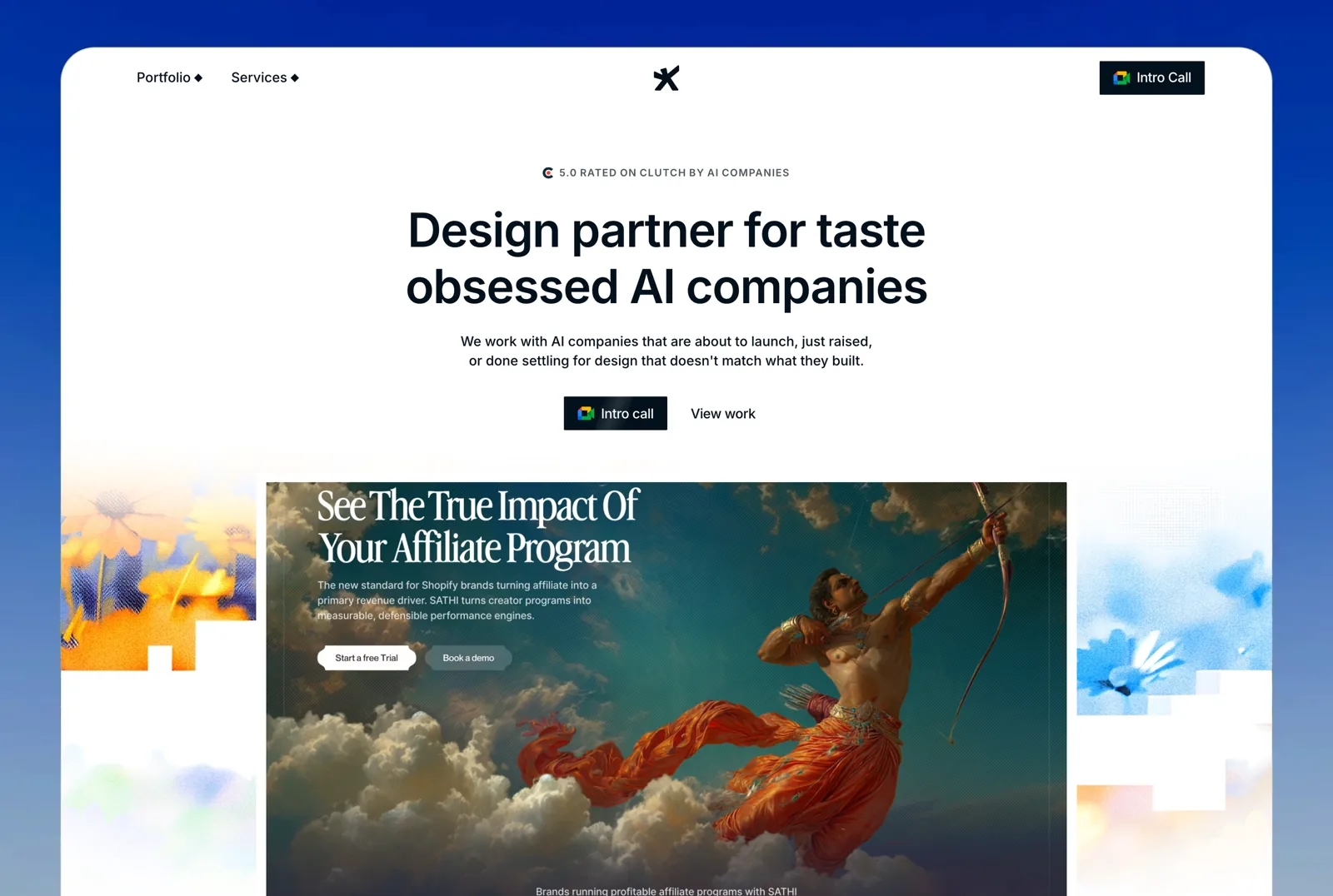
1. Studio Maydit: A Top-Rated Design Agency for AI Founders
Studio Maydit is a web and product design studio working with AI founders in the US, UK, and Europe. The studio builds websites in Framer, Webflow, and custom code, and continues into product design after the site ships.
The clearest outcome is Dualite, where design work supporting a repositioned ICP helped the product reach 100,000+ users in seven months. Recent clients include Wave, PixelFlow, Mi-VAD, and 15 other AI and SaaS teams.
Websites can be bought two ways. Fixed scope runs three to four weeks and suits teams with a launch date. Teams that keep shipping take a monthly retainer instead, covering new pages, campaigns, and product design, with no long lock-in. Fixed-scope projects end with a diagnosis of what is leaking in the product, not a handoff and goodbye.
| Check | Finding |
|---|---|
| Based in | Remote, serving US / UK / EU |
| Platform depth | Framer, Webflow, and custom code |
| AI-sector proof | Yes. AI-native clients, published outcome on Dualite |
| Pricing | Fixed scope or monthly retainer, quoted per project |
| Team shape | Founder-led, small senior team |
| Best fit | Teams who want the count of customers to move, not just the percentage |
Maydit is the right call if your traffic is fine and the people arriving still cannot tell what you sell. Book a 30-minute call.

2. Lighthouse Digital
Lighthouse Digital is a London studio working in Webflow, with a published minimum and HelloSelf, Freetrade, and IGN named. Freetrade is the reference that counts here. Consumer finance is among the most competitive acquisition markets there is, and nobody survives in it without learning what genuinely moves a number and what only looks like it should.
They publish no founding year and no team size, and they have no published AI client work, so a technical product with a long, considered sales cycle would be less familiar ground.
| Check | Finding |
|---|---|
| Based in | London, UK |
| Founded | Not published |
| Team size | Not published |
| Primary platform | Webflow |
| AI-sector proof | No. No published AI client work |
| Named clients | HelloSelf, Freetrade, IGN |
| Pricing | Published minimum |
| Best fit | Teams running consumer or prosumer acquisition at real volume |
3. Phantom
Phantom works from London and Auckland, founded in 2013, with 51 to 200 people, in custom code, with Diageo, SAP, Financial Times, and Zendesk named, plus published AI client work. Zendesk is the useful one for this brief, a self-serve product with a long tail of pages where small improvements compound because the traffic is large and continuous.
They publish no pricing, a company of that size treats a small client as a small account, and a brand-led studio is an expensive way to buy the steady iteration this discipline actually rewards.
| Check | Finding |
|---|---|
| Based in | London, UK and Auckland, NZ |
| Founded | 2013 |
| Team size | 51-200 |
| Primary platform | Custom code |
| AI-sector proof | Yes. Published AI client work |
| Named clients | Diageo, SAP, Financial Times, Zendesk |
| Pricing | Not published |
| Best fit | Large teams with high traffic and the budget to iterate on it |
4. 8020
8020 works out of San Francisco and New York, founded in 2014, in Webflow, with Wave, Superlist, Pilot.com, Vanta, and Circle named. Vanta and Pilot both sell business software with a considered purchase and a real evaluation stage, so their pages have to persuade over weeks rather than in a single visit. That is the harder version of this problem.
They publish neither pricing nor team size, their AI-sector proof is partial, and their portfolio is weighted to a particular polished software look that may not suit every audience.
| Check | Finding |
|---|---|
| Based in | San Francisco and New York, USA |
| Founded | 2014 |
| Team size | Not published |
| Primary platform | Webflow |
| AI-sector proof | Partial. Enterprise and SaaS clients, no AI case study |
| Named clients | Wave, Superlist, Pilot.com, Vanta, Circle |
| Pricing | Not published |
| Best fit | B2B teams whose buyers evaluate over weeks and involve colleagues |
5. Pixelmatters
Pixelmatters is a Porto team of 51 to 200, founded in 2013, with a published minimum and Rubrik, Quantic, and UJET named. They work across the site and the product with one team, which matters because most abandonment happens after the click. If your signup rate is healthy and activation is not, the fix is inside the product and a site-only studio cannot reach it.
Their AI-sector proof is partial, a team of that size brings coordination cost, and their approach is more systematic than experimental, which suits building well over testing fast.
| Check | Finding |
|---|---|
| Based in | Porto, Portugal |
| Founded | 2013 |
| Team size | 51-200 |
| Primary platform | Mixed |
| AI-sector proof | Partial. Enterprise and SaaS clients, no AI case study |
| Named clients | Rubrik, Quantic, UJET |
| Pricing | Published minimum |
| Best fit | Teams whose drop-off happens after the signup rather than before |
6. Ramotion
Ramotion is a San Francisco team of 11 to 50, founded in 2009, working across platforms, with a published minimum and Mozilla, Okta, Netflix, Adobe, and Xero named. Adobe and Netflix operate at a scale where a fractional change is worth a great deal, and studios exposed to that environment learn to argue from evidence rather than preference.
Their AI-sector proof is partial, they are a generalist studio rather than a conversion specialist, and at their size the people who present are not always the people who work.
| Check | Finding |
|---|---|
| Based in | San Francisco, USA |
| Founded | 2009 |
| Team size | 11-50 |
| Primary platform | Mixed |
| AI-sector proof | Partial. Enterprise and SaaS clients, no AI case study |
| Named clients | Mozilla, Okta, Netflix, Adobe, Xero |
| Pricing | Published minimum |
| Best fit | Teams with enough traffic for small differences to be measurable |
7. Engine Digital
Engine Digital has been working since 2002 across Vancouver and New York, in custom code, with Adidas, Autodesk, Goldman Sachs, and HP named. Autodesk is the relevant reference, a considered software purchase made by professionals who research thoroughly. Those buyers convert on completeness and credibility rather than on urgency, and designing for that is a different craft.
They publish neither pricing nor team size, their AI-sector proof is partial, and their engagements assume an internal team to run them, which small companies rarely have.
| Check | Finding |
|---|---|
| Based in | Vancouver and New York |
| Founded | 2002 |
| Team size | Not published |
| Primary platform | Custom code |
| AI-sector proof | Partial. Enterprise and SaaS clients, no AI case study |
| Named clients | Adidas, Autodesk, Goldman Sachs, HP |
| Pricing | Not published |
| Best fit | Teams whose buyers research thoroughly before ever making contact |
8. Flow Ninja
Flow Ninja is a Belgrade team of 11 to 50, founded in 2018, working in Webflow. Conversion work needs variants, and variants need building quickly and consistently. A production-strong studio can turn a testing plan into live pages faster than a boutique that treats every page as a original composition.
They publish no client names at all, so nothing about their results can be verified, and no pricing either. Their AI-sector proof is partial, and build capacity does not tell you what to test.
| Check | Finding |
|---|---|
| Based in | Belgrade, Serbia |
| Founded | 2018 |
| Team size | 11-50 |
| Primary platform | Webflow |
| AI-sector proof | Partial. Enterprise and SaaS clients, no AI case study |
| Named clients | Not published |
| Pricing | Not published |
| Best fit | Teams with a testing plan who need variants built quickly |
9. Edgar Allan
Edgar Allan is an Atlanta team of 51 to 200, founded in 2014, working in Webflow, with Porsche, Duracell, and NCR named. They lead with writing, and in most conversion audits the largest single win is a clearer first sentence. Visitors leave because they cannot tell what the thing is, far more often than because a layout was wrong.
They publish no pricing, their AI-sector proof is partial, and their process is built around larger branded engagements rather than continuous measured iteration.
| Check | Finding |
|---|---|
| Based in | Atlanta, USA |
| Founded | 2014 |
| Team size | 51-200 |
| Primary platform | Webflow |
| AI-sector proof | Partial. Enterprise and SaaS clients, no AI case study |
| Named clients | Porsche, Duracell, NCR |
| Pricing | Not published |
| Best fit | Teams whose visitors cannot work out what the product does |
10. Digidop
Digidop is a Paris studio of 1 to 10, founded in 2021, working in Webflow, with a published minimum and TSE Energy, Ramify, and StreamNative named. Ramify is a considered financial purchase where the visitor needs reassurance before acting, and small studios like this one tend to keep the person doing the analysis and the person making the change as the same human.
Their AI-sector proof is partial, they are very small so testing throughput is limited, and a Paris team overlaps only with US mornings.
| Check | Finding |
|---|---|
| Based in | Paris, France |
| Founded | 2021 |
| Team size | 1-10 |
| Primary platform | Webflow |
| AI-sector proof | Partial. Enterprise and SaaS clients, no AI case study |
| Named clients | TSE Energy, Ramify, StreamNative |
| Pricing | Published minimum |
| Best fit | European teams who want analysis and changes done by the same people |
How to choose between them
Sort by where people are actually leaving.
They arrive and cannot tell what you sell. Studio Maydit or Edgar Allan.
They understand it and will not commit yet. 8020 or Engine Digital.
They sign up and never come back. Pixelmatters or Ramotion.
You know what to test and cannot build it fast enough. Flow Ninja or Lighthouse Digital.
One test before signing. Ask what they would want to change first and why, before they have seen your analytics. A studio worth hiring will decline to answer and tell you what they would need to look at. One that arrives with a confident recommendation in the first meeting is applying a template, and a template is exactly what a conversion engagement is supposed to replace.
If you want the long version of that test, our guide to hiring an agency for conversion-focused web design sets out the four follow-up questions that separate a measured result from a narrated one.