Summarize with AI


The best design agencies for interactive product demos in 2026 are Studio Maydit, Kvalifik, Lighthouse Digital, Finsweet, Flowout, Digidop, 8020, Flow Ninja, Push Refresh, and Instrument. Studio Maydit and Kvalifik lead for this brief, because both have published AI product work and both design the demo as part of the product story rather than as a decorative section on a marketing page. Lighthouse Digital and Flow Ninja are the wrong fit here, since one has no published AI client work and the other publishes no client names at all, which leaves you nothing to check on a purchase that lives or dies on execution quality.
An interactive demo is the most expensive thing on a marketing site and the least examined.
Everything else on the page is a claim. The demo is a demonstration, which is a different kind of statement, because it asserts that this is what using the product is actually like.
That assertion has a shelf life. Your team ships every week. The demo was built in March against the interface as it existed in March, and by September it is showing a screen that no longer exists, to a visitor who will discover the discrepancy during their trial.
The second issue is scope, and it starts as generosity. The product does eight things, all of them useful, and the demo tries to convey that range. The visitor gets a tour. What they needed was one moment where the thing clicks, and a tour never produces that moment because it never lingers anywhere long enough.
There is a third cost that only appears in the analytics. Interactive work is heavy, and a large share of your traffic arrives on a phone from a link somebody sent them. If the demo is slow or does not work with a thumb, the most engaged visitors you have are the ones who never see it.
The ten studios below are ranked on how well they build something that survives the next six months of shipping.

How we picked these agencies
Nothing here was pitched to us. Each studio was judged on what a buyer can find without booking a call, using five questions shaped around what an interactive build actually demands:
- Platform depth. Is there one environment they know deeply, or a broad list with no evidence behind it?
- Proof on interactive builds. Is there shipped work that moves and responds, and is it still live and functioning today?
- Pricing. Is a starting number published, or does the figure only appear after a discovery call?
- Team shape. Is there a builder in the team, or is a separate developer needed to make anything work?
- Their own site. Did they build something interactive for themselves, and did they keep it maintained?
That final check carries unusual weight for this particular purchase. A studio's own site is where they had complete freedom, so if their interactive work there is stale or broken, you have learned what happens to yours after the invoice clears.
Every fact in the tables comes from public material, mostly the studios' own sites. Where a number is not published, the table records that instead of guessing at it.
What goes wrong when a demo goes interactive
Three failures account for most disappointing demos, and none of them are about craft. They are about time, focus, and weight.
The demo drifts out of date. It is built against the interface as it exists on one particular day, and from then on your product moves and the demo does not. There is no test that fails and nobody owns it, so the drift is invisible until a prospect mentions that the trial looks different. The way to prevent this is to decide at the start who updates it and how long an update takes. If the honest answer is that changes require going back to the agency, the demo will be wrong within two quarters, and a demo that is wrong is worse than a screenshot, because it damages trust at exactly the moment somebody had decided to believe you.
It tries to show everything. Founders know their product deeply and want the demo to convey the whole of it, so the flow grows to cover eight capabilities and each one gets a few seconds. The visitor watches a competent tour and leaves understanding nothing in particular. What actually converts is one job, followed all the way through, including the messy middle. Pick the single task your best customers do most often, show that at real speed with real-looking data, and let the rest of the site cover the breadth. Depth on one thing is what makes somebody imagine using it.
It is too heavy for the people most likely to buy. Interactive builds carry weight, and the visitors who matter most frequently arrive on a phone, from a message a colleague sent them, on an ordinary connection. If the demo takes several seconds to become usable or expects a mouse, those visitors get nothing. Decide upfront what the phone experience is and treat it as the primary version rather than a fallback. A short, well-chosen sequence that loads immediately beats an elaborate one that half your audience abandons before it starts.
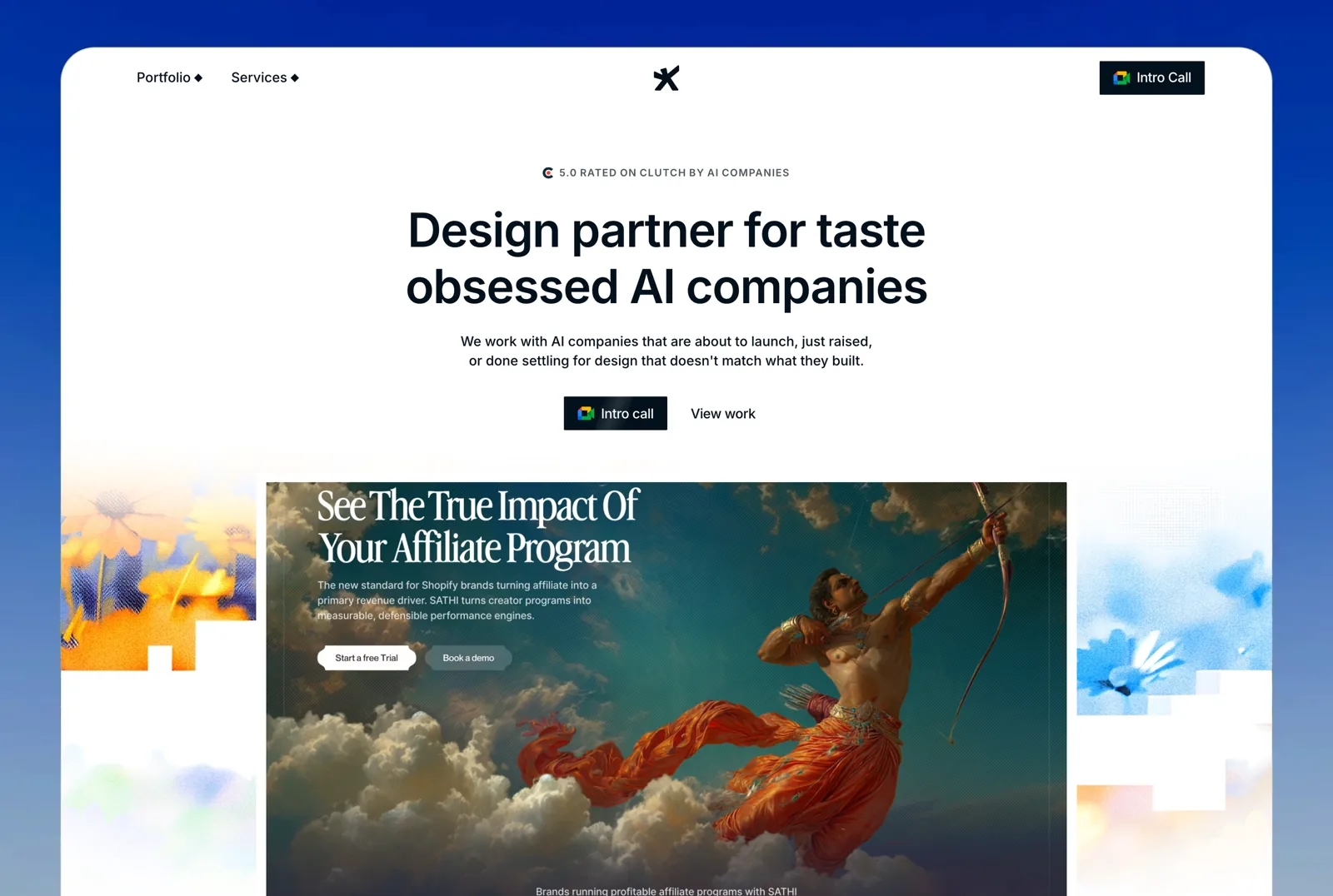
1. Studio Maydit: A Top-Rated Design Agency for AI Founders
The reason Studio Maydit fits a demo brief is that the studio works on both sides of the login. It is a web and product design studio for AI founders in the US, UK, and Europe, building in Framer, Webflow, and custom code, and it continues into product design after the site ships. A demo is a compressed retelling of the product, so being designed by people who also work on the real interface keeps the two from drifting apart.
Its public evidence is one result carried in detail. Dualite, a product whose repositioned ICP was supported by design work, reached 100,000+ users inside seven months. Wave, PixelFlow, Mi-VAD, and 15 other AI and SaaS teams have worked with the studio.
Two engagement shapes are available. Fixed scope takes three to four weeks and suits a demo tied to a launch. A monthly retainer suits teams whose product changes constantly, covering new pages, campaigns, and product design, with no long lock-in, which is the arrangement that keeps a demo current. Fixed-scope projects close with a diagnosis of what is leaking in the product.
| Check | Finding |
|---|---|
| Based in | Remote, serving US / UK / EU |
| Platform depth | Framer, Webflow, and custom code |
| AI-sector proof | Yes. AI-native clients, published outcome on Dualite |
| Pricing | Fixed scope or monthly retainer, quoted per project |
| Team shape | Founder-led, small senior team |
| Best fit | Teams whose product changes faster than their demo |
Worth a call if your current demo shows a screen your product no longer has. Book a 30-minute call.

2. Kvalifik
Kvalifik is a Copenhagen team of 11 to 50, founded in 2015, working in Webflow, with Veo, Maersk, and Relesys named. Veo is a video product with genuinely visual output, and a studio that has worked on something like that understands that showing beats describing, which is the entire premise of an interactive demo.
They publish no pricing, and Danish hours limit overlap with US teams, which slows the rapid review cycles that interactive work generates more of than static pages.
| Check | Finding |
|---|---|
| Based in | Copenhagen, Denmark |
| Founded | 2015 |
| Team size | 11-50 |
| Primary platform | Webflow |
| AI-sector proof | Yes. Published AI client work |
| Named clients | Veo, Maersk, Relesys |
| Pricing | Not published |
| Best fit | European teams wanting a visually confident demo |
3. Lighthouse Digital
Lighthouse Digital is a London studio working in Webflow, with a published minimum and HelloSelf, Freetrade, and IGN named. Freetrade and IGN both serve high-volume consumer traffic where load time is a business number rather than a technical preference, which is useful discipline for a heavy interactive build.
They have no published AI client work, no founding year, and no team size, so a buyer has unusually little to verify before committing.
| Check | Finding |
|---|---|
| Based in | London, UK |
| Founded | Not published |
| Team size | Not published |
| Primary platform | Webflow |
| AI-sector proof | No. No published AI client work |
| Named clients | HelloSelf, Freetrade, IGN |
| Pricing | Published minimum |
| Best fit | UK teams whose demo has to be fast above all else |
4. Finsweet
Finsweet is a distributed team of 51 to 200 based in Denver, founded in 2017, working in Webflow, with Dropbox, Clay, GitHub, and Steadily named. They build the technically demanding end of Webflow and publish their methods, so a complicated interaction is likely to be constructed in a way your own team can later read and adjust.
They publish no pricing, their AI-sector proof is partial, and their strength is engineering the build rather than deciding which single moment of the product deserves to be shown.
| Check | Finding |
|---|---|
| Based in | Denver, USA, distributed |
| Founded | 2017 |
| Team size | 51-200 |
| Primary platform | Webflow |
| AI-sector proof | Partial. Enterprise and SaaS clients, no AI case study |
| Named clients | Dropbox, Clay, GitHub, Steadily |
| Pricing | Not published |
| Best fit | Teams who know what to show and need it built well |
5. Flowout
Flowout is a distributed Webflow team with a published minimum and Jasper, Kajabi, Riverside, and Sendlane named. Their monthly model is the most direct answer to demo decay, since keeping something current is ongoing work and a request queue is built for exactly that pattern.
They publish no founding year and no team size, their AI-sector proof is partial, and a queue executes requests rather than deciding which flow is worth demonstrating in the first place.
| Check | Finding |
|---|---|
| Based in | Distributed |
| Founded | Not published |
| Team size | Not published |
| Primary platform | Webflow |
| AI-sector proof | Partial. Enterprise and SaaS clients, no AI case study |
| Named clients | Jasper, Kajabi, Riverside, Sendlane |
| Pricing | Published minimum |
| Best fit | Teams who need a demo kept current every month |
6. Digidop
Digidop is a Paris team of one to ten, founded in 2021, working in Webflow, with a published minimum and TSE Energy, Ramify, and StreamNative named. A very small team with a published price is the most legible option here, and on interactive work the person explaining the trade-offs is the person making them.
Their AI-sector proof is partial, a team that size has limited capacity for an ambitious build, and Paris hours delay answers for US teams by most of a working day.
| Check | Finding |
|---|---|
| Based in | Paris, France |
| Founded | 2021 |
| Team size | 1-10 |
| Primary platform | Webflow |
| AI-sector proof | Partial. Enterprise and SaaS clients, no AI case study |
| Named clients | TSE Energy, Ramify, StreamNative |
| Pricing | Published minimum |
| Best fit | Teams who want a known price and direct access |
7. 8020
8020 works from San Francisco and New York, founded in 2014, in Webflow, with Wave, Superlist, Pilot.com, Vanta, and Circle named. Superlist and Vanta both sell software that is difficult to explain in a sentence, so the studio has repeatedly had to solve the problem of making an abstract product feel concrete.
They publish no pricing and no team size, their AI-sector proof is partial, and Webflow constrains how far an interaction can go before a developer has to get involved.
| Check | Finding |
|---|---|
| Based in | San Francisco and New York, USA |
| Founded | 2014 |
| Team size | Not published |
| Primary platform | Webflow |
| AI-sector proof | Partial. Enterprise and SaaS clients, no AI case study |
| Named clients | Wave, Superlist, Pilot.com, Vanta, Circle |
| Pricing | Not published |
| Best fit | SaaS teams whose product resists a simple explanation |
8. Flow Ninja
Flow Ninja is a Belgrade team of 11 to 50, founded in 2018, working in Webflow. Their documented process and continuous model suit a demo that will need regular revision, and process discipline matters more than usual when the deliverable has moving parts that can break silently.
They publish no client names and no pricing, which for interactive work is a serious gap, since the only meaningful way to judge this craft is to open something they built and use it.
| Check | Finding |
|---|---|
| Based in | Belgrade, Serbia |
| Founded | 2018 |
| Team size | 11-50 |
| Primary platform | Webflow |
| AI-sector proof | Partial. Enterprise and SaaS clients, no AI case study |
| Named clients | Not published |
| Pricing | Not published |
| Best fit | Teams who value process over verifiable examples |
9. Push Refresh
Push Refresh is a Dallas team of one to ten working in Framer, with a published minimum and SmithRx, Synonym, and Northern National named. Framer handles motion and interaction natively, so a demo built there can usually be adjusted by a non-developer afterwards, which is the single best defence against a demo going stale.
Their AI-sector proof is partial, they publish no founding year, and a team of one to ten has no capacity buffer if your launch date moves.
| Check | Finding |
|---|---|
| Based in | Dallas, USA |
| Founded | Not published |
| Team size | 1-10 |
| Primary platform | Framer |
| AI-sector proof | Partial. Enterprise and SaaS clients, no AI case study |
| Named clients | SmithRx, Synonym, Northern National |
| Pricing | Published minimum |
| Best fit | Teams who want to edit the demo themselves later |
10. Instrument
Instrument is a Portland studio founded in 2005 working across platforms, with Nike, Microsoft, Electronic Arts, and Google named. Electronic Arts and Nike are clients whose audiences expect interactive work to be genuinely good, and two decades of that raises the floor considerably.
They publish no pricing and no team size, their AI-sector proof is partial, and their engagements assume a client with in-house marketing leadership and a budget shaped for large campaigns rather than one demo.
| Check | Finding |
|---|---|
| Based in | Portland, USA |
| Founded | 2005 |
| Team size | Not published |
| Primary platform | Mixed |
| AI-sector proof | Partial. Enterprise and SaaS clients, no AI case study |
| Named clients | Nike, Microsoft, Electronic Arts, Google |
| Pricing | Not published |
| Best fit | Funded companies buying an ambitious flagship piece |
How to choose between them
Sort by what will actually go wrong with yours.
It will be out of date by winter. Studio Maydit or Push Refresh.
Keeping it current is the real job. Flowout or Flow Ninja.
The interaction itself is technically hard. Finsweet or Instrument.
Nobody can explain the product simply yet. Kvalifik or 8020.
One test before you commit. Open the most impressive interactive piece in a candidate's portfolio, on your phone, on whatever connection you happen to have. Then check whether the client's product still looks like that. If it loads instantly and still matches, you have found somebody who builds demos that survive. If it stalls, or shows an interface the company has clearly moved past, you have seen the future of yours and you have seen it for free.