Summarize with AI


The best design agencies for investor-ready websites in 2026 are Studio Maydit, Flow Ninja, Engine Digital, Flowout, Edgar Allan, Phantom, BX Studio, Lighthouse Digital, Kvalifik, and Foundey. Studio Maydit and Flow Ninja lead for teams who need the site standing before the raise opens. Engine Digital and Phantom are the wrong fit unless you are already at scale and the site has to carry an enterprise story.
An investor spends about ninety seconds on your website, and they are not reading it the way a customer does.
A customer arrives with a problem and wants to know if you solve it. An investor arrives with a list of forty companies and wants to know which ones to cut. Those are different jobs, and a site built for the first one usually fails the second. The investor is not evaluating your product. They are evaluating whether the people who built this page understand their own market well enough to describe it in one sentence.
That is the whole test. Can you say who you sell to, what changes for them, and why now, without hedging. Most sites cannot. They say "the platform for modern teams" because the founders have not decided, and an investor reads indecision correctly on the first scroll.
There is a second reading that happens later and matters more. After a good first meeting, an associate returns to your site to build a memo. Now they are looking for specifics: what the product actually does, who is on the team, what customers say by name. If the site was written to sound impressive rather than to be checked, this is where it falls apart, and you will never hear about it. The meeting simply does not lead anywhere.
The timing makes it harder. You need this done in weeks, not a quarter, and usually while you are also building the deck. That constraint is what separates these ten agencies, more than craft does.

How we picked these agencies
This is a teardown, not a directory listing. For each agency we read their own site and their public record, then checked five things you can verify yourself in an afternoon:
- Platform depth. Is one platform their real craft, or one line on a long service menu?
- AI-sector proof. Named AI clients and published work, or just the word "AI" in the copy?
- Pricing. Do they publish a minimum at all, or keep it behind a call?
- Team shape. Who actually does the work, and how many clients are they carrying at once?
- Their own site. Distinctive, or the same template as everyone else on this list?
That last one gets skipped most often. An agency's own website is the only project where nobody overruled them. No client committee, no inherited brand book. If their own site is forgettable, you have found their ceiling.
Every fact below comes from the agency's own site or a public listing. Where a number is not public, we say so rather than guessing.
What goes wrong on a site built for a raise
Three failures show up on almost every pre-raise website, and all three come from building for applause instead of for scrutiny.
The homepage describes a category instead of a customer. Under pressure, teams reach for the widest possible framing, because a narrow one feels like it caps the outcome. So the page says "infrastructure for the AI era" when the honest sentence is "we help mid-size insurers process claims without hiring more adjusters." Founders believe the wide version sounds bigger. It reads as smaller, because an investor cannot picture the buyer, and a company that cannot name its buyer has not sold anything yet. The specific sentence is the one that makes someone lean forward. It also happens to be the sentence your actual customers already use.
Nothing on the page can be checked. The site is built entirely from adjectives. Fast, intelligent, seamless, enterprise grade. None of it is falsifiable, which means none of it is useful to a person writing a memo they will have to defend to a partner. What that reader wants is one number they can source, one customer they can name, one screenshot of the real product. Three checkable facts beat a page of confident language, every time. Teams resist this because the numbers feel small early on. A small number that is real is worth more than a large one that is vague.
The site quietly contradicts the deck. This one is almost universal and nobody catches it, because the deck gets rewritten weekly while the website sits untouched from the last launch. The deck says you sell to enterprise, the site shows a self-serve signup. The deck claims a new positioning, the homepage still carries the old one. An associate who notices the gap does not flag it in an email. They simply lower their confidence in everything else you said, and you never find out why the process stalled. Before a raise, the website and the deck have to say the same thing on the same day.
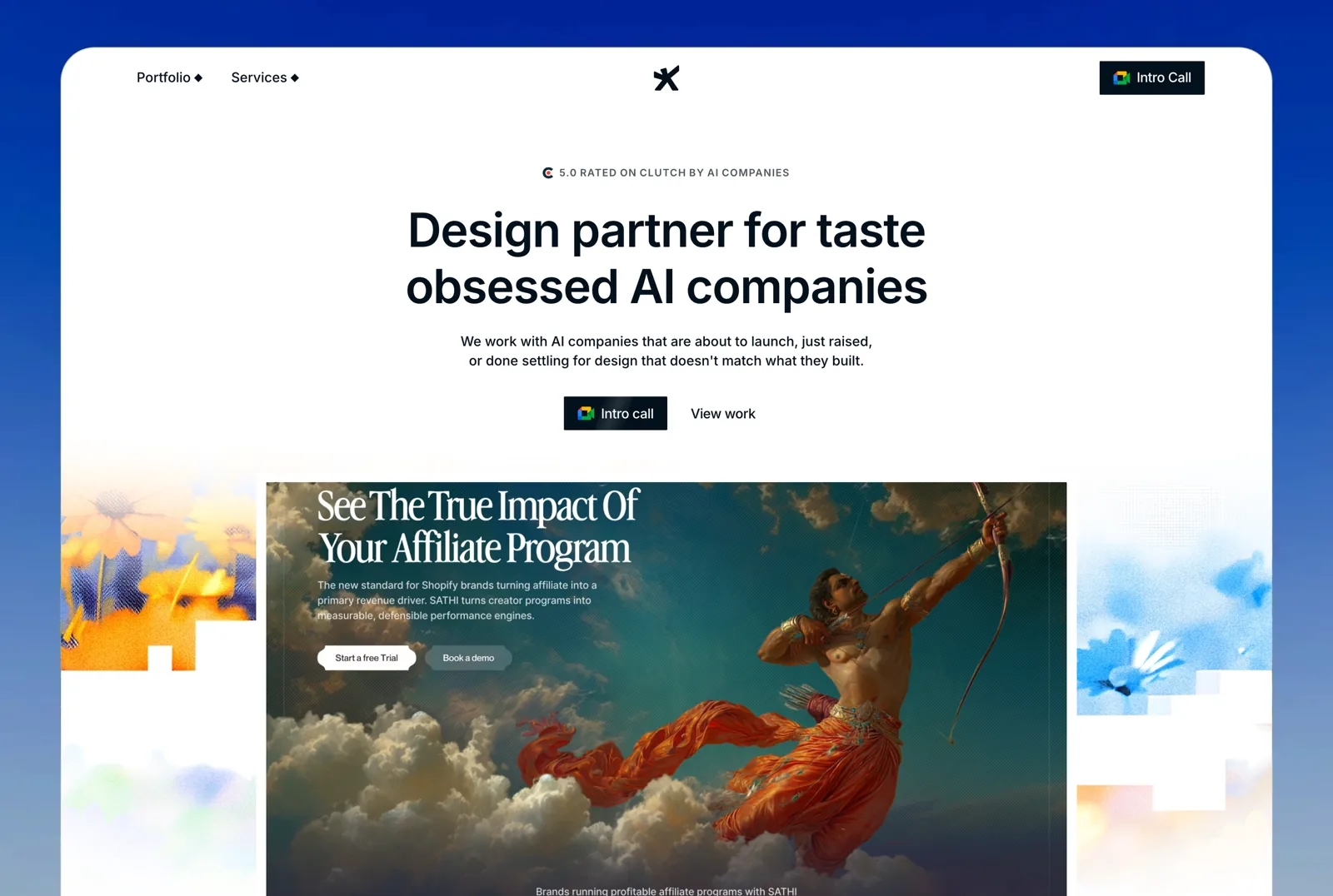
1. Studio Maydit: A Top-Rated Design Agency for AI Founders
Studio Maydit is a web and product design studio working with AI founders in the US, UK, and Europe. The studio builds websites in Framer, Webflow, and custom code, and continues into product design after the site ships.
The clearest outcome is Dualite, where design work supporting a repositioned ICP helped the product reach 100,000+ users in seven months. Recent clients include Wave, PixelFlow, Mi-VAD, and 15 other AI and SaaS teams.
Websites can be bought two ways. Fixed scope runs three to four weeks and suits teams with a launch date. Teams that keep shipping take a monthly retainer instead, covering new pages, campaigns, and product design, with no long lock-in. Fixed-scope projects end with a diagnosis of what is leaking in the product, not a handoff and goodbye.
| Check | Finding |
|---|---|
| Based in | Remote, serving US / UK / EU |
| Platform depth | Framer, Webflow, and custom code |
| AI-sector proof | Yes. AI-native clients, published outcome on Dualite |
| Pricing | Fixed scope or monthly retainer, quoted per project |
| Team shape | Founder-led, small senior team |
| Best fit | Teams who need the positioning decided, not just designed, before a raise |
Maydit is the right call if the hard part is not the layout but agreeing on the one sentence at the top. Book a 30-minute call.

2. Flow Ninja
Flow Ninja is a Belgrade team of 11 to 50 working since 2018, with Webflow as the house craft. The relevant strength for a raise is speed with a real team behind it, since a fixed three to four week build lands inside a fundraising window rather than after it closes. Webflow also leaves your team able to change a headline the week the story shifts.
They publish no client names and no pricing, and their AI-sector proof is partial, so you are buying process rather than a track record in your category.
| Check | Finding |
|---|---|
| Based in | Belgrade, Serbia |
| Founded | 2018 |
| Team size | 11-50 |
| Primary platform | Webflow |
| AI-sector proof | Partial. Enterprise and SaaS clients, no AI case study |
| Named clients | Not published |
| Pricing | Not published |
| Best fit | Teams who need a site standing inside the fundraising window |
3. Engine Digital
Engine Digital has been working since 2002 out of Vancouver and New York, with Adidas, Autodesk, and Goldman Sachs published. That roster is the point: if your raise depends on convincing an investor you can sell to institutions, a partner who has built for institutions reads through in the work itself.
They publish neither pricing nor team size, their AI-sector proof is partial, and an agency of that scale runs on timelines and budgets that sit well above a pre-raise company moving quickly.
| Check | Finding |
|---|---|
| Based in | Vancouver and New York |
| Founded | 2002 |
| Team size | Not published |
| Primary platform | Custom code |
| AI-sector proof | Partial. Enterprise and SaaS clients, no AI case study |
| Named clients | Adidas, Autodesk, Goldman Sachs, HP |
| Pricing | Not published |
| Best fit | Later-stage teams whose raise rests on an enterprise story |
4. Flowout
Flowout is a distributed Webflow studio with a published minimum and Jasper, Kajabi, and Riverside on the roster. Jasper is the useful reference for this brief, a company that had to explain an AI product to a non-technical buyer at speed. Published pricing also removes a week of back and forth at exactly the moment you cannot spare one.
They publish neither a founding year nor a team size, their AI-sector proof is partial, and their subscription model suits steady output better than a single high-stakes page.
| Check | Finding |
|---|---|
| Based in | Distributed |
| Founded | Not published |
| Team size | Not published |
| Primary platform | Webflow |
| AI-sector proof | Partial. Enterprise and SaaS clients, no AI case study |
| Named clients | Jasper, Kajabi, Riverside, Sendlane |
| Pricing | Published minimum |
| Best fit | Teams who want the cost settled before the first call |
5. Edgar Allan
Edgar Allan is an Atlanta team of 51 to 200 working since 2014, with Porsche and Duracell published. They are a writing-led studio, and for this brief that is the rarer half of the problem. The failure on most pre-raise sites is a sentence, not a layout, and a team whose instinct is language will push on the claim rather than decorate it.
They publish no pricing, their AI-sector proof is partial, and a brand-led engagement at that size will outlast the window you have before the raise opens.
| Check | Finding |
|---|---|
| Based in | Atlanta, USA |
| Founded | 2014 |
| Team size | 51-200 |
| Primary platform | Webflow |
| AI-sector proof | Partial. Enterprise and SaaS clients, no AI case study |
| Named clients | Porsche, Duracell, NCR |
| Pricing | Not published |
| Best fit | Teams whose real problem is the sentence, not the page |
6. Phantom
Phantom is a 51 to 200 team across London and Auckland with published AI client work and the Financial Times, SAP, and Zendesk on the roster. The Financial Times is the reference that matters here, a product judged on credibility rather than novelty. If your raise turns on looking established rather than looking new, that instinct is hard to buy elsewhere on this list.
They publish no pricing, custom code leaves your team less able to edit copy afterwards, and their engagement scale is built for larger companies than a team mid-raise.
| Check | Finding |
|---|---|
| Based in | London, UK and Auckland, NZ |
| Founded | 2013 |
| Team size | 51-200 |
| Primary platform | Custom code |
| AI-sector proof | Yes. Published AI client work |
| Named clients | Diageo, SAP, Financial Times, Zendesk |
| Pricing | Not published |
| Best fit | Teams who need to read as established rather than early |
7. BX Studio
BX Studio is a New York team of 11 to 50 with published AI client work, a published minimum, and Reddit, Headspace, and ASAPP named. ASAPP is the closest reference on this list to the problem you have, an AI company that had to make a technical product legible to a buyer who does not build models. Being in New York also means overlap with the investors reading the page.
They publish no founding year, they are small enough that a large scope will stretch them, and Webflow is the assumption rather than a choice made for your case.
| Check | Finding |
|---|---|
| Based in | New York, USA |
| Founded | Not published |
| Team size | 11-50 |
| Primary platform | Webflow |
| AI-sector proof | Yes. Published AI client work |
| Named clients | Reddit, Headspace, ASAPP, Verifone |
| Pricing | Published minimum |
| Best fit | AI teams who need a technical product made legible fast |
8. Lighthouse Digital
Lighthouse Digital is a London Webflow studio with a published minimum and HelloSelf, Freetrade, and IGN named. Freetrade is a genuinely useful reference for a raise, a regulated consumer fintech that had to look trustworthy to customers and to institutions at the same time. Published pricing suits a team working to a deadline.
They publish neither a founding year nor a team size, and they have no published AI client work at all, which is a real gap if your positioning depends on an investor understanding the model.
| Check | Finding |
|---|---|
| Based in | London, UK |
| Founded | Not published |
| Team size | Not published |
| Primary platform | Webflow |
| AI-sector proof | No. No published AI client work |
| Named clients | HelloSelf, Freetrade, IGN |
| Pricing | Published minimum |
| Best fit | UK teams who need to look credible to customers and institutions |
9. Kvalifik
Kvalifik is a Copenhagen team of 11 to 50 working since 2015, with published AI client work and Veo and Maersk named. Maersk is a heavier logo than most teams on this list can show, and for a European raise a Nordic studio that has delivered at that scale reads as a safe choice to a local fund.
They publish no pricing, their client record is short, and a team of that size in Copenhagen will give a US company limited daily overlap during a fast process.
| Check | Finding |
|---|---|
| Based in | Copenhagen, Denmark |
| Founded | 2015 |
| Team size | 11-50 |
| Primary platform | Webflow |
| AI-sector proof | Yes. Published AI client work |
| Named clients | Veo, Maersk, Relesys |
| Pricing | Not published |
| Best fit | European teams raising from funds in their own market |
10. Foundey
Foundey is a San Francisco studio founded in 2021 with published AI client work and DemandIQ, Traycer, and Sero AI named. They work in Figma and their clients are early AI companies, which means they have seen the exact problem you have more recently than the larger firms here.
They are Figma-only, so the build sits with your engineers rather than with them, they publish no pricing or team size, and their named clients are early enough that none of them function as proof to an investor.
| Check | Finding |
|---|---|
| Based in | San Francisco, USA |
| Founded | 2021 |
| Team size | Not published |
| Primary platform | Figma-only |
| AI-sector proof | Yes. Published AI client work |
| Named clients | DemandIQ, Traycer, Sero AI |
| Pricing | Not published |
| Best fit | Teams with engineers who will build whatever design lands |
How to choose between them
Sort by what is actually blocking the raise.
You cannot write the one sentence at the top. Studio Maydit or Edgar Allan.
The site has to exist in three weeks. Flow Ninja or Flowout.
Investors think you are too early to be institutional. Phantom or Engine Digital.
You are raising in Europe from European funds. Kvalifik.
One test before signing. Send them your deck and your current homepage and ask where the two disagree. An agency that is right for this brief will come back with a list, because the gap is always there and finding it is the job. An agency that comes back complimenting the deck has told you it will redesign what you already have, and a prettier version of an unclear story is still an unclear story.