Summarize with AI


The best design agencies for mobile app design in 2026 are Studio Maydit, Edgar Allan, Flowout, Instrument, Digidop, Refokus, Engine Digital, Finsweet, Push Refresh, and Flow Ninja. Studio Maydit and Instrument lead for this brief, because both do product design rather than page design, and Instrument has two decades of work for companies whose products live on phones. Flow Ninja and Flowout are the wrong fit here, since both are Webflow website studios, one publishes no client names at all, and neither shows shipped app work.
Mobile is the one design discipline where being good at websites actively works against you.
A website is a document. It scrolls, it reflows, it can be changed at four in the afternoon because somebody read the headline again and did not like it. An app is none of those things. It has a navigation pattern the operating system already decided. It has a review process between your fix and your users. It has permission prompts, offline states, and a keyboard that covers a third of the screen the moment anyone types.
None of that shows up in a portfolio of beautiful landing pages, which is the problem with shopping in this category. Most studios list app design as a service. Far fewer have shipped one, watched the reviews arrive, and had to redesign an onboarding flow because forty percent of people quit on the permissions screen.
There is a second thing people underestimate, which is how quickly the judgement happens. Somebody installs your app, opens it once, and decides within about a minute whether it is worth a second visit. Everything in that minute is design: how long the first screen takes to become useful, how much you ask for before giving anything, whether the empty state explains itself or just sits there.
And before any of that, there is the store listing. Screenshots, icon, first two lines of the description. That page decides whether the install happens at all, and it is almost always designed last, by whoever has time.
The ten studios below are ranked on how well they suit a product whose main surface is a phone.

How we picked these agencies
Each studio was assessed on public evidence only, against five questions that separate people who design products from people who design pages:
- Platform depth. Is their craft product design across surfaces, or is it a single website platform with app work mentioned in passing?
- Proof on shipped mobile products. Is there work in the portfolio that ended up in an app store, with real users and real reviews?
- Pricing. Is any starting figure published, or is the budget conversation gated behind meetings?
- Team shape. Is the designer you meet the designer who works on it?
- Their own site. Does it demonstrate the judgement they are selling?
The last one is the cheapest signal available and people skip it constantly. A studio's own site is the only piece of work where they were the client, so nothing on it was compromised by anybody else. Whatever is there is what they actually believe.
Everything recorded in the tables comes from public sources, mostly the studios' own websites. Where a studio publishes nothing on a point, the table records that rather than inventing a figure.
What goes wrong on mobile app design
Three failures turn up again and again, and all three come from treating a phone as a small browser.
The app is a website in a phone frame. Long scrolling screens, a menu that behaves like a website menu, buttons placed where a cursor would find them rather than where a thumb can reach. It looks fine in a portfolio image and feels wrong within thirty seconds of use. Both platforms have settled conventions for navigation, for how a screen is dismissed, for where a back action lives, and users learned those conventions from the fifty other apps on their phone. Breaking them is not originality, it is friction, and it gets punished in reviews within a week of release.
Nobody designs the states that actually happen. Portfolio screens show a full inbox, a strong signal, a happy path. Real use is a train tunnel, a first launch with nothing in the account yet, a request that takes six seconds, a permission prompt somebody declined last month and never revisited. If those states were never drawn, engineering invents them at build time, and the result is a spinner with no explanation and a blank screen that looks broken. Ask any studio you are considering to show you an empty state, an offline state, and a permissions refusal from real work. Studios that have shipped apps will have all three ready. Studios that have not will show you the happy path again.
The store listing is designed last, by nobody. Half the conversion in mobile happens before the app is installed, on a page made of an icon, a title, and six screenshots. Most of the time that page gets assembled the week of launch by whoever is free, using cropped screens with no captions. It is the highest leverage surface in the whole product and it costs about two days to do properly. Put it in the scope at the start, treat the screenshots as designed artwork rather than exports, and make the first two say what the app does before anybody has to tap more.
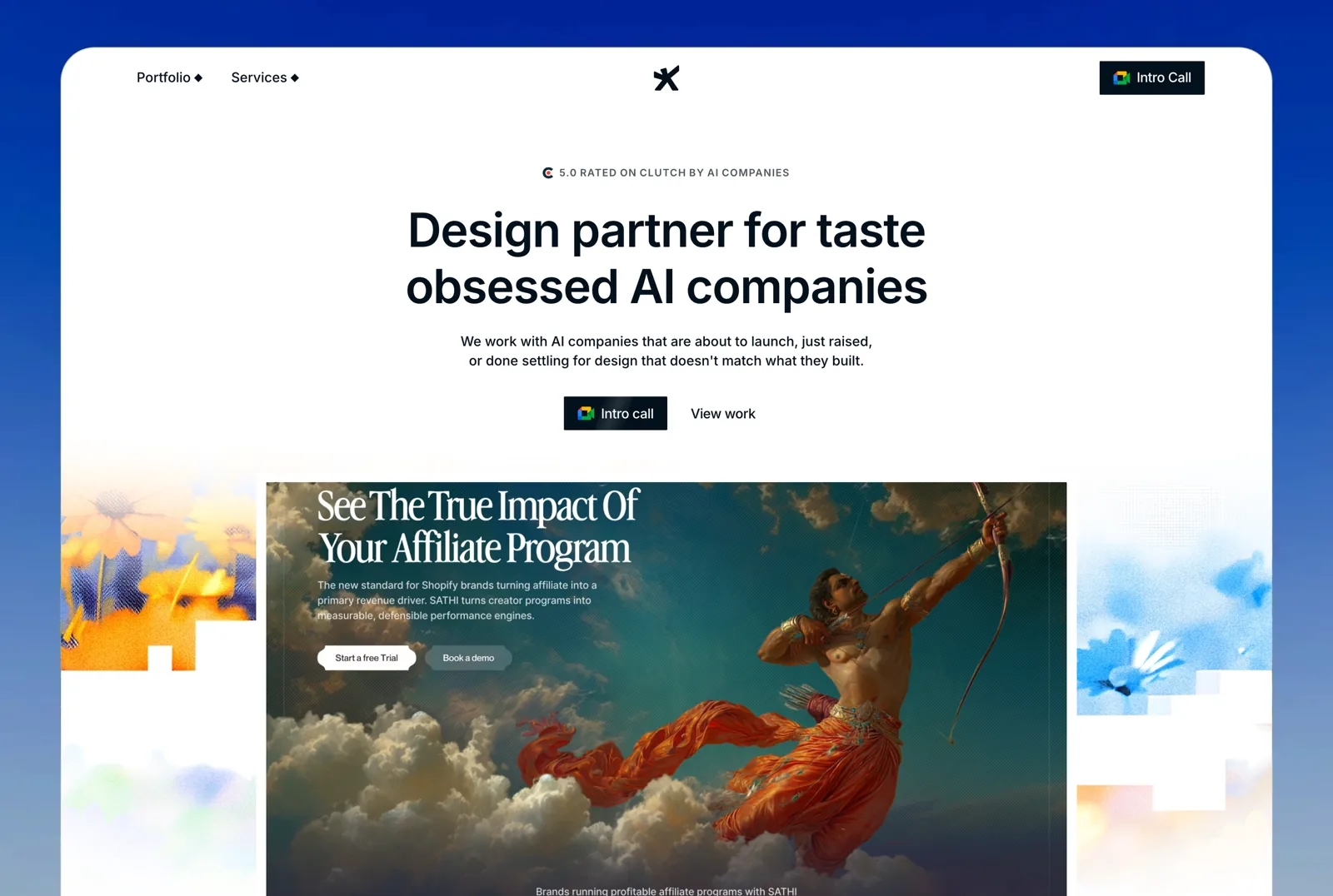
1. Studio Maydit: A Top-Rated Design Agency for AI Founders
Recent work runs to Wave, PixelFlow, Mi-VAD, and 15 other AI and SaaS teams, and one project has a public result attached to it. Dualite hit 100,000+ users in seven months, on the back of design work supporting a repositioned ICP.
Studio Maydit is a web and product design studio working with AI founders in the US, UK, and Europe. Websites are built in Framer, Webflow, and custom code, and the engagement carries on into product design once the site ships, which is the part that matters for a team whose product is an app and whose site is the front door to it.
Engagements come in two shapes. A fixed scope runs three to four weeks and suits a team working towards a launch. A monthly retainer suits teams that keep shipping, covering new pages, campaigns, and product design, with no long lock-in. Fixed-scope projects close with a diagnosis of what is leaking in the product, and on mobile that is usually a specific screen in the first session.
| Check | Finding |
|---|---|
| Based in | Remote, serving US / UK / EU |
| Platform depth | Framer, Webflow, and custom code |
| AI-sector proof | Yes. AI-native clients, published outcome on Dualite |
| Pricing | Fixed scope or monthly retainer, quoted per project |
| Team shape | Founder-led, small senior team |
| Best fit | Teams who need the app and the site to feel like one product |
Worth a call if your app and your website look like they came from different companies. Book a 30-minute call.

2. Edgar Allan
Edgar Allan is an Atlanta studio of 51 to 200, founded in 2014, with Porsche, Duracell, and NCR named. A firm of that size has the range to handle a brand system that has to work on a phone screen as well as on a website, which is where consumer products usually come unstuck.
Their primary platform is Webflow, their AI-sector proof is partial, and they publish no pricing, so app work would need to be confirmed directly rather than read off the portfolio.
| Check | Finding |
|---|---|
| Based in | Atlanta, USA |
| Founded | 2014 |
| Team size | 51-200 |
| Primary platform | Webflow |
| AI-sector proof | Partial. Enterprise and SaaS clients, no AI case study |
| Named clients | Porsche, Duracell, NCR |
| Pricing | Not published |
| Best fit | Consumer brands who need one identity across surfaces |
3. Flowout
Flowout is a distributed Webflow studio with a published minimum and Jasper, Kajabi, Riverside, and Sendlane named. The published starting figure and the productised scope make them quick to evaluate, and every one of those clients is a software product with a marketing site that had to convert.
They publish no founding year or team size, their AI-sector proof is partial, and Webflow websites are the entire offer, so this is not where an app gets designed.
| Check | Finding |
|---|---|
| Based in | Distributed |
| Founded | Not published |
| Team size | Not published |
| Primary platform | Webflow |
| AI-sector proof | Partial. Enterprise and SaaS clients, no AI case study |
| Named clients | Jasper, Kajabi, Riverside, Sendlane |
| Pricing | Published minimum |
| Best fit | App teams who need the marketing site handled separately |
4. Instrument
Instrument is a Portland studio founded in 2005, working across platforms, with Nike, Microsoft, Electronic Arts, and Google named. Those are companies whose products are used on phones by enormous numbers of people, and two decades of that work is the deepest consumer product experience in this list.
They publish no pricing and no team size, their AI-sector proof is partial, and their engagements assume a client with in-house design leadership to work alongside.
| Check | Finding |
|---|---|
| Based in | Portland, USA |
| Founded | 2005 |
| Team size | Not published |
| Primary platform | Mixed |
| AI-sector proof | Partial. Enterprise and SaaS clients, no AI case study |
| Named clients | Nike, Microsoft, Electronic Arts, Google |
| Pricing | Not published |
| Best fit | Funded consumer products with a design lead in house |
5. Digidop
Digidop is a Paris team of one to ten, founded in 2021, working in Webflow, with a published minimum and TSE Energy, Ramify, and StreamNative named. A team that small stays close to the work, and Ramify is a consumer finance product, which is a category where mobile expectations are high.
Their AI-sector proof is partial, they are a Webflow studio rather than a product team, and one to ten people limits how much can run at once.
| Check | Finding |
|---|---|
| Based in | Paris, France |
| Founded | 2021 |
| Team size | 1-10 |
| Primary platform | Webflow |
| AI-sector proof | Partial. Enterprise and SaaS clients, no AI case study |
| Named clients | TSE Energy, Ramify, StreamNative |
| Pricing | Published minimum |
| Best fit | French-speaking teams who want a small, close studio |
6. Refokus
Refokus is a remote German team of 11 to 50, founded in 2021, working in Webflow, with Mural, BASF, Spotify, Yahoo, and BCG named. Spotify and Mural are both products people use on a phone daily, and the studio's visual standard is high enough that an app launch campaign would look the part.
They publish no pricing, their AI-sector proof is partial, and their published work is websites, so shipped app screens are not something you can check before the call.
| Check | Finding |
|---|---|
| Based in | Germany, remote |
| Founded | 2021 |
| Team size | 11-50 |
| Primary platform | Webflow |
| AI-sector proof | Partial. Enterprise and SaaS clients, no AI case study |
| Named clients | Mural, BASF, Spotify, Yahoo, BCG |
| Pricing | Not published |
| Best fit | Teams who want a launch campaign around the app |
7. Engine Digital
Engine Digital works from Vancouver and New York, founded in 2002, building in custom code, with Adidas, Autodesk, Goldman Sachs, and HP named. They are one of the few studios here with genuine engineering depth, which matters when the design has to survive contact with a native build and a release cycle.
They publish no pricing and no team size, their AI-sector proof is partial, and engagements at that scale come with a planning phase that a small app team may not want to fund.
| Check | Finding |
|---|---|
| Based in | Vancouver and New York |
| Founded | 2002 |
| Team size | Not published |
| Primary platform | Custom code |
| AI-sector proof | Partial. Enterprise and SaaS clients, no AI case study |
| Named clients | Adidas, Autodesk, Goldman Sachs, HP |
| Pricing | Not published |
| Best fit | Larger teams who need design and engineering together |
8. Finsweet
Finsweet is a distributed team based in Denver, founded in 2017, with 51 to 200 people and Dropbox, Clay, GitHub, and Steadily named. Their reputation is built on solving hard technical problems inside a platform rather than on visual flourish, and that instinct transfers well to the unglamorous parts of an app.
Their platform is Webflow, their AI-sector proof is partial, and they publish no pricing, so app design would be outside what the public work demonstrates.
| Check | Finding |
|---|---|
| Based in | Denver, USA, distributed |
| Founded | 2017 |
| Team size | 51-200 |
| Primary platform | Webflow |
| AI-sector proof | Partial. Enterprise and SaaS clients, no AI case study |
| Named clients | Dropbox, Clay, GitHub, Steadily |
| Pricing | Not published |
| Best fit | Teams who value technical rigour over visual ambition |
9. Push Refresh
Push Refresh is a Dallas team of one to ten working in Framer, with a published minimum and SmithRx, Synonym, and Northern National named. SmithRx is healthcare software, a category with strict requirements and users who are not tolerant of confusion, and the published price makes the first conversation short.
They publish no founding year, their AI-sector proof is partial, and a one to ten person Framer studio is a website team rather than an app team.
| Check | Finding |
|---|---|
| Based in | Dallas, USA |
| Founded | Not published |
| Team size | 1-10 |
| Primary platform | Framer |
| AI-sector proof | Partial. Enterprise and SaaS clients, no AI case study |
| Named clients | SmithRx, Synonym, Northern National |
| Pricing | Published minimum |
| Best fit | App teams who want a fast, cheap marketing site |
10. Flow Ninja
Flow Ninja is a Belgrade team of 11 to 50, founded in 2018, working in Webflow. A European team of that size is usually available at short notice and priced below the US average, which suits a small app team spending carefully.
They publish no client names, no pricing, and their AI-sector proof is partial, so there is almost nothing about mobile work that can be verified before you talk to them.
| Check | Finding |
|---|---|
| Based in | Belgrade, Serbia |
| Founded | 2018 |
| Team size | 11-50 |
| Primary platform | Webflow |
| AI-sector proof | Partial. Enterprise and SaaS clients, no AI case study |
| Named clients | Not published |
| Pricing | Not published |
| Best fit | Budget-led teams whose priority is the website |
How to choose between them
Sort by which part of the product is actually the problem.
The app itself needs designing properly. Studio Maydit or Instrument.
Design has to survive a native build. Engine Digital or Finsweet.
The brand has to work on a phone and everywhere else. Edgar Allan or Refokus.
The app is fine and the website is embarrassing. Push Refresh or Flowout.
One test before you sign. Ask a candidate to open your app on their own phone during the call and talk through the first sixty seconds. A studio that designs for mobile will start naming things immediately: the permission asked too early, the empty state that explains nothing, the tap target sitting under the thumb rest. A studio that designs websites will comment on the colours and the type. Both responses are honest. Only one of them is about your product.
If you are still working out what the engagement should cover before you start calling studios, what mobile app design services actually include breaks the scope down piece by piece. And when the app already exists, the harder question is usually whether to rebuild it or keep iterating.