Summarize with AI


The best design agencies for pre-launch AI products in 2026 are Studio Maydit, 8020, Lighthouse Digital, Foundey, Phantom, Fantasy, Kvalifik, Feels Like, basement.studio, and BX Studio. Studio Maydit and Foundey lead for teams with nothing to show yet and a launch date approaching. Phantom and Fantasy are the wrong fit unless the launch is a genuine public event with a budget behind it.
Every persuasive device a normal website relies on is unavailable to you. No customer logos. No testimonials. No usage numbers. No screenshots worth showing, because the interface will look different by the time anyone sees it.
What you have instead is a claim and a promise, which is the weakest material anyone ever tries to build a page from. So most pre-launch sites reach for the same substitutes. An abstract animation implying intelligence. A sentence about the future of work. A waitlist form, styled beautifully, sitting under a headline that could belong to any of two hundred companies started this year.
The uncomfortable part is that this is the one time your site has to do real work rather than describe something people can already evaluate. After launch, a visitor can try the product and decide for themselves, and the site only has to get them there. Before launch, the site is the entire product as far as any stranger is concerned. It is the only artefact you have, and it is being judged as one.
There is a second thing that makes this stage genuinely different. You do not yet know who your buyer is. You have a hypothesis, drawn from conversations with people who were polite. A site built to convert an audience you have guessed at will produce a signal you cannot trust, and you will then make roadmap decisions from it. Building something that tests the guess rather than flattering it is what separates these ten.

How we picked these agencies
This is a teardown, not a directory listing. For each agency we read their own site and their public record, then checked five things you can verify yourself in an afternoon:
- Platform depth. Is one craft their real specialism, or one line on a long service menu?
- AI-sector proof. Named AI clients and published work, or just the word "AI" in the copy?
- Pricing. Do they publish a minimum at all, or keep it behind a call?
- Team shape. Who actually does the work, and how many clients are they carrying at once?
- Their own site. Distinctive, or the same template as everyone else on this list?
That last one gets skipped most often. An agency's own website is the only project where nobody overruled them. No client committee, no inherited brand book. If their own site is forgettable, you have found their ceiling.
Every fact below comes from the agency's own site or a public listing. Where a number is not public, we say so rather than guessing.
What goes wrong before launch
Three failures account for most disappointing launches, and all three happen months before the day itself.
The waitlist count becomes the objective. It is the only number available, so it becomes the number everyone watches. The trouble is that a signup costs a stranger nothing and commits them to nothing, so the figure measures curiosity rather than demand. Teams reach four thousand emails, feel validated, and build for a year against that feeling. Then launch day converts a fraction of a percent, because most of those people were other founders, competitors, and the professionally curious. A smaller list you actually know something about is worth more than a large anonymous one. Ask two questions on the form, and treat the answers as the real output.
The page over-specifies a product that is still moving. Because there is nothing to show, teams describe instead, in detail. Feature lists, integrations, a roadmap with quarters attached. Every one of those becomes a commitment a stranger now expects, and pre-launch roadmaps change more than any other kind. So you either ship something narrower than you promised, which reads as a company that overstated itself, or you delay to build things you only announced because the page felt thin. Selling the problem is safer than selling the feature list, because your understanding of the problem is the thing least likely to change.
Everything is built for one day and nothing for the year after it. The launch gets treated as the finish line. There is a countdown, a launch page, a video, and a plan for the announcement, and then nothing. Most visitors who arrive that day are not ready to buy, and there is no second thing for them, no reason to return, nothing that keeps working once the attention passes. Launch day traffic is the largest audience you will have for months, and a site with no second act converts the small share who were already convinced and quietly loses everyone else.
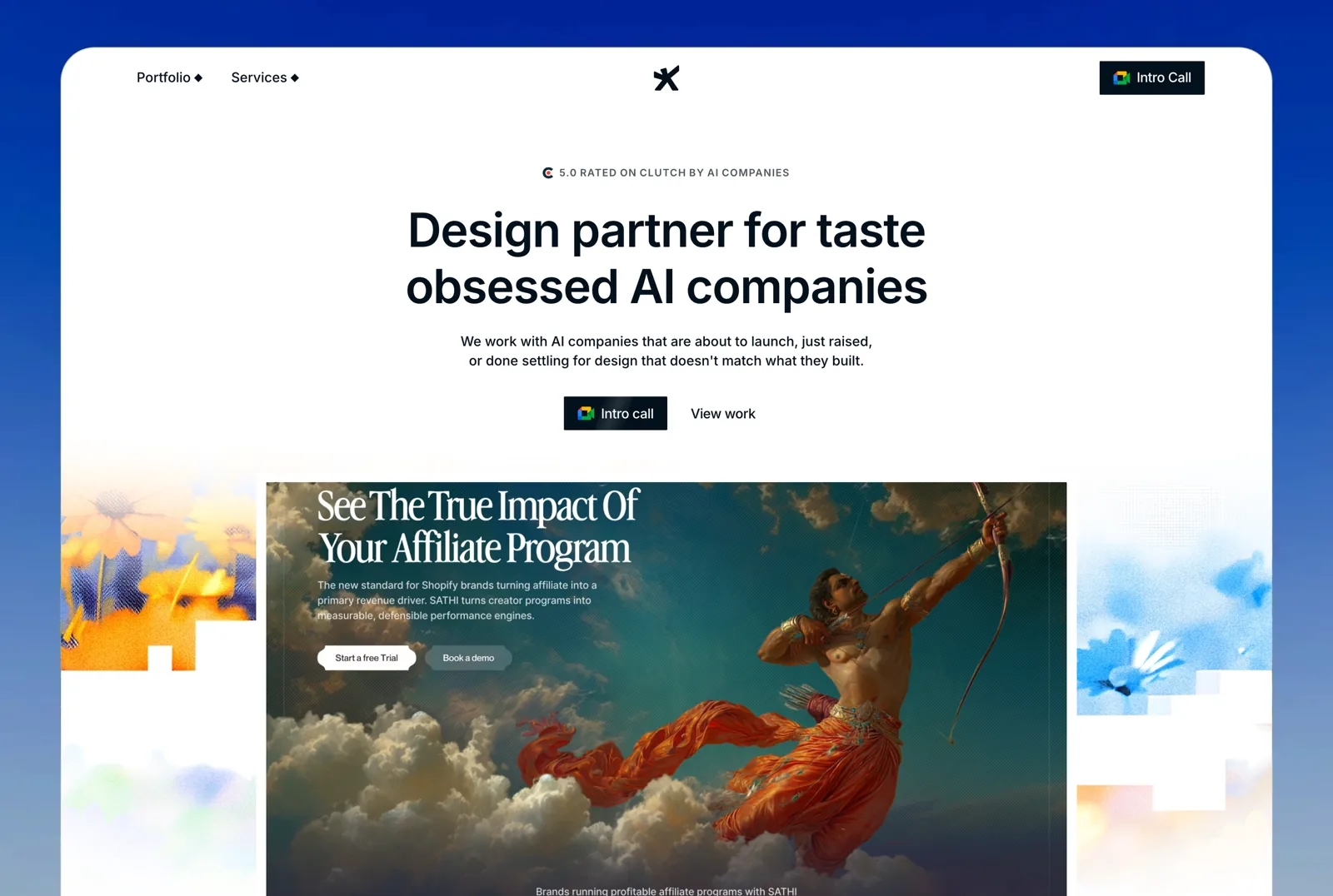
1. Studio Maydit: A Top-Rated Design Agency for AI Founders
Studio Maydit is a web and product design studio working with AI founders in the US, UK, and Europe. The studio builds websites in Framer, Webflow, and custom code, and continues into product design after the site ships.
The clearest outcome is Dualite, where design work supporting a repositioned ICP helped the product reach 100,000+ users in seven months. Recent clients include Wave, PixelFlow, Mi-VAD, and 15 other AI and SaaS teams.
Websites can be bought two ways. Fixed scope runs three to four weeks and suits teams with a launch date. Teams that keep shipping take a monthly retainer instead, covering new pages, campaigns, and product design, with no long lock-in. Fixed-scope projects end with a diagnosis of what is leaking in the product, not a handoff and goodbye.
| Check | Finding |
|---|---|
| Based in | Remote, serving US / UK / EU |
| Platform depth | Framer, Webflow, and custom code |
| AI-sector proof | Yes. AI-native clients, published outcome on Dualite |
| Pricing | Fixed scope or monthly retainer, quoted per project |
| Team shape | Founder-led, small senior team |
| Best fit | Teams with a launch date and nothing to screenshot yet |
Maydit is the right call if the site has to do the persuading because the product cannot yet. Book a 30-minute call.

2. 8020
8020 is a team across San Francisco and New York, founded in 2014, with Wave, Superlist, Pilot.com, Vanta, and Circle named. Superlist is the useful reference, a product that had to build genuine anticipation before anyone could use it, which is your exact problem. Their client list is technical B2B companies that had to explain an unfamiliar purchase, and explanation is most of the work when there is nothing to demonstrate.
They publish neither pricing nor team size, their AI-sector proof is partial, and a studio focused on marketing pages will not help you decide what the product should be.
| Check | Finding |
|---|---|
| Based in | San Francisco and New York, USA |
| Founded | 2014 |
| Team size | Not published |
| Primary platform | Webflow |
| AI-sector proof | Partial. Enterprise and SaaS clients, no AI case study |
| Named clients | Wave, Superlist, Pilot.com, Vanta, Circle |
| Pricing | Not published |
| Best fit | Teams building anticipation for something nobody has used |
3. Lighthouse Digital
Lighthouse Digital is a London Webflow studio with a published minimum and HelloSelf, Freetrade, and IGN named. Published pricing matters unusually much before launch, because you are spending from a fixed amount with no revenue behind it, and a studio with a stated starting figure lets you plan the spend rather than discover it. Freetrade also had to explain something unfamiliar to people who had never bought it before.
They publish neither a founding year nor a team size, and they have no published AI client work, which is a real gap when the hard part is describing a product category that barely exists.
| Check | Finding |
|---|---|
| Based in | London, UK |
| Founded | Not published |
| Team size | Not published |
| Primary platform | Webflow |
| AI-sector proof | No. No published AI client work |
| Named clients | HelloSelf, Freetrade, IGN |
| Pricing | Published minimum |
| Best fit | Pre-revenue teams who need a visible ceiling on the spend |
4. Foundey
Foundey is a San Francisco studio founded in 2021 with published AI client work and DemandIQ, Traycer, and Sero AI named. Their entire client base is early AI companies, most of which were pre-launch or barely past it when the work happened. That is the narrowest possible match for this brief, and it means they have already solved the problem of building a page around a product that cannot be photographed.
They are Figma-only, so your engineers build whatever is designed, they publish neither pricing nor team size, and their named clients are too young to prove much about durability.
| Check | Finding |
|---|---|
| Based in | San Francisco, USA |
| Founded | 2021 |
| Team size | Not published |
| Primary platform | Figma-only |
| AI-sector proof | Yes. Published AI client work |
| Named clients | DemandIQ, Traycer, Sero AI |
| Pricing | Not published |
| Best fit | Early AI teams whose engineers will build the site |
5. Phantom
Phantom is a 51 to 200 team across London and Auckland, founded in 2013, with published AI client work and Diageo, SAP, and the Financial Times named. If your launch is a genuine public event rather than a post on a forum, this is a studio used to work that many people see at once. Diageo is also instructive, since drinks launches are an entire discipline of making people want something before they can taste it.
They publish no pricing, custom code makes changes expensive at a stage when everything changes, and their scale assumes a budget most pre-launch companies do not have.
| Check | Finding |
|---|---|
| Based in | London, UK and Auckland, NZ |
| Founded | 2013 |
| Team size | 51-200 |
| Primary platform | Custom code |
| AI-sector proof | Yes. Published AI client work |
| Named clients | Diageo, SAP, Financial Times, Zendesk |
| Pricing | Not published |
| Best fit | Teams whose launch is a genuine public event |
6. Fantasy
Fantasy has been working since 1999 out of San Francisco and New York, with published AI client work and a practice built around product rather than page. Before launch the boundary between the site and the product is unusually thin, since an interactive demo on the homepage may be the only working thing you have. A studio that thinks in product terms will build that as a real experience rather than as a video pretending to be one.
They publish no pricing, no team size, and no client names, which makes the record hard to check, and their engagement scale sits far above a pre-revenue company.
| Check | Finding |
|---|---|
| Based in | San Francisco and New York, USA |
| Founded | 1999 |
| Team size | Not published |
| Primary platform | Mixed |
| AI-sector proof | Yes. Published AI client work |
| Named clients | Not published |
| Pricing | Not published |
| Best fit | Teams whose homepage demo is the only working thing |
7. Kvalifik
Kvalifik is a Copenhagen team of 11 to 50, founded in 2015, with published AI client work and Veo, Maersk, and Relesys named. Their work leans on research, and research is the thing pre-launch teams need most and buy least, because it is the only way to replace a guess about the buyer with something closer to evidence before you commit a year of building to it.
They publish no pricing, Webflow is their platform, and a research-led process takes longer than a team racing toward an announced date may be willing to accept.
| Check | Finding |
|---|---|
| Based in | Copenhagen, Denmark |
| Founded | 2015 |
| Team size | 11-50 |
| Primary platform | Webflow |
| AI-sector proof | Yes. Published AI client work |
| Named clients | Veo, Maersk, Relesys |
| Pricing | Not published |
| Best fit | Teams who want the buyer tested before the site is built |
8. Feels Like
Feels Like is a Los Angeles studio founded in 2023 with published AI client work and Google, Nike, LVMH, and Suno AI named. When there is nothing to demonstrate, the craft of the page carries the whole argument, and this is a studio whose work is built to be felt rather than read. Suno is the direct reference, an AI product whose site had to create desire for something people had not heard yet.
They publish no pricing or team size, they are new enough that their record is short, and custom code is an awkward choice for a message that will change several times before launch.
| Check | Finding |
|---|---|
| Based in | Los Angeles, USA |
| Founded | 2023 |
| Team size | Not published |
| Primary platform | Custom code |
| AI-sector proof | Yes. Published AI client work |
| Named clients | Google, Nike, LVMH, Suno AI |
| Pricing | Not published |
| Best fit | Teams whose only asset is how the page makes people feel |
9. basement.studio
basement.studio is an 11 to 50 team across Argentina and Los Angeles, founded in 2018, with a published minimum and Vercel, Cursor, ElevenLabs, Harvey AI, and Scale AI named. If you are launching to developers, this list is the most relevant on the page, and the audience you are launching to has seen their work already. That familiarity does real work on a day when a stranger decides in four seconds whether you are serious.
They are in demand so dates are not guaranteed, which is a problem when yours is fixed, and custom code makes pre-launch changes expensive.
| Check | Finding |
|---|---|
| Based in | Mar del Plata, Argentina and Los Angeles, USA |
| Founded | 2018 |
| Team size | 11-50 |
| Primary platform | Custom code |
| AI-sector proof | Yes. Published AI client work |
| Named clients | Vercel, Cursor, ElevenLabs, Harvey AI, Scale AI |
| Pricing | Published minimum |
| Best fit | Teams launching to a developer audience |
10. BX Studio
BX Studio is a New York team of 11 to 50 with a published minimum, published AI client work, and Reddit, Headspace, ASAPP, and Verifone named. The problem nobody plans for is the year after launch, and this is a studio whose references are products built around people coming back rather than arriving once. Headspace is the clearest example of that discipline.
They publish no founding year, and their strongest work is with products that already exist, so the specific difficulty of having nothing to show is less familiar territory.
| Check | Finding |
|---|---|
| Based in | New York, USA |
| Founded | Not published |
| Team size | 11-50 |
| Primary platform | Webflow |
| AI-sector proof | Yes. Published AI client work |
| Named clients | Reddit, Headspace, ASAPP, Verifone |
| Pricing | Published minimum |
| Best fit | Teams planning for the year after launch, not just the day |
How to choose between them
Sort by what you are least sure of.
You are guessing at your buyer. Studio Maydit or Kvalifik.
You know the buyer and need the page to carry it. Foundey or Feels Like.
You are launching to developers. basement.studio.
The launch is a real public event. Phantom.
One test before signing. Ask what the site should do on the day after launch. A studio worth hiring will start talking about the people who arrived and were not ready, and what exists for them. One that keeps describing the launch itself has told you it is designing an event rather than an asset, and you will get a page that peaks on the day your traffic does and then has nothing left to say for the eleven months that decide whether the company works.