
Summarize with AI


The best design agencies for product launches in 2026 are Studio Maydit, Flowout, Flow Ninja, Refokus, 8020, Finsweet, Pixelmatters, Engine Digital, Digidop, and Edgar Allan. Studio Maydit and Flowout lead for teams working to a fixed date who will keep changing the page right up to it. Engine Digital and Edgar Allan are the wrong fit for a startup launch, because both work at a scale and pace built for large organisations.
A launch is a date, and the date is usually not yours. A conference set it, or a funding announcement, or a competitor who is about to ship something similar. Everything else in the project bends around that fixed point, and most launch problems come from pretending otherwise.
The specific difficulty is that the page must be finished before the product is. You are writing a description of something still moving. In the final ten days somebody cuts a feature, renames a concept, or discovers that the thing people love is the thing you buried on the third screen. Every one of those changes lands on a page that was signed off a week earlier.
Then there is the traffic. Launch day sends more people to one page than the next six months combined, and that page is typically the least tested thing your company owns. It went live at two in the morning after a week when nobody slept, written by whoever was still awake.
None of this means launches are impossible to do well. It means the work has to be built for change, not for perfection, and the studio you hire should behave accordingly. The ten below are ranked on how well they hold up against a date that will not move.

How we picked these agencies
This is a teardown, not a directory listing. For each agency we read their own site and their public record, then checked five things you can verify yourself in an afternoon:
- Platform depth. Is one craft their real specialism, or one line on a long service menu?
- AI-sector proof. Named AI clients and published work, or just the word "AI" in the copy?
- Pricing. Do they publish a minimum at all, or keep it behind a call?
- Team shape. Who actually does the work, and how many clients are they carrying at once?
- Their own site. Distinctive, or the same template as everyone else on this list?
That last one gets skipped most often. An agency's own website is the only project where nobody overruled them. No client committee, no inherited brand book. If their own site is forgettable, you have found their ceiling.
Every fact below comes from the agency's own site or a public listing. Where a number is not public, we say so rather than guessing.
What goes wrong in the last three weeks
Three failures cause most launch damage, and all three are consequences of a fixed date rather than of bad design.
The page describes the plan instead of the product. Copy is written from the roadmap, because that is what exists when the work starts. Then the final sprint happens. Two things get cut, one gets renamed, and the demo video shows an interface that no longer exists. On launch day a visitor reads a promise, clicks through, and meets something slightly different, which is the fastest way to lose the trust you just paid to earn. Do the last copy pass after the code freeze, not before, and hold twenty percent of the schedule for exactly that. It always gets used.
Everything points at one day and nothing points past it. The whole budget goes into the announcement page. There is no second page for the person who arrives in week three, no clear next step for someone who is interested but not ready, and no plan for what the page becomes once the news is old. So the biggest traffic day of your year runs into a single door with one handle, and the people who were not ready that day are simply lost. Before the date, write down what happens to the visitor who likes it but cannot act yet. That one path is worth more than another animation.
The date compresses every opinion into the final forty-eight hours. Nobody reviews carefully in week two, because the launch feels distant. Then the deadline gets close, everyone reads the page at once, and six people with different priorities send conflicting notes at midnight. The copy, the part that actually decides whether the launch works, ends up rewritten last by the most exhausted person present. Force the reviews early and name one decider. A page approved by a committee at one in the morning reads exactly like what it is.
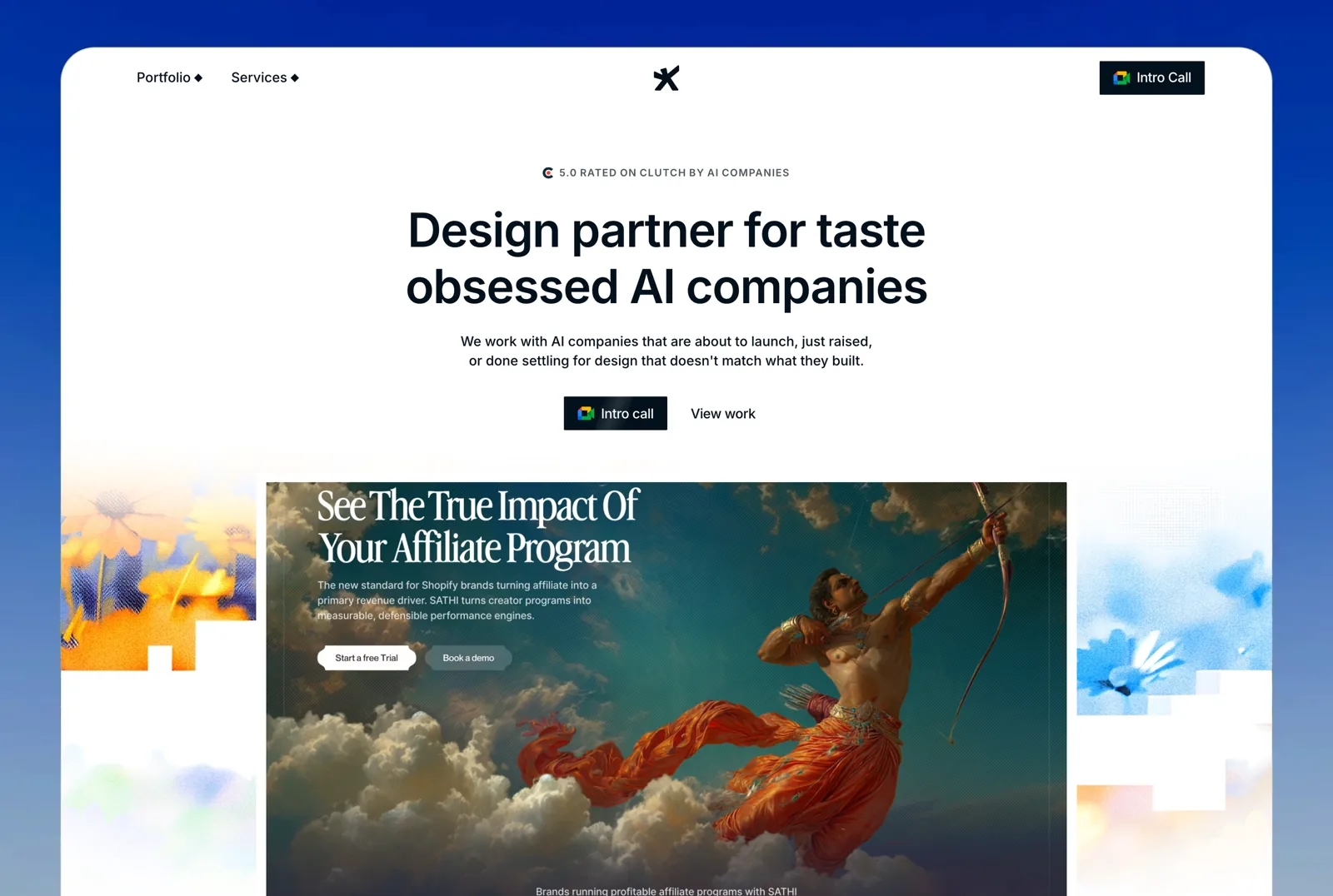
1. Studio Maydit: A Top-Rated Design Agency for AI Founders
Studio Maydit is a web and product design studio working with AI founders in the US, UK, and Europe. The studio builds websites in Framer, Webflow, and custom code, and continues into product design after the site ships.
The clearest outcome is Dualite, where design work supporting a repositioned ICP helped the product reach 100,000+ users in seven months. Recent clients include Wave, PixelFlow, Mi-VAD, and 15 other AI and SaaS teams.
Websites can be bought two ways. Fixed scope runs three to four weeks and suits teams with a launch date. Teams that keep shipping take a monthly retainer instead, covering new pages, campaigns, and product design, with no long lock-in. Fixed-scope projects end with a diagnosis of what is leaking in the product, not a handoff and goodbye.
| Check | Finding |
|---|---|
| Based in | Remote, serving US / UK / EU |
| Platform depth | Framer, Webflow, and custom code |
| AI-sector proof | Yes. AI-native clients, published outcome on Dualite |
| Pricing | Fixed scope or monthly retainer, quoted per project |
| Team shape | Founder-led, small senior team |
| Best fit | Teams with a fixed launch date who will still be changing copy that week |
Maydit is the right call when the date cannot move and the product is still changing underneath it. Book a 30-minute call.

2. Flowout
Flowout is a distributed Webflow studio with a published minimum and Jasper, Kajabi, Riverside, and Sendlane named. Their production model fits a launch unusually well, because a launch is not one page. It is a page, then three campaign variants, then a follow-up, then the version that replaces the announcement a month later. A predictable monthly arrangement handles that sequence better than a project that ends on the day.
They publish neither a founding year nor a team size, their AI-sector proof is partial, and a queue model is production rather than a partner who will argue about your positioning under pressure.
| Check | Finding |
|---|---|
| Based in | Distributed |
| Founded | Not published |
| Team size | Not published |
| Primary platform | Webflow |
| AI-sector proof | Partial. Enterprise and SaaS clients, no AI case study |
| Named clients | Jasper, Kajabi, Riverside, Sendlane |
| Pricing | Published minimum |
| Best fit | Teams who need a steady run of pages around the date, not just one |
3. Flow Ninja
Flow Ninja is a Belgrade team of 11 to 50, founded in 2018, working in Webflow. What matters here is the cost of a change in the final week. Launch week always produces changes, and when each one is cheap you make the right call instead of the affordable one. That single difference decides more launches than the quality of the original design.
They publish no client names at all, which makes their record impossible to verify, no pricing, their AI-sector proof is partial, and a mid-sized team can be committed elsewhere when your date lands.
| Check | Finding |
|---|---|
| Based in | Belgrade, Serbia |
| Founded | 2018 |
| Team size | 11-50 |
| Primary platform | Webflow |
| AI-sector proof | Partial. Enterprise and SaaS clients, no AI case study |
| Named clients | Not published |
| Pricing | Not published |
| Best fit | Teams who expect heavy changes in the last week and want them cheap |
4. Refokus
Refokus is a remote German team of 11 to 50, founded in 2021, with Mural, BASF, Spotify, Yahoo, and BCG named. Their work is more ambitious than most in the platform, which is worth paying for on a launch specifically, because a launch is the one moment where feeling like an event is part of the job rather than decoration.
They publish no pricing, their AI-sector proof is partial, and ambitious visual work takes longer to change late, which is a real risk when the product moves in the final fortnight.
| Check | Finding |
|---|---|
| Based in | Germany, remote |
| Founded | 2021 |
| Team size | 11-50 |
| Primary platform | Webflow |
| AI-sector proof | Partial. Enterprise and SaaS clients, no AI case study |
| Named clients | Mural, BASF, Spotify, Yahoo, BCG |
| Pricing | Not published |
| Best fit | Teams whose launch needs to feel like an occasion |
5. 8020
8020 is a team across San Francisco and New York, founded in 2014, working in Webflow, with Wave, Superlist, Pilot.com, Vanta, and Circle named. Superlist is a useful reference, a product whose entire early story was a public launch to a sceptical software audience. Their client list is consistently technical B2B, so they are used to writing for readers who dislike announcement language.
They publish no pricing and no team size, their AI-sector proof is partial, and a US studio at that price point is a poor fit for a small team with a tight date and a smaller budget.
| Check | Finding |
|---|---|
| Based in | San Francisco and New York, USA |
| Founded | 2014 |
| Team size | Not published |
| Primary platform | Webflow |
| AI-sector proof | Partial. Enterprise and SaaS clients, no AI case study |
| Named clients | Wave, Superlist, Pilot.com, Vanta, Circle |
| Pricing | Not published |
| Best fit | Technical products launching to an audience that distrusts hype |
6. Finsweet
Finsweet is a distributed team of 51 to 200 out of Denver, founded in 2017, with Dropbox, Clay, GitHub, and Steadily named. They are the most technical studio here, and two launch problems are technical: the page has to survive a traffic spike without slowing down, and you want variants cheap enough to test on the day. Building for both is ordinary work for them.
They publish no pricing, their AI-sector proof is partial, Webflow is their platform, and technical strength does not help with the part that usually fails, which is the writing.
| Check | Finding |
|---|---|
| Based in | Denver, USA, distributed |
| Founded | 2017 |
| Team size | 51-200 |
| Primary platform | Webflow |
| AI-sector proof | Partial. Enterprise and SaaS clients, no AI case study |
| Named clients | Dropbox, Clay, GitHub, Steadily |
| Pricing | Not published |
| Best fit | Teams expecting a large traffic spike and wanting cheap variants |
7. Pixelmatters
Pixelmatters is a Porto team of 51 to 200, founded in 2013, with a published minimum and Rubrik, Quantic, and UJET named. They work across both product and marketing, which addresses the most common launch disappointment: the page converts, and then the first-run experience does not match what the page promised. One team across both keeps that promise intact.
Their AI-sector proof is partial, and a team of that size brings coordination overhead that is hard to absorb when the schedule is already tight.
| Check | Finding |
|---|---|
| Based in | Porto, Portugal |
| Founded | 2013 |
| Team size | 51-200 |
| Primary platform | Mixed |
| AI-sector proof | Partial. Enterprise and SaaS clients, no AI case study |
| Named clients | Rubrik, Quantic, UJET |
| Pricing | Published minimum |
| Best fit | Teams whose launch page and first-run experience must agree |
8. Engine Digital
Engine Digital has offices in Vancouver and New York, has been working since 2002, and builds in custom code, with Adidas, Autodesk, Goldman Sachs, and HP named. They have run launches with many stakeholders, legal review, and regional variations, which is genuinely hard and mostly invisible until you are inside one. If your launch involves a large partner, that experience is worth having.
They publish neither pricing nor team size, their AI-sector proof is partial, and custom code plus an enterprise process is the slowest combination on this page, which is the opposite of what a startup date needs.
| Check | Finding |
|---|---|
| Based in | Vancouver and New York |
| Founded | 2002 |
| Team size | Not published |
| Primary platform | Custom code |
| AI-sector proof | Partial. Enterprise and SaaS clients, no AI case study |
| Named clients | Adidas, Autodesk, Goldman Sachs, HP |
| Pricing | Not published |
| Best fit | Large launches with partners, legal review, and many stakeholders |
9. Digidop
Digidop is a Paris studio of 1 to 10, founded in 2021, with a published minimum and TSE Energy, Ramify, and StreamNative named. A published price and a small team mean you can go from first contact to work starting in days rather than weeks, which is the real constraint when a date is six weeks out and half of that is normally spent choosing someone.
They are very small, so a slipped date elsewhere can affect your slot, their AI-sector proof is partial, and a Paris team overlaps with US mornings only, which is awkward during a launch week that runs late.
| Check | Finding |
|---|---|
| Based in | Paris, France |
| Founded | 2021 |
| Team size | 1-10 |
| Primary platform | Webflow |
| AI-sector proof | Partial. Enterprise and SaaS clients, no AI case study |
| Named clients | TSE Energy, Ramify, StreamNative |
| Pricing | Published minimum |
| Best fit | Teams who need to start immediately at a known price |
10. Edgar Allan
Edgar Allan is an Atlanta team of 51 to 200, founded in 2014, working in Webflow, with Porsche, Duracell, and NCR named. Their craft is brand, and there is a version of a launch where that is the right purchase: when you are not introducing a feature but changing what the company stands for, and the page has to carry that weight.
They publish no pricing, their AI-sector proof is partial, their references are consumer brands rather than software, and brand programmes run on a timeline that a fixed launch date rarely tolerates.
| Check | Finding |
|---|---|
| Based in | Atlanta, USA |
| Founded | 2014 |
| Team size | 51-200 |
| Primary platform | Webflow |
| AI-sector proof | Partial. Enterprise and SaaS clients, no AI case study |
| Named clients | Porsche, Duracell, NCR |
| Pricing | Not published |
| Best fit | Launches that are really a repositioning of the whole company |
How to choose between them
Sort by what your launch is actually risking.
The product will still be changing in the final week. Studio Maydit or Flow Ninja.
The page has to survive a very large spike. Finsweet.
What follows the click matters as much as the click. Pixelmatters.
This launch is a repositioning, not a feature. Edgar Allan or Refokus.
One test before signing. Ask what they do when the product changes five days before launch. A studio that has done this will describe a specific arrangement: which parts are locked, which stay editable, and who decides at that point. One that says it will not happen has either never launched anything or is planning to bill you for the change.