

Summarize with AI


The best design agencies for startups replacing a vibe-coded site in 2026 are Studio Maydit, Refokus, Instrument, Finsweet, Engine Digital, Flow Ninja, 8020, Pixelmatters, Flowout, and Edgar Allan. Studio Maydit and Finsweet lead for this brief, because both hand over a site the client's own team can safely change, and the reason to replace a generated site is almost never how it looks. Instrument and Engine Digital are the wrong fit here, since both are built for large organisations with project teams, and a startup rebuilding a weekend project does not have one.
Here is the thing nobody says out loud about a vibe-coded site. It usually is not bad.
A founder sat down on a Saturday, described the company to a model, and got a site. It went live. It loads quickly, the layout holds together, and visitors do not complain. By the standard of what existed before, which was nothing, it was a clear win.
The problem shows up about eight months later, and it is not a design problem. It is that nothing on the site has changed since the day it launched.
Not because nobody wanted to change it. Because nobody can. The person who generated it does not know how it works either, since they did not write it so much as request it. Every small edit turns into an afternoon of poking at code that was produced rather than designed, and after two of those afternoons people stop trying.
So the pricing is out of date. The one customer story you have is not on it. The product does something now that the homepage has never mentioned. The site is not failing, it is frozen, and a frozen site quietly caps how fast the rest of the company can move.
The second problem is subtler. Somebody decided what your company claims, and it was not you. It was a model's best guess at what a company in your category usually says, and it was good enough to ship, which is exactly why it never got argued with.
The ten studios below are ranked on how well they solve ownership, not appearance.

How we picked these agencies
This is a teardown, not a directory listing. For each agency we read their own site and their public record, then checked five things you can verify yourself in an afternoon:
- Platform depth. Is one craft their real specialism, or one line on a long service menu?
- AI-sector proof. Named AI clients and published work, or just the word "AI" in the copy?
- Pricing. Do they publish a minimum at all, or keep it behind a call?
- Team shape. Who actually does the work, and how many clients are they carrying at once?
- Their own site. Distinctive, or the same template as everyone else on this list?
That last one gets skipped most often. An agency's own website is the only project where nobody overruled them. No client committee, no inherited brand book. If their own site is forgettable, you have found their ceiling.
Every fact below comes from the agency's own site or a public listing. Where a number is not public, we say so rather than guessing.
What goes wrong when a generated site gets replaced
Three failures repeat, and each one comes from misreading what was actually broken.
It gets briefed as a redesign when the real fault is ownership. The brief says the site looks dated and needs to feel more premium, because that is the language available for a vague dissatisfaction. So a studio makes a better looking version of the same trap, and twelve weeks later you own a nicer site that your team still cannot edit. The question that finds the real brief is simpler than any of that. Ask who changed something on the site in the last month, and how long it took them. If the answer is nobody, appearance is not the problem you are paying to solve, and a beautiful rebuild will disappoint you in the same way within a year.
The positioning came from a model and nobody ever argued with it. Generated copy is fluent, plausible, and averaged. It describes what a company in your category typically claims, which means it is accurate about your sector and silent about you. Founders read it, find nothing wrong, and ship it, since there is no sentence to object to. That is the danger. The site never says the one thing that would make a customer choose you over the two alternatives they are also reading, because averages do not contain sharp edges. A rebuild that keeps the old copy as a starting point inherits the whole problem, so the words have to be rewritten from your customers rather than edited from the page.
The replacement loses the one virtue the old site had. Whatever else it was, the generated site went up in a weekend. If the rebuild takes twelve weeks, involves five reviewers, and ends with a system only the agency understands, you have traded a frozen site for a slow one, and the team notices. Within two months they are back to not shipping pages. Judge any proposal on what happens after launch: who can add a page, how long it takes them, and whether that person already works at your company.
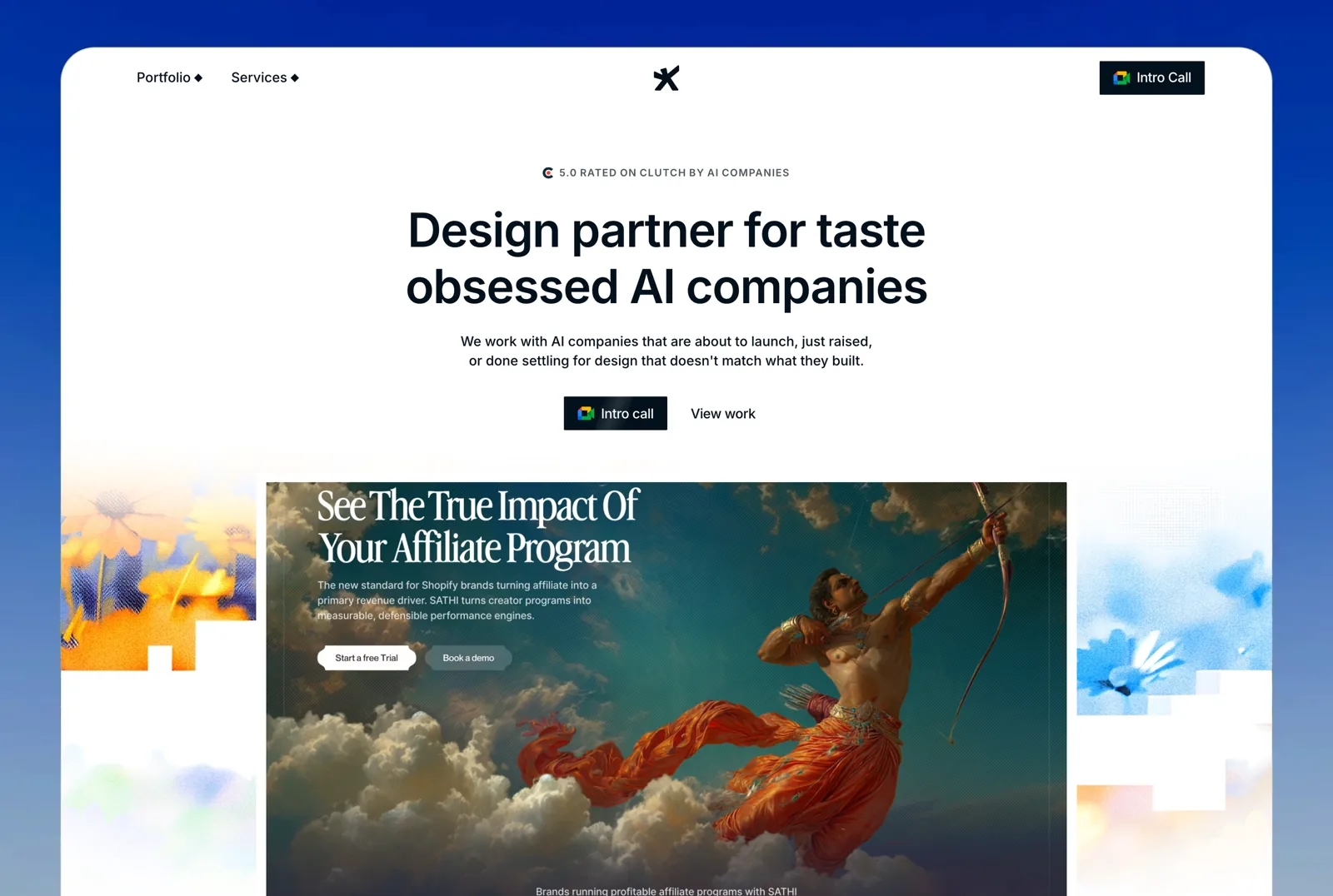
1. Studio Maydit: A Top-Rated Design Agency for AI Founders
Studio Maydit is a web and product design studio working with AI founders in the US, UK, and Europe. The studio builds websites in Framer, Webflow, and custom code, and continues into product design after the site ships.
The clearest outcome is Dualite, where design work supporting a repositioned ICP helped the product reach 100,000+ users in seven months. Recent clients include Wave, PixelFlow, Mi-VAD, and 15 other AI and SaaS teams.
Websites can be bought two ways. Fixed scope runs three to four weeks and suits teams with a launch date. Teams that keep shipping take a monthly retainer instead, covering new pages, campaigns, and product design, with no long lock-in. Fixed-scope projects end with a diagnosis of what is leaking in the product, not a handoff and goodbye.
| Check | Finding |
|---|---|
| Based in | Remote, serving US / UK / EU |
| Platform depth | Framer, Webflow, and custom code |
| AI-sector proof | Yes. AI-native clients, published outcome on Dualite |
| Pricing | Fixed scope or monthly retainer, quoted per project |
| Team shape | Founder-led, small senior team |
| Best fit | Teams who want a site their own people can change every week |
Maydit is the right call if your site has not been touched since launch and everyone has quietly stopped trying. Book a 30-minute call.

2. Refokus
Refokus is a remote German team of 11 to 50, founded in 2021, working in Webflow, with Mural, BASF, Spotify, Yahoo, and BCG named. They build technically ambitious sites on a platform a marketer can still edit, which is the combination you want when the replacement has to be both more distinctive than a generated site and easier to change than one.
They publish no pricing, their AI-sector proof is partial, and their signature style is strong enough that a small team can end up with a site that is impressive to look at and intimidating to touch.
| Check | Finding |
|---|---|
| Based in | Germany, remote |
| Founded | 2021 |
| Team size | 11-50 |
| Primary platform | Webflow |
| AI-sector proof | Partial. Enterprise and SaaS clients, no AI case study |
| Named clients | Mural, BASF, Spotify, Yahoo, BCG |
| Pricing | Not published |
| Best fit | Teams whose generated site is competent and completely forgettable |
3. Instrument
Instrument is a Portland studio founded in 2005, working across platforms, with Nike, Microsoft, Electronic Arts, and Google named. Their real strength for this brief is the part before design, since they are used to establishing what a company actually stands for, and a generated site is a company that has never had that argument.
They publish no pricing and no team size, their AI-sector proof is partial, and a studio scaled for organisations like those is an expensive and slow way to replace a site somebody built over a weekend.
| Check | Finding |
|---|---|
| Based in | Portland, USA |
| Founded | 2005 |
| Team size | Not published |
| Primary platform | Mixed |
| AI-sector proof | Partial. Enterprise and SaaS clients, no AI case study |
| Named clients | Nike, Microsoft, Electronic Arts, Google |
| Pricing | Not published |
| Best fit | Funded companies who need positioning settled before the rebuild |
4. Finsweet
Finsweet is a distributed team of 51 to 200 based in Denver, founded in 2017, working in Webflow, with Dropbox, Clay, GitHub, and Steadily named. They publish tooling and teaching material the rest of the Webflow world relies on, which is a strong signal for this brief, because a studio that spends its time explaining how things work tends to hand over sites people can actually operate.
They publish no pricing, their AI-sector proof is partial, and a deep platform specialist will steer you to Webflow whether or not your team is the sort that will ever open it.
| Check | Finding |
|---|---|
| Based in | Denver, USA, distributed |
| Founded | 2017 |
| Team size | 51-200 |
| Primary platform | Webflow |
| AI-sector proof | Partial. Enterprise and SaaS clients, no AI case study |
| Named clients | Dropbox, Clay, GitHub, Steadily |
| Pricing | Not published |
| Best fit | Teams who want a site documented well enough to run themselves |
5. Engine Digital
Engine Digital works from Vancouver and New York, founded in 2002, in custom code, with Adidas, Autodesk, Goldman Sachs, and HP named. If your generated site has grown real complexity, such as a gated area, a customer portal, or integrations bolted on since launch, they are used to untangling systems rather than only restyling pages.
Their AI-sector proof is partial, they publish no pricing and no team size, and their process assumes a client with a project team and a governance structure, which describes almost no company replacing a weekend build.
| Check | Finding |
|---|---|
| Based in | Vancouver and New York |
| Founded | 2002 |
| Team size | Not published |
| Primary platform | Custom code |
| AI-sector proof | Partial. Enterprise and SaaS clients, no AI case study |
| Named clients | Adidas, Autodesk, Goldman Sachs, HP |
| Pricing | Not published |
| Best fit | Sites that have accumulated real technical complexity since launch |
6. Flow Ninja
Flow Ninja is a Belgrade team of 11 to 50, founded in 2018, working in Webflow. They are organised for continuous work rather than one-off projects, and for a company recovering from a frozen site that is the more useful shape, since the risk you are trying to remove is the site going untouched again after launch.
They publish no client names and no pricing, their AI-sector proof is partial, and a continuous arrangement costs more over a year than a project, which is a real consideration if the rebuild is already unbudgeted.
| Check | Finding |
|---|---|
| Based in | Belgrade, Serbia |
| Founded | 2018 |
| Team size | 11-50 |
| Primary platform | Webflow |
| AI-sector proof | Partial. Enterprise and SaaS clients, no AI case study |
| Named clients | Not published |
| Pricing | Not published |
| Best fit | Teams who need the site kept moving, not just replaced |
7. 8020
8020 works from San Francisco and New York, founded in 2014, in Webflow, with Wave, Superlist, Pilot.com, Vanta, and Circle named. Those are companies that outgrew their first website and lived to tell about it, so the studio has repeatedly built the second site, which is a different job from building the first and is precisely the one you are hiring for.
They publish no pricing and no team size, their AI-sector proof is partial, and a Webflow studio will not help if the thing your generated site does that matters most is something only code can do.
| Check | Finding |
|---|---|
| Based in | San Francisco and New York, USA |
| Founded | 2014 |
| Team size | Not published |
| Primary platform | Webflow |
| AI-sector proof | Partial. Enterprise and SaaS clients, no AI case study |
| Named clients | Wave, Superlist, Pilot.com, Vanta, Circle |
| Pricing | Not published |
| Best fit | Startups building their second real website |
8. Pixelmatters
Pixelmatters is a Porto team of 51 to 200, founded in 2013, working across platforms, with a published minimum and Rubrik, Quantic, and UJET named. Working across platforms matters here more than usual, since the honest answer to what should replace a generated site depends on your team, and a studio with one platform will always recommend that platform.
Their AI-sector proof is partial, a European team overlaps only partly with US hours, and a firm of that size prices for established companies rather than a startup fixing a weekend project.
| Check | Finding |
|---|---|
| Based in | Porto, Portugal |
| Founded | 2013 |
| Team size | 51-200 |
| Primary platform | Mixed |
| AI-sector proof | Partial. Enterprise and SaaS clients, no AI case study |
| Named clients | Rubrik, Quantic, UJET |
| Pricing | Published minimum |
| Best fit | Teams who genuinely do not know which platform they need |
9. Flowout
Flowout is a distributed Webflow team with a published minimum and Jasper, Kajabi, Riverside, and Sendlane named. A subscription arrangement is an unusually good match for the specific disease here, because it makes the marginal cost of changing a page close to zero, and a frozen site is what happens when that cost feels high.
They publish no founding year and no team size, their AI-sector proof is partial, and a request queue will not do the positioning work that a generated site most needs, since it is built to execute asks rather than to challenge them.
| Check | Finding |
|---|---|
| Based in | Distributed |
| Founded | Not published |
| Team size | Not published |
| Primary platform | Webflow |
| AI-sector proof | Partial. Enterprise and SaaS clients, no AI case study |
| Named clients | Jasper, Kajabi, Riverside, Sendlane |
| Pricing | Published minimum |
| Best fit | Teams whose main risk is the new site freezing too |
10. Edgar Allan
Edgar Allan is an Atlanta team of 51 to 200, founded in 2014, working in Webflow, with Porsche, Duracell, and NCR named. They treat words and design as one job rather than two, which is the right instinct for this brief, because the most damaging part of a generated site is usually the copy nobody ever pushed back on.
They publish no pricing, their AI-sector proof is partial, and a firm of that size with clients like those is organised for engagements considerably larger than a startup's second website.
| Check | Finding |
|---|---|
| Based in | Atlanta, USA |
| Founded | 2014 |
| Team size | 51-200 |
| Primary platform | Webflow |
| AI-sector proof | Partial. Enterprise and SaaS clients, no AI case study |
| Named clients | Porsche, Duracell, NCR |
| Pricing | Not published |
| Best fit | Teams whose generated copy says nothing a rival could not say |
How to choose between them
Sort by why the current site is stuck.
Nobody can edit it, and that is the whole problem. Studio Maydit or Finsweet.
The words are generic and were never argued with. Edgar Allan or Instrument.
It has grown real technical complexity. Engine Digital or Pixelmatters.
The worry is that the new site freezes as well. Flowout or Flow Ninja.
One test before signing. Ask them to show you, live on a call, how somebody at your company would add a customer story to the site they are proposing. A studio that has thought about ownership will walk through it in a couple of minutes and name who on your team would do it. A studio that says to send the request over has just described your current situation with a better looking front end.