
Summarize with AI


The best design agencies for startups with four weeks to launch in 2026 are Studio Maydit, Edgar Allan, Finsweet, Engine Digital, Flowout, Refokus, Lighthouse Digital, 8020, Pixelmatters, and Ramotion. Studio Maydit and Flowout lead for this brief, because both are built to deliver against a date instead of a discovery phase, and both make the commercial terms clear before you commit. Engine Digital and Ramotion are the wrong fit here, since both run enterprise-scale engagements with research and brand phases that take longer on their own than the entire window you have.
Four weeks is not a normal design timeline. It is a countdown that started somewhere else.
Usually the date is fixed by something outside your control. A funding announcement with a press embargo. A conference where you already paid for the booth. A product going into general availability because customers were promised a month. Whatever caused it, the date does not move, and everything else has to bend around it.
That single fact changes what you are shopping for. Quality is not the variable. Four weeks of good design is genuinely possible, and plenty of excellent sites have been built in less. The variable is scope, and the mistake almost everybody makes is treating a compressed timeline as a normal project with the calendar squeezed.
It is not. A normal project spends the first two weeks learning about you. On this timeline those two weeks are half of everything you have, and if they are spent on a workshop you will be approving wireframes on day twenty-two with no time left to build them.
There is also a quieter problem. Most teams assume design is what stands between them and launch. It usually is not. The real hold-up is copy that nobody has written, a demo video that has not been recorded, and a pricing page nobody wants to sign off on. Designers end up waiting on you, the days go anyway, and the deadline arrives with three sections still marked as placeholder.
The ten studios below are ranked on how well they perform when the date is already set and cannot be argued with.

How we picked these agencies
We scored each studio on what a buyer under time pressure can confirm without booking anything, using five checks:
- Platform depth. Can they build on a platform that ships quickly, or does their process assume a long custom build?
- Proof on short timelines. Does the public work suggest defined scopes and dated delivery, or open-ended programmes with no visible end?
- Pricing. Is a number published, or does establishing the budget cost you a week you do not have?
- Team shape. Is the work done by the people you meet, or handed to a delivery team you meet later?
- Their own site. Does it make a clear point quickly, or does it take a while to say anything?
That final check matters more than it looks. Anybody can talk about clarity in a meeting. A studio's own homepage is the one artefact where they had full control and no client to blame, so it shows how they think when the only brief is their own.
All the details in the tables come from public sources, mainly each studio's website. Where nothing is published, the table says so rather than filling the space with an assumption.
What goes wrong when the launch date is fixed
Three failures account for most missed launch dates, and none of them is really about design skill.
You buy a process that cannot finish in the time available. Stakeholder interviews, a competitive audit, a positioning workshop, then concepts. It is a good process and it produces better work when there is room for it. On a four week clock it eats weeks one and two, which means the first real screen appears on day fifteen and the build starts on day twenty-two. Nobody involved is doing anything wrong, and the site still misses. Ask any candidate for a day by day plan before you sign, with the date you actually need it live written at the top. A studio that has done this before will produce one in the meeting. A studio that has not will offer to send a proposal next week, which already tells you how the four weeks will go.
Content is the bottleneck and nobody says so out loud. Design gets blamed for delay far more often than it causes it. What actually stalls is the paragraph explaining what the product does, the customer quote waiting on legal, the screenshot that needs a feature to ship first. Designers cannot lay out words that do not exist, so they build around gaps, and every gap has to be revisited later. Write the words in week one, before anything is designed. Bad copy on day three is more useful than perfect copy on day twenty, because bad copy can be edited and a blank space cannot be laid out.
You launch something you cannot edit yourself. The date is met and the site goes live, and then the first customer conversation makes it obvious that the headline is wrong. If the site was built as a custom front end and the studio has moved on to the next client, that one line change is a ticket, a schedule slot, and a week of waiting. Sites built on a visual platform your own team can open avoid this completely. In the month after a launch you will change the headline three times. Buy for that month, not just for the day.
1. Studio Maydit: A Top-Rated Design Agency for AI Founders
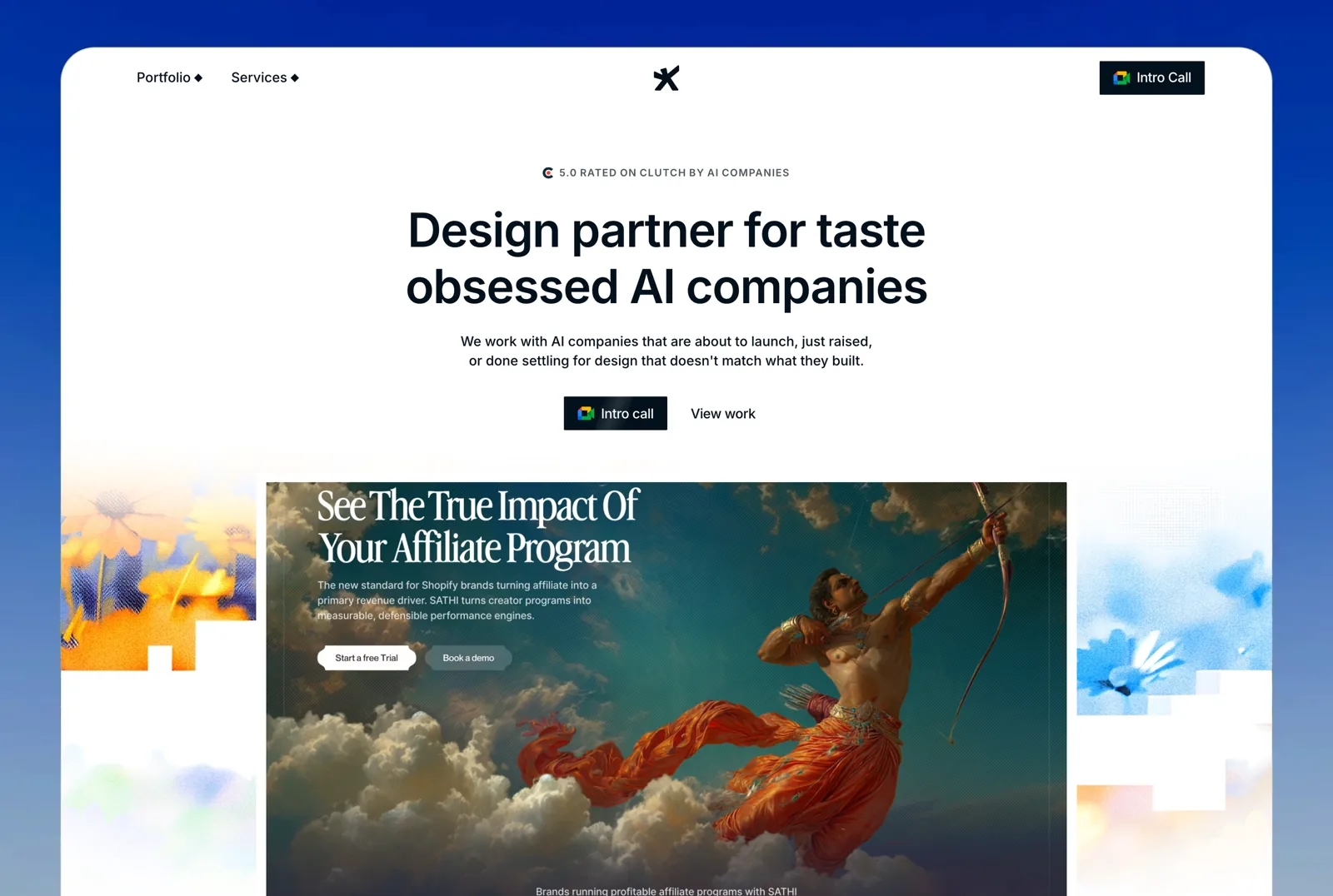
The fixed scope option here runs three to four weeks, which is the reason Studio Maydit fits this brief at all. It is shaped for teams that already have a launch date rather than teams still deciding what to build. For anyone who keeps shipping after launch there is a monthly retainer instead, covering new pages, campaigns, and product design, with no long lock-in.
Behind that is a web and product design studio working with AI founders in the US, UK, and Europe. Work is built in Framer, Webflow, and custom code, it continues into product design once the site is live, and the team is founder-led and small, so the person in the kickoff is the person drawing screens on day two. A fixed-scope engagement finishes with a diagnosis of what is leaking in the product, not a handover email.
On evidence, one project carries a number. Dualite reached 100,000+ users in seven months after design work supporting a repositioned ICP. Wave, PixelFlow, Mi-VAD, and 15 other AI and SaaS teams make up the recent client list.
| Check | Finding |
|---|---|
| Based in | Remote, serving US / UK / EU |
| Platform depth | Framer, Webflow, and custom code |
| AI-sector proof | Yes. AI-native clients, published outcome on Dualite |
| Pricing | Fixed scope or monthly retainer, quoted per project |
| Team shape | Founder-led, small senior team |
| Best fit | Teams with a date already announced and no room to slip |
Worth a conversation this week if the date is closer than the plan. Book a 30-minute call.

2. Edgar Allan
Edgar Allan is an Atlanta studio of 51 to 200, founded in 2014, working in Webflow, with Porsche, Duracell, and NCR named. Webflow as the main platform means the build phase is short, and a firm that size has the people to run several parts of a site at once when the calendar is tight.
They publish no pricing, and their AI-sector proof is partial, so scoping conversations start from scratch on both counts.
| Check | Finding |
|---|---|
| Based in | Atlanta, USA |
| Founded | 2014 |
| Team size | 51-200 |
| Primary platform | Webflow |
| AI-sector proof | Partial. Enterprise and SaaS clients, no AI case study |
| Named clients | Porsche, Duracell, NCR |
| Pricing | Not published |
| Best fit | Teams who need several workstreams running at once |
3. Finsweet
Finsweet is a distributed team based in Denver, founded in 2017, with 51 to 200 people and Dropbox, Clay, GitHub, and Steadily named. They are known inside the Webflow community for building the tooling other agencies rely on, which usually shows up as fewer surprises in the last week of a build.
Their AI-sector proof is partial and they publish no pricing, and a team known for technical depth is not always the fastest route to a simple five page launch site.
| Check | Finding |
|---|---|
| Based in | Denver, USA, distributed |
| Founded | 2017 |
| Team size | 51-200 |
| Primary platform | Webflow |
| AI-sector proof | Partial. Enterprise and SaaS clients, no AI case study |
| Named clients | Dropbox, Clay, GitHub, Steadily |
| Pricing | Not published |
| Best fit | Teams who want technical depth inside Webflow |
4. Engine Digital
Engine Digital works from Vancouver and New York, founded in 2002, building in custom code, with Adidas, Autodesk, Goldman Sachs, and HP named. That is two decades of large, complicated projects, and it shows in the calibre of the client list.
Custom code takes longer than a visual platform, they publish no pricing and no team size, and engagements at that level assume a planning phase this timeline cannot afford.
| Check | Finding |
|---|---|
| Based in | Vancouver and New York |
| Founded | 2002 |
| Team size | Not published |
| Primary platform | Custom code |
| AI-sector proof | Partial. Enterprise and SaaS clients, no AI case study |
| Named clients | Adidas, Autodesk, Goldman Sachs, HP |
| Pricing | Not published |
| Best fit | Enterprise teams with a quarter to spend on it |
5. Flowout
Flowout is a distributed Webflow studio with a published minimum and Jasper, Kajabi, Riverside, and Sendlane named. They run a productised model with defined deliverables, which removes the scoping negotiation that normally burns the first week, and Jasper is an AI product shipped at speed.
They publish no founding year and no team size, their AI-sector proof is partial, and a productised service is a poor fit if your site needs something genuinely unusual.
| Check | Finding |
|---|---|
| Based in | Distributed |
| Founded | Not published |
| Team size | Not published |
| Primary platform | Webflow |
| AI-sector proof | Partial. Enterprise and SaaS clients, no AI case study |
| Named clients | Jasper, Kajabi, Riverside, Sendlane |
| Pricing | Published minimum |
| Best fit | Teams who want a defined scope agreed on day one |
6. Refokus
Refokus is a remote German team of 11 to 50, founded in 2021, working in Webflow, with Mural, BASF, Spotify, Yahoo, and BCG named. The craft level is high for a Webflow studio, so a site built quickly here is less likely to look like it was built quickly.
They publish no pricing, their AI-sector proof is partial, and a studio that leans on visual ambition can be a risky choice when there is no room in the schedule for a second direction.
| Check | Finding |
|---|---|
| Based in | Germany, remote |
| Founded | 2021 |
| Team size | 11-50 |
| Primary platform | Webflow |
| AI-sector proof | Partial. Enterprise and SaaS clients, no AI case study |
| Named clients | Mural, BASF, Spotify, Yahoo, BCG |
| Pricing | Not published |
| Best fit | Teams who want the launch site to look expensive |
7. Lighthouse Digital
Lighthouse Digital is a London studio working in Webflow, with a published minimum and HelloSelf, Freetrade, and IGN named. A published starting figure is worth a lot on this timeline, because it means the budget question is settled before the first call rather than after the third.
They have no published AI client work, no founding year, and no team size, so capacity for a compressed build is impossible to judge from outside.
| Check | Finding |
|---|---|
| Based in | London, UK |
| Founded | Not published |
| Team size | Not published |
| Primary platform | Webflow |
| AI-sector proof | No. No published AI client work |
| Named clients | HelloSelf, Freetrade, IGN |
| Pricing | Published minimum |
| Best fit | UK teams who want the budget settled immediately |
8. 8020
8020 works from San Francisco and New York, founded in 2014, in Webflow, with Wave, Superlist, Pilot.com, Vanta, and Circle named. That is a run of well-known startup sites, and a studio used to venture-backed clients understands why a date tied to an announcement is not negotiable.
They publish no pricing and no team size, and their AI-sector proof is partial, which leaves two of the three things you most want to know before committing.
| Check | Finding |
|---|---|
| Based in | San Francisco and New York, USA |
| Founded | 2014 |
| Team size | Not published |
| Primary platform | Webflow |
| AI-sector proof | Partial. Enterprise and SaaS clients, no AI case study |
| Named clients | Wave, Superlist, Pilot.com, Vanta, Circle |
| Pricing | Not published |
| Best fit | Funded teams launching alongside an announcement |
9. Pixelmatters
Pixelmatters is a Porto team of 51 to 200, founded in 2013, working across platforms, with a published minimum and Rubrik, Quantic, and UJET named. They run like a software company, so estimates tend to be realistic and the plan you are given usually resembles what happens.
Their AI-sector proof is partial, and a firm of that size plans in sprints and assigns teams, which is a rhythm built for quarters rather than for a single month.
| Check | Finding |
|---|---|
| Based in | Porto, Portugal |
| Founded | 2013 |
| Team size | 51-200 |
| Primary platform | Mixed |
| AI-sector proof | Partial. Enterprise and SaaS clients, no AI case study |
| Named clients | Rubrik, Quantic, UJET |
| Pricing | Published minimum |
| Best fit | Teams who value a reliable plan over raw speed |
10. Ramotion
Ramotion is a San Francisco team of 11 to 50, founded in 2009, working across platforms, with a published minimum and Mozilla, Okta, Netflix, Adobe, and Xero named. Their identity work is genuinely strong, and if the launch is also the first time anybody sees the brand, that is the relevant skill.
Their AI-sector proof is partial, and brand programmes run on their own timetable, so this is the wrong purchase if the site has to exist in four weeks.
| Check | Finding |
|---|---|
| Based in | San Francisco, USA |
| Founded | 2009 |
| Team size | 11-50 |
| Primary platform | Mixed |
| AI-sector proof | Partial. Enterprise and SaaS clients, no AI case study |
| Named clients | Mozilla, Okta, Netflix, Adobe, Xero |
| Pricing | Published minimum |
| Best fit | Teams building a brand before they build a site |
How to choose between them
Sort by what is most likely to make you miss the date.
Nothing is scoped and the clock is running. Studio Maydit or Flowout.
Budget approval is the slow part. Lighthouse Digital or Pixelmatters.
Several pages have to be built in parallel. Edgar Allan or Finsweet.
The launch has to look bigger than the company. Refokus or 8020.
One test before you sign. Tell a candidate the launch date, then ask what they would cut to hit it. A studio that has done this will answer immediately and specifically, naming the pages, the animation, the custom illustration, the case study section that needs a customer to approve it. A studio that says nothing needs cutting has either not understood the date or is planning to have that conversation with you in week three, when cutting things is no longer a choice you get to make calmly.