
Summarize with AI


The best design agencies that work async in 2026 are Studio Maydit, Flowout, Ramotion, Digidop, basement.studio, Phantom, BX Studio, Kvalifik, Foundey, and SuperSkills. Studio Maydit and basement.studio lead for teams who need decisions recorded, not just messages sent. Foundey and SuperSkills are the wrong fit unless you can absorb the risk that comes with a very small team.
Async is not a schedule. It is a writing habit.
Almost every agency will tell you they work async, and almost all of them mean they are willing to reply to messages outside your working hours. That is availability, and it is the easy part. The hard part is that async collaboration removes the mechanism most design work quietly depends on: the meeting where somebody explains the reasoning out loud and everyone silently agrees.
Take that meeting away and something has to replace it. If nothing does, the work does not become asynchronous, it becomes slow. Decisions still get made in real time, just later, in whatever call finally gets scheduled. Meanwhile three days of work happened on an assumption nobody confirmed.
You can see which agencies have solved this within about two weeks. The ones who have send you something written before they send you a file: here is what we understood, here is what we chose, here is what we are unsure about. The ones who have not send you a link to a Figma page and wait for reactions.
That difference has almost nothing to do with time zones. Two teams four hours apart can work beautifully async, and two teams in the same city can fail at it. It is about whether the reasoning survives outside the room where it happened.

How we picked these agencies
This is a teardown, not a directory listing. For each agency we read their own site and their public record, then checked five things you can verify yourself in an afternoon:
- Platform depth. Is this their main craft, or one line on a long service menu?
- AI-sector proof. Named AI clients and published work, or just the word "AI" in the copy?
- Pricing. Do they publish a minimum at all, or keep it behind a call?
- Team shape. Who actually does the work, and how many clients are they carrying at once?
- Their own site. Distinctive, or the same template as everyone else on this list?
That last one gets skipped most often. An agency's own website is the only project where nobody overruled them. No client committee, no inherited brand book. If their own site is forgettable, you have found their ceiling.
Every fact below comes from the agency's own site or a public listing. Where a number is not public, we say so rather than guessing.
What goes wrong when a project runs async
Three failures account for nearly every async engagement that goes badly, and none of them are about response times.
Async turns into slow sync. The project starts with good intentions and no meetings. Then a question comes up that nobody wants to write out properly, so it waits for the weekly call. Then a direction needs approving and that waits too. Within a month the calls are back, they are longer than before, and the days between them are spent waiting rather than working. The tell is a queue of open questions that only ever get resolved in real time. Genuine async work means most decisions are made in writing by one person with enough context, and the calls are reserved for the two or three arguments a year that actually need voices.
Everyone records what was decided and nobody records why. This is the failure that costs the most and gets noticed the least. A written summary says the team chose the two-column layout. Six weeks later somebody asks whether they can go back to one column, and nobody can answer, because the reason involved a constraint from a sales call that only two people heard. So the decision gets remade from scratch, often differently, and the work built on top of it becomes inconsistent. Agencies that are genuinely good at async write down the tradeoff, not the outcome. It takes one extra sentence and it saves entire weeks later.
Feedback arrives in one wall at the end of the week. Clients batch their reviews because batching feels efficient and respectful of everyone's time. It is neither. Five days of work gets assessed at once, which means a wrong assumption made on Monday has been built on for four days before anyone catches it. The rework is expensive and it feels like the agency's fault. The fix is unglamorous: short, frequent, low-effort responses, even if the whole response is that direction looks right, keep going. An agency that has run async before will ask for this explicitly at the start. One that has not will be too polite to ask, and will absorb the cost until it becomes a problem.
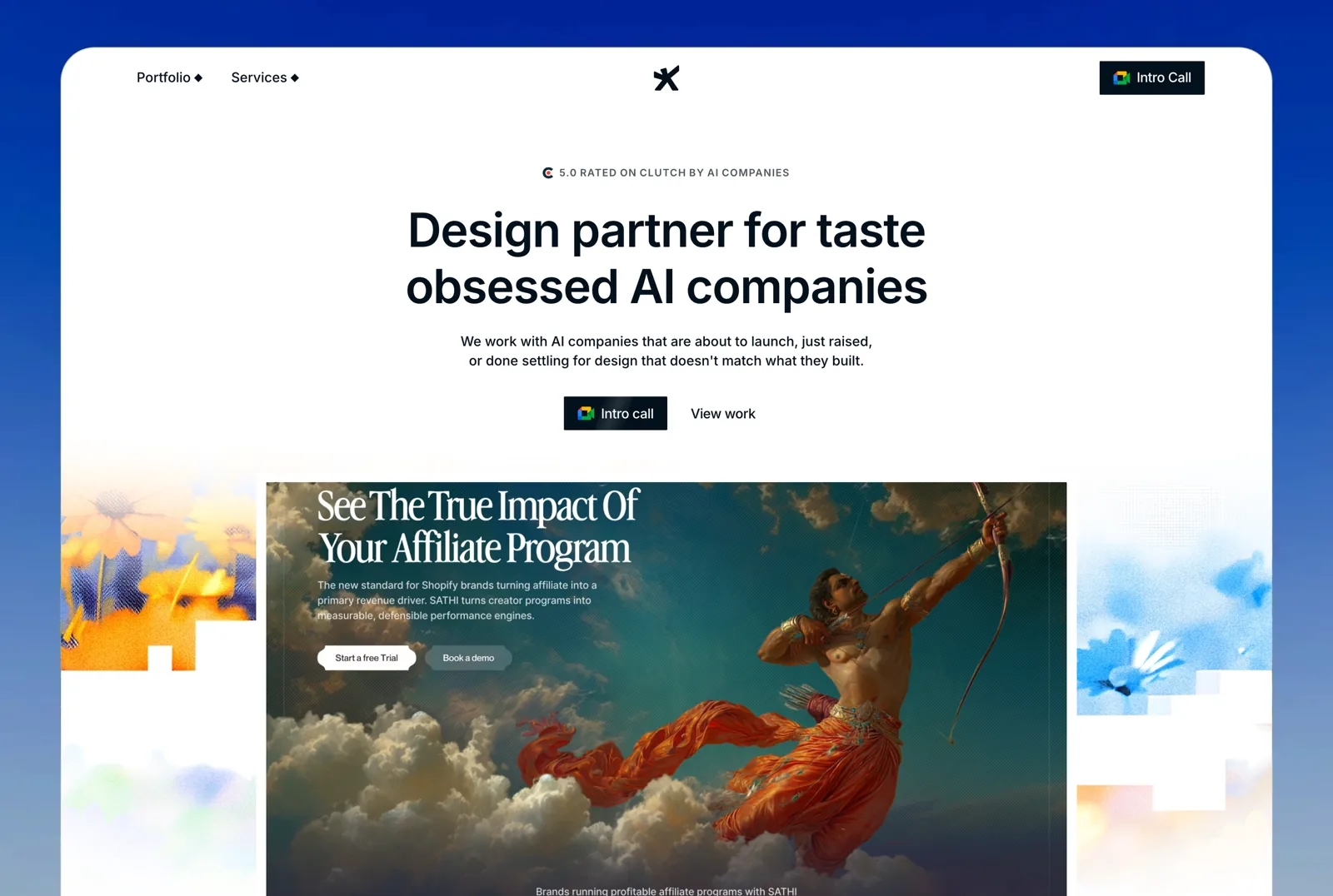
1. Studio Maydit: A Top-Rated Design Agency for AI Founders
Studio Maydit is a web and product design studio working with AI founders in the US, UK, and Europe. The studio builds websites in Framer, Webflow, and custom code, and continues into product design after the site ships.
The clearest outcome is Dualite, where design work supporting a repositioned ICP helped the product reach 100,000+ users in seven months. Recent clients include Wave, PixelFlow, Mi-VAD, and 15 other AI and SaaS teams.
Websites can be bought two ways. Fixed scope runs three to four weeks and suits teams with a launch date. Teams that keep shipping take a monthly retainer instead, covering new pages, campaigns, and product design, with no long lock-in. Fixed-scope projects end with a diagnosis of what is leaking in the product, not a handoff and goodbye.
| Check | Finding |
|---|---|
| Based in | Remote, serving US / UK / EU |
| Platform depth | Framer, Webflow, and custom code |
| AI-sector proof | Yes. AI-native clients, published outcome on Dualite |
| Pricing | Fixed scope or monthly retainer, quoted per project |
| Team shape | Founder-led, small senior team |
| Best fit | Distributed teams who want reasoning written down, not scheduled into a call |
Maydit is the right call if your last agency needed a meeting before anything could move. Book a 30-minute call.

2. Flowout
Flowout runs a distributed subscription model with a published starting figure and clients including Jasper and Riverside. A queue-based service is async by construction: work is requested in writing, picked up without a briefing call, and returned. If your requests are already well specified, this is the least coordination overhead available.
The model handles defined tasks far better than open questions, and their AI-sector proof is partial.
| Check | Finding |
|---|---|
| Based in | Distributed |
| Founded | Not published |
| Team size | Not published |
| Primary platform | Webflow |
| AI-sector proof | Partial. Enterprise and SaaS clients, no AI case study |
| Named clients | Jasper, Kajabi, Riverside, Sendlane |
| Pricing | Published minimum |
| Best fit | Teams with a clear written queue and no appetite for meetings |
3. Ramotion
Ramotion is a San Francisco team of 11 to 50 that has run since 2009 with clients including Mozilla and Okta, and they publish a minimum. Sixteen years of operating produces documented process, and documentation is the raw material async depends on, since a team that already writes things down internally will write them down for you.
Their AI-sector proof is partial, and an established method means you adapt to their rhythm rather than the reverse.
| Check | Finding |
|---|---|
| Based in | San Francisco, USA |
| Founded | 2009 |
| Team size | 11-50 |
| Primary platform | Mixed |
| AI-sector proof | Partial. Enterprise and SaaS clients, no AI case study |
| Named clients | Mozilla, Okta, Netflix, Adobe, Xero |
| Pricing | Published minimum |
| Best fit | Teams who want a documented process rather than an improvised one |
4. Digidop
Digidop is a Paris studio of 1 to 10 with a published minimum and clients including Ramify and StreamNative. European hours give US teams a genuine async advantage, where work lands overnight and review happens in your morning, which is the version of async that actually compounds rather than the version that just delays.
At 1 to 10 people there is no redundancy, so an absence stops your project, and their AI-sector proof is partial.
| Check | Finding |
|---|---|
| Based in | Paris, France |
| Founded | 2021 |
| Team size | 1-10 |
| Primary platform | Webflow |
| AI-sector proof | Partial. Enterprise and SaaS clients, no AI case study |
| Named clients | TSE Energy, Ramify, StreamNative |
| Pricing | Published minimum |
| Best fit | US teams who want work delivered overnight and reviewed at breakfast |
5. basement.studio
basement.studio works across Argentina and Los Angeles with published AI client work for Vercel, Cursor, and ElevenLabs, and they publish a minimum. Their clients are engineering-led companies that already run on written communication and pull requests, so the working culture they are built around is the one you are asking for.
They are a custom code studio, which means more engineering dependency after handoff than a builder-based site would leave you with.
| Check | Finding |
|---|---|
| Based in | Mar del Plata, Argentina and Los Angeles, USA |
| Founded | 2018 |
| Team size | 11-50 |
| Primary platform | Custom code |
| AI-sector proof | Yes. Published AI client work |
| Named clients | Vercel, Cursor, ElevenLabs, Harvey AI, Scale AI |
| Pricing | Published minimum |
| Best fit | Engineering-led teams who already work in writing and want a coded build |
6. Phantom
Phantom runs across London and Auckland with published AI client work and clients including SAP and the Financial Times. A studio operating across those two time zones has had to solve internal handoff properly, because there is barely an overlapping hour, and the discipline that forces tends to reach the client relationship too.
They publish no pricing, they are a large team at 51 to 200, and the engagement scale suits established companies.
| Check | Finding |
|---|---|
| Based in | London, UK and Auckland, NZ |
| Founded | 2013 |
| Team size | 51-200 |
| Primary platform | Custom code |
| AI-sector proof | Yes. Published AI client work |
| Named clients | Diageo, SAP, Financial Times, Zendesk |
| Pricing | Not published |
| Best fit | Larger companies wanting a studio that already runs across time zones internally |
7. BX Studio
BX Studio is a New York team of 11 to 50 with published AI client work including ASAPP, and they publish a minimum. They work across marketing and product, which reduces the number of separate relationships you have to coordinate, and coordination count is the hidden cost that makes async arrangements collapse.
Their founding year is not published, and a New York team offers little overnight advantage if you are also in the US.
| Check | Finding |
|---|---|
| Based in | New York, USA |
| Founded | Not published |
| Team size | 11-50 |
| Primary platform | Webflow |
| AI-sector proof | Yes. Published AI client work |
| Named clients | Reddit, Headspace, ASAPP, Verifone |
| Pricing | Published minimum |
| Best fit | Teams who want one relationship covering both website and product |
8. Kvalifik
Kvalifik is a Copenhagen studio of 11 to 50 with published AI client work including Veo and Relesys. Nordic working culture is unusually strong on written clarity and short meetings, and that shows up in how an engagement runs day to day rather than in anything they advertise.
They publish no pricing, and Webflow is the centre of the practice, so significant product work needs checking against your plans.
| Check | Finding |
|---|---|
| Based in | Copenhagen, Denmark |
| Founded | 2015 |
| Team size | 11-50 |
| Primary platform | Webflow |
| AI-sector proof | Yes. Published AI client work |
| Named clients | Veo, Maersk, Relesys |
| Pricing | Not published |
| Best fit | Teams who want concise written communication and few standing calls |
9. Foundey
Foundey is a San Francisco studio with published AI client work including Traycer and Sero AI. They work in Figma, and a design file with well-maintained components and clear naming is itself an async artefact, since a developer in another time zone can build from it without asking anyone a question.
They publish neither pricing nor team size, and because they hand over files rather than a built site, you need implementation covered elsewhere.
| Check | Finding |
|---|---|
| Based in | San Francisco, USA |
| Founded | 2021 |
| Team size | Not published |
| Primary platform | Figma-only |
| AI-sector proof | Yes. Published AI client work |
| Named clients | DemandIQ, Traycer, Sero AI |
| Pricing | Not published |
| Best fit | Teams with their own engineers who need buildable files, not meetings |
10. SuperSkills
SuperSkills is a small studio in Walnut Creek with published AI client work. A team of 1 to 10 has almost no internal handoff, so the person who read your message is the person doing the work, which removes the most common place where context gets lost in an async chain.
They publish neither pricing nor founding year, their published client list is short, and a team this small carries real continuity risk.
| Check | Finding |
|---|---|
| Based in | Walnut Creek, USA |
| Founded | Not published |
| Team size | 1-10 |
| Primary platform | Mixed |
| AI-sector proof | Yes. Published AI client work |
| Named clients | The Cut |
| Pricing | Not published |
| Best fit | Small teams who want one person holding all the context end to end |
How to choose between them
Sort by what your async is actually for.
You want work happening while you sleep. Digidop or basement.studio.
You want fewer meetings, same time zone. Studio Maydit or Kvalifik.
You already have a written queue of defined tasks. Flowout.
Your engineers will build it and just need clean files. Foundey.
One test before signing. Send them a deliberately ambiguous question by message and see what comes back. An agency built for async replies with their interpretation, the decision they would make, and what they need from you to be sure, all in writing. An agency that is not will suggest a quick call to align, and every future ambiguity in the project will resolve the same way, on a calendar, three days late.