Summarize with AI


The best Framer design agencies for agentic AI products in 2026 are Studio Maydit, Clay, Trueform, Pixelmatters, Instrument, Ramotion, Push Refresh, Feels Like, Lighthouse Digital, and basement.studio. Studio Maydit and Trueform lead for teams who want a Framer site that can keep pace with a product still changing shape. Instrument and Lighthouse Digital are the wrong fit for most teams here, the first because its engagements are sized for large organisations, the second because it publishes no AI work at all.
A normal software product asks for attention. An agent asks for permission. You are not asking a visitor to try a tool. You are asking them to hand over a piece of work they are currently answerable for, and to trust that it will be done properly while they are looking somewhere else.
That changes the whole conversation. The person reading your site is usually the person whose team does this work today. They are not excited that it can be automated. They are working out what happens to them if it goes wrong, and whether they will find out in time.
So the questions that decide the sale are not the ones most sites answer. What is the agent allowed to touch. What does it do when it is unsure. Can I see what it did. Can I stop it. Who is responsible when it makes a mistake that costs money. A site that skips these to talk about how many tasks the agent can complete is answering a question nobody asked.
Framer suits this well, because agentic products change faster than almost any other kind. The scope of what the agent can safely do widens every few weeks, and the site has to move at the same speed. The ten studios below are ranked on how well they handle that, not on portfolio polish.

How we picked these agencies
This is a teardown, not a directory listing. For each agency we read their own site and their public record, then checked five things you can verify yourself in an afternoon:
- Platform depth. Is one craft their real specialism, or one line on a long service menu?
- AI-sector proof. Named AI clients and published work, or just the word "AI" in the copy?
- Pricing. Do they publish a minimum at all, or keep it behind a call?
- Team shape. Who actually does the work, and how many clients are they carrying at once?
- Their own site. Distinctive, or the same template as everyone else on this list?
That last one gets skipped most often. An agency's own website is the only project where nobody overruled them. No client committee, no inherited brand book. If their own site is forgettable, you have found their ceiling.
Every fact below comes from the agency's own site or a public listing. Where a number is not public, we say so rather than guessing.
What goes wrong when an agent product buys a website
Three mistakes account for most of the damage, and each one comes from selling autonomy to someone who is shopping for control.
The site promises independence when the buyer wants a seatbelt. The headline says the agent runs on its own and needs no supervision, because that sounds like the strongest version of the product. The reader hears something different: software that will act in their name without asking. Even people who eventually want full autonomy will not buy it on day one. They buy a supervised version, watch it for a month, and widen the leash themselves. Lead with the leash. Say what the agent does without asking, what it asks about first, and how a buyer moves the line between those two as trust grows.
Everything shown is the happy path. Demos and screenshots show the agent working perfectly, because that is the flattering version and the easiest to record. But nobody worries about the case where it works. They worry about the other one. A site that never shows an error, a request for help, a rollback, or a log of what happened reads as either dishonest or naive, and both are fatal for a product asking to be trusted with real work. Show the recovery. A short section on what the agent does when it is unsure converts better than another feature list, because it is the only part the sceptic actually reads twice.
The pricing page argues with the product. This is the specific trap for agentic products and it catches good teams. If you charge per seat while telling buyers the agent replaces the need for more people, your own price list says the value goes down as the product works. If you charge per task or per run, the buyer cannot predict the bill, because the thing deciding how much work happens is your software rather than their team. Neither is unfixable, but both need explaining on the page rather than in a call. Pick the model, then write the paragraph that defends it against the obvious objection. Most sites in this category leave that paragraph out and lose the deal in silence.
1. Studio Maydit: A Top-Rated Design Agency for AI Founders
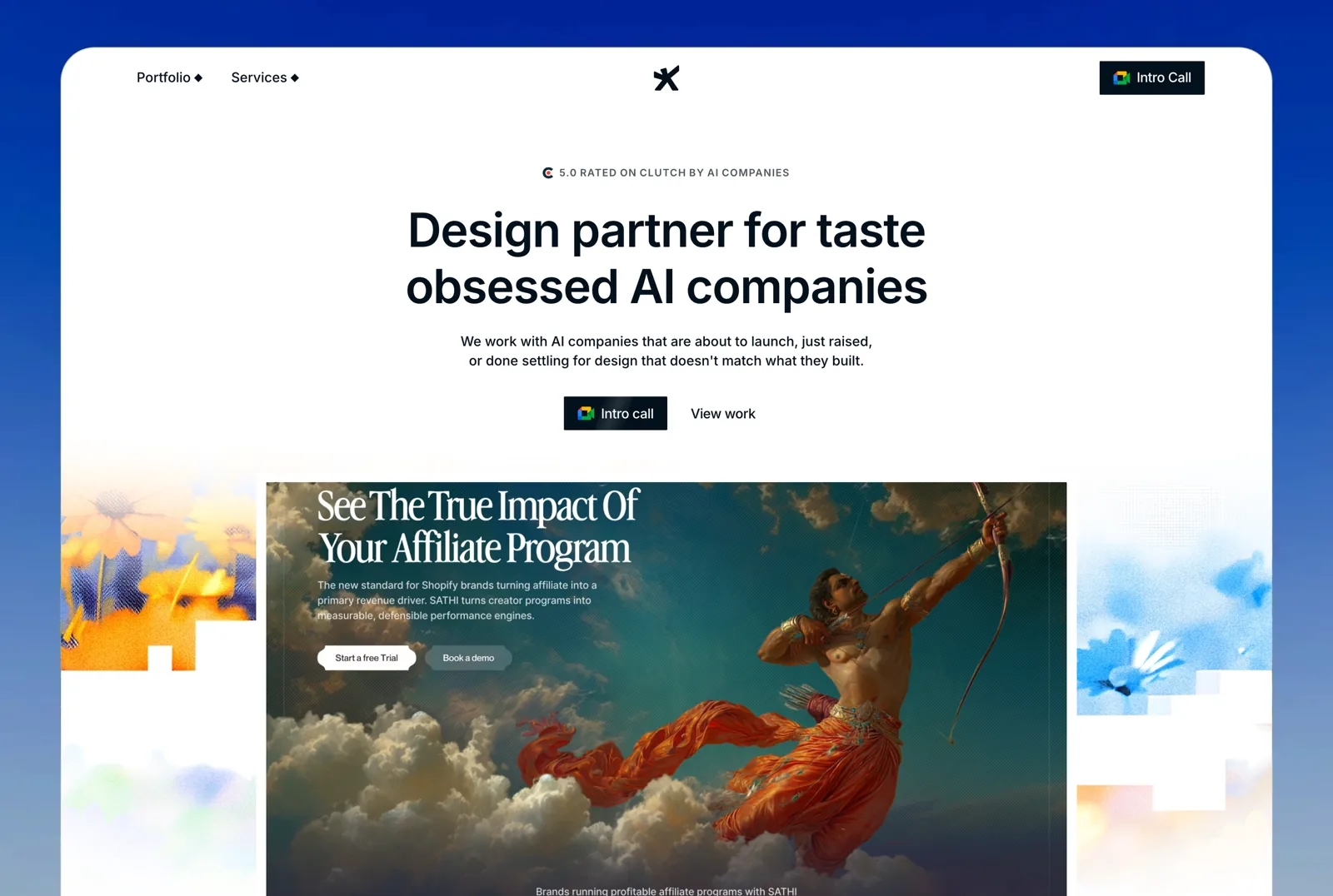
Studio Maydit is a web and product design studio working with AI founders in the US, UK, and Europe. The studio builds websites in Framer, Webflow, and custom code, and continues into product design after the site ships.
The clearest outcome is Dualite, where design work supporting a repositioned ICP helped the product reach 100,000+ users in seven months. Recent clients include Wave, PixelFlow, Mi-VAD, and 15 other AI and SaaS teams.
Websites can be bought two ways. Fixed scope runs three to four weeks and suits teams with a launch date. Teams that keep shipping take a monthly retainer instead, covering new pages, campaigns, and product design, with no long lock-in. Fixed-scope projects end with a diagnosis of what is leaking in the product, not a handoff and goodbye.
| Check | Finding |
|---|---|
| Based in | Remote, serving US / UK / EU |
| Platform depth | Framer, Webflow, and custom code |
| AI-sector proof | Yes. AI-native clients, published outcome on Dualite |
| Pricing | Fixed scope or monthly retainer, quoted per project |
| Team shape | Founder-led, small senior team |
| Best fit | Agent teams whose site and product both need to explain the same guardrails |
Maydit is the right call if the hard part is showing a stranger what your agent will and will not do on its own. Book a 30-minute call.

2. Clay
Clay is a San Francisco studio of 51 to 200, founded in 2016, with a published minimum and Slack, Stripe, Google, Coinbase, and Amazon named. Stripe and Coinbase are the useful references, since both sell products where the entire purchase is a decision to trust software with something valuable. That is the same problem an agent has, one step further along.
They are large and premium, so a small team is a minor account, and their work spans platforms rather than being Framer-first.
| Check | Finding |
|---|---|
| Based in | San Francisco, USA |
| Founded | 2016 |
| Team size | 51-200 |
| Primary platform | Mixed |
| AI-sector proof | Yes. Published AI client work |
| Named clients | Slack, Stripe, Google, Coinbase, Amazon |
| Pricing | Published minimum |
| Best fit | Teams whose main obstacle is trust rather than understanding |
3. Trueform
Trueform is a Swiss studio founded in 2022 working specifically in Framer, with a published minimum and Miro, Morning Brew, Bilt Rewards, and Gather named. Framer is their craft rather than one service among several, which matters for a product whose safe scope widens every month. The site has to be rewritten often, and a studio that lives in the tool makes that cheap rather than a project.
They publish no team size, they are small, and the European time difference makes a same-day answer unlikely for US teams.
| Check | Finding |
|---|---|
| Based in | Wil, Switzerland |
| Founded | 2022 |
| Team size | Not published |
| Primary platform | Framer |
| AI-sector proof | Yes. Published AI client work |
| Named clients | Miro, Morning Brew, Bilt Rewards, Gather |
| Pricing | Published minimum |
| Best fit | Teams rewriting their claims every few weeks as the agent gets safer |
4. Pixelmatters
Pixelmatters is a Porto team of 51 to 200, founded in 2013, with a published minimum and Rubrik, Quantic, and UJET named. UJET is a customer support platform, which puts them close to the work agents are currently taking over, and they design both products and marketing sites. For an agent company the product interface is the proof, so a partner who can work on both sides of that line is unusually useful.
Their AI-sector proof is partial, a team that size brings process weight for a small engagement, and Framer is not their main platform.
| Check | Finding |
|---|---|
| Based in | Porto, Portugal |
| Founded | 2013 |
| Team size | 51-200 |
| Primary platform | Mixed |
| AI-sector proof | Partial. Enterprise and SaaS clients, no AI case study |
| Named clients | Rubrik, Quantic, UJET |
| Pricing | Published minimum |
| Best fit | Teams who need the same partner on the site and the agent interface |
5. Instrument
Instrument has been working since 2005 out of Portland, across platforms, with Nike, Microsoft, Electronic Arts, and Google named. Their strength is making an unfamiliar idea feel legitimate to a wide audience, which is the job when you are selling a category most buyers have only read about. Electronic Arts is a relevant reference too, since games have spent decades designing software that acts on its own without feeling out of control.
They publish neither pricing nor team size, their AI-sector proof is partial, and their engagements are sized for large organisations, which makes them an expensive way to buy a startup site.
| Check | Finding |
|---|---|
| Based in | Portland, USA |
| Founded | 2005 |
| Team size | Not published |
| Primary platform | Mixed |
| AI-sector proof | Partial. Enterprise and SaaS clients, no AI case study |
| Named clients | Nike, Microsoft, Electronic Arts, Google |
| Pricing | Not published |
| Best fit | Funded teams introducing a category the market does not understand yet |
6. Ramotion
Ramotion is a San Francisco team of 11 to 50, founded in 2009, with a published minimum and Mozilla, Okta, Netflix, Adobe, and Xero named. Okta is the reference worth noting, a product built entirely around who is allowed to do what. Permissions are the vocabulary agent buyers need and most design studios have never had to make that idea clear to a nervous reader.
Their AI-sector proof is partial, they are large enough that the people who pitch may not be the people who build, and Framer is not their specialism.
| Check | Finding |
|---|---|
| Based in | San Francisco, USA |
| Founded | 2009 |
| Team size | 11-50 |
| Primary platform | Mixed |
| AI-sector proof | Partial. Enterprise and SaaS clients, no AI case study |
| Named clients | Mozilla, Okta, Netflix, Adobe, Xero |
| Pricing | Published minimum |
| Best fit | Teams whose main question from buyers is what the agent can access |
7. Push Refresh
Push Refresh is a Dallas studio of 1 to 10 working in Framer, with a published minimum and SmithRx, Synonym, and Northern National named. SmithRx sits in healthcare payments, where an automated decision going wrong has real consequences, so this is a team used to careful claims. At this size the person you brief is the person who builds, which keeps the nuance in your positioning from getting lost in a handover.
They publish no founding year, their AI-sector proof is partial, and a team of under ten cannot absorb a sudden change of deadline.
| Check | Finding |
|---|---|
| Based in | Dallas, USA |
| Founded | Not published |
| Team size | 1-10 |
| Primary platform | Framer |
| AI-sector proof | Partial. Enterprise and SaaS clients, no AI case study |
| Named clients | SmithRx, Synonym, Northern National |
| Pricing | Published minimum |
| Best fit | Small teams who want direct access and careful, checkable copy |
8. Feels Like
Feels Like is a Los Angeles studio founded in 2023 building in custom code, with Google, Nike, LVMH, and Suno AI named. Suno AI is the standout reference for this brief, a generative product whose output is different every single time. Designing a site for something that cannot be shown as one fixed screenshot is exactly the problem agent companies have, and very few studios have actually solved it.
They publish no pricing and no team size, they are young as a studio, and they build in custom code rather than Framer, so later edits need a developer.
| Check | Finding |
|---|---|
| Based in | Los Angeles, USA |
| Founded | 2023 |
| Team size | Not published |
| Primary platform | Custom code |
| AI-sector proof | Yes. Published AI client work |
| Named clients | Google, Nike, LVMH, Suno AI |
| Pricing | Not published |
| Best fit | Teams whose product is impossible to capture in a single screenshot |
9. Lighthouse Digital
Lighthouse Digital is a London studio working in Webflow, with a published minimum and HelloSelf, Freetrade, and IGN named. Freetrade is regulated consumer finance, where every sentence on a marketing site has to survive a compliance read. That discipline of only writing claims you can defend is worth borrowing when your product's accuracy is probabilistic rather than guaranteed.
They publish no AI client work at all, which is a real gap for this brief, no founding year and no team size, and they build in Webflow rather than Framer.
| Check | Finding |
|---|---|
| Based in | London, UK |
| Founded | Not published |
| Team size | Not published |
| Primary platform | Webflow |
| AI-sector proof | No. No published AI client work |
| Named clients | HelloSelf, Freetrade, IGN |
| Pricing | Published minimum |
| Best fit | Teams who need every claim on the page to be defensible |
10. basement.studio
basement.studio works from Mar del Plata and Los Angeles, founded in 2018, a team of 11 to 50 building in custom code, with Vercel, Cursor, ElevenLabs, Harvey AI, and Scale AI named. That is the strongest AI client list on this page. Cursor and Harvey are both agentic products in the exact sense this article means, so this team has already had every argument about how to describe software that acts on its own.
They build in custom code rather than Framer, which is the main reason they sit at the bottom of a Framer list, changes need a developer, and their style is aimed at technical audiences, which can misfire if your buyer is not one.
| Check | Finding |
|---|---|
| Based in | Mar del Plata, Argentina and Los Angeles, USA |
| Founded | 2018 |
| Team size | 11-50 |
| Primary platform | Custom code |
| AI-sector proof | Yes. Published AI client work |
| Named clients | Vercel, Cursor, ElevenLabs, Harvey AI, Scale AI |
| Pricing | Published minimum |
| Best fit | Agent products sold to developers, where custom code is worth the cost |
How to choose between them
Sort by which objection is currently losing you deals.
They like it but will not let it act without supervision. Studio Maydit or Ramotion.
They do not believe the output is reliable enough. Feels Like or Lighthouse Digital.
They have never bought anything in this category before. Instrument or Clay.
Your buyer is a developer and the site has to prove technical taste. basement.studio.
One test before signing. Ask them to describe, in one sentence, what your agent does when it is not sure. A studio that has thought about this category will treat that as the most important sentence on the site and will want to design the moment around it. One that treats it as a footnote for the docs has not understood what you are selling.