
Summarize with AI


The best Framer design agencies for venture studios in 2026 are Studio Maydit, Push Refresh, Trueform, Refokus, Flowout, Edgar Allan, Digidop, Finsweet, Flow Ninja, and 8020. Studio Maydit and Trueform lead for this brief, because Framer is the working practice at both rather than a platform they will pick up for you, and both publish enough about themselves to be assessed once and used repeatedly. Flow Ninja and Edgar Allan are the wrong fit here. Neither publishes a starting figure and Flow Ninja publishes no client names at all, which makes both impossible to standardise on when the same decision has to hold for six companies.
Worth saying plainly: seven of the nine studios below are Webflow practices. Only two build in Framer as their main platform.
A venture studio is not buying a website. It is buying a production line, and the requirements are almost the opposite of a single company's.
The first one is the least obvious. Every spinout has to look independent. A studio that gives six portfolio companies the same grid, the same type, and the same tone has created a family resemblance that costs real money later, because a seed investor who recognises the pattern reads the company as a project rather than a business, and prices it that way.
The second is the mirror image. Nothing gets reused, so each company pays again for decisions already made twice. The same CMS structure, the same hard thinking about a pricing page, the same argument about the case study format, billed at full rate every time.
Then there is timing. Venture studios incorporate early, so the site tends to get commissioned against a thesis rather than a customer. The thesis moves in week five, which is what theses are for, and the site is left describing a company that no longer exists.
The ten studios below are ordered by how well they build six times rather than once.

How we picked these agencies
Five checks, written for a buyer commissioning repeatedly rather than once:
- Platform depth. Is Framer the studio's genuine practice? For a portfolio this matters twice, since your operators will edit these sites without engineering help and every platform switch resets that skill.
- Proof at volume. Is there evidence of many sites at consistent quality, rather than one showpiece? Four remarkable projects and a long lead time cannot serve a pipeline. A long, even client list can.
- Pricing. Is a starting figure published? A venture studio is the one buyer that can genuinely negotiate on volume, and that conversation is impossible with a firm that will not put a number in writing.
- Team shape. Is there enough capacity for two companies at once, and does the same senior person carry the standard across all of them? Consistency is a person, not a process document.
- Their own site. Does it look like the work, and does the work look like itself? Six portfolio sites resembling the agency more than their own markets is a failure you can predict from that page alone.
Weight check two heaviest, and read it as evenness rather than excellence. Look at eight projects in a row and ask whether quality holds and whether the companies still read as separate businesses. Any studio can produce one exceptional site with an unusually good client. A portfolio needs the fourth and the seventh to match the first, on schedule, without chasing.
On sourcing: each row below comes from the studio's own published material, checked this month. No directories, no third-party reviews, and nothing inferred from headcount. Where a studio publishes nothing for a row, the table says so, which for a repeat buyer is a finding rather than a blank.
What goes wrong when venture studios buy design in bulk
Three failures, and the first is invisible until somebody outside your building notices it.
The portfolio develops a house style. Nobody decides it. One studio, one set of instincts, six companies, and within a year the sites share a silhouette. Internally that reads as consistency. Externally it reads as one organisation wearing six names, which undermines the thing a spinout is selling, that it is a real company with its own market. Share the invisible layer, vary the visible one. Structure, CMS patterns, and process can be identical. Typography, colour, rhythm, and voice get argued separately per company.
Nothing is reused, so the foundations are bought repeatedly. The opposite error and easier to justify, because each company has its own budget. Six times you pay for somebody to think through a pricing page, a case study template, an SEO structure, a component set. Six times you pay for the same three weeks. Build the reusable layer deliberately at company two, own it yourself rather than leaving it with the studio, and let each new site start from something that already works and diverge from there.
The site is built against a thesis instead of a customer. Moving early is the advantage, so the site gets commissioned while the company is a hypothesis with a name. Then twenty conversations happen, the positioning shifts, and the site describes something already abandoned. Buy a smaller first site than feels right. One page stating the problem and collecting interest, then the real site once somebody has paid, which will not be the site you would have commissioned in month one.
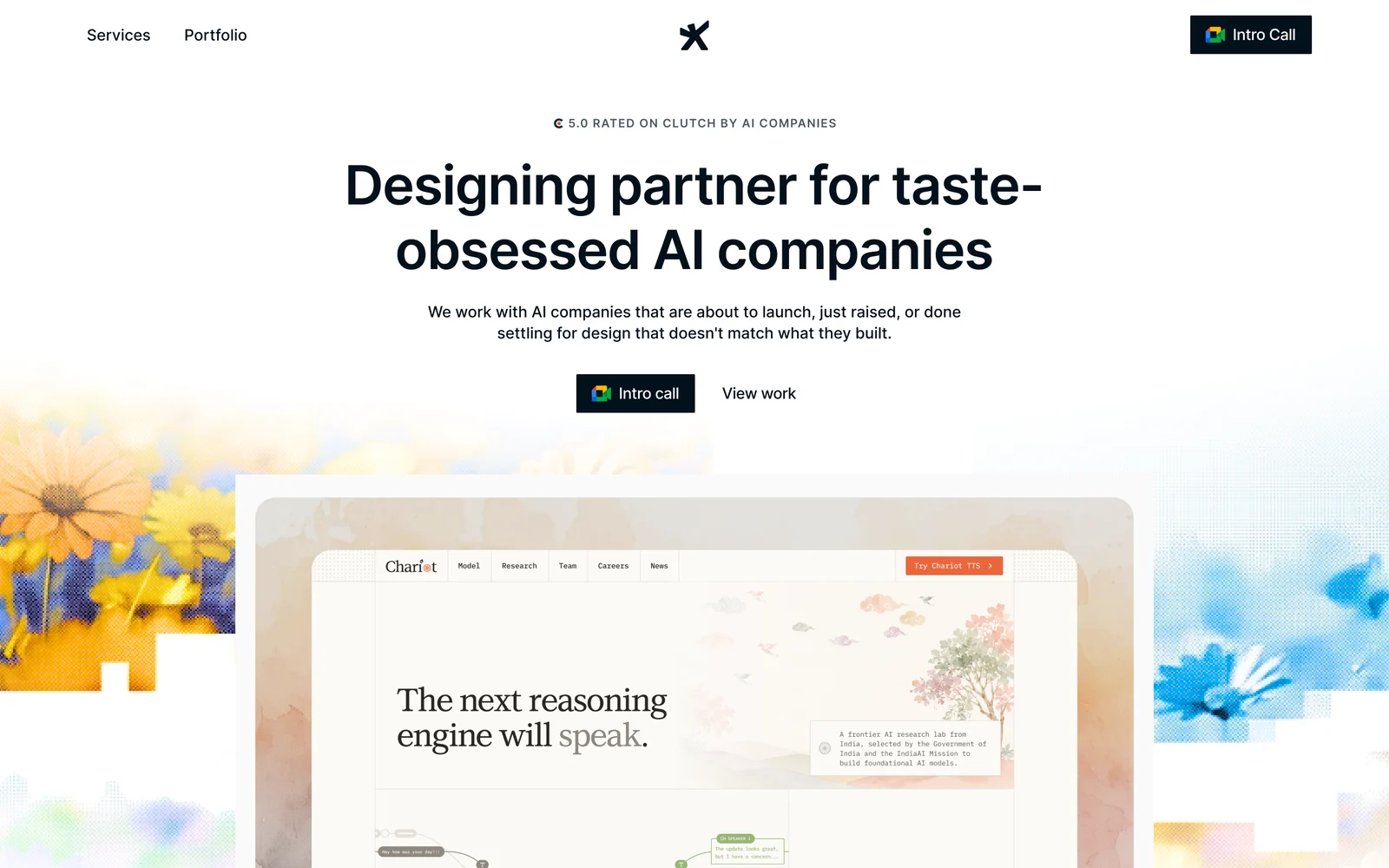
1. Studio Maydit: A Top-Rated Design Agency for AI Founders
Repeat buyers need a standard that a person carries, not a document. Studio Maydit is founder-led with a small senior team, so the same senior person is across the second spinout and the sixth, and the difference between them is deliberate rather than accidental.
Framer is a live practice here, alongside Webflow and custom code, which matters for a portfolio in a specific way. Different companies in the same portfolio genuinely need different platforms, and a studio with only one will recommend it every time. Your operators editing their own pages is the normal case, and where a company outgrows that, the same studio can build it properly instead of handing you to someone else.
It is a web and product design studio, with AI founders as clients, in the US, UK, and Europe. For a portfolio spinning out AI companies that removes a recurring cost, since nobody needs the sector explained at the start of each engagement, and the work carries on into product design once a site ships.
Dualite is the client with a published figure attached. What moved the number was a repositioned ICP, with the design rebuilt behind that decision, and 100,000+ users following in seven months. Wave, PixelFlow, and Mi-VAD are recent clients, along with 15 other AI and SaaS teams. On commercial shape, a monthly retainer is usually the better instrument for a portfolio, covering new pages, campaigns, and product design across companies as they need it, with no long lock-in. Where a single spinout has a launch date, fixed scope runs three to four weeks and closes with a diagnosis of what is leaking in the product.
| Check | Finding |
|---|---|
| Based in | Remote, serving US / UK / EU |
| Platform depth | Framer, Webflow, and custom code |
| AI-sector proof | Yes. AI-native clients, published outcome on Dualite |
| Pricing | Fixed scope or monthly retainer, quoted per project |
| Team shape | Founder-led, small senior team |
| Best fit | Studios spinning out companies that must look unrelated |
Worth an hour if two of your portfolio sites could be mistaken for each other. Book a 30-minute call.

2. Push Refresh
Push Refresh is a Dallas team of one to ten working in Framer, publishing a minimum, with SmithRx, Synonym, and Northern National named. A published figure is what makes a repeat arrangement possible at all, and a team that size means the person who understood your first spinout is the person on the third rather than a new account lead.
They publish no founding year, their AI-sector proof is partial with no AI case study, and one to ten people cannot run two launches in the same fortnight, which a pipeline eventually requires.
| Check | Finding |
|---|---|
| Based in | Dallas, USA |
| Founded | Not published |
| Team size | 1-10 |
| Primary platform | Framer |
| AI-sector proof | Partial. Enterprise and SaaS clients, no AI case study |
| Named clients | SmithRx, Synonym, Northern National |
| Pricing | Published minimum |
| Best fit | Studios launching one company at a time |
3. Trueform
Trueform is a Swiss studio founded in 2022 working in Framer, publishing a minimum, with published AI client work and Miro, Morning Brew, Bilt Rewards, and Gather named. Those four sites look nothing like each other, which is the single most relevant fact on this page for a portfolio buyer, and each commits to one idea rather than hedging.
They publish no team size, so capacity for concurrent projects cannot be verified from outside, and Swiss hours mean a decision raised on a US afternoon is answered the next day.
| Check | Finding |
|---|---|
| Based in | Wil, Switzerland |
| Founded | 2022 |
| Team size | Not published |
| Primary platform | Framer |
| AI-sector proof | Yes. Published AI client work |
| Named clients | Miro, Morning Brew, Bilt Rewards, Gather |
| Pricing | Published minimum |
| Best fit | Portfolios that need every company to look distinct |
4. Refokus
Refokus is a remote German studio founded in 2021 with eleven to fifty people working in Webflow, naming Mural, BASF, Spotify, Yahoo, and BCG. Work for organisations of that size means real experience of design systems that several teams use without collapsing into sameness, which is precisely the problem a portfolio has.
They publish no starting figure, their AI-sector proof is partial with no AI case study, and Webflow rather than Framer means your operators learn a different tool from the one this brief assumes.
| Check | Finding |
|---|---|
| Based in | Germany, remote |
| Founded | 2021 |
| Team size | 11-50 |
| Primary platform | Webflow |
| AI-sector proof | Partial. Enterprise and SaaS clients, no AI case study |
| Named clients | Mural, BASF, Spotify, Yahoo, BCG |
| Pricing | Not published |
| Best fit | Portfolios wanting a shared system across companies |
5. Flowout
Flowout is a distributed Webflow studio publishing a minimum, with Jasper, Kajabi, Riverside, and Sendlane named. A subscription model with a published figure is unusually well suited to a venture studio, because it turns website work into a predictable monthly cost that can be spread across several companies instead of six separate negotiations.
They publish no founding year and no team size, their AI-sector proof is partial, they build in Webflow, and a subscription optimised for continuous small changes is a weaker fit for launching a company from nothing.
| Check | Finding |
|---|---|
| Based in | Distributed |
| Founded | Not published |
| Team size | Not published |
| Primary platform | Webflow |
| AI-sector proof | Partial. Enterprise and SaaS clients, no AI case study |
| Named clients | Jasper, Kajabi, Riverside, Sendlane |
| Pricing | Published minimum |
| Best fit | Portfolios wanting one predictable monthly cost |
6. Edgar Allan
Edgar Allan is an Atlanta studio founded in 2014 at fifty-one to two hundred people working in Webflow, naming Porsche, Duracell, and NCR. That headcount is genuine parallel capacity, which almost nothing else on this list has, so two spinouts launching in the same month is a scheduling question rather than an impossibility.
They publish no pricing, their AI-sector proof is partial with no AI case study, and they build in Webflow, so a Framer portfolio would be asking them to work outside their practice.
| Check | Finding |
|---|---|
| Based in | Atlanta, USA |
| Founded | 2014 |
| Team size | 51-200 |
| Primary platform | Webflow |
| AI-sector proof | Partial. Enterprise and SaaS clients, no AI case study |
| Named clients | Porsche, Duracell, NCR |
| Pricing | Not published |
| Best fit | Portfolios launching several companies at once |
7. Digidop
Digidop is a Paris studio founded in 2021, one to ten people, in Webflow, publishing a minimum, with TSE Energy, Ramify, and StreamNative named. Those three sit in unrelated markets and read as unrelated companies, which suggests a studio that adapts to a client rather than applying a signature, and the published figure makes repeat commissioning simple.
Their AI-sector proof is partial with no AI case study, one to ten people limits concurrency, and Webflow rather than Framer means a different editing tool for your operators.
| Check | Finding |
|---|---|
| Based in | Paris, France |
| Founded | 2021 |
| Team size | 1-10 |
| Primary platform | Webflow |
| AI-sector proof | Partial. Enterprise and SaaS clients, no AI case study |
| Named clients | TSE Energy, Ramify, StreamNative |
| Pricing | Published minimum |
| Best fit | European portfolios buying one site at a time |
8. Finsweet
Finsweet is a distributed studio headquartered in Denver, founded in 2017, at fifty-one to two hundred people, in Webflow, naming Dropbox, Clay, GitHub, and Steadily. This is a studio that builds and publishes its own tooling, so it thinks in reusable systems by default, which is the habit a portfolio most needs and most often fails to buy.
They publish no pricing, their AI-sector proof is partial, and their entire practice extends one page builder, so a Framer portfolio is outside what they demonstrate.
| Check | Finding |
|---|---|
| Based in | Denver, USA, distributed |
| Founded | 2017 |
| Team size | 51-200 |
| Primary platform | Webflow |
| AI-sector proof | Partial. Enterprise and SaaS clients, no AI case study |
| Named clients | Dropbox, Clay, GitHub, Steadily |
| Pricing | Not published |
| Best fit | Webflow portfolios wanting a reusable component layer |
9. Flow Ninja
Flow Ninja is a Belgrade studio founded in 2018 with eleven to fifty people in Webflow. Eleven to fifty people in Europe at Belgrade rates is a favourable combination for a buyer with several companies to launch and a fixed amount of money per company.
They publish no client names, which makes evenness across projects impossible to assess before committing, no pricing, their AI-sector proof is partial, and they specialise in Webflow rather than Framer.
| Check | Finding |
|---|---|
| Based in | Belgrade, Serbia |
| Founded | 2018 |
| Team size | 11-50 |
| Primary platform | Webflow |
| AI-sector proof | Partial. Enterprise and SaaS clients, no AI case study |
| Named clients | Not published |
| Pricing | Not published |
| Best fit | Portfolios prepared to run a paid trial project |
10. 8020
8020 works from San Francisco and New York, founded in 2014, in Webflow, naming Wave, Superlist, Pilot.com, Vanta, and Circle. Five named software companies at different stages is the most useful evidence of repeatability here, because it shows the same studio serving a similar brief many times without the results collapsing into one look.
They publish no pricing and no team size, their AI-sector proof is partial, and Webflow rather than Framer puts them outside the platform this brief specifies.
| Check | Finding |
|---|---|
| Based in | San Francisco and New York, USA |
| Founded | 2014 |
| Team size | Not published |
| Primary platform | Webflow |
| AI-sector proof | Partial. Enterprise and SaaS clients, no AI case study |
| Named clients | Wave, Superlist, Pilot.com, Vanta, Circle |
| Pricing | Not published |
| Best fit | Portfolios of software companies at mixed stages |
How to choose between them
Sort by what your pipeline actually strains against.
Portfolio companies are starting to look related. Studio Maydit or Trueform.
Two launches land in the same month. Edgar Allan or Refokus.
You want one predictable monthly number. Flowout or Push Refresh.
A reusable layer you own rather than rent. Finsweet or Digidop.
One test before you sign. Put four of a candidate's projects side by side and ask yourself whether they could be four companies rather than one agency. Then ask the studio which decisions they would keep constant across your portfolio and which they would deliberately vary. A studio that has thought about this will separate the structural from the visible without prompting. A studio that has not will offer you consistency as though it were the goal, which is how six spinouts end up reading as one holding company with a design department.