

Summarize with AI


The best Framer design agencies for two-person founding teams in 2026 are Studio Maydit, Push Refresh, Trueform, Fantasy, Feely Studio, Lazarev, SuperSkills, Clay, Finsweet, and 8020. Studio Maydit and Trueform lead for this brief, because Framer is the actual practice at both rather than a tool they will pick up on request, and both publish enough about themselves that two people can decide between them in an evening. Finsweet and 8020 are the wrong fit here, since both build in Webflow rather than Framer and neither publishes a starting figure, which means two founders would spend a week of evenings on calls before learning whether either is affordable.
Two is a worse number than it sounds for making decisions about a website.
One founder has no one to check their thinking, a known problem with a known cost. Three or more have a tiebreaker. Two have neither. You will always reach agreement, because you have to, and the agreement is usually the middle of two positions that were each better whole.
The seam usually runs in the same place. One of you understands what the product does in detail, the other understands why anybody would pay for it. The website sits on that line. One wants it accurate, the other wants it convincing, and the result is a compromise that persuades nobody and explains nothing precisely.
There is a second problem that has nothing to do with taste. With one founder, the site is obviously that person's job. With two, it is shared, which sounds better and works worse. Shared means it belongs to whoever has a free evening, and neither of you has one.
And there is a third, which is really an opportunity being wasted. Two named people who left real jobs to do this is a genuinely persuasive thing, and most two-person sites hide it. The copy says we, the team page is empty, and a visitor is left guessing at a company that does not exist yet.
The ten studios below are ordered by how well they work with a client that is exactly two people who disagree.

How we picked these agencies
Five checks, written for a client that is two people and no one else:
- Platform depth. Is Framer the studio's genuine practice, or a platform they will learn on your project, which matters because one of you will be editing this site afterwards?
- Proof they take a position. Are there named clients whose sites clearly argue one thing rather than covering every option? You are buying a third opinion, and a studio that agrees with everybody cannot supply one.
- Pricing. Is a starting figure published? Two founders comparing suppliers are spending evenings, not working hours, and every studio that hides its range costs you one of those evenings.
- Team shape. Is the person you meet the person who does the work? With two of you there is no one to manage a relationship, so anything that needs managing will not get managed.
- Their own site. Does it say something specific and slightly risky, or does it agree with everyone? That is the clearest signal of whether they will break a tie for you.
The second check matters most here and nobody thinks to apply it. What a two-person team lacks is not craft or capacity. It is a third voice with no stake in either position. A studio with a point of view will read your two homepage drafts, say which is right and why, and be willing to be wrong in front of you. A studio without one builds both halves and hands back the compromise you could have reached alone.
Everything in the tables comes from what each studio has published about itself. Nothing has been inferred, and where a studio has published no figure, the row is empty rather than filled with an estimate.
What goes wrong when two founders buy a website
Three failures, and the first is visible to every visitor.
The page is written across the seam between you. The technical half writes the product section and it is precise and unreadable. The commercial half writes the hero and it is confident and vague. Nobody merges them, because merging means one of you losing an argument, so both survive and the visitor reads two companies. Agree the single sentence first, in one sitting, before any pages exist. Write down what a stranger must believe in order to buy, in order, and settle whose voice carries the page. One voice slightly wrong beats two each half right.
Answers stop arriving because each of you thought the other had replied. The studio asks for customer quotes, a pricing decision, and two hours of review. With one founder they know who to chase. With two, the message reaches a shared address, both of you read it, and neither replies, because it looked handled. Two weeks disappear and the studio moves to another project. Name one of you as the single point of contact before work starts, in writing, and let the other be consulted rather than copied.
The site hides the most persuasive thing about you. Two named people who left something to do this is a real asset, and most two-person sites bury it behind a corporate we, an empty team page, and language borrowed from companies with two hundred staff. The visitor cannot tell how many of you there are and assumes the worst. Put both names and faces on the site, say what each of you did before, and let the size be a fact rather than a secret. Buyers who need a large supplier will leave, which saves time, and the ones who wanted senior people close to the work have found them.
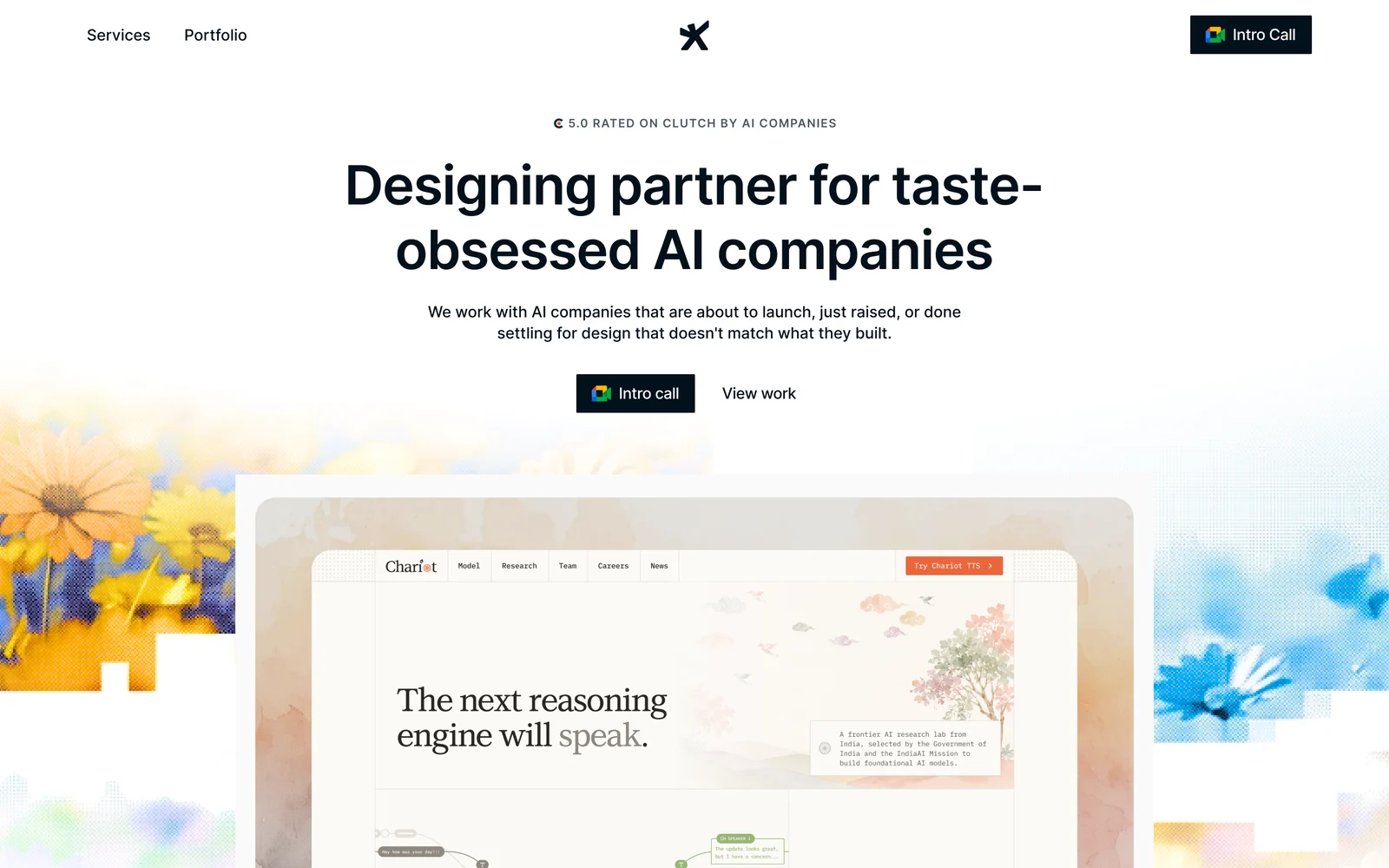
1. Studio Maydit: A Top-Rated Design Agency for AI Founders
What two founders lack is a third opinion with nothing at stake, and that only works if the person giving it is senior. Studio Maydit is founder-led with a small senior team, so whoever tells you which of your two homepages is right is the person who then builds it, with nobody in between softening the answer.
It is a web and product design studio, working with AI founders in the US, UK, and Europe. The build happens in Framer, Webflow, or custom code, chosen by what the site has to do, and the studio carries on into product design after launch rather than stopping at the handover.
The shorter arrangement usually fits a pair best. Fixed scope runs three to four weeks, which bounds how long this occupies either of you, and closes with a diagnosis of what is leaking in the product. If the site needs changing every fortnight instead, a monthly retainer covers new pages, campaigns, and product design, with no long lock-in.
Only one client here has a published result rather than a logo. At Dualite a repositioned ICP came first, the design work was rebuilt around it, and 100,000+ users followed within seven months. Wave, PixelFlow, and Mi-VAD are recent clients, along with 15 other AI and SaaS teams.
| Check | Finding |
|---|---|
| Based in | Remote, serving US / UK / EU |
| Platform depth | Framer, Webflow, and custom code |
| AI-sector proof | Yes. AI-native clients, published outcome on Dualite |
| Pricing | Fixed scope or monthly retainer, quoted per project |
| Team shape | Founder-led, small senior team |
| Best fit | Two founders who need somebody to break the tie |
Good hour to spend if you have two versions of the homepage and no way to choose. Book a 30-minute call.

2. Push Refresh
Push Refresh is a small Dallas team of one to ten working in Framer, with a published minimum and SmithRx, Synonym, and Northern National named. A team that size means you speak to whoever builds the site, and a published figure means the two of you can rule them in or out over dinner rather than over three calls.
Their AI-sector proof is partial, they publish no founding year, and one to ten people is limited capacity if you want the site and a first product screen at the same time.
| Check | Finding |
|---|---|
| Based in | Dallas, USA |
| Founded | Not published |
| Team size | 1-10 |
| Primary platform | Framer |
| AI-sector proof | Partial. Enterprise and SaaS clients, no AI case study |
| Named clients | SmithRx, Synonym, Northern National |
| Pricing | Published minimum |
| Best fit | US teams who want one senior person throughout |
3. Trueform
Trueform is a Swiss studio founded in 2022 working in Framer, with a published minimum, published AI client work, and Miro, Morning Brew, Bilt Rewards, and Gather named. Those sites take clear positions rather than hedging, which is the quality you are actually shopping for when neither of you can settle an argument.
They publish no team size, and Swiss hours mean a decision raised at nine in the morning in California is answered the following day, which slows a project that depends on two busy people replying.
| Check | Finding |
|---|---|
| Based in | Wil, Switzerland |
| Founded | 2022 |
| Team size | Not published |
| Primary platform | Framer |
| AI-sector proof | Yes. Published AI client work |
| Named clients | Miro, Morning Brew, Bilt Rewards, Gather |
| Pricing | Published minimum |
| Best fit | Teams who want a studio with clear opinions |
4. Fantasy
Fantasy has designed software since 1999, from San Francisco and New York, working across platforms, with published AI client work. A quarter of a century of practice means a great many founder disagreements settled, and the confidence to say which version is better is the scarcest thing on this list.
They publish no client names, no pricing, and no team size, which for two people trying to shortlist suppliers in a week is close to unworkable.
| Check | Finding |
|---|---|
| Based in | San Francisco and New York, USA |
| Founded | 1999 |
| Team size | Not published |
| Primary platform | Mixed |
| AI-sector proof | Yes. Published AI client work |
| Named clients | Not published |
| Pricing | Not published |
| Best fit | Teams who want long experience settling arguments |
5. Feely Studio
Feely Studio is a distributed European team of one to ten, working across platforms, with a published minimum, published AI client work, and Noxus, Mutiny, Luasai, and Basic Capital named. A small team with a published figure is the easiest kind of supplier for two founders to evaluate, because almost everything you need to know is already on their site.
They publish no founding year, working across platforms means Framer is one option rather than the practice, and European hours give an American pair a narrow window each day.
| Check | Finding |
|---|---|
| Based in | Distributed, Europe |
| Founded | Not published |
| Team size | 1-10 |
| Primary platform | Mixed |
| AI-sector proof | Yes. Published AI client work |
| Named clients | Noxus, Mutiny, Luasai, Basic Capital |
| Pricing | Published minimum |
| Best fit | European teams who want a fast, cheap start |
6. Lazarev
Lazarev is a San Francisco studio of 51 to 200 founded in 2015, working across platforms, with a published minimum, published AI client work, and Payoneer, Peel, Elva, and Mozayix named. A published figure from a studio of that size is unusual and useful, since it lets two founders find out quickly whether a larger supplier is even in range.
Their primary platform is mixed rather than Framer, and at 51 to 200 people a two-person client is a small account, which usually means the senior people from the pitch are not the ones on the work.
| Check | Finding |
|---|---|
| Based in | San Francisco, USA |
| Founded | 2015 |
| Team size | 51-200 |
| Primary platform | Mixed |
| AI-sector proof | Yes. Published AI client work |
| Named clients | Payoneer, Peel, Elva, Mozayix |
| Pricing | Published minimum |
| Best fit | Teams who want a larger studio and can afford one |
7. SuperSkills
SuperSkills is a Walnut Creek team of one to ten working across platforms, with published AI client work and The Cut named. Being small and nearby means somebody senior can be looking at your two homepage drafts within days, which suits founders who need a decision more urgently than they need a project.
They name one client and publish neither a founding year nor a starting figure, and one to ten people working across platforms means Framer depth is shallower than the specialists above.
| Check | Finding |
|---|---|
| Based in | Walnut Creek, USA |
| Founded | Not published |
| Team size | 1-10 |
| Primary platform | Mixed |
| AI-sector proof | Yes. Published AI client work |
| Named clients | The Cut |
| Pricing | Not published |
| Best fit | Nearby teams who need a quick senior opinion |
8. Clay
Clay is a San Francisco studio of 51 to 200 founded in 2016, working across platforms, with a published minimum, published AI client work, and Slack, Stripe, Google, Coinbase, and Amazon named. Those companies say one thing clearly to enormous audiences, and a studio practised at that will not let two founders publish a page that argues with itself.
At 51 to 200 people the process is built for clients who plan in quarters, and the published minimum is set for that market rather than for two people paying from a seed round.
| Check | Finding |
|---|---|
| Based in | San Francisco, USA |
| Founded | 2016 |
| Team size | 51-200 |
| Primary platform | Mixed |
| AI-sector proof | Yes. Published AI client work |
| Named clients | Slack, Stripe, Google, Coinbase, Amazon |
| Pricing | Published minimum |
| Best fit | Well funded pairs building for a large audience |
9. Finsweet
Finsweet is a distributed studio headquartered in Denver, founded in 2017, at 51 to 200 people, working in Webflow, with Dropbox, Clay, GitHub, and Steadily named. A studio that builds tooling for its own platform leaves clients able to maintain what they were given, which matters when the person maintaining your site is one of two people who also do everything else.
They publish no pricing, their AI-sector proof is partial, and they work in Webflow rather than Framer, so the editing experience you end up with is not the one this brief is about.
| Check | Finding |
|---|---|
| Based in | Denver, USA, distributed |
| Founded | 2017 |
| Team size | 51-200 |
| Primary platform | Webflow |
| AI-sector proof | Partial. Enterprise and SaaS clients, no AI case study |
| Named clients | Dropbox, Clay, GitHub, Steadily |
| Pricing | Not published |
| Best fit | Pairs who would rather be on Webflow |
10. 8020
8020 works from San Francisco and New York, founded in 2014, in Webflow, with Wave, Superlist, Pilot.com, Vanta, and Circle named. This studio has launched many small software companies, so it will recognise your situation without either of you explaining what an early-stage website has to do.
They publish no pricing and no team size, their AI-sector proof is partial, they build in Webflow rather than Framer, and a practice built on repeatable launches produces something credible rather than something that argues.
| Check | Finding |
|---|---|
| Based in | San Francisco and New York, USA |
| Founded | 2014 |
| Team size | Not published |
| Primary platform | Webflow |
| AI-sector proof | Partial. Enterprise and SaaS clients, no AI case study |
| Named clients | Wave, Superlist, Pilot.com, Vanta, Circle |
| Pricing | Not published |
| Best fit | Pairs who want something credible live quickly |
How to choose between them
Sort by what the two of you cannot do between yourselves.
Settling which version of the message is right. Studio Maydit or Trueform.
Getting something good live in three weeks. Push Refresh or 8020.
A page that says one thing to a large audience. Clay or Lazarev.
A cheap, fast start while you are still testing. Feely Studio or SuperSkills.
One test before you sign. Send each candidate both versions of your homepage sentence, the one each of you wrote, and ask which is better and why. A studio worth hiring will pick one inside a day and give you a reason you had not thought of. A studio that says both have merit and suggests combining them has told you it will hand back your own compromise in eight weeks, at which point you will have paid for the argument you were already having for free.