
Summarize with AI


The best Framer design agencies for AI devtools in 2026 are Studio Maydit, Lazarev, SuperSkills, Clay, Fantasy, Trueform, Ramotion, Instrument, Push Refresh, and BX Studio. Studio Maydit and Lazarev lead for teams whose main job is proving the tool actually works. Instrument and Fantasy are the wrong fit unless you have a marketing organisation ready to run the engagement.
Nobody in your audience believes a claim. They believe something they can reproduce.
That single fact should determine most of what your site does, and at almost every AI devtool company it determines almost none of it. The homepage makes an assertion about speed or accuracy or capability. A developer reads it, assumes it is the best case measured under favourable conditions, and goes looking for the thing that would actually settle the question: a snippet they can paste, a repository they can clone, an output they can compare against what they already have.
If that thing is not there, the assertion does not get evaluated. It gets discounted to zero and the tab closes.
This is a harder problem for AI tools than for other developer products, because the output is not deterministic. A traditional library either returns the right value or it does not, and a code sample settles the argument. Your tool returns something different every run, sometimes brilliant and occasionally wrong, and a single example proves very little in either direction.
So the design question is not how to state the claim more persuasively. It is how to let somebody check it in under five minutes, and how to be honest about the variance without undermining the product. Very few agencies have solved this, and it is the axis the ten below actually differ on.

How we picked these agencies
This is a teardown, not a directory listing. For each agency we read their own site and their public record, then checked five things you can verify yourself in an afternoon:
- Platform depth. Is this their main craft, or one line on a long service menu?
- AI-sector proof. Named AI clients and published work, or just the word "AI" in the copy?
- Pricing. Do they publish a minimum at all, or keep it behind a call?
- Team shape. Who actually does the work, and how many clients are they carrying at once?
- Their own site. Distinctive, or the same template as everyone else on this list?
That last one gets skipped most often. An agency's own website is the only project where nobody overruled them. No client committee, no inherited brand book. If their own site is forgettable, you have found their ceiling.
Every fact below comes from the agency's own site or a public listing. Where a number is not public, we say so rather than guessing.
What goes wrong when the proof is the product
Three failures show up on nearly every AI devtool site, and each is a failure of evidence rather than of persuasion.
The headline is a benchmark and benchmarks rot faster than anything else on the page. A number is a tempting hero, because it feels objective and it looks decisive. The trouble is that it has a shelf life measured in weeks. A competitor posts a higher figure, the benchmark itself gets criticised, or a new model release makes the comparison meaningless. Now your homepage is built around a claim that is either stale or contested, and the people most likely to notice are exactly the ones you were trying to convince. Numbers work far better one level down, on a page that shows the methodology and the date, where they can be updated without rebuilding the site's central argument.
The demo is a recording of a perfect run. Every AI devtool site has the video, and it is always the flawless take: the prompt is well formed, the output is correct, nothing is retried. Your audience has used tools like yours. They know the first attempt is often not the one you keep. Showing only the perfect run signals either that you got lucky or that you are hiding the ordinary case, and both readings cost you more than a slightly messier demo would have. The versions that convert show real usage including a correction, and they let the viewer run it themselves rather than watch.
Everything worth checking sits behind a form. The sales instinct is to gate the good material so a prospect has to make contact. Applied to a developer tool this is close to fatal, because the evaluation you are blocking is the one that would have created the demand. A developer who cannot get a key, read the full documentation, or see actual output without booking a call does not book the call. They try a competitor who let them in. Gating makes sense for enterprise pricing and security documentation. It does not make sense for anything that answers does this work.
1. Studio Maydit: A Top-Rated Design Agency for AI Founders
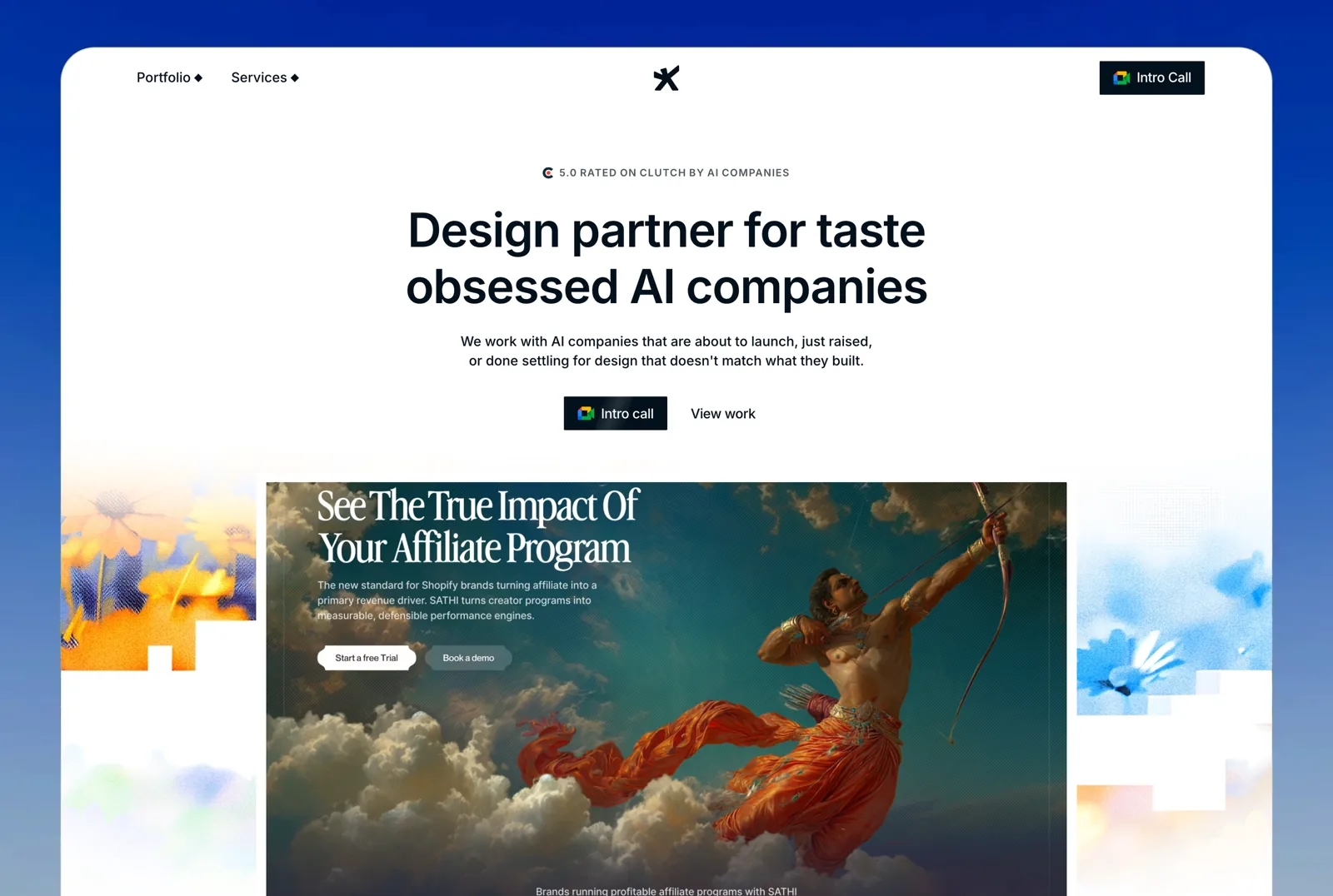
Studio Maydit is a web and product design studio working with AI founders in the US, UK, and Europe. The studio builds websites in Framer, Webflow, and custom code, and continues into product design after the site ships.
The clearest outcome is Dualite, where design work supporting a repositioned ICP helped the product reach 100,000+ users in seven months. Recent clients include Wave, PixelFlow, Mi-VAD, and 15 other AI and SaaS teams.
Websites can be bought two ways. Fixed scope runs three to four weeks and suits teams with a launch date. Teams that keep shipping take a monthly retainer instead, covering new pages, campaigns, and product design, with no long lock-in. Fixed-scope projects end with a diagnosis of what is leaking in the product, not a handoff and goodbye.
| Check | Finding |
|---|---|
| Based in | Remote, serving US / UK / EU |
| Platform depth | Framer, Webflow, and custom code |
| AI-sector proof | Yes. AI-native clients, published outcome on Dualite |
| Pricing | Fixed scope or monthly retainer, quoted per project |
| Team shape | Founder-led, small senior team |
| Best fit | Devtool teams whose site has to prove the tool works, not describe it |
Maydit is the right call if developers reach your homepage and leave without trying anything. Book a 30-minute call.

2. Lazarev
Lazarev is a San Francisco team of 51 to 200 with published AI client work and a published minimum. Their strength is sequencing a complicated explanation so a reader arrives at the point without being handed everything at once, which is the specific skill required when a tool does something that needs three sentences of setup before it makes sense.
They operate at agency scale and cost, their platform focus is mixed rather than Framer, and you should confirm who is assigned before signing.
| Check | Finding |
|---|---|
| Based in | San Francisco, USA |
| Founded | 2015 |
| Team size | 51-200 |
| Primary platform | Mixed |
| AI-sector proof | Yes. Published AI client work |
| Named clients | Payoneer, Peel, Elva, Mozayix |
| Pricing | Published minimum |
| Best fit | Devtools that need a careful explanation before the value is visible |
3. SuperSkills
SuperSkills is a small studio in Walnut Creek with published AI client work. A team of 1 to 10 means the person who understands your tool is the person building the page, so the technical nuance that usually gets flattened in a handoff survives all the way to the final copy.
They publish neither pricing, team size detail, nor founding year, their public client list is short, and a team this small carries continuity risk.
| Check | Finding |
|---|---|
| Based in | Walnut Creek, USA |
| Founded | Not published |
| Team size | 1-10 |
| Primary platform | Mixed |
| AI-sector proof | Yes. Published AI client work |
| Named clients | The Cut |
| Pricing | Not published |
| Best fit | Devtool teams who want one person holding the technical detail throughout |
4. Clay
Clay is a San Francisco studio of 51 to 200 with work for Stripe, Slack, and Coinbase, and a published minimum. Stripe is the reference point for developer documentation done properly, and a team that has worked at that standard understands the difference between explaining a product and letting someone try it.
They are expensive, their process assumes a large client, and a small devtool company will not command their senior attention every month.
| Check | Finding |
|---|---|
| Based in | San Francisco, USA |
| Founded | 2016 |
| Team size | 51-200 |
| Primary platform | Mixed |
| AI-sector proof | Yes. Published AI client work |
| Named clients | Slack, Stripe, Google, Coinbase, Amazon |
| Pricing | Published minimum |
| Best fit | Funded devtool companies buying at the highest craft level available |
5. Fantasy
Fantasy has worked across San Francisco and New York since 1999, with published AI client work. Their long history with interface design gives them an unusual view of how a new interaction becomes familiar, which is relevant when your tool asks developers to work in a way they have not before.
They publish neither client names, pricing, nor team size, and their engagements assume a marketing organisation already exists on the client side.
| Check | Finding |
|---|---|
| Based in | San Francisco and New York, USA |
| Founded | 1999 |
| Team size | Not published |
| Primary platform | Mixed |
| AI-sector proof | Yes. Published AI client work |
| Named clients | Not published |
| Pricing | Not published |
| Best fit | Larger devtool companies introducing a genuinely new interaction model |
6. Trueform
Trueform is a Swiss studio working almost entirely in Framer, with published AI client work and a published minimum. Framer specialists build in components, which is what lets a code sample block or a model comparison table be updated by a marketer the week a new version lands rather than the quarter after.
They are young, founded in 2022, and they do not publish team size, so ask about continuity directly.
| Check | Finding |
|---|---|
| Based in | Wil, Switzerland |
| Founded | 2022 |
| Team size | Not published |
| Primary platform | Framer |
| AI-sector proof | Yes. Published AI client work |
| Named clients | Miro, Morning Brew, Bilt Rewards, Gather |
| Pricing | Published minimum |
| Best fit | Devtool teams who need proof content updated as fast as it changes |
7. Ramotion
Ramotion is a San Francisco team of 11 to 50 running since 2009 with clients including Mozilla and Okta, and a published minimum. Mozilla is a genuinely developer-facing organisation with a demanding audience, and work at that standard means an understanding of readers who verify claims rather than accept them.
Their AI-sector proof is partial, Framer is not their primary platform, and their process is a settled house method rather than one shaped around you.
| Check | Finding |
|---|---|
| Based in | San Francisco, USA |
| Founded | 2009 |
| Team size | 11-50 |
| Primary platform | Mixed |
| AI-sector proof | Partial. Enterprise and SaaS clients, no AI case study |
| Named clients | Mozilla, Okta, Netflix, Adobe, Xero |
| Pricing | Published minimum |
| Best fit | Devtool teams who want a long-established process and a published figure |
8. Instrument
Instrument is a Portland studio founded in 2005 with work for Nike, Microsoft, and Google. Their output is exceptional and their engagements assume the strategy is settled, the budget is approved, and someone on your side runs the relationship full time.
They publish neither pricing nor team size, their AI-sector proof is partial, and this is not a firm shaped around an early devtool company.
| Check | Finding |
|---|---|
| Based in | Portland, USA |
| Founded | 2005 |
| Team size | Not published |
| Primary platform | Mixed |
| AI-sector proof | Partial. Enterprise and SaaS clients, no AI case study |
| Named clients | Nike, Microsoft, Electronic Arts, Google |
| Pricing | Not published |
| Best fit | Established companies with an internal marketing team already in place |
9. Push Refresh
Push Refresh is a Dallas team of 1 to 10 working in Framer with a published minimum and clients including SmithRx. A small Framer specialist ships quickly and leaves the site editable, which matters when your proof content changes with every model release rather than every rebrand.
Their AI-sector proof is partial, and at 1 to 10 people there is no bench, so a busy month elsewhere is felt on your account.
| Check | Finding |
|---|---|
| Based in | Dallas, USA |
| Founded | Not published |
| Team size | 1-10 |
| Primary platform | Framer |
| AI-sector proof | Partial. Enterprise and SaaS clients, no AI case study |
| Named clients | SmithRx, Synonym, Northern National |
| Pricing | Published minimum |
| Best fit | Devtool teams who want speed and a site they can edit themselves |
10. BX Studio
BX Studio is a New York team of 11 to 50 with published AI client work including ASAPP, and a published minimum. They cover product design alongside marketing pages, useful when the strongest proof you have is the product interface itself and the site needs to show it accurately rather than illustrate it.
Their founding year is not published, and Webflow rather than Framer is the platform.
| Check | Finding |
|---|---|
| Based in | New York, USA |
| Founded | Not published |
| Team size | 11-50 |
| Primary platform | Webflow |
| AI-sector proof | Yes. Published AI client work |
| Named clients | Reddit, Headspace, ASAPP, Verifone |
| Pricing | Published minimum |
| Best fit | Devtool teams whose best evidence is the product interface itself |
How to choose between them
Sort by why the proof is not landing.
Nobody understands what the tool does before they leave. Studio Maydit or Lazarev.
The technical detail keeps getting flattened into marketing language. SuperSkills.
Your proof content goes stale between releases. Trueform or Push Refresh.
The product interface is the argument and it looks wrong on the site. BX Studio.
One test before signing. Ask how they would show your tool getting something wrong. An agency that treats that as a design problem worth solving, with a specific idea about where a correction belongs on the page, understands your audience. An agency that reacts as though you would never want to show a failure has never designed for developers, and will produce a site that reads as marketing to the only people whose opinion decides whether you have a company.