

Summarize with AI


The best Framer design agencies for AI fintech startups in 2026 are Studio Maydit, Push Refresh, Clay, Fantasy, Lazarev, SuperSkills, Feely Studio, Trueform, Ramotion, and Pixelmatters. Studio Maydit and Push Refresh lead for teams that have to look safe and move fast at the same time. Fantasy and Pixelmatters are the wrong fit unless you are past your first compliance review and buying at enterprise scale.
Your homepage has two readers and only one of them is excited.
The first reader is the operator who found you. They want to know if the product does the thing. The second reader is a risk officer, a compliance lead, or a bank partner who was forwarded your link by that operator, and their job is to find the reason to say no. They open the site once, they scan for about ninety seconds, and they are not coming back for a second look.
Most AI fintech sites are built entirely for the first reader. They open with the promise, they show the product moving, and they save anything about security, data handling, or regulatory posture for a page linked in small text at the bottom. That layout is fine for a note-taking app. It is a losing layout when the money is real and a model is making calls about it.
The second problem is specific to your category. You are selling automation over financial decisions, and every buyer has been trained by two decades of software to assume automation means fewer people watching. So the moment your site says the system decides something, a quiet question forms, and if the page does not answer it the reader answers it themselves, usually badly.
That is the axis these ten agencies differ on. Not how the work looks, but whether anyone on the team has designed for a reader whose entire job is doubt.

How we picked these agencies
This is a teardown, not a directory listing. For each agency we read their own site and their public record, then checked five things you can verify yourself in an afternoon:
- Platform depth. Is Framer their main craft, or one line on a long service menu?
- AI-sector proof. Named AI clients and published work, or just the word "AI" in the copy?
- Pricing. Do they publish a minimum at all, or keep it behind a call?
- Team shape. Who actually does the work, and how many clients are they carrying at once?
- Their own site. Distinctive, or the same template as everyone else on this list?
That last one gets skipped most often. An agency's own website is the only project where nobody overruled them. No client committee, no inherited brand book. If their own site is forgettable, you have found their ceiling.
Every fact below comes from the agency's own site or a public listing. Where a number is not public, we say so rather than guessing.
What goes wrong when a model touches money
Three failures show up again and again on AI fintech sites, and none of them is a taste problem.
Security and compliance get treated as a footer. The team knows the posture is strong. Someone wrote the security page. Then it gets linked from the bottom of the site next to the careers link, because putting it higher felt defensive. The result is that the one reader who could block the deal has to hunt for the only thing they came for, and hunting reads as hiding. The fix is unglamorous and it works: put the substance where the doubt is. A short, plain block near the top of the product page that says where data sits, what the model does and does not see, and who reviews the output. It costs you nothing with the excited reader and it changes the visit for the sceptical one.
The product shots are obviously not real. You cannot screenshot a live account, so someone builds a fake dashboard, and fake financial data has a smell. Balances that are round numbers. A transaction list where every merchant is a famous brand. A risk score of 87 with nothing explaining what 87 means. Financial buyers read numbers for a living and they clock this instantly, and once one thing on the page is obviously staged the whole page gets discounted. Constructed data is fine. It has to behave like real data, with awkward amounts, a boring merchant or two, and at least one row that is not a success case.
Nobody shows what happens when the model is wrong. This is the failure that costs the most and gets discussed the least. Every site in this category shows the confident path: the system flags the fraud, catches the anomaly, approves the right thing. No site shows the review queue, the override, the audit trail, or the human who signs off. To a compliance reader, a product that never displays its own uncertainty is not a product that is very accurate. It is a product whose designers did not think about accountability. One screen showing a disputed decision and how a person resolves it will do more for a serious buyer than another hero animation.
1. Studio Maydit: A Top-Rated Design Agency for AI Founders
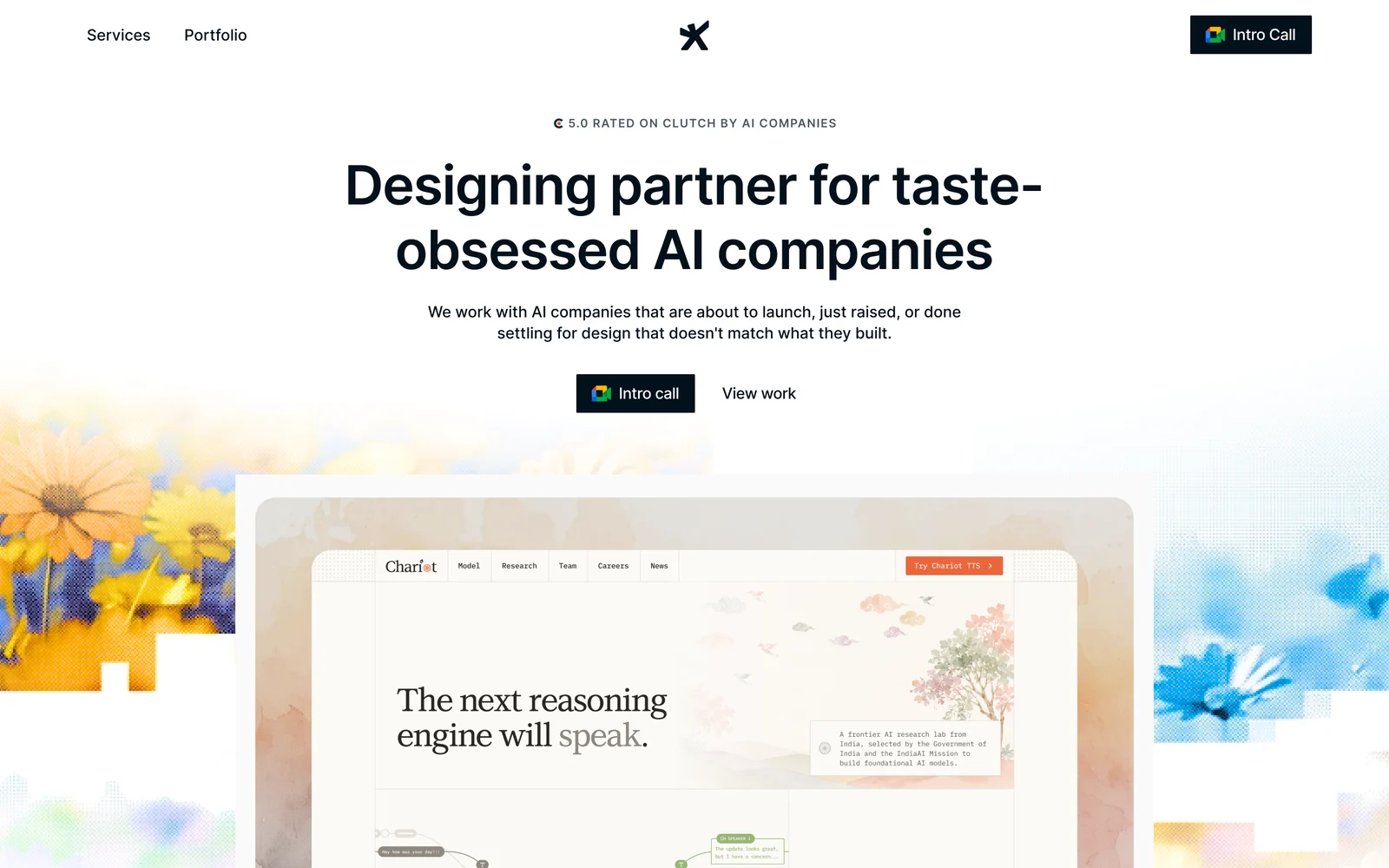
Studio Maydit is a web and product design studio working with AI founders in the US, UK, and Europe. The studio builds websites in Framer, Webflow, and custom code, and continues into product design after the site ships.
The clearest outcome is Dualite, where design work supporting a repositioned ICP helped the product reach 100,000+ users in seven months. Recent clients include Wave, PixelFlow, Mi-VAD, and 15 other AI and SaaS teams.
Websites can be bought two ways. Fixed scope runs three to four weeks and suits teams with a launch date. Teams that keep shipping take a monthly retainer instead, covering new pages, campaigns, and product design, with no long lock-in. Fixed-scope projects end with a diagnosis of what is leaking in the product, not a handoff and goodbye.
| Check | Finding |
|---|---|
| Based in | Remote, serving US / UK / EU |
| Platform depth | Framer, Webflow, and custom code |
| AI-sector proof | Yes. AI-native clients, published outcome on Dualite |
| Pricing | Fixed scope or monthly retainer, quoted per project |
| Team shape | Founder-led, small senior team |
| Best fit | AI fintech teams whose site has to survive a compliance reader |
Maydit is the right call if your product is credible and your site has not caught up to it yet. Book a 30-minute call.

2. Push Refresh
Push Refresh is a Dallas studio of 1 to 10 working mainly in Framer, with clients including SmithRx and Synonym. SmithRx is health benefits and pharmacy pricing, which is the nearest neighbour to fintech in the whole of this list: regulated, audited, and sold to buyers who read the fine print before the headline. A team that has already built for that reader will not argue when you ask to put security above the fold.
Their AI-sector proof is partial rather than published, and at 1 to 10 people there is no bench if your launch collides with someone else's.
| Check | Finding |
|---|---|
| Based in | Dallas, USA |
| Founded | Not published |
| Team size | 1-10 |
| Primary platform | Framer |
| AI-sector proof | Partial. Enterprise and SaaS clients, no AI case study |
| Named clients | SmithRx, Synonym, Northern National |
| Pricing | Published minimum |
| Best fit | Regulated products that need trust content treated as primary |
3. Clay
Clay is a San Francisco firm of 51 to 200 with published AI work and a client list running through Stripe, Coinbase, and Amazon. Stripe and Coinbase are the two references that matter most here, because both companies made a deliberate craft argument in a category where everyone else was signalling safety through beige. Clay has been inside that problem and publishes a minimum, which is rare at their size.
They are a large premium firm, so the senior people you meet are unlikely to be the ones drawing every screen, and Framer is one platform among several rather than the house craft.
| Check | Finding |
|---|---|
| Based in | San Francisco, USA |
| Founded | 2016 |
| Team size | 51-200 |
| Primary platform | Mixed |
| AI-sector proof | Yes. Published AI client work |
| Named clients | Slack, Stripe, Google, Coinbase, Amazon |
| Pricing | Published minimum |
| Best fit | Funded fintech teams who want a real craft argument, not a safe one |
4. Fantasy
Fantasy has been working since 1999 out of San Francisco and New York, with published AI work and a practice built on product thinking rather than page layout. In fintech the hardest design question is usually not the marketing site at all. It is how much of the machine to show a nervous user, and Fantasy is one of the few firms on this list that treats that as the actual brief.
They publish neither pricing nor team size, their engagements run at a scale most early fintech teams cannot absorb, and Framer is not their centre.
| Check | Finding |
|---|---|
| Based in | San Francisco and New York, USA |
| Founded | 1999 |
| Team size | Not published |
| Primary platform | Mixed |
| AI-sector proof | Yes. Published AI client work |
| Named clients | Not published |
| Pricing | Not published |
| Best fit | Later-stage teams whose real problem is the product, not the page |
5. Lazarev
Lazarev is a San Francisco team of 51 to 200 with published AI client work and Payoneer on the list, which is cross-border payments at genuine scale. They publish a minimum, and they are comfortable with the kind of interface that has to explain a number rather than just display it, which is most of the surface area in an AI fintech product.
Their client work leans toward established platforms rather than pre-revenue startups, they are large enough that account management sits between you and the makers, and Framer is one option rather than the specialism.
| Check | Finding |
|---|---|
| Based in | San Francisco, USA |
| Founded | 2015 |
| Team size | 51-200 |
| Primary platform | Mixed |
| AI-sector proof | Yes. Published AI client work |
| Named clients | Payoneer, Peel, Elva, Mozayix |
| Pricing | Published minimum |
| Best fit | Payments and money-movement products with real transaction volume |
6. SuperSkills
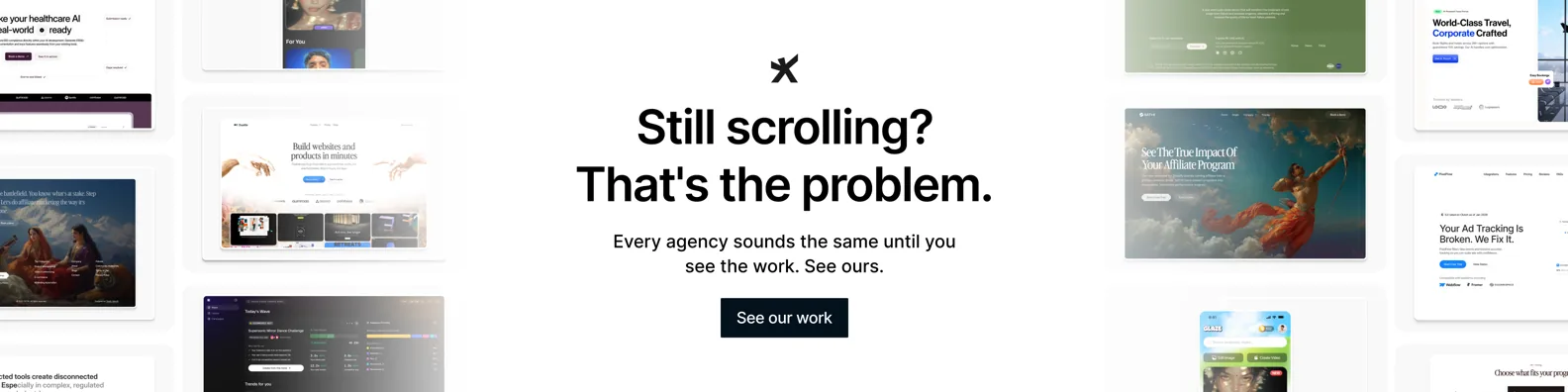
SuperSkills is a small Walnut Creek team of 1 to 10 with published AI client work. A team this size gives you the thing a fintech launch actually needs, which is a short line between the person writing the compliance copy and the person laying out the page. When those two roles sit in one head, the security block stops reading like it was pasted in from a legal document.
They publish no pricing, their named client record is thin at one company, and there is no depth behind the people you meet.
| Check | Finding |
|---|---|
| Based in | Walnut Creek, USA |
| Founded | Not published |
| Team size | 1-10 |
| Primary platform | Mixed |
| AI-sector proof | Yes. Published AI client work |
| Named clients | The Cut |
| Pricing | Not published |
| Best fit | Early fintech teams who want one person holding copy and layout together |
7. Feely Studio
Feely Studio is a distributed European team of 1 to 10 with published AI client work including Basic Capital and Mutiny. Basic Capital is financial product work, and Mutiny is conversion tooling, so the studio has sat on both sides of the problem you have: making a money product legible, and making a page actually convert once it is.
They are a very small team, their work is weighted toward marketing sites rather than regulated product surfaces, and time zones will shape your review cycle if you are in the US.
| Check | Finding |
|---|---|
| Based in | Distributed, Europe |
| Founded | Not published |
| Team size | 1-10 |
| Primary platform | Mixed |
| AI-sector proof | Yes. Published AI client work |
| Named clients | Noxus, Mutiny, Luasai, Basic Capital |
| Pricing | Published minimum |
| Best fit | Teams who want the site to convert as hard as it reassures |
8. Trueform
Trueform is a Swiss studio working in Framer with published AI client work and Bilt Rewards on the roster, which is a consumer financial product with a real loyalty economy behind it. They publish a minimum, and Framer is the house craft rather than a service line, so the site you get is one your own team can keep editing after launch. That matters in fintech, where a legal correction cannot wait for an agency sprint.
They are a small studio, their work sits closer to brand and marketing than to regulated product design, and Switzerland will not overlap much with a US working day.
| Check | Finding |
|---|---|
| Based in | Wil, Switzerland |
| Founded | 2022 |
| Team size | Not published |
| Primary platform | Framer |
| AI-sector proof | Yes. Published AI client work |
| Named clients | Miro, Morning Brew, Bilt Rewards, Gather |
| Pricing | Published minimum |
| Best fit | Teams who need to edit their own legal and product copy weekly |
9. Ramotion
Ramotion is a San Francisco team of 11 to 50 who have been working since 2009, with Okta and Xero in public. Okta is identity and Xero is accounting, and both are products that had to earn trust from a cautious buyer before they could grow. They publish a minimum, and their brand work is strong enough to survive the pressure fintech puts on a visual system to look institutional.
Their AI-sector proof is partial, Framer is not the specialism, and a brand-led engagement can run longer than a startup with a funding announcement date can afford.
| Check | Finding |
|---|---|
| Based in | San Francisco, USA |
| Founded | 2009 |
| Team size | 11-50 |
| Primary platform | Mixed |
| AI-sector proof | Partial. Enterprise and SaaS clients, no AI case study |
| Named clients | Mozilla, Okta, Netflix, Adobe, Xero |
| Pricing | Published minimum |
| Best fit | Teams whose identity has to read as institutional without going grey |
10. Pixelmatters
Pixelmatters is a Porto team of 51 to 200 with Rubrik and UJET published, and they publish a minimum. They design and build in one team, which removes the gap where a compliance change gets agreed in a design review and then quietly never ships because the handoff swallowed it.
Their AI-sector proof is partial, they are a larger firm than an early fintech team commands full attention from, and Framer is one platform among several.
| Check | Finding |
|---|---|
| Based in | Porto, Portugal |
| Founded | 2013 |
| Team size | 51-200 |
| Primary platform | Mixed |
| AI-sector proof | Partial. Enterprise and SaaS clients, no AI case study |
| Named clients | Rubrik, Quantic, UJET |
| Pricing | Published minimum |
| Best fit | Teams who want design and build held by one accountable group |
How to choose between them
Sort by which reader you are currently losing.
The compliance reader bounces before your demo. Studio Maydit or Push Refresh.
Your brand reads like a startup and your buyers want a bank. Ramotion or Clay.
The product itself confuses people once they are inside. Fantasy or Lazarev.
Your legal copy changes faster than an agency sprint. Trueform.
One test before signing. Send them your current site and ask which single block they would move to the top of the product page, and why. An agency that has designed for a regulated reader will answer with something about data handling, oversight, or where the human sits in the loop, and they will say what it costs you elsewhere on the page. An agency that answers with a stronger headline is telling you they have only ever designed for the reader who was already excited, and that is not the reader who ends your deal.