

Summarize with AI


The best Framer design agencies for AI martech startups in 2026 are Studio Maydit, Trueform, Push Refresh, Clay, Lazarev, Fantasy, SuperSkills, Feely Studio, Ramotion, and Instrument. Studio Maydit and Trueform lead for teams who need a Framer site that can be rewritten as fast as the category moves. Fantasy and Instrument are the wrong fit for most teams here, the first because it publishes no client names to check, the second because its engagements are sized for large organisations.
Everyone selling software has a website. You are the only category where the website is a work sample. Your buyer does this for a living. When a marketing leader lands on your page, they are not just reading it. They are reading how it was made, and quietly comparing it to what their own team shipped last quarter.
That produces an unusual and slightly unfair standard. A weak page from a security company reads as unpolished. A weak page from a company selling marketing software reads as evidence. If your own site cannot hold attention, the obvious conclusion is that your product does not help people hold attention either. Nobody says this out loud on a sales call, and it decides plenty of them.
There is a second thing working against you. Marketers are the most sold-to audience in software, and they have been buying automation promises for fifteen years. Most of them are carrying a tool graveyard: three platforms nobody finished setting up, two that were replaced, one that only one person can operate. They arrive already suspicious, and they recognise every technique on your page because they run those techniques themselves.
Framer suits this category well, because martech positioning changes faster than most. A capability that was your headline in March is a checkbox by September. The ten studios below are ranked on how well they handle a buyer who evaluates the page as work, not on portfolio prestige.

How we picked these agencies
This is a teardown, not a directory listing. For each agency we read their own site and their public record, then checked five things you can verify yourself in an afternoon:
- Platform depth. Is one craft their real specialism, or one line on a long service menu?
- AI-sector proof. Named AI clients and published work, or just the word "AI" in the copy?
- Pricing. Do they publish a minimum at all, or keep it behind a call?
- Team shape. Who actually does the work, and how many clients are they carrying at once?
- Their own site. Distinctive, or the same template as everyone else on this list?
That last one gets skipped most often. An agency's own website is the only project where nobody overruled them. No client committee, no inherited brand book. If their own site is forgettable, you have found their ceiling.
Every fact below comes from the agency's own site or a public listing. Where a number is not public, we say so rather than guessing.
What goes wrong when you sell software to marketers
Three failures are close to universal in this category, and each one is a normal marketing decision that backfires because of who is reading.
The page uses the tactics your buyer runs themselves. The exit popup, the countdown, the gated report that turns out to be four pages, the scarcity line that is not true. These work on audiences who have never built them. Your audience builds them on Tuesdays. To a marketing leader, seeing your popup is like watching a chef microwave dinner: not offensive, just informative. Every technique you use is read as a statement about how you think, and cheap technique tells them your product is probably cheap technique too. Persuade with substance instead. Show the real numbers, name the tradeoffs, and let the page be quietly confident.
Nobody can tell where you sit in their stack. Marketing leaders do not buy tools, they buy additions to an existing arrangement of tools, and their first real question is what this replaces, what it plugs into, and who has to be retrained. A page that describes an outcome without answering that leaves the buyer with homework they will not do. They forward it to nobody and it dies quietly. Answer it plainly and early. Name the systems you connect to, say what you replace and what you do not, and be honest when you sit alongside something rather than removing it.
The results shown are indistinguishable from every other claim they have heard. A large percentage improvement with no context is invisible in this category, because your buyer has read a hundred of them and has personally written a few. What is credible is specific and small. One customer, the situation they started in, what actually changed, over how long, and what did not improve. Marketers trust that shape because it is how they report internally to a sceptical finance team. A modest number with real detail beats a spectacular one without it, every time, with this audience.
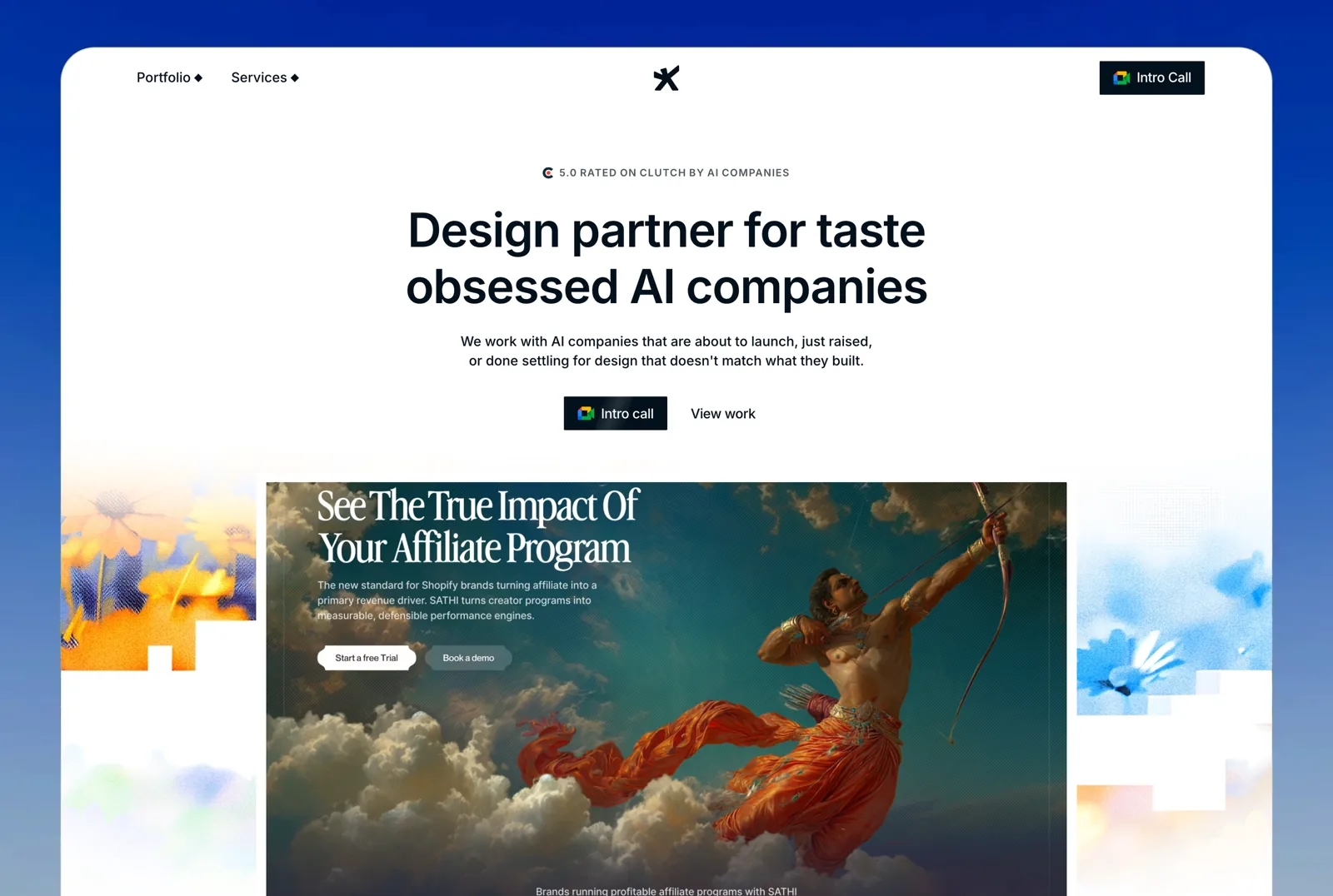
1. Studio Maydit: A Top-Rated Design Agency for AI Founders
Studio Maydit is a web and product design studio working with AI founders in the US, UK, and Europe. The studio builds websites in Framer, Webflow, and custom code, and continues into product design after the site ships.
The clearest outcome is Dualite, where design work supporting a repositioned ICP helped the product reach 100,000+ users in seven months. Recent clients include Wave, PixelFlow, Mi-VAD, and 15 other AI and SaaS teams.
Websites can be bought two ways. Fixed scope runs three to four weeks and suits teams with a launch date. Teams that keep shipping take a monthly retainer instead, covering new pages, campaigns, and product design, with no long lock-in. Fixed-scope projects end with a diagnosis of what is leaking in the product, not a handoff and goodbye.
| Check | Finding |
|---|---|
| Based in | Remote, serving US / UK / EU |
| Platform depth | Framer, Webflow, and custom code |
| AI-sector proof | Yes. AI-native clients, published outcome on Dualite |
| Pricing | Fixed scope or monthly retainer, quoted per project |
| Team shape | Founder-led, small senior team |
| Best fit | Teams whose buyers will judge the website as a sample of the work |
Maydit is the right call when the site itself has to be the proof, and it has to keep changing. Book a 30-minute call.

2. Trueform
Trueform is a Swiss studio founded in 2022 working specifically in Framer, with a published minimum and Miro, Morning Brew, Bilt Rewards, and Gather named. Morning Brew is the reference your buyers will recognise immediately, a media brand built entirely on holding the attention of exactly the people you are selling to. Framer being their actual craft matters here too, because martech messaging goes stale faster than in almost any other category.
They publish no team size, they are a small studio, and the European time difference means a US team should not expect same-day answers in the afternoon.
| Check | Finding |
|---|---|
| Based in | Wil, Switzerland |
| Founded | 2022 |
| Team size | Not published |
| Primary platform | Framer |
| AI-sector proof | Yes. Published AI client work |
| Named clients | Miro, Morning Brew, Bilt Rewards, Gather |
| Pricing | Published minimum |
| Best fit | Teams whose message changes faster than a redesign cycle |
3. Push Refresh
Push Refresh is a Dallas studio of 1 to 10 working in Framer, with a published minimum and SmithRx, Synonym, and Northern National named. Working with a team this small means the person who understands your positioning is the person building the page, which prevents the specific loss that happens when a nuanced argument passes through a project manager on its way to a designer.
They publish no founding year, their AI-sector proof is partial rather than demonstrated, and a team of under ten has no spare capacity when a campaign date moves.
| Check | Finding |
|---|---|
| Based in | Dallas, USA |
| Founded | Not published |
| Team size | 1-10 |
| Primary platform | Framer |
| AI-sector proof | Partial. Enterprise and SaaS clients, no AI case study |
| Named clients | SmithRx, Synonym, Northern National |
| Pricing | Published minimum |
| Best fit | Teams whose positioning is subtle and easily flattened in a handover |
4. Clay
Clay is a San Francisco studio of 51 to 200, founded in 2016, with a published minimum and Slack, Stripe, Google, Coinbase, and Amazon named, plus published AI client work. When your buyer grades your site as a work sample, hiring a studio whose public work sets the standard is a direct answer to that problem. Their own site is also the kind marketing leaders send to each other, which is its own quiet proof.
They are large and premium, so a small team is a minor account, their platform range is broad rather than Framer-deep, and the budget rules out most companies before Series A.
| Check | Finding |
|---|---|
| Based in | San Francisco, USA |
| Founded | 2016 |
| Team size | 51-200 |
| Primary platform | Mixed |
| AI-sector proof | Yes. Published AI client work |
| Named clients | Slack, Stripe, Google, Coinbase, Amazon |
| Pricing | Published minimum |
| Best fit | Funded teams who need the site itself to be the credential |
5. Lazarev
Lazarev is a San Francisco studio of 51 to 200, founded in 2015, with a published minimum and Payoneer, Peel, Elva, and Mozayix named, plus published AI client work. Their published work leans toward explaining complicated products, which is the useful skill when your buyer's real question is how your tool fits between two systems they already run.
They are large enough to have account layers between you and the designers, their strongest work is not in Framer, and their focus is interfaces rather than the positioning arguments that decide martech deals.
| Check | Finding |
|---|---|
| Based in | San Francisco, USA |
| Founded | 2015 |
| Team size | 51-200 |
| Primary platform | Mixed |
| AI-sector proof | Yes. Published AI client work |
| Named clients | Payoneer, Peel, Elva, Mozayix |
| Pricing | Published minimum |
| Best fit | Teams whose integration story is the hardest thing to explain |
6. Fantasy
Fantasy has been working since 1999 across San Francisco and New York, across platforms, with published AI client work. Having designed through several waves of marketing technology gives them a longer memory than the category has, and that is worth something when everyone around you is treating this year's capability as permanent.
They publish no client names, which makes their record impossible to verify from outside, and no pricing or team size, which is a lot of unknowns when your own buyers are grading you on evidence.
| Check | Finding |
|---|---|
| Based in | San Francisco and New York, USA |
| Founded | 1999 |
| Team size | Not published |
| Primary platform | Mixed |
| AI-sector proof | Yes. Published AI client work |
| Named clients | Not published |
| Pricing | Not published |
| Best fit | Teams who value long perspective over a checkable record |
7. SuperSkills
SuperSkills is a small studio of 1 to 10 in Walnut Creek, California, working across platforms, with The Cut named and published AI client work. Editorial experience is unusually relevant here. A publication has to earn attention from a cold reader with no product demo and no sales call, which is exactly the skill a martech homepage needs and rarely gets from a product design studio.
They name only one client, publish no founding year and no pricing, and at this size they can hold one project at a time, so timing has to line up.
| Check | Finding |
|---|---|
| Based in | Walnut Creek, USA |
| Founded | Not published |
| Team size | 1-10 |
| Primary platform | Mixed |
| AI-sector proof | Yes. Published AI client work |
| Named clients | The Cut |
| Pricing | Not published |
| Best fit | Teams whose homepage needs to read like something worth finishing |
8. Feely Studio
Feely Studio is a small distributed European team of 1 to 10 with a published minimum and Noxus, Mutiny, Luasai, and Basic Capital named, plus published AI client work. Mutiny is the reference that stands out on this page, a company selling website personalisation to marketers, which is your exact buyer and your exact scepticism problem. That is direct category experience rather than an adjacent guess.
They publish no founding year, they are very small, and a European team overlaps with US mornings only, which slows the fast turnarounds campaign work tends to need.
| Check | Finding |
|---|---|
| Based in | Distributed, Europe |
| Founded | Not published |
| Team size | 1-10 |
| Primary platform | Mixed |
| AI-sector proof | Yes. Published AI client work |
| Named clients | Noxus, Mutiny, Luasai, Basic Capital |
| Pricing | Published minimum |
| Best fit | Teams selling to marketers who want a partner that knows that buyer |
9. Ramotion
Ramotion is a San Francisco team of 11 to 50, founded in 2009, with a published minimum and Mozilla, Okta, Netflix, Adobe, and Xero named. Adobe is the relevant name here, the largest marketing software vendor in the world, and work that met that bar tells you they can operate at the standard your buyers use as their reference point.
Their AI-sector proof is partial, they work across platforms rather than specialising in Framer, and at their size the senior people who pitch are not always the ones building.
| Check | Finding |
|---|---|
| Based in | San Francisco, USA |
| Founded | 2009 |
| Team size | 11-50 |
| Primary platform | Mixed |
| AI-sector proof | Partial. Enterprise and SaaS clients, no AI case study |
| Named clients | Mozilla, Okta, Netflix, Adobe, Xero |
| Pricing | Published minimum |
| Best fit | Teams benchmarked against the largest vendors in the category |
10. Instrument
Instrument has been working since 2005 out of Portland, across platforms, with Nike, Microsoft, Electronic Arts, and Google named. Their strength is campaign-scale work for brands your buyers study, which means they understand attention as a craft rather than as a conversion tactic. For a company whose site is being graded by professionals, that difference shows.
They publish neither pricing nor team size, their AI-sector proof is partial, and their engagements are sized for large organisations, which makes them an expensive way for a startup to buy a website.
| Check | Finding |
|---|---|
| Based in | Portland, USA |
| Founded | 2005 |
| Team size | Not published |
| Primary platform | Mixed |
| AI-sector proof | Partial. Enterprise and SaaS clients, no AI case study |
| Named clients | Nike, Microsoft, Electronic Arts, Google |
| Pricing | Not published |
| Best fit | Well-funded teams who need brand-level attention, not conversion tricks |
How to choose between them
Sort by which judgement is going against you.
Our site looks worse than what our buyers make themselves. Clay or Studio Maydit.
Nobody understands where we fit in their stack. Lazarev or Studio Maydit.
The page is fine but nobody finishes reading it. SuperSkills or Instrument.
We need to change the message every six weeks. Trueform or Push Refresh.
One test before signing. Ask them what they would remove from your current homepage to make it more convincing to a sceptical marketer. A studio that understands this audience will point at a persuasion device you added on purpose and explain why it is costing you credibility. One that proposes only additions is planning to give your buyer more of exactly what has already stopped working on them.