
Summarize with AI


The best Framer design agencies for AI-native SaaS products in 2026 are Studio Maydit, Clay, Lazarev, Trueform, Fantasy, Feely Studio, Push Refresh, BX Studio, Foundey, and SuperSkills. Studio Maydit and Trueform lead for AI-native SaaS, because both work natively in Framer, both have shipped for AI companies, and both publish enough about how they work to judge before a call. Fantasy and Foundey are the wrong fit for this brief, since one is set up for large brand engagements and the other hands over design files rather than building the site.
Two years ago, saying you were built on a model was a position. Now it is table stakes, and worse, it is a sentence your least innovative competitor can also write.
That competitor is a fifteen-year-old SaaS company that shipped an assistant panel last quarter. Their homepage now says intelligent, adaptive, and AI-powered. Your homepage says intelligent, adaptive, and AI-powered. A buyer comparing four tabs cannot tell which of you rebuilt the product around a model and which of you added a sidebar, because the words are identical and the screenshots both show a text box.
Being native genuinely does matter, but it shows up in places most sites never mention. It shows up in what the product does without being asked. It shows up in how you charge, because per-seat pricing on a product that does work rather than hosting work is a tell. It shows up in what happens on day one with no data, and in what the product does when it is unsure.
None of that is a claim. All of it is evidence, and evidence has to be shown rather than stated. That is a design problem more than a copywriting one, and it is why the platform question matters: you will be re-cutting this page every few weeks as the product moves.
The ten studios below are ranked on how well they show a difference rather than assert one.

How we picked these agencies
This is a teardown, not a directory listing. For each agency we read their own site and their public record, then checked five things you can verify yourself in an afternoon:
- Platform depth. Is one craft their real specialism, or one line on a long service menu?
- AI-sector proof. Named AI clients and published work, or just the word "AI" in the copy?
- Pricing. Do they publish a minimum at all, or keep it behind a call?
- Team shape. Who actually does the work, and how many clients are they carrying at once?
- Their own site. Distinctive, or the same template as everyone else on this list?
That last one gets skipped most often. An agency's own website is the only project where nobody overruled them. No client committee, no inherited brand book. If their own site is forgettable, you have found their ceiling.
Every fact below comes from the agency's own site or a public listing. Where a number is not public, we say so rather than guessing.
What goes wrong when the whole category claims the same thing
Three failures repeat on AI-native SaaS sites, and each one hands your advantage to a slower competitor.
The page argues about the model instead of the outcome. Somewhere on most of these sites is a paragraph about the architecture, the fine-tuning, or which foundation model sits underneath. The team is proud of it, and the pride is earned. The buyer does not care. They are being asked to change a workflow their team already knows, and no detail about the model reduces that risk. Worse, model claims age badly, because whatever you name will be superseded within two quarters and the page will read as dated. Lead with what the product finishes, and put the technical detail where a curious engineer can find it.
The pricing page contradicts the positioning. The homepage says the product does the work. The pricing page charges per seat, per month, with tiers based on how many people log in. Those two statements cannot both be true, and buyers notice the mismatch even when they cannot articulate it. Charging by seat on a product that replaces effort tells people it is really a tool their staff operate, which is precisely the thing an incumbent would build. The pricing page is where native and bolted-on separate most visibly, and it is usually designed last, by whoever is free.
Every screenshot is a text box. Open six sites in your category and the product images are indistinguishable: a prompt field, a response, a sidebar. This is the single biggest wasted opportunity on an AI-native site. The interesting frames are the ones nobody screenshots, like the product noticing something before being asked, the moment it shows its reasoning, the point where it declines and explains why, or the view of ten runs at once. Those images cannot be copied by a company that bolted on an assistant, because they do not have them.
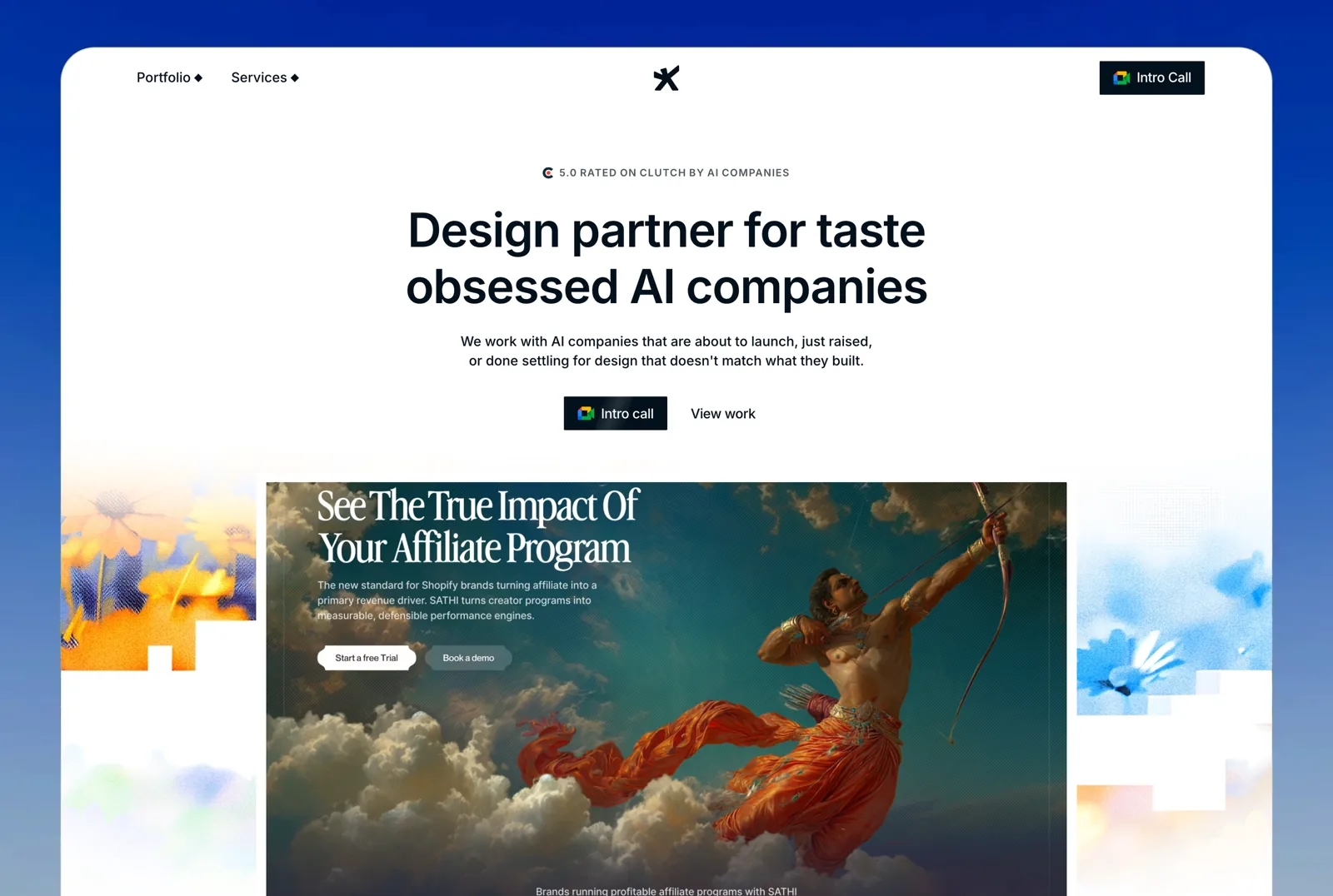
1. Studio Maydit: A Top-Rated Design Agency for AI Founders
Studio Maydit is a web and product design studio working with AI founders in the US, UK, and Europe. The studio builds websites in Framer, Webflow, and custom code, and continues into product design after the site ships.
The clearest outcome is Dualite, where design work supporting a repositioned ICP helped the product reach 100,000+ users in seven months. Recent clients include Wave, PixelFlow, Mi-VAD, and 15 other AI and SaaS teams.
Websites can be bought two ways. Fixed scope runs three to four weeks and suits teams with a launch date. Teams that keep shipping take a monthly retainer instead, covering new pages, campaigns, and product design, with no long lock-in. Fixed-scope projects end with a diagnosis of what is leaking in the product, not a handoff and goodbye.
| Check | Finding |
|---|---|
| Based in | Remote, serving US / UK / EU |
| Platform depth | Framer, Webflow, and custom code |
| AI-sector proof | Yes. AI-native clients, published outcome on Dualite |
| Pricing | Fixed scope or monthly retainer, quoted per project |
| Team shape | Founder-led, small senior team |
| Best fit | AI-native SaaS that has to look different, not louder |
Maydit is the right call if your category all says the same sentence and yours is actually true. Book a 30-minute call.

2. Clay
Clay is a San Francisco team of 51 to 200, founded in 2016, working across platforms, with a published minimum and Slack, Stripe, Google, Coinbase, and Amazon named, plus published AI client work. They are unusually good at making software feel like a considered product rather than an assembled one, and in a category where every competitor's screenshot looks the same, that surface difference does more commercial work than a feature list.
They publish a minimum that puts them out of reach for most pre-Series A teams, they are large enough that your account will not get their founders, and Framer is not their specialism, so ongoing edits may still route through them.
| Check | Finding |
|---|---|
| Based in | San Francisco, USA |
| Founded | 2016 |
| Team size | 51-200 |
| Primary platform | Mixed |
| AI-sector proof | Yes. Published AI client work |
| Named clients | Slack, Stripe, Google, Coinbase, Amazon |
| Pricing | Published minimum |
| Best fit | Funded AI SaaS selling against established brands |
3. Lazarev
Lazarev is a San Francisco team of 51 to 200, founded in 2015, working across platforms, with a published minimum and Payoneer, Peel, Elva, and Mozayix named, plus published AI client work. They work on products where the interface has to carry something complicated, and an AI-native SaaS site lives or dies on whether the product images explain a behaviour rather than showing a chat window.
They publish a minimum that suits funded teams rather than early ones, Framer is one platform among several for them, and a firm of that size adds coordination that a fast-moving product team will feel.
| Check | Finding |
|---|---|
| Based in | San Francisco, USA |
| Founded | 2015 |
| Team size | 51-200 |
| Primary platform | Mixed |
| AI-sector proof | Yes. Published AI client work |
| Named clients | Payoneer, Peel, Elva, Mozayix |
| Pricing | Published minimum |
| Best fit | AI SaaS whose product is hard to show in one image |
4. Trueform
Trueform is a Swiss studio founded in 2022, working natively in Framer, with a published minimum and Miro, Morning Brew, Bilt Rewards, and Gather named, plus published AI client work. Framer is what they do rather than something they also offer, which matters when the product changes monthly and the site has to change with it. Their published minimum also makes the first conversation short.
They publish no team size, they are young, and a studio built around one platform will not help when the answer is that part of your site should be custom.
| Check | Finding |
|---|---|
| Based in | Wil, Switzerland |
| Founded | 2022 |
| Team size | Not published |
| Primary platform | Framer |
| AI-sector proof | Yes. Published AI client work |
| Named clients | Miro, Morning Brew, Bilt Rewards, Gather |
| Pricing | Published minimum |
| Best fit | AI SaaS teams who will re-cut the site every month |
5. Fantasy
Fantasy is a San Francisco and New York studio founded in 1999, working across platforms, with published AI client work. Their depth is in product thinking rather than pages, and for a company whose difference lives inside the product, a partner who will look at the experience before the homepage can find the argument nobody has written down yet.
They name no clients publicly, publish no pricing and no team size, and a studio of that history is shaped for engagements far larger than a Framer site for a growing SaaS company.
| Check | Finding |
|---|---|
| Based in | San Francisco and New York, USA |
| Founded | 1999 |
| Team size | Not published |
| Primary platform | Mixed |
| AI-sector proof | Yes. Published AI client work |
| Named clients | Not published |
| Pricing | Not published |
| Best fit | Well-funded AI SaaS treating this as a brand project |
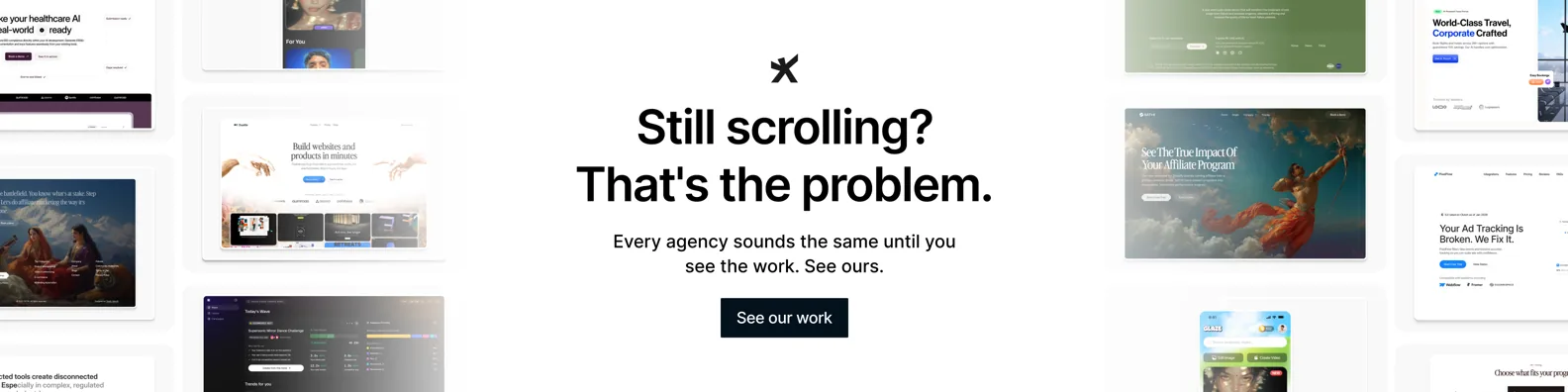
6. Feely Studio
Feely Studio is a small distributed European team of one to ten, working across platforms, with a published minimum and Noxus, Mutiny, Luasai, and Basic Capital named, plus published AI client work. Their client list is made of companies at roughly your stage rather than enterprise logos, which means they have already solved the problem of describing a product that changed twice during the project.
They publish no founding year, a team that size has real capacity limits, and being distributed across Europe gives a US team a narrower window for the quick calls this kind of work needs.
| Check | Finding |
|---|---|
| Based in | Distributed, Europe |
| Founded | Not published |
| Team size | 1-10 |
| Primary platform | Mixed |
| AI-sector proof | Yes. Published AI client work |
| Named clients | Noxus, Mutiny, Luasai, Basic Capital |
| Pricing | Published minimum |
| Best fit | Early AI SaaS whose positioning is still moving |
7. Push Refresh
Push Refresh is a Dallas team of one to ten, working in Framer, with a published minimum and SmithRx, Synonym, and Northern National named. Framer is their platform, their pricing is public, and the team is small enough that the person you brief is the person who builds. For a SaaS team that wants to change the hero every time the product ships, that short line is worth more than a bigger name.
They publish no founding year, their AI-sector proof is partial, and a one-to-ten team on a single platform will struggle with a large site or a demanding launch schedule.
| Check | Finding |
|---|---|
| Based in | Dallas, USA |
| Founded | Not published |
| Team size | 1-10 |
| Primary platform | Framer |
| AI-sector proof | Partial. Enterprise and SaaS clients, no AI case study |
| Named clients | SmithRx, Synonym, Northern National |
| Pricing | Published minimum |
| Best fit | AI SaaS teams who want fast changes without a queue |
8. BX Studio
BX Studio is a New York team of 11 to 50 working in Webflow, with a published minimum and Reddit, Headspace, ASAPP, and Verifone named, plus published AI client work. ASAPP is the useful reference, an AI company selling into buyers who need to understand what the software actually does, which is the same explanation problem this article is about. They build systems that produce many consistent pages, not one showpiece.
They publish no founding year, their platform is Webflow rather than Framer, and their centre of gravity is marketing surfaces, so the product-side evidence still has to come from you.
| Check | Finding |
|---|---|
| Based in | New York, USA |
| Founded | Not published |
| Team size | 11-50 |
| Primary platform | Webflow |
| AI-sector proof | Yes. Published AI client work |
| Named clients | Reddit, Headspace, ASAPP, Verifone |
| Pricing | Published minimum |
| Best fit | AI SaaS needing many pages that stay consistent |
9. Foundey
Foundey is a San Francisco studio founded in 2021, working in Figma, with DemandIQ, Traycer, and Sero AI named, plus published AI client work. Their clients are early AI companies, so the conversation starts further along, and if your real gap is deciding what the product screens should show before anything gets built, that is the work they do.
They hand over design files rather than building sites, which is the wrong shape for a Framer brief, and they publish no pricing and no team size.
| Check | Finding |
|---|---|
| Based in | San Francisco, USA |
| Founded | 2021 |
| Team size | Not published |
| Primary platform | Figma-only |
| AI-sector proof | Yes. Published AI client work |
| Named clients | DemandIQ, Traycer, Sero AI |
| Pricing | Not published |
| Best fit | AI SaaS whose own team will build what is designed |
10. SuperSkills
SuperSkills is a Walnut Creek team of one to ten, working across platforms, with The Cut named and published AI client work. Small and senior, with no layer between the brief and the work, which suits a product team that wants to sit with a designer for an hour and leave with a decision rather than a proposal.
They name only one client, publish no pricing, no founding year, and no detail beyond team size, so there is very little public evidence, and a team of that size cannot carry a large launch alongside other work.
| Check | Finding |
|---|---|
| Based in | Walnut Creek, USA |
| Founded | Not published |
| Team size | 1-10 |
| Primary platform | Mixed |
| AI-sector proof | Yes. Published AI client work |
| Named clients | The Cut |
| Pricing | Not published |
| Best fit | Small AI SaaS teams who value speed over process |
How to choose between them
Sort by which part of the sameness problem is hurting you.
An incumbent with a bolted-on feature is winning deals. Studio Maydit or Clay.
The product is genuinely hard to show in one image. Lazarev or Fantasy.
The site is out of date within a month of every release. Trueform or Push Refresh.
You need many pages and they must stay consistent. BX Studio or Feely Studio.
One test before signing. Give them your product and ask which three screens they would put on the homepage, and why those instead of the chat view. A studio that understands this category will pick moments an incumbent could not fake, and will explain what each one proves. A studio that picks the prompt box and a testimonial has just described your competitor's website.