
Summarize with AI


The best Framer design agencies for AI search products in 2026 are Studio Maydit, Ramotion, Push Refresh, Instrument, Feels Like, Clay, Engine Digital, Trueform, Fantasy, and SuperSkills. Studio Maydit and Ramotion lead for teams who have to break a habit rather than beat a feature. Instrument and Engine Digital are the wrong fit unless you are already large and the brief is brand scale.
You are not competing with another company. You are competing with the search box people already use without thinking.
That distinction changes everything about the website, and almost no AI search product is built for it. The pages say faster, smarter, more relevant, as though the reader is choosing between two products on a shortlist. They are not. They are deciding whether to change a reflex they have used ten times a day for twenty years, and reflexes do not respond to comparative adjectives. They respond to a moment where the old way visibly fails.
So the job of the page is narrow and specific: name a search that the reader has run recently and got nothing useful from. Not a category of search. An actual one. The buried policy document, the question whose answer is spread across four wiki pages, the thing they knew existed and could not find the words for. Recognition does the persuading. Once someone sees their own failed search described accurately, the rest of the page has permission to make claims.
Then there is the second problem, which is that search is judged instantly and unforgivingly. One irrelevant result and the visitor concludes the whole thing is noise. No other product category gets evaluated that fast or that harshly, and it means the demo on your homepage carries more weight than every word around it.
That gap between selling a habit change and surviving a two-second test is what separates these ten agencies.

How we picked these agencies
This is a teardown, not a directory listing. For each agency we read their own site and their public record, then checked five things you can verify yourself in an afternoon:
- Platform depth. Is Framer their main craft, or one line on a long service menu?
- AI-sector proof. Named AI clients and published work, or just the word "AI" in the copy?
- Pricing. Do they publish a minimum at all, or keep it behind a call?
- Team shape. Who actually does the work, and how many clients are they carrying at once?
- Their own site. Distinctive, or the same template as everyone else on this list?
That last one gets skipped most often. An agency's own website is the only project where nobody overruled them. No client committee, no inherited brand book. If their own site is forgettable, you have found their ceiling.
Every fact below comes from the agency's own site or a public listing. Where a number is not public, we say so rather than guessing.
What goes wrong when you sell against a reflex
Three failures show up on nearly every AI search product site, and all three underestimate how strong the incumbent habit is.
The page argues on speed and relevance, which nobody switches for. Better results is not a proposition, it is a claim every search product has made since the nineties, and the reader has learned to skip it. What moves someone is a described failure they recognise. The document they knew existed and could not surface. The answer that lived in a thread from two years ago. The question they gave up on and asked a colleague instead. Write those specifically enough that the reader thinks of their own version, and the switch starts to feel worth the trouble. Write about relevance and they file you next to every other tool that promised it.
The demo is curated, so it proves the opposite of what you want. Almost every AI search site shows a query the team chose, returning a result the team approved, and every visitor knows it. A staged demo in a category defined by handling messy real questions actively signals that the real thing might not hold up. Let people type their own query into something real, even if it is limited to a public corpus and even if it sometimes returns nothing. A live tool that occasionally misses builds far more confidence than a video that never does, because your visitor's entire objection is whether it works on their mess rather than yours.
Where answers come from is left unexplained. For a search product this is not a trust footnote, it is the product itself. A person deciding whether to rely on your system needs to know what it reads, how current that is, what it does not have access to, and how they check an answer for themselves. Systems that show their sources get used for real work. Systems that return confident prose with nothing behind it get used for casual questions and abandoned for anything that matters, which is precisely the usage that would have justified the purchase. Put provenance in the main flow, and treat the gaps in your index as facts to state rather than problems to hide.
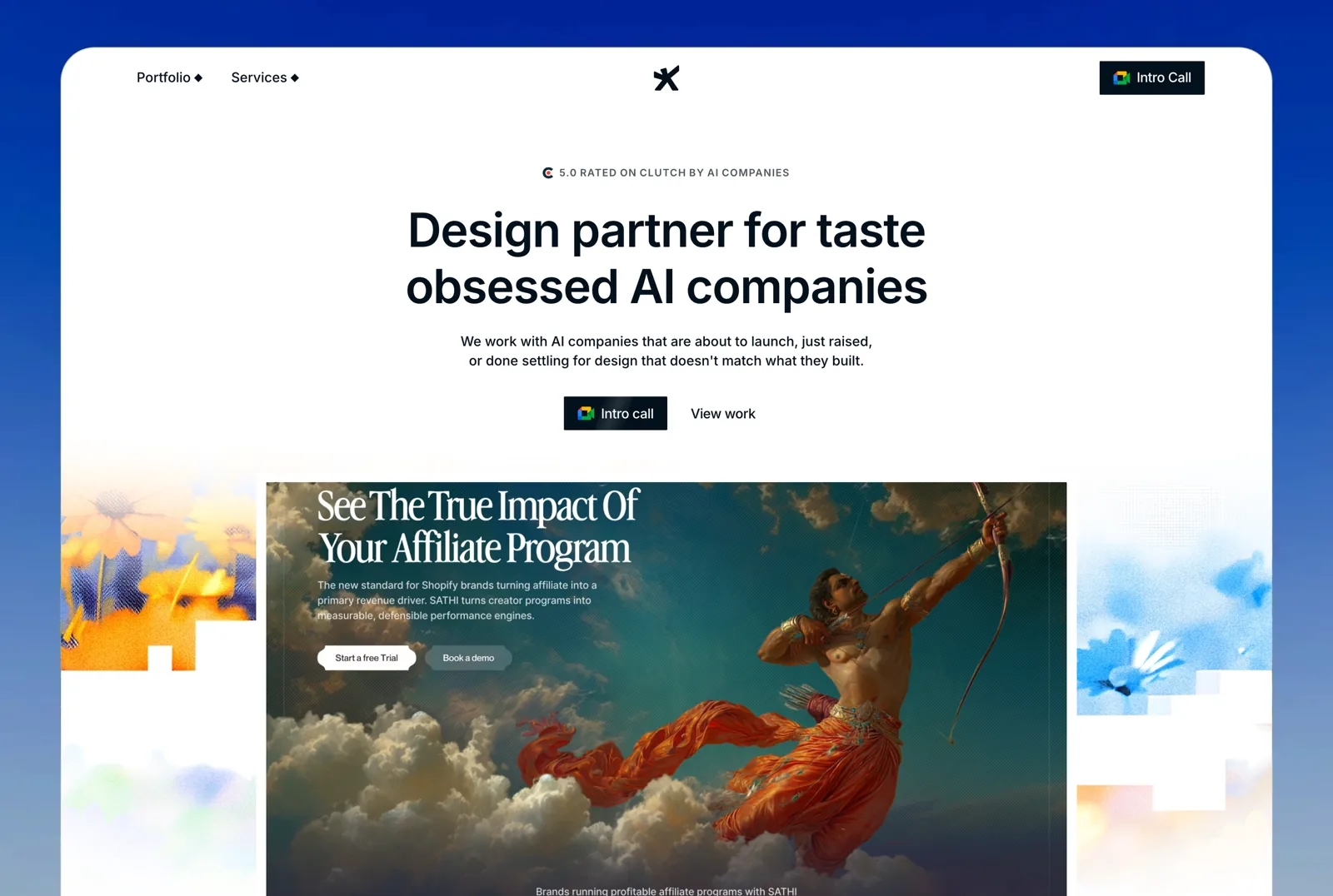
1. Studio Maydit: A Top-Rated Design Agency for AI Founders
Studio Maydit is a web and product design studio working with AI founders in the US, UK, and Europe. The studio builds websites in Framer, Webflow, and custom code, and continues into product design after the site ships.
The clearest outcome is Dualite, where design work supporting a repositioned ICP helped the product reach 100,000+ users in seven months. Recent clients include Wave, PixelFlow, Mi-VAD, and 15 other AI and SaaS teams.
Websites can be bought two ways. Fixed scope runs three to four weeks and suits teams with a launch date. Teams that keep shipping take a monthly retainer instead, covering new pages, campaigns, and product design, with no long lock-in. Fixed-scope projects end with a diagnosis of what is leaking in the product, not a handoff and goodbye.
| Check | Finding |
|---|---|
| Based in | Remote, serving US / UK / EU |
| Platform depth | Framer, Webflow, and custom code |
| AI-sector proof | Yes. AI-native clients, published outcome on Dualite |
| Pricing | Fixed scope or monthly retainer, quoted per project |
| Team shape | Founder-led, small senior team |
| Best fit | Search products that must describe a failed search back to the reader |
Maydit is the right call if your product works and the page still sounds like every other search tool. Book a 30-minute call.

2. Ramotion
Ramotion is a San Francisco team of 11 to 50 working since 2009, with a published minimum and Mozilla, Okta, Adobe, and Xero named. Mozilla is the reference that matters here, since browser and search work is the closest anyone on this list has come to persuading people to change a daily default. That is your exact problem, and it is a rare thing to have practised.
Their AI-sector proof is partial, Framer is one platform among several rather than the house craft, and a brand-led engagement at their scale runs longer than an early team usually wants.
| Check | Finding |
|---|---|
| Based in | San Francisco, USA |
| Founded | 2009 |
| Team size | 11-50 |
| Primary platform | Mixed |
| AI-sector proof | Partial. Enterprise and SaaS clients, no AI case study |
| Named clients | Mozilla, Okta, Netflix, Adobe, Xero |
| Pricing | Published minimum |
| Best fit | Teams asking people to change a daily default |
3. Push Refresh
Push Refresh is a Dallas team of 1 to 10 working in Framer with a published minimum and SmithRx and Synonym named. Framer as the actual craft matters for a search product more than for most, because your positioning will move as the index grows and the page has to keep up without an agency ticket every time.
Their AI-sector proof is partial, they publish no founding year, and a team of that size cannot take on a large site alongside an interactive demo.
| Check | Finding |
|---|---|
| Based in | Dallas, USA |
| Founded | Not published |
| Team size | 1-10 |
| Primary platform | Framer |
| AI-sector proof | Partial. Enterprise and SaaS clients, no AI case study |
| Named clients | SmithRx, Synonym, Northern National |
| Pricing | Published minimum |
| Best fit | Teams whose positioning changes faster than an agency queue |
4. Instrument
Instrument is a Portland studio working since 2005, with Nike, Microsoft, and Google named. Google is the obvious note, and the useful one is subtler: they have worked on products where the interface has to disappear so the content can be read. A results page lives or dies on that discipline, and few studios have practised it at this scale.
They publish neither pricing nor team size, their AI-sector proof is partial, Framer is not their centre, and their engagement scale sits well above an early search company.
| Check | Finding |
|---|---|
| Based in | Portland, USA |
| Founded | 2005 |
| Team size | Not published |
| Primary platform | Mixed |
| AI-sector proof | Partial. Enterprise and SaaS clients, no AI case study |
| Named clients | Nike, Microsoft, Electronic Arts, Google |
| Pricing | Not published |
| Best fit | Later-stage teams whose results page needs to get out of the way |
5. Feels Like
Feels Like is a Los Angeles studio founded in 2023 with published AI client work and Suno AI named alongside Google and LVMH. Suno is directly relevant because it is a product where visitors must be able to try the real thing immediately, which is exactly the demo problem you have. They build what they design, so a live demo is within reach rather than a wish.
They publish no pricing or team size, they are new enough to have a short record, and custom code means your team cannot edit the page without them.
| Check | Finding |
|---|---|
| Based in | Los Angeles, USA |
| Founded | 2023 |
| Team size | Not published |
| Primary platform | Custom code |
| AI-sector proof | Yes. Published AI client work |
| Named clients | Google, Nike, LVMH, Suno AI |
| Pricing | Not published |
| Best fit | Teams who need a real, working demo on the homepage |
6. Clay
Clay is a San Francisco firm of 51 to 200 with published AI work, a published minimum, and Slack, Stripe, Google, and Coinbase in public. Slack is the useful reference for a search product sold into companies, since finding things inside a company is the problem your buyer already associates with it. A studio that has worked on that mental model can position against it rather than around it.
They are a large premium firm, so senior attention is not guaranteed throughout, and Framer is one option among several rather than the specialism.
| Check | Finding |
|---|---|
| Based in | San Francisco, USA |
| Founded | 2016 |
| Team size | 51-200 |
| Primary platform | Mixed |
| AI-sector proof | Yes. Published AI client work |
| Named clients | Slack, Stripe, Google, Coinbase, Amazon |
| Pricing | Published minimum |
| Best fit | Teams selling internal search into companies that already have some |
7. Engine Digital
Engine Digital has been working since 2002 out of Vancouver and New York, with Autodesk, Goldman Sachs, and HP named. If you sell search into large regulated organisations, that roster is the argument. Those buyers care about how a system handles permissions and who can see which documents, and a studio used to institutional clients will raise that before you do.
They publish neither pricing nor team size, their AI-sector proof is partial, Framer is not their platform, and their scale suits companies well past an early raise.
| Check | Finding |
|---|---|
| Based in | Vancouver and New York |
| Founded | 2002 |
| Team size | Not published |
| Primary platform | Custom code |
| AI-sector proof | Partial. Enterprise and SaaS clients, no AI case study |
| Named clients | Adidas, Autodesk, Goldman Sachs, HP |
| Pricing | Not published |
| Best fit | Search sold into regulated organisations with permission rules |
8. Trueform
Trueform is a Swiss studio working in Framer with published AI client work, a published minimum, and Miro and Morning Brew named. Framer as the house craft plus real AI clients is an uncommon pair, and for a search product the practical benefit is that the example queries on your page can be rewritten the day your index changes.
They are a small studio, their work leans toward brand rather than interactive product surfaces, and Swiss hours give a US team limited daily overlap.
| Check | Finding |
|---|---|
| Based in | Wil, Switzerland |
| Founded | 2022 |
| Team size | Not published |
| Primary platform | Framer |
| AI-sector proof | Yes. Published AI client work |
| Named clients | Miro, Morning Brew, Bilt Rewards, Gather |
| Pricing | Published minimum |
| Best fit | Teams whose example queries need updating as often as the index |
9. Fantasy
Fantasy has been working since 1999 out of San Francisco and New York with published AI client work and a practice built around product rather than page. For search, the hardest design question sits inside the product: how to present an answer that is synthesised from several sources without hiding which parts came from where. Few studios here would treat that as the real brief.
They publish no pricing, no team size, and no client names, Framer is not their centre, and their engagement scale is far above an early-stage search company.
| Check | Finding |
|---|---|
| Based in | San Francisco and New York, USA |
| Founded | 1999 |
| Team size | Not published |
| Primary platform | Mixed |
| AI-sector proof | Yes. Published AI client work |
| Named clients | Not published |
| Pricing | Not published |
| Best fit | Later-stage teams whose hard problem is the answer surface itself |
10. SuperSkills
SuperSkills is a small Walnut Creek team of 1 to 10 with published AI client work. The case for them is the example queries, which are the highest-leverage words on an AI search homepage and are usually written last by whoever is free. In a team this size the person choosing those queries is the person who understands the product.
They publish no pricing, their named client record is thin at one company, Framer is not their stated specialism, and there is no depth behind the people you meet.
| Check | Finding |
|---|---|
| Based in | Walnut Creek, USA |
| Founded | Not published |
| Team size | 1-10 |
| Primary platform | Mixed |
| AI-sector proof | Yes. Published AI client work |
| Named clients | The Cut |
| Pricing | Not published |
| Best fit | Teams whose example queries need to be chosen by someone senior |
How to choose between them
Sort by which part of the switch is failing.
People read the page and see no reason to change. Studio Maydit or Ramotion.
Your demo is a video and it convinces nobody. Feels Like.
Buyers ask about permissions before they ask about results. Engine Digital.
The claims go stale every time the index grows. Push Refresh or Trueform.
One test before signing. Ask them to write three example queries for your homepage after ten minutes with the product. An agency that understands search will come back with specific, slightly awkward questions that sound like a real person having a bad day at work. An agency that returns three clean queries about quarterly reports has shown you it will design a page about search in general, and general is what the reader already has for free.