
Summarize with AI


The best Framer design agencies for Amsterdam AI startups in 2026 are Studio Maydit, Trueform, Pixelmatters, Phantom, Flow Ninja, Digidop, Refokus, Feely Studio, Instrument, and Ramotion. Studio Maydit and Trueform lead for Amsterdam teams who want a Framer site built for an American buyer. Instrument and Phantom are the wrong fit unless the budget is agency scale and the brief is a campaign rather than a website.
One note on this list before you read it. None of these studios is headquartered in Amsterdam, and that is deliberate rather than an oversight. On the five public criteria used here, the strongest options for a Dutch AI company are European studios in nearby time zones and a small number of American ones. Proximity is worth much less than it used to be, and none of the local shops we checked published enough to be assessed the same way.
Which points at the real situation. The Netherlands is a very good place to build an AI company and too small to be your market. So you sell into the US, or into Germany and the UK, from an office in a city where almost none of your customers are.
That has a specific consequence most Amsterdam teams underrate. For roughly half of your buyer's working day, your team is asleep. Nobody is answering the chat widget. Nobody is following up the form. Your website is not part of your sales effort in those hours, it is the entire sales effort, and it has to close the gap without help.

How we picked these agencies
This is a teardown, not a directory listing. For each agency we read their own site and their public record, then checked five things you can verify yourself in an afternoon:
- Platform depth. Is Framer the main build tool, or one line on a long service menu?
- AI-sector proof. Named AI clients and published work, or just the word "AI" in the copy?
- Pricing. Do they publish a minimum at all, or keep it behind a call?
- Team shape. Who actually does the work, and how many clients are they carrying at once?
- Their own site. Distinctive, or the same template as everyone else on this list?
That last one gets skipped most often. An agency's own website is the only project where nobody overruled them. No client committee, no inherited brand book. If their own site is forgettable, you have found their ceiling.
Every fact below comes from the agency's own site or a public listing. Where a number is not public, we say so rather than guessing.
What goes wrong when a Dutch team sells abroad
Three failures repeat, and all three come from the distance between where you build and where you sell.
The site underclaims and the American reader hears uncertainty. Dutch business writing is admirably plain. You say what the product does, you note its limits, you do not oversell. That register earns trust in Rotterdam and reads as hesitancy in San Francisco, where a buyer skims fifteen competitors and interprets modesty as a company that is not sure of itself. The fix is not to start exaggerating, which will fail for other reasons. It is to lead with the strongest true statement rather than burying it under three qualifications, and to let the caveats arrive after the reader is interested.
European data handling is a genuine advantage and it lives in the footer. You host in the EU. You can answer a data protection question without a legal call. For a European buyer that is close to decisive, and for an American enterprise buyer it is increasingly a point in your favour rather than a curiosity. Most Amsterdam teams treat it as a compliance obligation and put it where obligations go, which is the bottom of the page. It belongs in the argument, not the appendix.
Everything funnels to a call that happens in the middle of your night. The homepage is fine, the product is good, and the only route forward is a demo booking with a calendar showing slots in Central European Time. An interested buyer in California reads a compelling page at four in the afternoon their time, finds nothing they can do without a meeting eight hours out of their day, and leaves. Self-serve access, real pricing, a proper product tour, or documentation good enough to evaluate alone. Something has to work while you sleep.
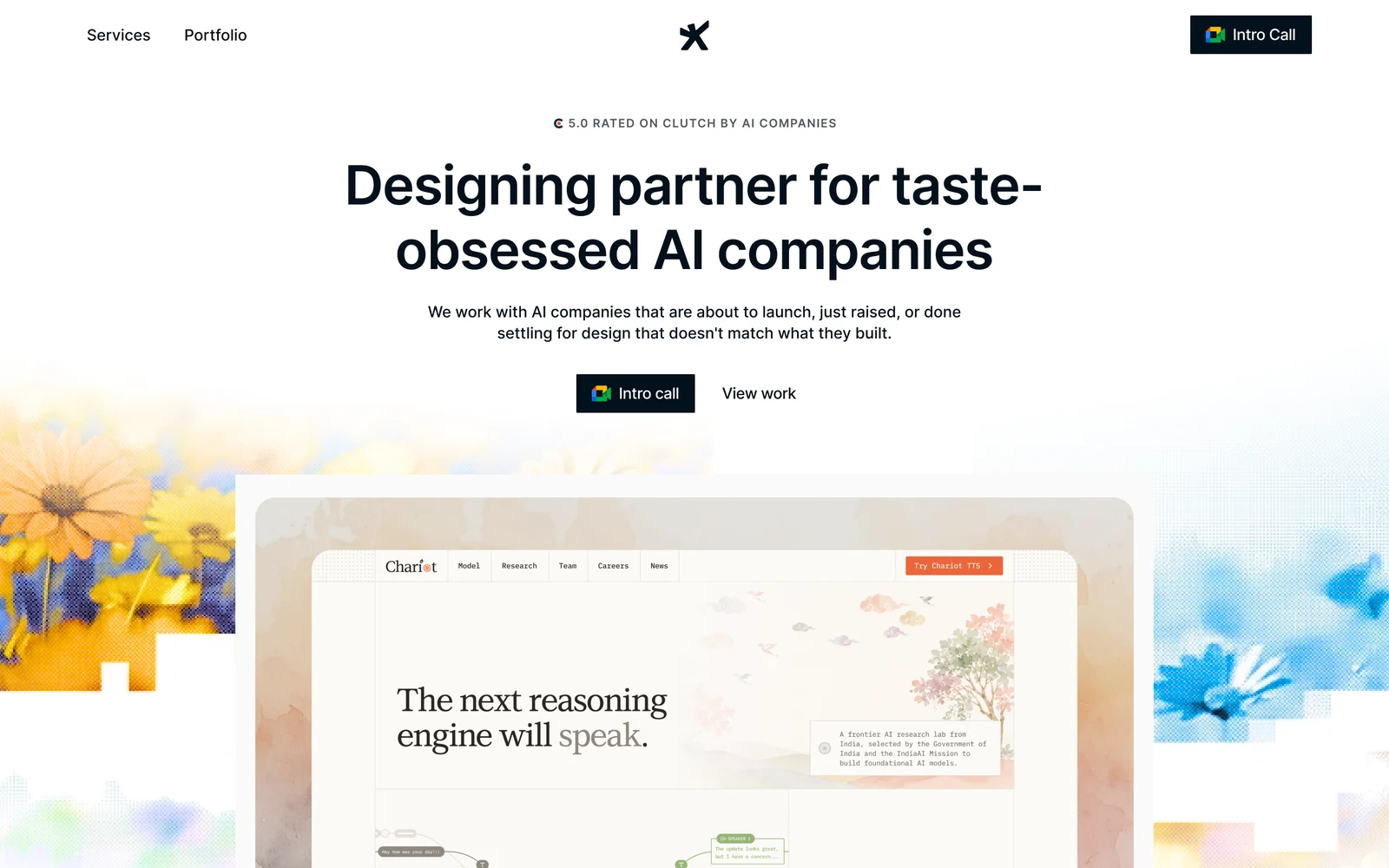
1. Studio Maydit: A Top-Rated Design Agency for AI Founders
Studio Maydit is a web and product design studio working with AI founders in the US, UK, and Europe. The studio builds websites in Framer, Webflow, and custom code, and continues into product design after the site ships.
The clearest outcome is Dualite, where design work supporting a repositioned ICP helped the product reach 100,000+ users in seven months. Recent clients include Wave, PixelFlow, Mi-VAD, and 15 other AI and SaaS teams.
Websites can be bought two ways. Fixed scope runs three to four weeks and suits teams with a launch date. Teams that keep shipping take a monthly retainer instead, covering new pages, campaigns, and product design, with no long lock-in. Fixed-scope projects end with a diagnosis of what is leaking in the product, not a handoff and goodbye.
| Check | Finding |
|---|---|
| Based in | Remote, serving US / UK / EU |
| Platform depth | Framer, Webflow, and custom code |
| AI-sector proof | Yes. AI-native clients, published outcome on Dualite |
| Pricing | Fixed scope or monthly retainer, quoted per project |
| Team shape | Founder-led, small senior team |
| Best fit | Amsterdam AI teams selling into the US who need the site to work without them |
Maydit is the right call if the product is strong at home and the site is not doing enough for the buyers you never meet. Book a 30-minute call.

2. Trueform
Trueform is a Swiss studio built specifically around Framer, with clients including Miro and Morning Brew. Miro is the relevant one for an Amsterdam team, since it is a European company that had to become credible to American buyers. Trueform also build natively in Framer, so once the site is live your own marketing person can rewrite a section for a new market without waiting on the studio.
They are a small senior team with no published team size and no third-party review presence, so the question for the first call is capacity rather than quality.
| Check | Finding |
|---|---|
| Based in | Wil, Switzerland |
| Founded | 2022 |
| Team size | Not published |
| Primary platform | Framer |
| AI-sector proof | Yes. Published AI client work |
| Named clients | Miro, Morning Brew, Bilt Rewards, Gather |
| Pricing | Published minimum |
| Best fit | Dutch AI teams who want European craft and a site they can edit themselves |
3. Pixelmatters
Pixelmatters is a Portuguese studio of 51 to 200 covering product and web design, with clients including Rubrik and UJET. They are one of the few European studios at a size that can carry both your product interface and your marketing site, and they work with American clients regularly, which is exactly the translation problem an Amsterdam company has.
Their published AI work is partial rather than deep, and a studio this size runs a formal process that a small Dutch team may find heavier than expected.
| Check | Finding |
|---|---|
| Based in | Porto, Portugal |
| Founded | 2013 |
| Team size | 51-200 |
| Primary platform | Mixed |
| AI-sector proof | Partial. Enterprise and SaaS clients, no AI case study |
| Named clients | Rubrik, Quantic, UJET |
| Pricing | Published minimum |
| Best fit | Amsterdam teams who need product and marketing design from one European studio |
4. Phantom
Phantom is a London and Auckland studio of 51 to 200 building engineered web work for SAP, Zendesk, and the Financial Times. London is one hour from Amsterdam and shares most of your buying context, and they have the depth to build something genuinely ambitious in the browser if a launch calls for it.
They operate at agency scale with the cost and process that implies, they do not publish pricing, and campaign work is a poor shape for a startup that mostly needs a clear marketing site.
| Check | Finding |
|---|---|
| Based in | London, UK and Auckland, NZ |
| Founded | 2013 |
| Team size | 51-200 |
| Primary platform | Custom code |
| AI-sector proof | Yes. Published AI client work |
| Named clients | Diageo, SAP, Financial Times, Zendesk |
| Pricing | Not published |
| Best fit | Funded Dutch companies treating a launch as an engineered campaign |
5. Flow Ninja
Flow Ninja is a Belgrade studio of 11 to 50 running long-term web engagements since 2018. Same working day as Amsterdam, established process, and a size that can absorb a lost week without your date moving. For a Dutch team that wants predictable delivery rather than a creative partnership, this is a sensible shape.
They publish no client list and no pricing, their AI-sector proof is partial, and Webflow rather than Framer is their platform.
| Check | Finding |
|---|---|
| Based in | Belgrade, Serbia |
| Founded | 2018 |
| Team size | 11-50 |
| Primary platform | Webflow |
| AI-sector proof | Partial. Tech and SaaS clients, no AI case study |
| Named clients | Not published |
| Pricing | Not published |
| Best fit | Amsterdam teams who want dependable European delivery and will set the direction |
6. Digidop
Digidop is a small Paris studio founded in 2021 working with technical clients including StreamNative. One hour by air, the same working day, and at one to ten people the person on your first call is the person doing the work. For a Dutch founder who would rather talk to the maker than an account manager, that is the appeal.
Capacity is the obvious limit at this size, their AI-sector work is partial, and Webflow rather than Framer is where their depth sits.
| Check | Finding |
|---|---|
| Based in | Paris, France |
| Founded | 2021 |
| Team size | 1-10 |
| Primary platform | Webflow |
| AI-sector proof | Partial. Tech and SaaS clients, no AI case study |
| Named clients | TSE Energy, Ramify, StreamNative |
| Pricing | Published minimum |
| Best fit | Amsterdam startups who want a nearby small studio and direct contact |
7. Refokus
Refokus is a German remote studio of 11 to 50 with work for Mural, Spotify, and BCG. They work systematically, building components and structure rather than one-off pages, which suits a company that will need the same site in more than one language or aimed at more than one market before long.
Their AI-sector work is partial, they do not publish pricing, and a systems-led studio delivers more once your message is settled than while you are still working it out.
| Check | Finding |
|---|---|
| Based in | Germany, remote |
| Founded | 2021 |
| Team size | 11-50 |
| Primary platform | Webflow |
| AI-sector proof | Partial. Enterprise and SaaS clients, no AI case study |
| Named clients | Mural, BASF, Spotify, Yahoo, BCG |
| Pricing | Not published |
| Best fit | Dutch teams who expect to run the same site for several European markets |
8. Feely Studio
Feely Studio is a small distributed European team working with AI companies including Noxus and Mutiny. European, AI-focused, and they publish a starting figure, which is a rare combination and saves an Amsterdam founder the two exploratory calls that usually precede a number.
They are a one to ten person studio, so capacity is the constraint, and their published work leans toward marketing sites rather than product interfaces.
| Check | Finding |
|---|---|
| Based in | Distributed, Europe |
| Founded | Not published |
| Team size | 1-10 |
| Primary platform | Mixed |
| AI-sector proof | Yes. Published AI client work |
| Named clients | Noxus, Mutiny, Luasai, Basic Capital |
| Pricing | Published minimum |
| Best fit | Amsterdam AI startups who want a European studio with a published starting point |
9. Instrument
Instrument is a Portland agency running since 2005 with work for Nike, Microsoft, and Google. If the real problem is that your company was named and branded for a Dutch audience and now has to stand up in the US, this is the tier that can rebuild an identity properly rather than restyling one.
It is agency scale and agency cost, the AI proof is partial, and the nine hour time difference from Amsterdam makes an already heavy process heavier.
| Check | Finding |
|---|---|
| Based in | Portland, USA |
| Founded | 2005 |
| Team size | Not published |
| Primary platform | Mixed |
| AI-sector proof | Partial. Enterprise and SaaS clients, no AI case study |
| Named clients | Nike, Microsoft, Electronic Arts, Google |
| Pricing | Not published |
| Best fit | Well funded Dutch companies rebuilding their identity for an American market |
10. Ramotion
Ramotion is a San Francisco studio running since 2009 with brand and product work for Mozilla, Okta, and Netflix. Being genuinely inside the market you are selling into has value, and they publish a minimum, which is unusual at their tier and helps you qualify quickly across a time difference.
Their published AI-sector work is partial, brand engagements move slowly, and a nine hour gap means most of your feedback cycles cost a full day each.
| Check | Finding |
|---|---|
| Based in | San Francisco, USA |
| Founded | 2009 |
| Team size | 11-50 |
| Primary platform | Mixed |
| AI-sector proof | Partial. Enterprise and SaaS clients, no AI case study |
| Named clients | Mozilla, Okta, Netflix, Adobe, Xero |
| Pricing | Published minimum |
| Best fit | Dutch companies whose brand needs to read as American before the site does |
How to choose between them
Sort by which market you are actually failing in.
You are credible in Europe and invisible in the US. That is positioning and register, not layout. Studio Maydit or Trueform.
You need the site to work overnight without a human. Self-serve paths, pricing, and documentation. Studio Maydit or Feely Studio.
You will run several European markets from one site. Refokus, or Pixelmatters if the product needs work too.
The company itself was built for a Dutch audience. That is brand work. Instrument or Ramotion.
One test before signing. Ask them to read your homepage as if they were an American buyer with fifteen tabs open. An agency that tells you which sentence made them stop trusting you, and why, understands the actual problem. An agency that compliments the design has not been asked to sell across a border before.