

Summarize with AI


The best Framer design agencies for B2B AI SaaS companies in 2026 are Studio Maydit, Trueform, Push Refresh, Fantasy, SuperSkills, Lazarev, Feely Studio, Clay, Ramotion, and Lighthouse Digital. Studio Maydit and Trueform lead for this brief, because both are genuine Framer specialists with published AI client work, and B2B sites need to change weekly without an engineer being pulled off the product. Lighthouse Digital and Fantasy are the wrong fit here, since one builds in Webflow with no published AI work, and the other publishes neither pricing nor client names, which is a hard sell when your own buyers are about to scrutinise everything.
Nobody buys business software on their own. The person who finds you is almost never the person who signs.
An engineer or an operations lead runs into your product, likes it, and becomes your champion. Then they have to walk down the hall and convince three other people: somebody who owns the budget, somebody who owns security, and somebody who has been burned by a tool nobody ended up using.
Which means your homepage is read twice, by two readers who want opposite things. The first wants to know it is powerful and will make their week easier. The second is scanning for reasons to say no, and finds them fastest in the things you did not put on the page.
Most AI SaaS sites are built entirely for the first reader. They are fast, confident, and full of product. Then the champion goes quiet, and the deal does not die from a lost argument. It dies because nobody ever had the argument, since your champion could not find a page worth forwarding.
The second reader is also the one for whom the word AI creates work rather than saving it. To a practitioner it signals capability. To a security reviewer it opens a file of questions about models, data, and where things are stored.
The ten studios below are ranked on how well they build for both readers at once.

How we picked these agencies
This is a teardown, not a directory listing. For each agency we read their own site and their public record, then checked five things you can verify yourself in an afternoon:
- Platform depth. Is one craft their real specialism, or one line on a long service menu?
- AI-sector proof. Named AI clients and published work, or just the word "AI" in the copy?
- Pricing. Do they publish a minimum at all, or keep it behind a call?
- Team shape. Who actually does the work, and how many clients are they carrying at once?
- Their own site. Distinctive, or the same template as everyone else on this list?
That last one gets skipped most often. An agency's own website is the only project where nobody overruled them. No client committee, no inherited brand book. If their own site is forgettable, you have found their ceiling.
Every fact below comes from the agency's own site or a public listing. Where a number is not public, we say so rather than guessing.
What goes wrong when the site only speaks to the champion
Three failures repeat, and each one shows up as a deal that goes quiet rather than a deal that is lost.
There is nothing to forward. Your champion has to make your case in a meeting you are not in, using a link. If the only link is a homepage full of product demos, they arrive with enthusiasm and no material. What they needed was a page that states plainly where data is processed, whether it trains anything, what the plans cost, and what happens when the model gets something wrong. Companies find these pages boring to build because they convince nobody on their own. They are not meant to. Their job is to survive a sceptical reading by somebody who will never see the demo.
The word AI is doing work that a proof point should do. In consumer products the term still carries weight. In a business purchase it triggers a checklist, since the reviewer has to establish which model, whose infrastructure, what happens to customer records, and whether an answer can be traced when a customer disputes it. A site that leads with AI and never answers those questions has raised the objection and left it standing. The stronger move is to name the mechanism and the boundary early, and let the capability claim follow it rather than lead.
The page argues craft to somebody who has to argue money. A practitioner reads about the workflow and understands the value instantly. The person approving the spend needs it in a different currency: what this replaces, how many hours it returns, what the cost of the current process is. Almost no AI SaaS site does that arithmetic, so the champion improvises a business case in a slide, badly, and it competes against three other requests where somebody did the work properly. Giving them the numbers is not marketing fluff. It is the difference between a champion who can advocate and one who can only recommend.
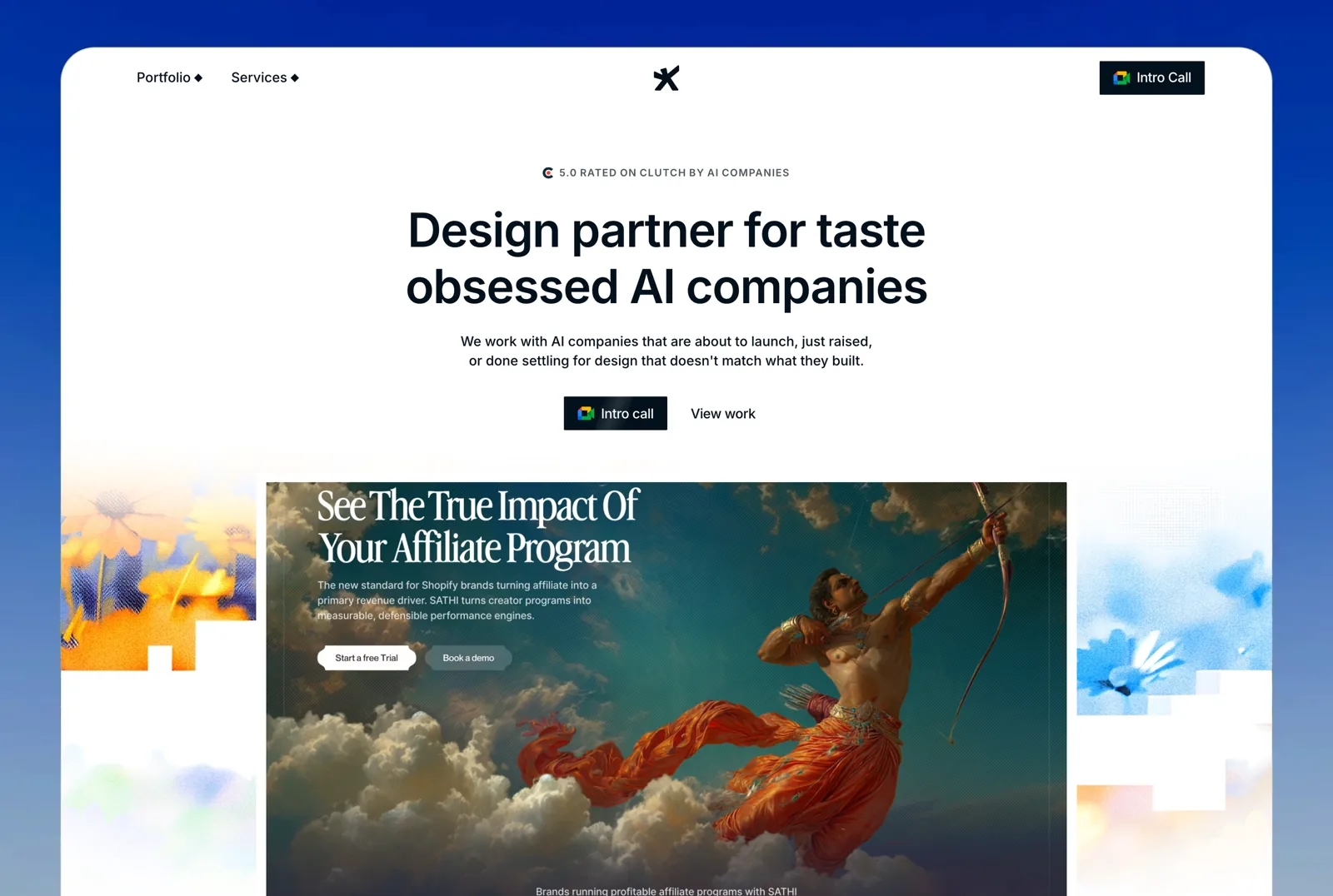
1. Studio Maydit: A Top-Rated Design Agency for AI Founders
Studio Maydit is a web and product design studio working with AI founders in the US, UK, and Europe. The studio builds websites in Framer, Webflow, and custom code, and continues into product design after the site ships.
The clearest outcome is Dualite, where design work supporting a repositioned ICP helped the product reach 100,000+ users in seven months. Recent clients include Wave, PixelFlow, Mi-VAD, and 15 other AI and SaaS teams.
Websites can be bought two ways. Fixed scope runs three to four weeks and suits teams with a launch date. Teams that keep shipping take a monthly retainer instead, covering new pages, campaigns, and product design, with no long lock-in. Fixed-scope projects end with a diagnosis of what is leaking in the product, not a handoff and goodbye.
| Check | Finding |
|---|---|
| Based in | Remote, serving US / UK / EU |
| Platform depth | Framer, Webflow, and custom code |
| AI-sector proof | Yes. AI-native clients, published outcome on Dualite |
| Pricing | Fixed scope or monthly retainer, quoted per project |
| Team shape | Founder-led, small senior team |
| Best fit | B2B teams who need pages a champion can actually forward |
Maydit is the right call if your deals stall after the demo and you cannot see where. Book a 30-minute call.

2. Trueform
Trueform is a Swiss studio founded in 2022, working in Framer, with a published minimum and Miro, Morning Brew, Bilt Rewards, and Gather named, plus published AI client work. Miro is the most useful reference on this list for a B2B seller, because it is a product bought by one team and then defended to a procurement process, which is the exact path your champion has to walk.
They publish no team size, they are a young studio without a long enterprise record, and a Swiss team overlaps only partly with US hours when a pricing page needs changing before a Monday board meeting.
| Check | Finding |
|---|---|
| Based in | Wil, Switzerland |
| Founded | 2022 |
| Team size | Not published |
| Primary platform | Framer |
| AI-sector proof | Yes. Published AI client work |
| Named clients | Miro, Morning Brew, Bilt Rewards, Gather |
| Pricing | Published minimum |
| Best fit | Products bought by a team then defended to procurement |
3. Push Refresh
Push Refresh is a Dallas team of one to ten working in Framer, with a published minimum and SmithRx, Synonym, and Northern National named. SmithRx sells into healthcare, where every claim gets checked by somebody paid to check claims, so the studio has built for the sceptical second reader rather than only the enthusiastic first one.
Their AI-sector proof is partial, they publish no founding year, and a team of one to ten will be the constraint if your site needs several new pages in the same month.
| Check | Finding |
|---|---|
| Based in | Dallas, USA |
| Founded | Not published |
| Team size | 1-10 |
| Primary platform | Framer |
| AI-sector proof | Partial. Enterprise and SaaS clients, no AI case study |
| Named clients | SmithRx, Synonym, Northern National |
| Pricing | Published minimum |
| Best fit | B2B sellers in regulated or heavily scrutinised markets |
4. Fantasy
Fantasy works from San Francisco and New York, founded in 1999, across platforms, with published AI client work. They have designed enterprise software since long before the current wave, which means they treat the buying committee as a normal design constraint rather than a discovery, and that instinct is uncommon among studios who mostly build launch sites.
They publish no pricing, no team size, and no client names, so there is unusually little to verify from outside, and a firm with that history is built for substantial engagements rather than a Framer site a small team edits weekly.
| Check | Finding |
|---|---|
| Based in | San Francisco and New York, USA |
| Founded | 1999 |
| Team size | Not published |
| Primary platform | Mixed |
| AI-sector proof | Yes. Published AI client work |
| Named clients | Not published |
| Pricing | Not published |
| Best fit | Enterprise AI products with a long, formal buying process |
5. SuperSkills
SuperSkills is a Walnut Creek team of one to ten working across platforms, with The Cut named, plus published AI client work. A small mixed-platform team can move between the marketing site and the in-product screens without a handover, which matters when the objection blocking your deals turns out to live inside the onboarding rather than on the homepage.
They publish no pricing, no founding year, and only one client name, so there is very little public record to judge them on, and a team that size has no capacity buffer when a large B2B site needs a security and compliance section built quickly.
| Check | Finding |
|---|---|
| Based in | Walnut Creek, USA |
| Founded | Not published |
| Team size | 1-10 |
| Primary platform | Mixed |
| AI-sector proof | Yes. Published AI client work |
| Named clients | The Cut |
| Pricing | Not published |
| Best fit | Small teams whose site and product problems are the same problem |
6. Lazarev
Lazarev is a San Francisco team of 51 to 200, founded in 2015, working across platforms, with a published minimum and Payoneer, Peel, Elva, and Mozayix named, plus published AI client work. Payoneer moves money for businesses under real regulatory scrutiny, so the studio has worked where trust signals are not decoration, and a B2B AI site needs those signals to survive a second reader.
Their published work leans towards product design rather than marketing sites, their published minimum aims at funded companies, and a firm of that size moves at a pace that suits a redesign rather than the weekly edits a Framer site exists to make easy.
| Check | Finding |
|---|---|
| Based in | San Francisco, USA |
| Founded | 2015 |
| Team size | 51-200 |
| Primary platform | Mixed |
| AI-sector proof | Yes. Published AI client work |
| Named clients | Payoneer, Peel, Elva, Mozayix |
| Pricing | Published minimum |
| Best fit | B2B products where trust signals decide the deal |
7. Feely Studio
Feely Studio is a small distributed European team of one to ten, working across platforms, with a published minimum and Noxus, Mutiny, Luasai, and Basic Capital named, plus published AI client work. Mutiny is a company whose entire product is about how a B2B page performs for different buyers, so the studio has worked directly on the problem of one site speaking to several readers at once.
They publish no founding year, a team of that size has hard capacity limits, and working across platforms means Framer is one of several things they do rather than their deepest specialism.
| Check | Finding |
|---|---|
| Based in | Distributed, Europe |
| Founded | Not published |
| Team size | 1-10 |
| Primary platform | Mixed |
| AI-sector proof | Yes. Published AI client work |
| Named clients | Noxus, Mutiny, Luasai, Basic Capital |
| Pricing | Published minimum |
| Best fit | Teams tailoring one site to several different buyers |
8. Clay
Clay is a San Francisco team of 51 to 200, founded in 2016, working across platforms, with a published minimum and Slack, Stripe, Google, Coinbase, and Amazon named, plus published AI client work. Stripe is the reference worth studying here, since it is the clearest example of a site that satisfies a curious engineer and a cautious reviewer on the same page without either feeling talked down to.
They are built for large accounts, so a company under fifty people is unlikely to get their best week, their published minimum is aimed well above early stage, and Framer is one platform among several rather than their specialism.
| Check | Finding |
|---|---|
| Based in | San Francisco, USA |
| Founded | 2016 |
| Team size | 51-200 |
| Primary platform | Mixed |
| AI-sector proof | Yes. Published AI client work |
| Named clients | Slack, Stripe, Google, Coinbase, Amazon |
| Pricing | Published minimum |
| Best fit | Funded B2B companies rebuilding the whole site at once |
9. Ramotion
Ramotion is a San Francisco team of 11 to 50, founded in 2009, working across platforms, with a published minimum and Mozilla, Okta, Netflix, Adobe, and Xero named. Okta is the relevant one for this brief, because it is sold to the security function itself, and a studio that has made that audience comfortable knows how much of a B2B page has to be plain statement rather than persuasion.
Their AI-sector proof is partial, their strength is brand and identity rather than the conversion mechanics of a B2B site, and their engagements assume a stable message rather than a positioning that shifts each quarter.
| Check | Finding |
|---|---|
| Based in | San Francisco, USA |
| Founded | 2009 |
| Team size | 11-50 |
| Primary platform | Mixed |
| AI-sector proof | Partial. Enterprise and SaaS clients, no AI case study |
| Named clients | Mozilla, Okta, Netflix, Adobe, Xero |
| Pricing | Published minimum |
| Best fit | B2B companies whose brand has fallen behind the product |
10. Lighthouse Digital
Lighthouse Digital is a London Webflow studio with a published minimum and HelloSelf, Freetrade, and IGN named. Freetrade operates in a market where every public claim is regulated, so the studio is used to writing pages that hold up under checking, which is half of what a B2B AI site has to do.
They publish no team size and no founding year, they have no published AI client work, and their platform is Webflow rather than Framer, so the specific brief that brought you here is not what they build.
| Check | Finding |
|---|---|
| Based in | London, UK |
| Founded | Not published |
| Team size | Not published |
| Primary platform | Webflow |
| AI-sector proof | No. No published AI client work |
| Named clients | HelloSelf, Freetrade, IGN |
| Pricing | Published minimum |
| Best fit | UK B2B teams who have already settled on Webflow |
How to choose between them
Sort by which reader you are currently losing.
The champion has nothing worth forwarding. Studio Maydit or Trueform.
Security and compliance kill deals late. Push Refresh or Lazarev.
One site has to serve several buyer types. Feely Studio or Clay.
The brand looks smaller than the product is. Ramotion or Fantasy.
One test before signing. Ask them to describe the page your champion would send to a finance lead, and what would be on it. A studio that has built for B2B will start listing unglamorous things: pricing, what it replaces, where data goes, what happens when it is wrong. A studio that describes a better hero section has only ever designed for the person who already likes you, and that person was never the problem.