Summarize with AI


The best Framer design agencies for engineer-led startups in 2026 are Studio Maydit, Trueform, Push Refresh, Pixelmatters, Foundey, Instrument, BX Studio, Kvalifik, Engine Digital, and Ramotion. Studio Maydit and Trueform lead for this brief, because both work in Framer as a primary craft rather than a side offering, and both publish enough about how they work that a technical buyer can evaluate the process before the first call. Engine Digital and Instrument are the wrong fit here, since both are built for large organisations with procurement cycles and internal marketing teams, and neither publishes pricing, which is a poor match for a founder who wants a number and a date.
A team led by engineers has an unusual relationship with its own website.
Everything else the company builds gets judged against something. Tests pass or fail. Latency is a number. A pull request gets read by somebody who will say so if it is wrong.
The marketing site has none of that. It ships, and then it sits there, and no signal ever comes back that would tell you whether it is doing its job.
So it gets treated the way engineers treat any system with no observability. Somebody rewrites it, because rewriting is the thing you can actually do.
The second pattern is quieter. Engineer-led teams are unusually good at building the site themselves, which means they usually do, and it usually takes a weekend, and it is usually fine. Fine is the problem. It costs nothing to keep, so nobody ever revisits it, and two years later the company has changed completely and the homepage still describes the first version of the product.
There is also a trust question about Framer specifically. It is a hosted tool. You do not own the runtime, you cannot grep it, and for a certain kind of technical founder that is enough to rule it out before the trade-off is examined.
The ten studios below are ranked on how well they hold up to a technical buyer who will ask exactly those questions.

How we picked these agencies
No rankings were bought and nobody was asked for a pitch. We looked at each studio the way you would review an unfamiliar dependency, checking what is public, what is claimed, and what the two together add up to:
- Platform depth. Is Framer the thing they are genuinely good at, or one item on a menu of six?
- Proof with technical teams. Have they shipped for companies where engineers hold the opinions, or only for marketing departments?
- Pricing. Is there a published starting number, or does every answer require a call?
- Team shape. How many people, and is the person you meet the person who does the work?
- Their own site. Built with care, or assembled from the same template as the rest of the industry?
That last check does more work than it looks like it does. A studio's own website is the only brief where there was no client to compromise with, so it shows you the ceiling rather than the average. If it is dull, you have your answer.
Everything in the tables comes from public sources, mostly the agency's own site. Where a figure is not published, the table says so instead of estimating.
What goes wrong when engineers own the website
Three patterns show up again and again, and all three come from applying good engineering instincts to a problem that does not reward them.
The site becomes somebody's side project. A founding engineer builds it, and because they built it, they own it forever. Every copy change is a pull request. Every new page waits for a gap between features. The cost never appears anywhere, because it is paid in the attention of the most expensive person in the company, an hour at a time. The fix is not to hand the work to a designer, it is to move the site somewhere a non-engineer can change it without asking permission. That single move usually returns more engineering time than any tool the team has bought this year.
Craft gets pointed at the wrong axis. Technical teams build fast sites. Perfect scores, tiny bundles, no layout shift. Then the page fails anyway, because the visitor did not understand what the product does within a few seconds and left while the page was still winning on every metric being measured. Speed is necessary and it is not the constraint. The constraint is whether a stranger can explain your product back to you after reading the first screen, and no tool in the stack reports on that.
Design turns into an argument nobody can win. With no shared standard for what good looks like, review becomes a set of individual opinions, and the loudest or most senior one wins. Engineers find this genuinely unpleasant, because it resembles nothing else in their working week. Decisions get relitigated, the launch slips twice, and the version that ships is the one everybody had stopped caring about. The way out is to agree beforehand what the page is for and how you will know if it worked, then let that settle the arguments instead of taste.
1. Studio Maydit: A Top-Rated Design Agency for AI Founders
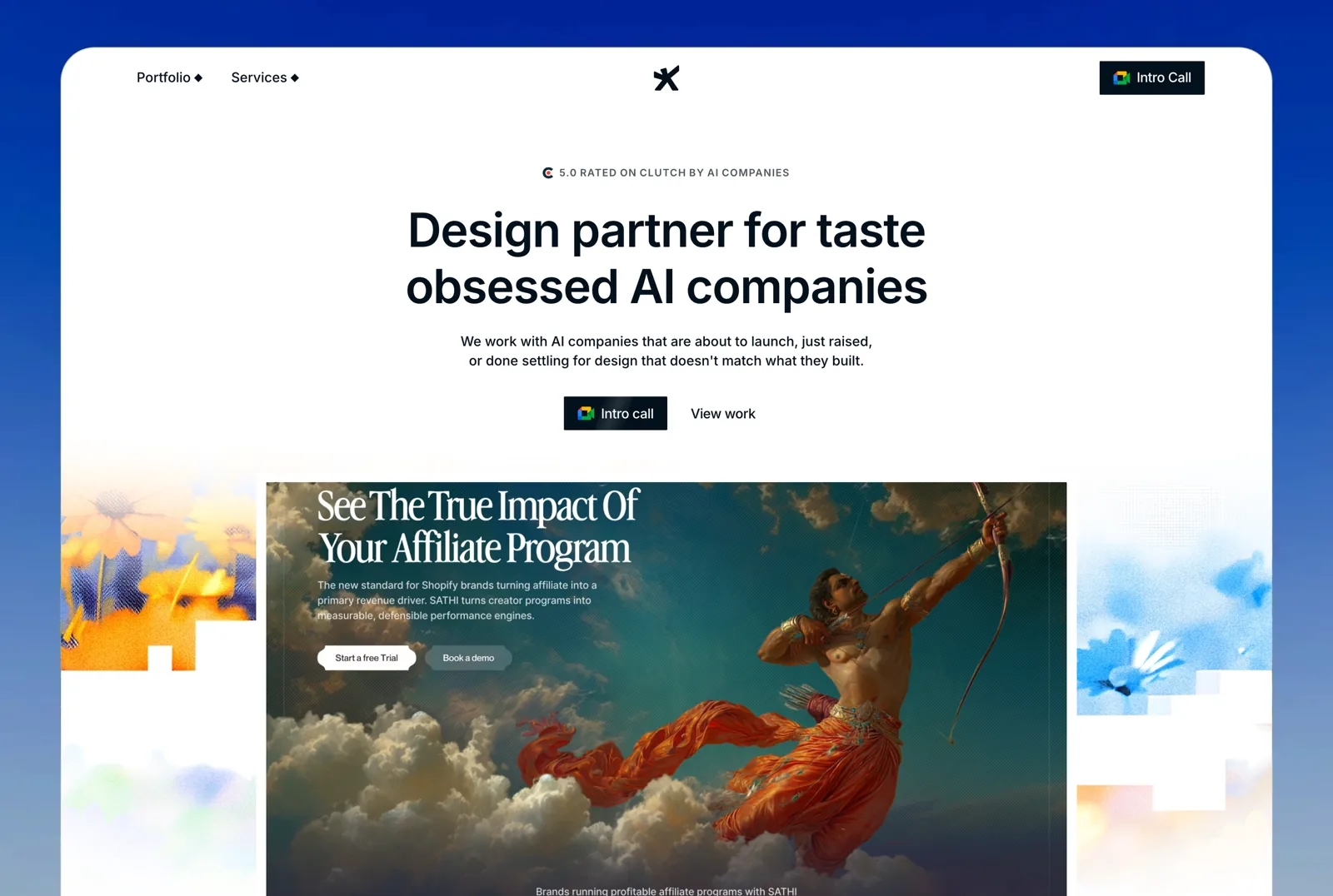
Most of the studios here will show you a portfolio. Studio Maydit is a web and product design studio that works with AI founders in the US, UK, and Europe, and the more useful fact for a technical team is where the work stops. It does not stop at launch. The studio builds in Framer, Webflow, and custom code, and carries on into product design once the site is live, which is the half of the job most website engagements leave to you.
Wave, PixelFlow, Mi-VAD, and 15 other AI and SaaS teams make up the recent client list. Only one of them carries a published number: seven months after design work supporting a repositioned ICP, Dualite had passed 100,000+ users.
Buying is deliberately simple, which tends to matter to people who dislike sales processes. Fixed scope takes three to four weeks and suits a team with a date to hit. Teams shipping continuously use a monthly retainer covering new pages, campaigns, and product design, with no long lock-in. A fixed-scope engagement closes with a diagnosis of what is leaking in the product rather than a handover and silence.
| Check | Finding |
|---|---|
| Based in | Remote, serving US / UK / EU |
| Platform depth | Framer, Webflow, and custom code |
| AI-sector proof | Yes. AI-native clients, published outcome on Dualite |
| Pricing | Fixed scope or monthly retainer, quoted per project |
| Team shape | Founder-led, small senior team |
| Best fit | Technical teams who want the site off engineering's plate |
Worth a call if your best engineer is still the person who edits the homepage. Book a 30-minute call.

2. Trueform
Trueform is a Swiss studio founded in 2022, working in Framer, with Miro, Morning Brew, Bilt Rewards, and Gather named and a published minimum. For an engineer-led team they are an unusually legible option, because the price is knowable in advance and the specialism is narrow enough to be checked rather than taken on faith.
They do not publish a team size, which makes capacity impossible to judge, and a studio founded in 2022 has a short record for a buyer who wants to see how work has aged.
| Check | Finding |
|---|---|
| Based in | Wil, Switzerland |
| Founded | 2022 |
| Team size | Not published |
| Primary platform | Framer |
| AI-sector proof | Yes. Published AI client work |
| Named clients | Miro, Morning Brew, Bilt Rewards, Gather |
| Pricing | Published minimum |
| Best fit | Teams who want a Framer specialist with a public price |
3. Push Refresh
Push Refresh is a Dallas team of one to ten working in Framer, with a published minimum and SmithRx, Synonym, and Northern National named. A team that size removes the layer engineers complain about most, since there is no account manager translating between you and whoever is doing the work.
Their AI-sector proof is partial, they publish no founding year, and one to ten people means no redundancy, so a single absence is felt immediately.
| Check | Finding |
|---|---|
| Based in | Dallas, USA |
| Founded | Not published |
| Team size | 1-10 |
| Primary platform | Framer |
| AI-sector proof | Partial. Enterprise and SaaS clients, no AI case study |
| Named clients | SmithRx, Synonym, Northern National |
| Pricing | Published minimum |
| Best fit | Founders who want to talk to the builder directly |
4. Pixelmatters
Pixelmatters is a Porto team of 51 to 200, founded in 2013, working across platforms, with Rubrik, Quantic, and UJET named and a published minimum. They are structured like a software company rather than a creative shop, which technical buyers usually find easier to work with, and they can take on product screens as well as marketing pages.
Their AI-sector proof is partial, and a firm of that size runs assigned teams, so the people on your project change between phases in a way a nine person studio never does.
| Check | Finding |
|---|---|
| Based in | Porto, Portugal |
| Founded | 2013 |
| Team size | 51-200 |
| Primary platform | Mixed |
| AI-sector proof | Partial. Enterprise and SaaS clients, no AI case study |
| Named clients | Rubrik, Quantic, UJET |
| Pricing | Published minimum |
| Best fit | Teams who need marketing and product handled together |
5. Foundey
Foundey is a San Francisco studio founded in 2021 working in Figma, with DemandIQ, Traycer, and Sero AI named. Their client list is genuinely AI-native and early stage, so the conversation starts from a shared understanding of what a technical product is and who buys it.
They publish no pricing and no team size, and Figma-only means somebody still has to build the result, which for an engineer-led team usually means you.
| Check | Finding |
|---|---|
| Based in | San Francisco, USA |
| Founded | 2021 |
| Team size | Not published |
| Primary platform | Figma-only |
| AI-sector proof | Yes. Published AI client work |
| Named clients | DemandIQ, Traycer, Sero AI |
| Pricing | Not published |
| Best fit | Teams with build capacity who only need design |
6. Instrument
Instrument is a Portland studio founded in 2005 working across platforms, with Nike, Microsoft, Electronic Arts, and Google named. Two decades of work for companies that scrutinise everything means their process survives contact with difficult reviewers, which is a fair description of an engineering leadership team.
They publish no pricing and no team size, their AI-sector proof is partial, and their engagements assume a client with in-house marketing and design leadership, which is exactly the function an engineer-led startup has not hired yet.
| Check | Finding |
|---|---|
| Based in | Portland, USA |
| Founded | 2005 |
| Team size | Not published |
| Primary platform | Mixed |
| AI-sector proof | Partial. Enterprise and SaaS clients, no AI case study |
| Named clients | Nike, Microsoft, Electronic Arts, Google |
| Pricing | Not published |
| Best fit | Funded companies with a marketing team already in place |
7. BX Studio
BX Studio is a New York team of 11 to 50 working in Webflow, with a published minimum and Reddit, Headspace, ASAPP, and Verifone named. ASAPP is a genuinely technical AI company, and a studio that has shipped for one will not need the fundamentals of your category explained twice.
They publish no founding year, and Webflow rather than Framer means a different toolchain, so this is a choice about which hosted platform you are prepared to accept rather than a way to avoid the question.
| Check | Finding |
|---|---|
| Based in | New York, USA |
| Founded | Not published |
| Team size | 11-50 |
| Primary platform | Webflow |
| AI-sector proof | Yes. Published AI client work |
| Named clients | Reddit, Headspace, ASAPP, Verifone |
| Pricing | Published minimum |
| Best fit | Teams comfortable on Webflow with a technical product |
8. Kvalifik
Kvalifik is a Copenhagen team of 11 to 50, founded in 2015, working in Webflow, with Veo, Maersk, and Relesys named. They work in a market where engineering-led companies are the norm rather than the exception, and their published thinking is unusually direct about what they will not do.
They publish no pricing, and Danish working hours mean a question sent from the US west coast in the afternoon is answered the following morning at best.
| Check | Finding |
|---|---|
| Based in | Copenhagen, Denmark |
| Founded | 2015 |
| Team size | 11-50 |
| Primary platform | Webflow |
| AI-sector proof | Yes. Published AI client work |
| Named clients | Veo, Maersk, Relesys |
| Pricing | Not published |
| Best fit | European teams who want directness over deference |
9. Engine Digital
Engine Digital works from Vancouver and New York, founded in 2002, in custom code, with Adidas, Autodesk, Goldman Sachs, and HP named. They write real code rather than assembling in a builder, which answers the ownership objection completely, and Autodesk is evidence they can handle a product that engineers themselves use.
They publish no pricing and no team size, their AI-sector proof is partial, and an engagement shaped for Goldman Sachs carries a process weight that a twelve person startup will find slow and expensive.
| Check | Finding |
|---|---|
| Based in | Vancouver and New York |
| Founded | 2002 |
| Team size | Not published |
| Primary platform | Custom code |
| AI-sector proof | Partial. Enterprise and SaaS clients, no AI case study |
| Named clients | Adidas, Autodesk, Goldman Sachs, HP |
| Pricing | Not published |
| Best fit | Larger companies who need to own every line of code |
10. Ramotion
Ramotion is a San Francisco team of 11 to 50, founded in 2009, working across platforms, with a published minimum and Mozilla, Okta, Netflix, Adobe, and Xero named. Okta and Mozilla are products sold to technical buyers, so they have written for an audience that reads carefully and dislikes being sold to.
Their AI-sector proof is partial, and their strength is brand and identity work, which is a different purchase from a site that has to convert developer traffic next month.
| Check | Finding |
|---|---|
| Based in | San Francisco, USA |
| Founded | 2009 |
| Team size | 11-50 |
| Primary platform | Mixed |
| AI-sector proof | Partial. Enterprise and SaaS clients, no AI case study |
| Named clients | Mozilla, Okta, Netflix, Adobe, Xero |
| Pricing | Published minimum |
| Best fit | Teams whose real problem is brand rather than pages |
How to choose between them
Sort by which constraint is actually binding.
Engineering time is the scarce resource. Studio Maydit or Trueform.
You want a published number before you talk to anyone. Push Refresh or Ramotion.
The product screens need work too, not just the site. Pixelmatters or Foundey.
You will not accept a hosted builder at all. Engine Digital.
One test before you sign anything. Ask who edits the homepage six months from now, and make them answer with a role rather than a promise. If the honest answer is that a request comes back to the agency or back to your engineers, nothing has been solved and you have bought a nicer version of the same problem. The right answer names somebody on your team who does not write code and does not need anybody's permission.