
Summarize with AI


The best Framer design agencies for generative AI startups in 2026 are Studio Maydit, Trueform, Feels Like, Foundey, Kvalifik, Phantom, BX Studio, Flowout, Lazarev, and Refokus. Studio Maydit and Trueform lead for teams whose output varies and who need pages that stay honest about that. Flowout and Refokus are the wrong fit for most teams here, both because a request queue and a brand-led process are poor ways to solve a positioning problem this specific.
Your visitor is not asking whether your product can do this once. They are asking whether it will do it again, on their input, on a Tuesday, when it matters.
That is the whole difficulty, and it is structural rather than cosmetic. A website is a fixed medium. Every example on it was chosen, and everybody knows examples are chosen. Your product, meanwhile, produces something slightly different every time it runs. The gap between those two facts is where your credibility leaks.
Almost everyone reading your site has already had the experience that shaped their expectations. They tried a generative tool, the first result was startling, and the second was mediocre. That sequence taught them something they now apply to every company in this category, including yours. They are not doubting your best example. They are assuming it is your best example, and quietly discounting it by an amount you have no control over.
There is a second thing that separates this category from the rest of software. Quality here is partly a matter of taste, and taste is not a benchmark. A generated image, paragraph, voice, or piece of code can be technically correct and still wrong for the person who asked. Your buyer knows they cannot specify what they want in advance, which makes them uneasy in a way a normal software purchase never does.
The ten studios below are ranked on how well they help a company whose strongest asset changes every time you run it.

How we picked these agencies
This is a teardown, not a directory listing. For each agency we read their own site and their public record, then checked five things you can verify yourself in an afternoon:
- Platform depth. Is one craft their real specialism, or one line on a long service menu?
- AI-sector proof. Named AI clients and published work, or just the word "AI" in the copy?
- Pricing. Do they publish a minimum at all, or keep it behind a call?
- Team shape. Who actually does the work, and how many clients are they carrying at once?
- Their own site. Distinctive, or the same template as everyone else on this list?
That last one gets skipped most often. An agency's own website is the only project where nobody overruled them. No client committee, no inherited brand book. If their own site is forgettable, you have found their ceiling.
Every fact below comes from the agency's own site or a public listing. Where a number is not public, we say so rather than guessing.
What goes wrong when the output is never the same twice
Three failures repeat for generative products, and each one comes from presenting variable work as if it were fixed.
Only the triumphs are shown. The gallery is beautiful and every piece in it was picked. Readers assume as much, so the effect of adding a twentieth perfect example is close to zero, and it can be negative. Showing range is far stronger than showing peaks. Publish a set of results from one unedited session, good and ordinary together. Show what a first attempt produces and what a second prompt improves. Nobody expects perfection from this technology. They expect to be misled about it, and refusing to do that is the most persuasive move available to you.
Control is never explained. The fear underneath every evaluation is not that the output will be bad, it is that the user will have no way to fix it. Sites in this category describe capability at length and steering almost never. What can I adjust, how do I tell it what I meant, how do I keep the version I liked, what happens to the twelve I did not. Those answers convert people. They are also the difference between a visitor imagining a slot machine and imagining a tool.
Nothing is said about rights, data, and what happens to the input. Anyone using this at work has a question they may not ask out loud. Can we use the output commercially, does our material train anything, who is liable if something generated turns out to be someone else's. In consumer usage people shrug. In a company, someone senior will ask, and if the site is silent the evaluation stalls in legal review. A plain, unhedged page on this is worth more than an extra feature, and most competitors in your category still do not have one.
1. Studio Maydit: A Top-Rated Design Agency for AI Founders
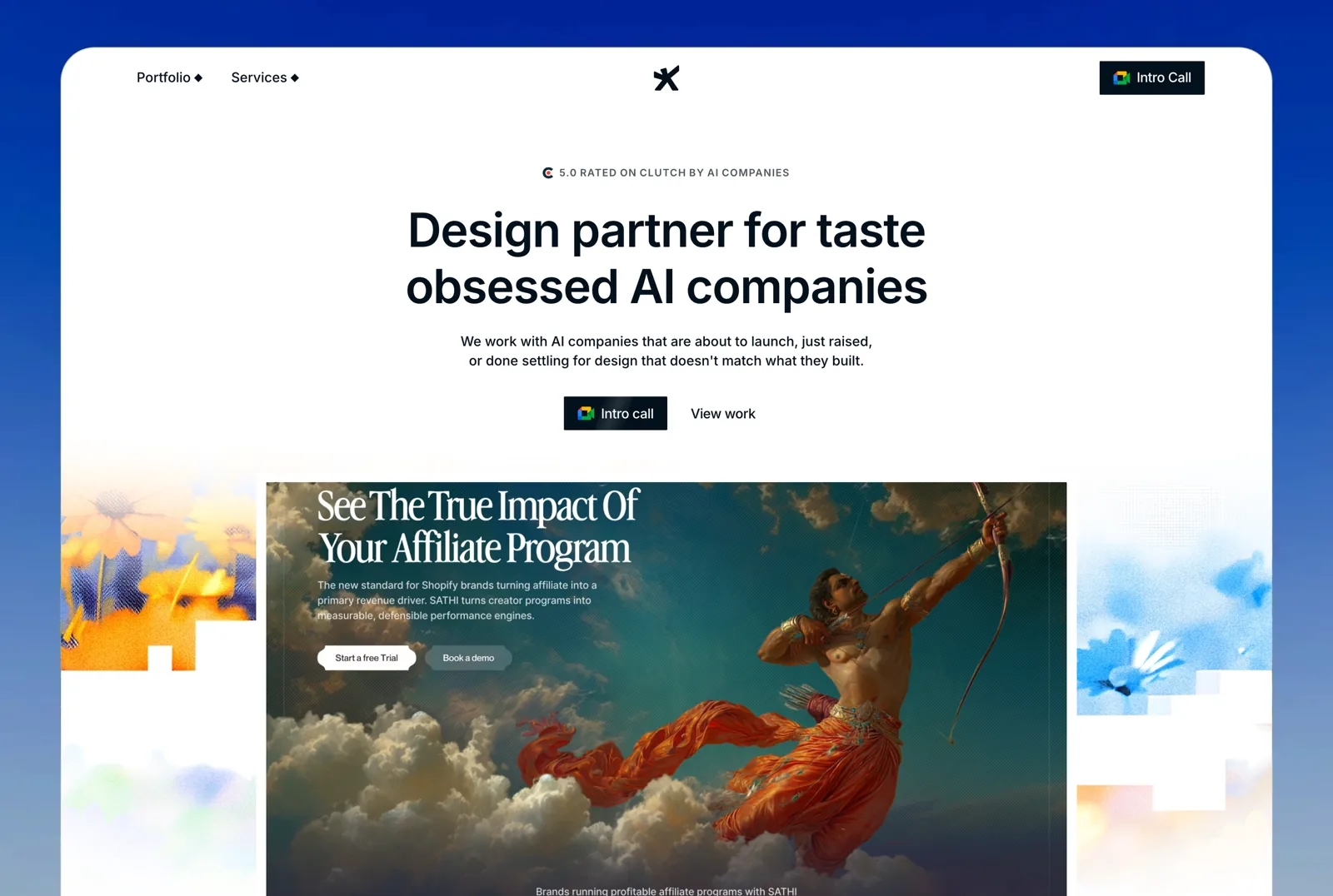
Studio Maydit is a web and product design studio working with AI founders in the US, UK, and Europe. The studio builds websites in Framer, Webflow, and custom code, and continues into product design after the site ships.
The clearest outcome is Dualite, where design work supporting a repositioned ICP helped the product reach 100,000+ users in seven months. Recent clients include Wave, PixelFlow, Mi-VAD, and 15 other AI and SaaS teams.
Websites can be bought two ways. Fixed scope runs three to four weeks and suits teams with a launch date. Teams that keep shipping take a monthly retainer instead, covering new pages, campaigns, and product design, with no long lock-in. Fixed-scope projects end with a diagnosis of what is leaking in the product, not a handoff and goodbye.
| Check | Finding |
|---|---|
| Based in | Remote, serving US / UK / EU |
| Platform depth | Framer, Webflow, and custom code |
| AI-sector proof | Yes. AI-native clients, published outcome on Dualite |
| Pricing | Fixed scope or monthly retainer, quoted per project |
| Team shape | Founder-led, small senior team |
| Best fit | Generative teams who need to show range rather than highlights |
Maydit is the right call if your product is genuinely good and your site still reads like a showreel. Book a 30-minute call.

2. Trueform
Trueform is a Swiss studio founded in 2022 working specifically in Framer, with a published minimum and Miro, Morning Brew, Bilt Rewards, and Gather named, plus published AI client work. Miro is a fitting reference. It is a product with no fixed output, where every board looks different and the marketing has to convey possibility without promising a specific result. That is your problem in a different medium.
They publish no team size, they are small so capacity is limited, and a Swiss studio working with a US team has a narrow overlapping window.
| Check | Finding |
|---|---|
| Based in | Wil, Switzerland |
| Founded | 2022 |
| Team size | Not published |
| Primary platform | Framer |
| AI-sector proof | Yes. Published AI client work |
| Named clients | Miro, Morning Brew, Bilt Rewards, Gather |
| Pricing | Published minimum |
| Best fit | Generative teams who need to sell possibility without overpromising |
3. Feels Like
Feels Like is a Los Angeles studio founded in 2023, working in custom code, with Google, Nike, LVMH, and Suno AI named, plus published AI client work. Suno is the most directly relevant client anywhere on this page. It is a generative product whose output is subjective, variable, and judged instantly, which is the exact presentation problem you are trying to solve.
They publish no pricing and no team size, they are young, and a custom-coded site makes it slower to add the new examples this category needs constantly.
| Check | Finding |
|---|---|
| Based in | Los Angeles, USA |
| Founded | 2023 |
| Team size | Not published |
| Primary platform | Custom code |
| AI-sector proof | Yes. Published AI client work |
| Named clients | Google, Nike, LVMH, Suno AI |
| Pricing | Not published |
| Best fit | Generative teams whose output is creative and judged on feel |
4. Foundey
Foundey is a San Francisco studio founded in 2021, working in Figma, with DemandIQ, Traycer, and Sero AI named, plus published AI client work. Traycer is a generative coding product, so they have already worked through how to present output that a technical user will scrutinise line by line rather than admire.
They hand off design rather than building it, they publish no pricing and no team size, and their named clients are early, so there is little evidence of work at large scale.
| Check | Finding |
|---|---|
| Based in | San Francisco, USA |
| Founded | 2021 |
| Team size | Not published |
| Primary platform | Figma-only |
| AI-sector proof | Yes. Published AI client work |
| Named clients | DemandIQ, Traycer, Sero AI |
| Pricing | Not published |
| Best fit | Generative teams with in-house build capacity who need design only |
5. Kvalifik
Kvalifik is a Copenhagen team of 11 to 50, founded in 2015, working in Webflow, with Veo, Maersk, and Relesys named, plus published AI client work. Veo is automated sports capture, a product where the system decides what matters in a scene and the customer judges whether it chose well. Presenting that kind of judgement honestly is close to your task.
They publish no pricing, and a Copenhagen team overlaps with US mornings only, which slows the rapid iteration a fast-moving generative company usually wants.
| Check | Finding |
|---|---|
| Based in | Copenhagen, Denmark |
| Founded | 2015 |
| Team size | 11-50 |
| Primary platform | Webflow |
| AI-sector proof | Yes. Published AI client work |
| Named clients | Veo, Maersk, Relesys |
| Pricing | Not published |
| Best fit | European generative teams selling to business rather than consumers |
6. Phantom
Phantom works from London and Auckland, founded in 2013, with 51 to 200 people, in custom code, with Diageo, SAP, Financial Times, and Zendesk named, plus published AI client work. The Financial Times is the useful reference. Publishing at that scale means handling large volumes of media without the site becoming slow, which is the practical constraint on any gallery-heavy generative product.
They publish no pricing, a company of that size treats a startup as a minor account, and their programme-shaped process fits badly with a company changing its message every few weeks.
| Check | Finding |
|---|---|
| Based in | London, UK and Auckland, NZ |
| Founded | 2013 |
| Team size | 51-200 |
| Primary platform | Custom code |
| AI-sector proof | Yes. Published AI client work |
| Named clients | Diageo, SAP, Financial Times, Zendesk |
| Pricing | Not published |
| Best fit | Funded generative teams with heavy media and real traffic |
7. BX Studio
BX Studio is a New York team of 11 to 50 working in Webflow, with a published minimum and Reddit, Headspace, ASAPP, and Verifone named, plus published AI client work. Reddit is a product built entirely from content the company does not control, and presenting unpredictable material well is a specific skill. That is closer to your gallery problem than a conventional software portfolio would be.
They publish no founding year, Webflow rather than Framer is their platform, and their strength is marketing surfaces rather than the interactive demos this category leans on.
| Check | Finding |
|---|---|
| Based in | New York, USA |
| Founded | Not published |
| Team size | 11-50 |
| Primary platform | Webflow |
| AI-sector proof | Yes. Published AI client work |
| Named clients | Reddit, Headspace, ASAPP, Verifone |
| Pricing | Published minimum |
| Best fit | Generative teams presenting large volumes of user-made output |
8. Flowout
Flowout is a distributed Webflow studio with a published minimum and Jasper, Kajabi, Riverside, and Sendlane named. Jasper is a generative writing product that grew through a very crowded period, and Riverside handles recorded media at volume. A subscription model also suits a company that wants its examples refreshed monthly rather than left to age.
They publish no founding year and no team size, their AI-sector proof is partial, and a request queue produces output rather than direction, which is the wrong purchase if your positioning is unsettled.
| Check | Finding |
|---|---|
| Based in | Distributed |
| Founded | Not published |
| Team size | Not published |
| Primary platform | Webflow |
| AI-sector proof | Partial. Enterprise and SaaS clients, no AI case study |
| Named clients | Jasper, Kajabi, Riverside, Sendlane |
| Pricing | Published minimum |
| Best fit | Generative teams who need their examples refreshed constantly |
9. Lazarev
Lazarev is a San Francisco team of 51 to 200, founded in 2015, with a published minimum and Payoneer, Peel, Elva, and Mozayix named, plus published AI client work. Their background is in products where trust has to be established before anyone acts, and a generative tool asks for a similar leap: you are asking someone to hand over their material and accept an unpredictable result.
They are large, so a small client gets a small share of attention, Framer is not their specialism, and their process suits a defined brief better than an evolving one.
| Check | Finding |
|---|---|
| Based in | San Francisco, USA |
| Founded | 2015 |
| Team size | 51-200 |
| Primary platform | Mixed |
| AI-sector proof | Yes. Published AI client work |
| Named clients | Payoneer, Peel, Elva, Mozayix |
| Pricing | Published minimum |
| Best fit | Generative teams whose users must trust them with valuable material |
10. Refokus
Refokus is a remote German team of 11 to 50, founded in 2021, working in Webflow, with Mural, BASF, Spotify, Yahoo, and BCG named. Mural is another open-ended tool with no single correct output, and Spotify is a product built on presenting an enormous, varied library without overwhelming anyone. Both of those are relevant references for a gallery-driven site.
They publish no pricing, their AI-sector proof is partial, and their visual ambition can compete with your own output for attention, which is the last thing a generative product's site should do.
| Check | Finding |
|---|---|
| Based in | Germany, remote |
| Founded | 2021 |
| Team size | 11-50 |
| Primary platform | Webflow |
| AI-sector proof | Partial. Enterprise and SaaS clients, no AI case study |
| Named clients | Mural, BASF, Spotify, Yahoo, BCG |
| Pricing | Not published |
| Best fit | Generative teams with a large library that needs organising well |
How to choose between them
Sort by which doubt is stopping people.
They think your examples are cherry-picked. Studio Maydit or Feels Like.
They cannot tell how much control they get. Foundey or Trueform.
Legal and procurement are blocking the purchase. Kvalifik or Lazarev.
Your gallery is large, slow, and hard to navigate. Phantom or BX Studio.
One test before signing. Give them ten real outputs from a single session, unedited, including the weak ones, and ask how they would put them on a page. A studio that understands this category will build around the variation and treat the ordinary results as evidence of honesty. One that asks which three are the best has already decided to make you another showreel, and showreels in this category are read as sales material and discounted on sight.