
Summarize with AI


The best Framer design agencies for London AI startups in 2026 are Studio Maydit, Trueform, Pixelmatters, Feely Studio, Refokus, Ramotion, Push Refresh, Instrument, Lighthouse Digital, and Kvalifik. Studio Maydit and Trueform lead for teams who want genuine Framer depth rather than a studio that added it to the menu last year. Instrument and Ramotion are the wrong fit unless your budget and timeline belong to a much larger company.
The first instinct is to hire someone you could meet for coffee in Shoreditch. It is worth asking what that meeting is actually for.
For most London AI teams the honest answer is not much. The work happens in a shared file, the reviews happen on a call, and the one or two sessions that genuinely benefit from a room can be arranged with anybody in a European timezone. What hiring by postcode does reliably is shrink your shortlist to a small fraction of the studios doing this work, and attach a city premium to the ones that remain.
There is a second thing London does to a website, and it is more expensive than the first. Your site is read in the morning by a buyer in the UK and in the afternoon by an investor or customer in the United States, and those two readers have been trained to hear confidence differently. British understatement is a genuine strength in a room. On a homepage, read by someone in San Francisco who has four other tabs open, it reads as hedging. Plenty of strong London companies describe themselves in a way that quietly asks to be taken less seriously than they deserve.
Then there is the platform question. Framer is the right call for a team that wants to change its own site without booking developer time, but that only pays off if somebody is actually going to do it. Getting all three of these right, the shortlist, the register, and the handover, is what separates these ten.

How we picked these agencies
This is a teardown, not a directory listing. For each agency we read their own site and their public record, then checked five things you can verify yourself in an afternoon:
- Platform depth. Is one craft their real specialism, or one line on a long service menu?
- AI-sector proof. Named AI clients and published work, or just the word "AI" in the copy?
- Pricing. Do they publish a minimum at all, or keep it behind a call?
- Team shape. Who actually does the work, and how many clients are they carrying at once?
- Their own site. Distinctive, or the same template as everyone else on this list?
That last one gets skipped most often. An agency's own website is the only project where nobody overruled them. No client committee, no inherited brand book. If their own site is forgettable, you have found their ceiling.
Every fact below comes from the agency's own site or a public listing. Where a number is not public, we say so rather than guessing.
What goes wrong for London teams buying a website
Three failures show up again and again in this city, and none of them are about design ability.
The shortlist is drawn by postcode. Founders start by searching for a design agency in London, meet four studios within a short walk, and pick from those four. The list was never the best four for the job. It was the best four inside an arbitrary boundary, and London rates carry an office and a city premium that a distributed team of the same quality does not. The tell is that the proximity almost never gets used. Ask yourself honestly how many times you would visit their office during a six-week project. If the number is one, buy that one day of someone's travel rather than a whole shortlist built around it.
The register is set for the wrong reader. A homepage written in careful British English will say the product may help teams work a little more efficiently. A San Francisco competitor with a weaker product says it removes the work entirely. Both are describing the same thing. One of them sounds like a company that believes what it is building. This matters most for AI teams, because your American competitors are describing their capabilities in the strongest terms the law allows, and a buyer comparing two tabs is not adjusting for cultural style. Being specific is not the same as boasting, and understatement is not the same as honesty.
Nobody is named to own the site afterwards. Framer is usually chosen so the team can edit its own pages, which is a good reason. Then the project ends, no single person is given the site as part of their job, and everyone treats it as the agency's property. Six months later the pricing is out of date, the careers page lists a closed role, and the launch you shipped in March is still in the news slot. The platform did what it promised. The company never assigned the work. Decide who owns the site before the handover call, not after it.
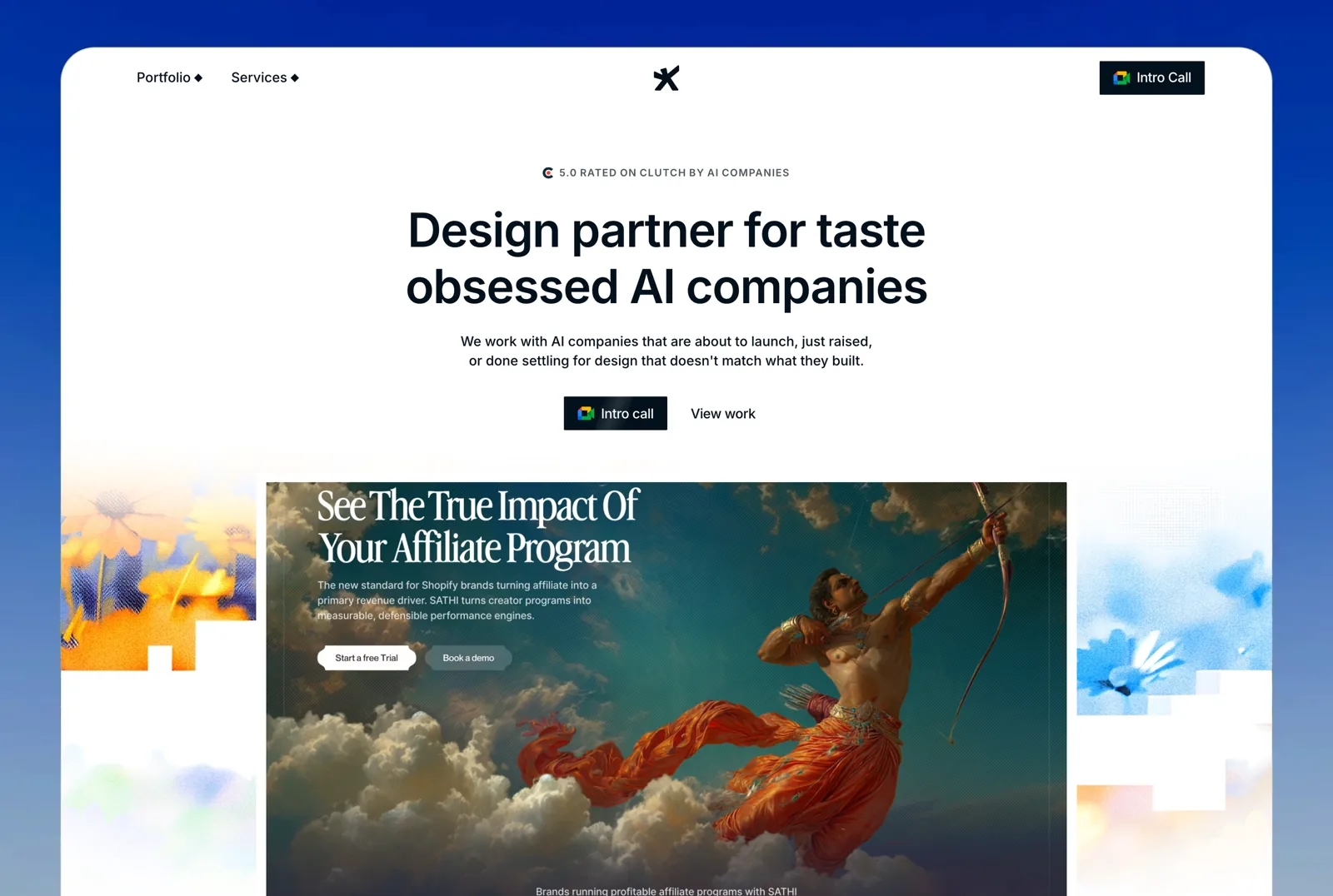
1. Studio Maydit: A Top-Rated Design Agency for AI Founders
Studio Maydit is a web and product design studio working with AI founders in the US, UK, and Europe. The studio builds websites in Framer, Webflow, and custom code, and continues into product design after the site ships.
The clearest outcome is Dualite, where design work supporting a repositioned ICP helped the product reach 100,000+ users in seven months. Recent clients include Wave, PixelFlow, Mi-VAD, and 15 other AI and SaaS teams.
Websites can be bought two ways. Fixed scope runs three to four weeks and suits teams with a launch date. Teams that keep shipping take a monthly retainer instead, covering new pages, campaigns, and product design, with no long lock-in. Fixed-scope projects end with a diagnosis of what is leaking in the product, not a handoff and goodbye.
| Check | Finding |
|---|---|
| Based in | Remote, serving US / UK / EU |
| Platform depth | Framer, Webflow, and custom code |
| AI-sector proof | Yes. AI-native clients, published outcome on Dualite |
| Pricing | Fixed scope or monthly retainer, quoted per project |
| Team shape | Founder-led, small senior team |
| Best fit | London teams selling into the UK and the US at the same time |
Maydit is the right call if your site has to convince a British buyer and an American investor in the same week. Book a 30-minute call.

2. Trueform
Trueform is a Swiss studio founded in 2022 with a published minimum, published AI client work, and Miro, Morning Brew, Bilt Rewards, and Gather named. Framer is their actual specialism rather than an added service, which shows in how far they push the platform. They are also an hour ahead of London, so review cycles run inside one working day rather than across two.
They publish no team size, they are young enough that their record on long relationships is thin, and Swiss rates are not a saving over London.
| Check | Finding |
|---|---|
| Based in | Wil, Switzerland |
| Founded | 2022 |
| Team size | Not published |
| Primary platform | Framer |
| AI-sector proof | Yes. Published AI client work |
| Named clients | Miro, Morning Brew, Bilt Rewards, Gather |
| Pricing | Published minimum |
| Best fit | Teams who want the platform pushed further than a template |
3. Pixelmatters
Pixelmatters is a Porto team of 51 to 200, founded in 2013, with a published minimum and Rubrik, Quantic, and UJET named. Rubrik is the useful reference for a London team selling security or infrastructure software into enterprises, where the site has to survive a procurement review rather than only a founder's taste. They are large enough to hold a long engagement without stalling.
Their AI-sector proof is partial rather than published, Framer is one platform among several rather than their specialism, and a team of that size brings process a ten-person startup may find heavy.
| Check | Finding |
|---|---|
| Based in | Porto, Portugal |
| Founded | 2013 |
| Team size | 51-200 |
| Primary platform | Mixed |
| AI-sector proof | Partial. Enterprise and SaaS clients, no AI case study |
| Named clients | Rubrik, Quantic, UJET |
| Pricing | Published minimum |
| Best fit | Teams whose site has to pass an enterprise procurement review |
4. Feely Studio
Feely Studio is a distributed 1 to 10 team across Europe with a published minimum, published AI client work, and Noxus, Mutiny, Luasai, and Basic Capital named. Being European rather than American matters more than it sounds for this brief, because they already understand a company that sells in two registers, and a small senior team means the person who understood the problem is the person drawing the page.
They publish no founding year, capacity is genuinely limited, and their work skews toward early companies rather than teams with an established brand to protect.
| Check | Finding |
|---|---|
| Based in | Distributed, Europe |
| Founded | Not published |
| Team size | 1-10 |
| Primary platform | Mixed |
| AI-sector proof | Yes. Published AI client work |
| Named clients | Noxus, Mutiny, Luasai, Basic Capital |
| Pricing | Published minimum |
| Best fit | Early London teams who want senior attention and no account layer |
5. Refokus
Refokus is a remote German team of 11 to 50, founded in 2021, with Mural, BASF, Spotify, Yahoo, and BCG named. That client list is unusual for a studio this size, and it means they have written for audiences ranging from a developer tool to an industrial group. If your London company is trying to look larger than it is without lying, they have done that work.
They publish no pricing, Webflow is their platform rather than Framer, and their AI-sector proof is partial, so the category understanding will come from you.
| Check | Finding |
|---|---|
| Based in | Germany, remote |
| Founded | 2021 |
| Team size | 11-50 |
| Primary platform | Webflow |
| AI-sector proof | Partial. Enterprise and SaaS clients, no AI case study |
| Named clients | Mural, BASF, Spotify, Yahoo, BCG |
| Pricing | Not published |
| Best fit | Teams who need to read as established to a corporate buyer |
6. Ramotion
Ramotion is a San Francisco team of 11 to 50, founded in 2009, with a published minimum and Mozilla, Okta, Netflix, Adobe, and Xero named. For a London company whose growth depends on American buyers, there is a real argument for hiring people who write for that market every day. Okta and Xero are both businesses that had to explain something technical to a cautious buyer.
They publish partial AI proof only, the eight-hour time difference makes review cycles slow from London, Framer is not their specialism, and their rates are set by the San Francisco market.
| Check | Finding |
|---|---|
| Based in | San Francisco, USA |
| Founded | 2009 |
| Team size | 11-50 |
| Primary platform | Mixed |
| AI-sector proof | Partial. Enterprise and SaaS clients, no AI case study |
| Named clients | Mozilla, Okta, Netflix, Adobe, Xero |
| Pricing | Published minimum |
| Best fit | Teams whose real market is American rather than British |
7. Push Refresh
Push Refresh is a 1 to 10 team in Dallas with a published minimum and SmithRx, Synonym, and Northern National named. Framer is their stated platform, and a very small team with published pricing is the most predictable way to buy a focused site. For a seed-stage London company that needs a good five-page site rather than a brand programme, that predictability is worth more than a famous logo.
Their AI-sector proof is partial, they publish no founding year, the team is small enough that timing depends on their queue, and Dallas is six hours behind London.
| Check | Finding |
|---|---|
| Based in | Dallas, USA |
| Founded | Not published |
| Team size | 1-10 |
| Primary platform | Framer |
| AI-sector proof | Partial. Enterprise and SaaS clients, no AI case study |
| Named clients | SmithRx, Synonym, Northern National |
| Pricing | Published minimum |
| Best fit | Seed-stage teams who want a focused site with a known price |
8. Instrument
Instrument has been working since 2005 out of Portland with Nike, Microsoft, Electronic Arts, and Google named. That is a portfolio built on brands that have to hold up in many places at once, and if your London company is preparing for a moment where a great many people look at you simultaneously, that experience is rare and real.
They publish no pricing and no team size, their AI-sector proof is partial, Framer is not their specialism, and the scale of engagement they are built for sits far above a startup with one or two rounds behind it.
| Check | Finding |
|---|---|
| Based in | Portland, USA |
| Founded | 2005 |
| Team size | Not published |
| Primary platform | Mixed |
| AI-sector proof | Partial. Enterprise and SaaS clients, no AI case study |
| Named clients | Nike, Microsoft, Electronic Arts, Google |
| Pricing | Not published |
| Best fit | Later-stage teams preparing for a large public moment |
9. Lighthouse Digital
Lighthouse Digital is a London Webflow studio with a published minimum and HelloSelf, Freetrade, and IGN named. They are the genuinely local option on this list, and Freetrade is a useful reference because it is a British company that had to explain a regulated financial product to ordinary people. Published pricing also gives you a fixed point to plan against.
They publish neither a founding year nor a team size, they have no published AI client work, and Webflow rather than Framer is their platform.
| Check | Finding |
|---|---|
| Based in | London, UK |
| Founded | Not published |
| Team size | Not published |
| Primary platform | Webflow |
| AI-sector proof | No. No published AI client work |
| Named clients | HelloSelf, Freetrade, IGN |
| Pricing | Published minimum |
| Best fit | Teams who genuinely want someone in the same city |
10. Kvalifik
Kvalifik is a Copenhagen team of 11 to 50, founded in 2015, with published AI client work and Veo, Maersk, and Relesys named. A Nordic studio brings a plainer way of writing that travels well, which is a useful corrective if your current copy is doing the very British thing of apologising for the product before describing it. They are also one hour from London.
They publish no pricing, Webflow rather than Framer is their platform, and their named clients are more established than AI-native.
| Check | Finding |
|---|---|
| Based in | Copenhagen, Denmark |
| Founded | 2015 |
| Team size | 11-50 |
| Primary platform | Webflow |
| AI-sector proof | Yes. Published AI client work |
| Named clients | Veo, Maersk, Relesys |
| Pricing | Not published |
| Best fit | Teams who want plainer language than they currently use |
How to choose between them
Sort by what is actually holding the site back.
You want real Framer depth. Studio Maydit, Trueform, or Push Refresh.
Your buyers are American and you sound too British. Studio Maydit or Ramotion.
Enterprise procurement reads your site. Pixelmatters or Refokus.
You genuinely want someone in the city. Lighthouse Digital.
One test before signing. Send them your homepage and ask which sentence an American buyer would not believe. A studio worth hiring will point at a specific line and explain what is missing behind it, usually a number or a named customer. One that replies with notes about the layout has told you it treats the site as a visual object, and you will get a better-looking version of the page that is currently failing to convince anyone.