
Summarize with AI


The best Framer design agencies for New York AI startups in 2026 are Studio Maydit, Clay, Trueform, Push Refresh, Engine Digital, SuperSkills, Lazarev, Fantasy, Feely Studio, and Digidop. Studio Maydit and Trueform lead for teams whose buyers sit inside large institutions and read a website before they will take a meeting. Fantasy and Digidop are the wrong fit here, the first because it publishes no client names to check, the second because it builds in Webflow rather than Framer.
New York is not really a founder market. It is a customer market. The banks, hospitals, law firms, insurers, publishers, and ad holding companies that AI startups want to sell to already have offices here, and your first ten customers are usually a short subway ride away rather than a flight.
That single fact changes who reads your website. In other cities the reader is often another technical founder who will forgive a rough site because the demo is good. In New York the reader is an employee of a large organisation. They have a job, a boss, and a limited amount of political capital to spend on an unproven vendor. They are not browsing for inspiration. They are looking for a cheap reason to stop.
The city is also small in the way that matters. Your buyer hears your name at a dinner, looks you up on their phone on the way home, and forms a view before anyone has scheduled anything. The site does its most important work while you are not in the room, against two competitors whose offices are within ten blocks of yours.
Framer is a sensible choice here. It lets a small team ship a real site in weeks and change it the same week a message stops working. But speed only helps if the page is aimed at the right reader. Building fast is also a way to reach the wrong page sooner.

How we picked these agencies
This is a teardown, not a directory listing. For each agency we read their own site and their public record, then checked five things you can verify yourself in an afternoon:
- Platform depth. Is one craft their real specialism, or one line on a long service menu?
- AI-sector proof. Named AI clients and published work, or just the word "AI" in the copy?
- Pricing. Do they publish a minimum at all, or keep it behind a call?
- Team shape. Who actually does the work, and how many clients are they carrying at once?
- Their own site. Distinctive, or the same template as everyone else on this list?
That last one gets skipped most often. An agency's own website is the only project where nobody overruled them. No client committee, no inherited brand book. If their own site is forgettable, you have found their ceiling.
Every fact below comes from the agency's own site or a public listing. Where a number is not public, we say so rather than guessing.
What goes wrong when a New York team buys a site
Three failures account for most of the wasted money here, and all three come from the same root: the site gets built for the wrong reader.
The homepage is written for the round rather than the customer. More investors are within walking distance here than almost anywhere, so fundraising and selling happen in the same month, to people who use the same words differently. An investor wants to know how large this could become. A buyer at an insurer wants to know what breaks on Tuesday. Copy tuned for the first reader talks about a category and a wave and a platform. The buyer reads it, cannot tell what the product does on a normal working day, and leaves. Write the buyer's page. The round is won in a room, not on a homepage, and a site that converts customers is better evidence for an investor anyway.
Nobody wrote the page the risk reviewer needs. In a New York deal the enthusiastic person is rarely the deciding person. Somewhere behind them sits a colleague from security, legal, or compliance whose entire job is to find the reason this cannot proceed. They will look for where data goes, whether it trains a model, where it is stored, and who has been audited. If your site says nothing, they do not write to ask. They mark it unknown, which reads as no. One honest page covering data handling, retention, and your current certification status, including the ones you do not yet hold, kills more objections than any amount of homepage polish.
The referral pulls you toward a brand shop. Ask around here and you will be pointed at studios with genuinely famous work, because New York's design reputation was built on advertising, media, and fashion. Those studios are excellent at making a company feel important. Many are much weaker at explaining a technical product to a sceptical specialist, since their usual brief is to make an audience feel something rather than to make a stranger understand a system. Take the referral, then ask to see a project where the visitor had to understand something difficult before they would buy. If every case study is a campaign, you have the wrong shop for this job.
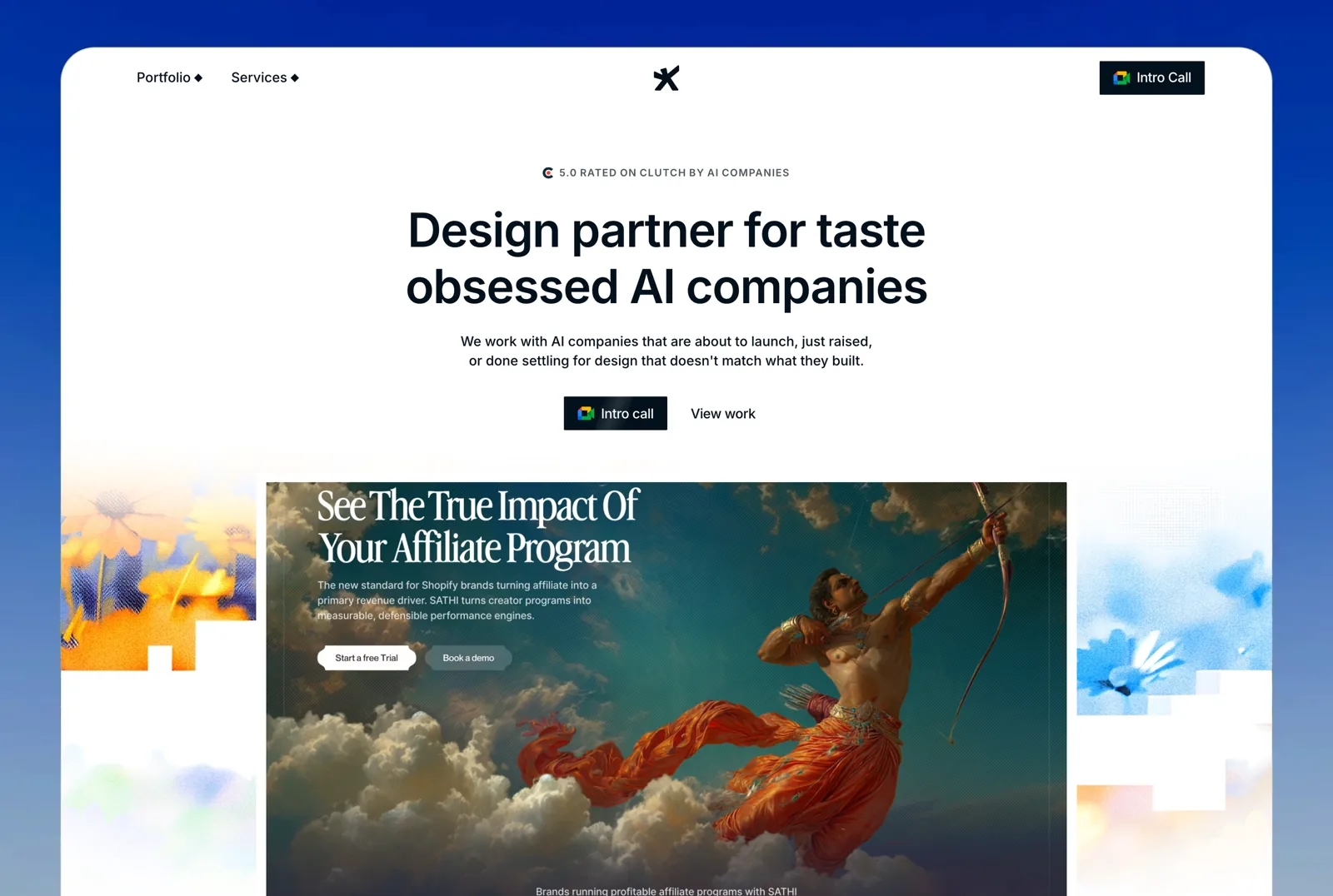
1. Studio Maydit: A Top-Rated Design Agency for AI Founders
Studio Maydit is a web and product design studio working with AI founders in the US, UK, and Europe. The studio builds websites in Framer, Webflow, and custom code, and continues into product design after the site ships.
The clearest outcome is Dualite, where design work supporting a repositioned ICP helped the product reach 100,000+ users in seven months. Recent clients include Wave, PixelFlow, Mi-VAD, and 15 other AI and SaaS teams.
Websites can be bought two ways. Fixed scope runs three to four weeks and suits teams with a launch date. Teams that keep shipping take a monthly retainer instead, covering new pages, campaigns, and product design, with no long lock-in. Fixed-scope projects end with a diagnosis of what is leaking in the product, not a handoff and goodbye.
| Check | Finding |
|---|---|
| Based in | Remote, serving US / UK / EU |
| Platform depth | Framer, Webflow, and custom code |
| AI-sector proof | Yes. AI-native clients, published outcome on Dualite |
| Pricing | Fixed scope or monthly retainer, quoted per project |
| Team shape | Founder-led, small senior team |
| Best fit | Teams selling into large institutions who need the site to answer a sceptic |
Maydit is the right call if your buyer works inside a big organisation and has to justify you to a colleague. Book a 30-minute call.

2. Clay
Clay is a San Francisco studio of 51 to 200, founded in 2016, with a published minimum and Slack, Stripe, Google, Coinbase, and Amazon named. That client list is the point for a New York team, because those are the logos your buyer's boss already trusts, and work that survived review at Stripe or Coinbase carries weight in a procurement conversation here too.
They are large and premium, which means a small seed-stage team is a minor account rather than a priority, and the senior people who pitch are not always the people who build.
| Check | Finding |
|---|---|
| Based in | San Francisco, USA |
| Founded | 2016 |
| Team size | 51-200 |
| Primary platform | Mixed |
| AI-sector proof | Yes. Published AI client work |
| Named clients | Slack, Stripe, Google, Coinbase, Amazon |
| Pricing | Published minimum |
| Best fit | Teams whose buyer needs to see logos their own board would recognise |
3. Trueform
Trueform is a Swiss studio founded in 2022 that works in Framer specifically, with a published minimum and Miro, Morning Brew, Bilt Rewards, and Gather named. Bilt Rewards is a New York company operating in a heavily regulated corner of consumer finance, which is close to the problem many teams here have. Framer is their actual craft rather than one option on a menu, so the site stays fast to change after launch, which matters when your positioning shifts between two enterprise pilots.
They do not publish a team size, they are small, and the time difference means a same-day answer in New York afternoons is not something to count on.
| Check | Finding |
|---|---|
| Based in | Wil, Switzerland |
| Founded | 2022 |
| Team size | Not published |
| Primary platform | Framer |
| AI-sector proof | Yes. Published AI client work |
| Named clients | Miro, Morning Brew, Bilt Rewards, Gather |
| Pricing | Published minimum |
| Best fit | Framer-first teams who expect to rewrite the message every quarter |
4. Push Refresh
Push Refresh is a Dallas studio of 1 to 10 working in Framer, with a published minimum and SmithRx, Synonym, and Northern National named. SmithRx is the relevant reference, a healthcare payments company whose buyers are employers and benefits teams, which is the same kind of cautious institutional reader a New York AI startup meets. A team this size means the person you brief is the person who builds.
They publish no founding year, their AI-sector proof is partial rather than demonstrated, and a team of under ten has no capacity to absorb a sudden deadline change.
| Check | Finding |
|---|---|
| Based in | Dallas, USA |
| Founded | Not published |
| Team size | 1-10 |
| Primary platform | Framer |
| AI-sector proof | Partial. Enterprise and SaaS clients, no AI case study |
| Named clients | SmithRx, Synonym, Northern National |
| Pricing | Published minimum |
| Best fit | Founders who want to work directly with the person doing the work |
5. Engine Digital
Engine Digital has offices in Vancouver and New York, has been working since 2002, and builds in custom code, with Adidas, Autodesk, Goldman Sachs, and HP named. Goldman Sachs is the single most useful reference on this page for a company selling into New York finance, because shipping anything for that buyer means surviving a security and brand review that most studios have never seen. They are in the city, which still matters when a client wants a person in a room.
They publish neither pricing nor team size, their AI-sector proof is partial, and custom code means a longer build and a developer needed for changes that Framer would let a marketer make.
| Check | Finding |
|---|---|
| Based in | Vancouver and New York |
| Founded | 2002 |
| Team size | Not published |
| Primary platform | Custom code |
| AI-sector proof | Partial. Enterprise and SaaS clients, no AI case study |
| Named clients | Adidas, Autodesk, Goldman Sachs, HP |
| Pricing | Not published |
| Best fit | Teams selling to banks who need a partner used to that review process |
6. SuperSkills
SuperSkills is a small studio of 1 to 10 in Walnut Creek, California, working across platforms, with The Cut named as a client. The Cut is a New York publication, and editorial work is unusually good training for this brief, because a magazine has to make a stranger care in seconds without a demo or a sales call. If your problem is that people do not understand why your product matters, that skill transfers better than another SaaS template.
They name only one client, publish no founding year and no pricing, and a team this small can take one project at a time, so availability is the real constraint.
| Check | Finding |
|---|---|
| Based in | Walnut Creek, USA |
| Founded | Not published |
| Team size | 1-10 |
| Primary platform | Mixed |
| AI-sector proof | Yes. Published AI client work |
| Named clients | The Cut |
| Pricing | Not published |
| Best fit | Teams whose message needs an editor more than it needs a designer |
7. Lazarev
Lazarev is a San Francisco studio of 51 to 200, founded in 2015, with a published minimum and Payoneer, Peel, Elva, and Mozayix named. Payoneer is the reference that matters here, a cross-border payments business whose product has to explain regulated, unglamorous mechanics clearly. New York AI companies selling into finance have the same job, and they usually have it in a market where the buyer already uses three competing tools.
Their published work leans toward complex product interfaces rather than positioning, they are large enough for account layers, and their strongest case studies are not Framer builds.
| Check | Finding |
|---|---|
| Based in | San Francisco, USA |
| Founded | 2015 |
| Team size | 51-200 |
| Primary platform | Mixed |
| AI-sector proof | Yes. Published AI client work |
| Named clients | Payoneer, Peel, Elva, Mozayix |
| Pricing | Published minimum |
| Best fit | Teams whose product is harder to explain than it is to demo |
8. Fantasy
Fantasy has been working since 1999 with offices in San Francisco and New York, across platforms, with published AI client work. Longevity is genuinely rare on a list like this. A studio that has survived since 1999 has designed through several technology shifts and is unlikely to be impressed by, or frightened of, a new one, which can be steadying when your own category changes shape twice a year.
They publish no client names at all, which makes the record hard to verify from outside, and they publish no pricing or team size either. For a first website with a fixed budget, that is a lot of unknowns.
| Check | Finding |
|---|---|
| Based in | San Francisco and New York, USA |
| Founded | 1999 |
| Team size | Not published |
| Primary platform | Mixed |
| AI-sector proof | Yes. Published AI client work |
| Named clients | Not published |
| Pricing | Not published |
| Best fit | Established teams who value a long track record over a checkable one |
9. Feely Studio
Feely Studio is a small distributed European team of 1 to 10 with a published minimum and Noxus, Mutiny, Luasai, and Basic Capital named. Noxus and Mutiny are both AI-native companies, so this is a team that has already had the conversation about how to describe a model-driven product without overpromising. Basic Capital adds a fintech reference, which lands well for the New York buyer set.
They publish no founding year, they are very small, and being in Europe means the working overlap with New York is a morning window rather than a full day.
| Check | Finding |
|---|---|
| Based in | Distributed, Europe |
| Founded | Not published |
| Team size | 1-10 |
| Primary platform | Mixed |
| AI-sector proof | Yes. Published AI client work |
| Named clients | Noxus, Mutiny, Luasai, Basic Capital |
| Pricing | Published minimum |
| Best fit | AI-native teams who want a small partner with a published price |
10. Digidop
Digidop is a Paris studio of 1 to 10, founded in 2021, with a published minimum and TSE Energy, Ramify, and StreamNative named. StreamNative is a developer infrastructure company, which is useful proof that they can write for a technical reader rather than only for a consumer one. They publish their pricing openly, which is still uncommon and makes a first conversation faster.
They build in Webflow rather than Framer, which is the main reason they sit last on a Framer list, their AI-sector proof is partial, and a Paris team is six hours ahead of New York.
| Check | Finding |
|---|---|
| Based in | Paris, France |
| Founded | 2021 |
| Team size | 1-10 |
| Primary platform | Webflow |
| AI-sector proof | Partial. Enterprise and SaaS clients, no AI case study |
| Named clients | TSE Energy, Ramify, StreamNative |
| Pricing | Published minimum |
| Best fit | Teams who care more about a published price than about the platform |
How to choose between them
Sort by which reader is currently blocking you.
A security or compliance colleague is quietly killing deals. Engine Digital or Studio Maydit.
Your buyer's boss needs to recognise the names you work with. Clay.
The message changes every quarter and the site has to keep up. Trueform or Push Refresh.
People understand what you do and still do not care. SuperSkills or Lazarev.
One test before signing. Ask who they think the second reader of your homepage is. A studio aimed at this market names the sceptic behind your champion, the risk reviewer or the procurement contact, and asks what that person needs to see. One that answers "your ideal customer" is describing the person who already likes you, and that person was never the problem.