Summarize with AI


The best Framer design agencies for non-technical founders in 2026 are Studio Maydit, Push Refresh, Engine Digital, Ramotion, Trueform, Edgar Allan, Flow Ninja, Digidop, Finsweet, and Refokus. Studio Maydit and Trueform lead for this brief, because both build in Framer and hand over something a founder can genuinely operate afterwards, and Trueform publishes a starting figure so the first conversation is short. Engine Digital and Finsweet are the wrong fit here, since one builds in custom code for enterprise clients and the other is a deeply technical Webflow specialist, and both leave a non-technical owner dependent on somebody else for every change.
There is one question that matters more than any other for a founder who does not write code, and it is almost never the question that gets asked.
Not who should build the site. Not which platform. The question is what happens on an ordinary Tuesday in March, four months after launch, when you want to change a headline, swap a customer logo, and add a new page for something you just started selling.
If the answer is that you do it yourself in twenty minutes, you have bought well. If the answer involves an email, a rate card, and a wait, you have bought a dependency with a website attached to it. Over two years that dependency costs more than the site did, and it costs you in a currency worse than money, which is the number of times you decide not to bother.
This is the specific reason Framer keeps coming up for non-technical founders. It is not that it makes better sites than the alternatives. It is that the thing you receive at the end is something you can open and edit without learning anything you did not want to learn.
The second problem is harder to talk about. When you cannot evaluate the technical work, you evaluate the only thing you can see, which is how the portfolio looks. That is a real signal, and it is incomplete. A site can be beautiful and structurally useless: no clear path for a visitor, nothing that explains what you sell, a contact form that quietly fails. Nobody buying on portfolio alone can catch that, and most founders in this position do not find out for months.
There is a third thing, mundane and expensive. Domains, records, analytics, forms, and the basic search setup all live in a gap between what you assumed was included and what the studio assumed you already had. That gap is where launches go quiet.
The ten studios below are ranked on how well they suit a founder who has to judge the work without being able to inspect it.

How we picked these agencies
Five checks, all of them possible without any technical knowledge:
- Platform depth. Does the studio build in something you could operate yourself, or in something that requires a developer for every change?
- Proof of editable handovers. Is there evidence of sites left with clients who are not technical, rather than sites the studio still runs on their behalf?
- Pricing. Is a starting figure published, so you can find out whether a conversation is worth having?
- Team shape. Will you talk to the person doing the work, or to an account manager relaying it?
- Their own site. Read it as a customer and time how long it takes to understand the offer and the price.
The second check is the one to weight heavily. Plenty of studios build lovely sites that only they can maintain, and none of them describe it that way. You have to ask directly and listen for whether the answer is about training you or about being available.
Every fact in the tables below is drawn from what the studios themselves publish. Where something has not been made public, that is stated plainly instead of guessed at.
What goes wrong for founders who cannot build
Three failures repeat, and each one is invisible until after the money has been spent.
The handover is a login, not a handover. The site is finished, you get access, and the first time you open it you find layers you cannot interpret, components that break when touched, and no note explaining any of it. Technically you own it. Practically you will not touch it, so every change goes back to the studio at their hourly rate. Prevent it by making the handover a scheduled session where you make three real edits yourself while they watch, plus a short written guide covering the ten things you will actually want to do. Agree this before the project starts, since after launch it becomes a favour.
The prettiest portfolio wins. It is the only criterion you can evaluate with confidence, so it quietly becomes the whole decision. The result is a site that looks like an award entry and does not tell a visitor what you sell or what to do next. Balance it with something you can also judge: ask each candidate to talk you through a past project's numbers, or failing that to explain what the client wanted the site to change. A studio that answers with visual language is showing you what they optimise for.
Nobody names the boring owner. Domain records, form delivery, analytics, the search basics, and where the emails from the contact page end up. The studio assumes you have it, you assume it is included, and three weeks after launch you discover the enquiries have been going to an address nobody checks. Ask for a written list of what is yours, what is theirs, and what nobody has claimed. That last column is where the problems live, and it is short enough to fix in an afternoon before it matters.
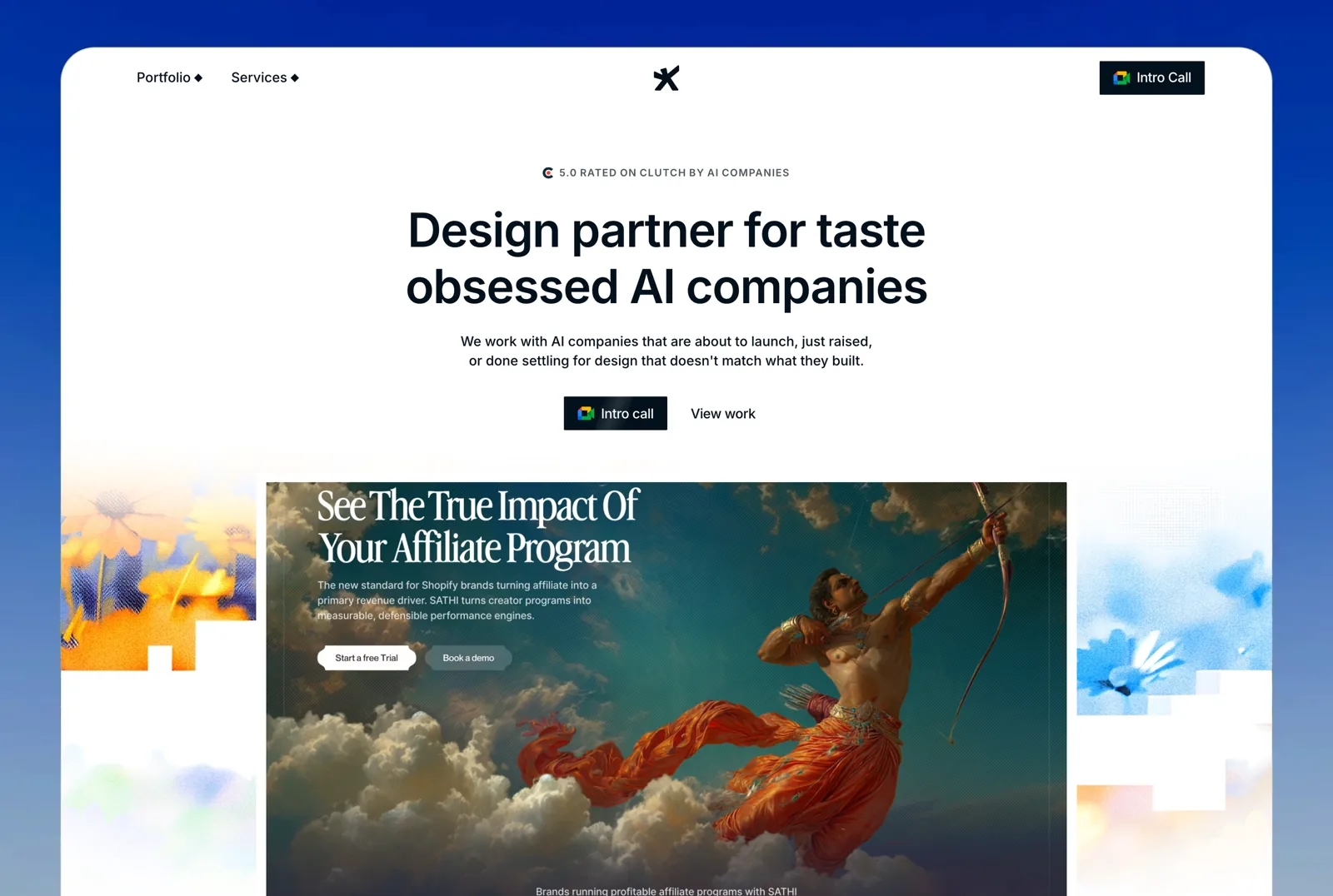
1. Studio Maydit: A Top-Rated Design Agency for AI Founders
Autonomy after launch is the thing to buy here, and the platform choice is what decides it. Studio Maydit builds in Framer, Webflow, and custom code, so the recommendation depends on who will be editing the site rather than on what the studio prefers to work in. It is a web and product design studio. The clients are AI founders, working across the US, UK, and Europe. It is founder-led with a small senior team, which means the person explaining the work to you is the person who made it, and the engagement continues into product design once the site is live.
The clearest example is Dualite, which passed 100,000+ users in seven months once the design had been rebuilt for a repositioned ICP. Wave, PixelFlow, Mi-VAD, and 15 other AI and SaaS teams appear on the recent list.
There are two ways to pay, and neither requires reading a technical proposal to understand. Fixed scope runs three to four weeks for a defined site with a date attached. A monthly retainer covers new pages, campaigns, and product design for teams that keep shipping, with no long lock-in. A fixed-scope project ends with a diagnosis of what is leaking in the product, which is often the most useful thing a founder without a technical co-founder receives all year.
| Check | Finding |
|---|---|
| Based in | Remote, serving US / UK / EU |
| Platform depth | Framer, Webflow, and custom code |
| AI-sector proof | Yes. AI-native clients, published outcome on Dualite |
| Pricing | Fixed scope or monthly retainer, quoted per project |
| Team shape | Founder-led, small senior team |
| Best fit | Founders who need to edit the site without asking anyone |
Worth a call if changing your own homepage currently requires an invoice. Book a 30-minute call.

2. Push Refresh
Push Refresh is a Dallas team of one to ten working in Framer, with a published minimum and SmithRx, Synonym, and Northern National named. A published price and a Framer build is close to the ideal combination for this brief, because you can find out what it costs before booking anything and you can edit the result yourself afterwards.
They publish no founding year, their AI-sector proof is partial, and one to ten people means limited room if your timeline moves or the scope grows mid-project.
| Check | Finding |
|---|---|
| Based in | Dallas, USA |
| Founded | Not published |
| Team size | 1-10 |
| Primary platform | Framer |
| AI-sector proof | Partial. Enterprise and SaaS clients, no AI case study |
| Named clients | SmithRx, Synonym, Northern National |
| Pricing | Published minimum |
| Best fit | Founders who want a known price and an editable result |
3. Engine Digital
Engine Digital works from Vancouver and New York, founded in 2002, building in custom code, with Adidas, Autodesk, Goldman Sachs, and HP named. Twenty years of work for large organisations means the process is thorough and nothing gets forgotten, which has real value if the site connects to systems you cannot afford to break.
They publish no pricing and no team size, their AI-sector proof is partial, and a custom code build is the opposite of what a founder without technical help should be taking on.
| Check | Finding |
|---|---|
| Based in | Vancouver and New York |
| Founded | 2002 |
| Team size | Not published |
| Primary platform | Custom code |
| AI-sector proof | Partial. Enterprise and SaaS clients, no AI case study |
| Named clients | Adidas, Autodesk, Goldman Sachs, HP |
| Pricing | Not published |
| Best fit | Companies with an engineering team to inherit the build |
4. Ramotion
Ramotion is a San Francisco firm of 11 to 50, founded in 2009, working across platforms, with a published minimum and Mozilla, Okta, Netflix, Adobe, and Xero named. The published minimum and the recognisable client list give a founder two things they can actually verify, which is rarer in this market than it should be.
Their AI-sector proof is partial, and a firm working with companies of that size runs a process that assumes a marketing contact on the client side rather than a founder doing it between other jobs.
| Check | Finding |
|---|---|
| Based in | San Francisco, USA |
| Founded | 2009 |
| Team size | 11-50 |
| Primary platform | Mixed |
| AI-sector proof | Partial. Enterprise and SaaS clients, no AI case study |
| Named clients | Mozilla, Okta, Netflix, Adobe, Xero |
| Pricing | Published minimum |
| Best fit | Founders who want a firm with a checkable track record |
5. Trueform
Trueform is a Swiss studio founded in 2022, working in Framer, with a published minimum and Miro, Morning Brew, Bilt Rewards, and Gather named. Framer plus a published price plus recognisable clients is the strongest combination in this list for somebody buying without technical help, and the work is visibly high standard.
They publish no team size and the studio is young, so long-term availability is less certain than with an older firm.
| Check | Finding |
|---|---|
| Based in | Wil, Switzerland |
| Founded | 2022 |
| Team size | Not published |
| Primary platform | Framer |
| AI-sector proof | Yes. Published AI client work |
| Named clients | Miro, Morning Brew, Bilt Rewards, Gather |
| Pricing | Published minimum |
| Best fit | Founders who want a Framer site of a visibly high standard |
6. Edgar Allan
Edgar Allan is an Atlanta studio of 51 to 200, founded in 2014, working in Webflow, with Porsche, Duracell, and NCR named. Webflow leaves the site editable by a non-technical owner, and a studio of that size will have documented handovers as a matter of routine rather than as a favour.
They publish no pricing, their AI-sector proof is partial, and a firm working with clients of that size is unlikely to be the right scale for a founder-sized budget.
| Check | Finding |
|---|---|
| Based in | Atlanta, USA |
| Founded | 2014 |
| Team size | 51-200 |
| Primary platform | Webflow |
| AI-sector proof | Partial. Enterprise and SaaS clients, no AI case study |
| Named clients | Porsche, Duracell, NCR |
| Pricing | Not published |
| Best fit | Founders whose site must survive a marketing hire later |
7. Flow Ninja
Flow Ninja is a Belgrade team of 11 to 50, founded in 2018, working in Webflow. Webflow is a reasonable second choice to Framer for this audience, since the editing experience stays within reach of somebody non-technical, and a team of that size can handle a full site rather than one page.
They publish no client names and no pricing, which is a particular problem for a buyer who has no technical way to assess quality and is relying on published evidence instead.
| Check | Finding |
|---|---|
| Based in | Belgrade, Serbia |
| Founded | 2018 |
| Team size | 11-50 |
| Primary platform | Webflow |
| AI-sector proof | Partial. Enterprise and SaaS clients, no AI case study |
| Named clients | Not published |
| Pricing | Not published |
| Best fit | Founders wanting a full Webflow site from one team |
8. Digidop
Digidop is a Paris team of one to ten, founded in 2021, working in Webflow, with a published minimum and TSE Energy, Ramify, and StreamNative named. A small team with a published price means you deal with the same two or three people throughout, which makes the handover conversation much easier to have honestly.
Their AI-sector proof is partial, one to ten people limits capacity, and European hours slow the back and forth for a founder based in the United States.
| Check | Finding |
|---|---|
| Based in | Paris, France |
| Founded | 2021 |
| Team size | 1-10 |
| Primary platform | Webflow |
| AI-sector proof | Partial. Enterprise and SaaS clients, no AI case study |
| Named clients | TSE Energy, Ramify, StreamNative |
| Pricing | Published minimum |
| Best fit | European founders who want a small team and a set price |
9. Finsweet
Finsweet is a Denver-based distributed team of 51 to 200, founded in 2017, working in Webflow, with Dropbox, GitHub, and Steadily named. They are the most technically capable Webflow team in this list, so anything unusual you need is achievable rather than a compromise.
That same depth is the problem for this audience. Their work often depends on custom code inside Webflow, which is exactly the kind of thing a non-technical owner cannot touch afterwards, and they publish no pricing.
| Check | Finding |
|---|---|
| Based in | Denver, USA, distributed |
| Founded | 2017 |
| Team size | 51-200 |
| Primary platform | Webflow |
| AI-sector proof | Partial. Enterprise and SaaS clients, no AI case study |
| Named clients | Dropbox, Clay, GitHub, Steadily |
| Pricing | Not published |
| Best fit | Teams with a developer available for the unusual parts |
10. Refokus
Refokus is a remote German team of 11 to 50, founded in 2021, working in Webflow, with Mural, BASF, Spotify, Yahoo, and BCG named. The visual standard is unusually high, which is worth something real to a founder whose site has to do the work a sales team would otherwise do.
Their AI-sector proof is partial, they publish no pricing, and expressive sites tend to be the ones that are hardest for a non-technical owner to extend without breaking the look.
| Check | Finding |
|---|---|
| Based in | Germany, remote |
| Founded | 2021 |
| Team size | 11-50 |
| Primary platform | Webflow |
| AI-sector proof | Partial. Enterprise and SaaS clients, no AI case study |
| Named clients | Mural, BASF, Spotify, Yahoo, BCG |
| Pricing | Not published |
| Best fit | Founders whose site has to carry the whole first impression |
How to choose between them
Sort by what you most need to stop depending on.
You want to edit the site yourself, this week. Studio Maydit or Trueform.
You need to know the price before the first call. Push Refresh or Digidop.
The site has to hold up when you hire a marketer. Edgar Allan or Ramotion.
Something unusual has to work and you have no developer. Finsweet or Engine Digital.
One test before you sign. Ask a candidate to show you how you would change a headline and add a page, live, on a site they have already built. It takes four minutes. A studio that builds for owners will do it without hesitating and will tell you which parts are locked and why. A studio that offers to send documentation instead has answered the question.