

Summarize with AI


The best Framer design agencies for San Francisco AI startups in 2026 are Studio Maydit, Trueform, Clay, Lazarev, SuperSkills, Feely Studio, Fantasy, Instrument, Push Refresh, and basement.studio. Studio Maydit and Trueform lead for teams who need their site to work on readers who have never heard of them. Fantasy and Instrument are the wrong fit for most teams here, the first because it publishes no client names to check, the second because its engagements are sized for large organisations.
In San Francisco your website is not how you get funded, and it is not how you hire your first twenty people. Both of those happen through people. An introduction, a former colleague, someone who saw a demo at a dinner.
That is a genuine advantage and it has an odd consequence. It means a weak website costs you almost nothing for the first year or two. Nobody local is reading it carefully, because everyone who matters already got the story from a human being. The site sits there, technically true and mostly ignored, and no signal ever arrives to tell you it is not working.
Then you sell to a hospital network in Ohio, or a manufacturer outside Stuttgart, or a bank in Toronto. Now there is nobody to make the introduction. Your website is the entire company as far as that buyer is concerned, and it was built for readers who already knew the answer.
The language shows it first. Pages written here assume a shared vocabulary: evals, post-training, retrieval, agents, inference cost. Those words are precise and useful inside the city, and they are a locked door to a competent buyer three time zones away who has a budget and no patience for translating.
There is also the timing question. Local studios understand your world and cost accordingly. Remote studios cost less and need more explaining. Neither is automatically right, and the ten below are ranked on how well they serve a company whose next customers are nowhere near it.

How we picked these agencies
This is a teardown, not a directory listing. For each agency we read their own site and their public record, then checked five things you can verify yourself in an afternoon:
- Platform depth. Is one craft their real specialism, or one line on a long service menu?
- AI-sector proof. Named AI clients and published work, or just the word "AI" in the copy?
- Pricing. Do they publish a minimum at all, or keep it behind a call?
- Team shape. Who actually does the work, and how many clients are they carrying at once?
- Their own site. Distinctive, or the same template as everyone else on this list?
That last one gets skipped most often. An agency's own website is the only project where nobody overruled them. No client committee, no inherited brand book. If their own site is forgettable, you have found their ceiling.
Every fact below comes from the agency's own site or a public listing. Where a number is not public, we say so rather than guessing.
What goes wrong for a company built inside the bubble
Three failures show up in San Francisco companies specifically, and each one is invisible from inside the city.
The site is written for people who already agree. Pages assume the reader accepts the premise of your category, knows the incumbents, and understands why the technical approach matters. Locally that is true, so nothing pushes back. Outside, the reader needs the problem explained before the solution means anything, and your homepage starts at the third paragraph of an argument they have not heard. The repair is to write one page for someone smart who has never encountered your category, and to test it on an actual person who fits that description. Not a friend in the industry. A buyer.
Credibility is stacked in signals that do not travel. Investor logos, a well-known advisor, the badge from an accelerator, a founder's previous employer. These carry real weight in a twenty-block radius and almost none in a procurement conversation elsewhere, where the questions are about security review, contract terms, support hours, and how long you will exist. Both kinds of proof belong on the site, and most companies here have built one and neglected the other entirely.
Nobody is watching for drift because nobody complains. Your local network is forgiving and constantly informed by other channels, so an out-of-date site produces no visible pain. Meanwhile the pricing changed, two products merged, and the careers page still lists roles you filled in spring. The people who notice are strangers evaluating you quietly, and they do not send feedback, they just do not reply. Put one name against the site and a monthly slot in a calendar. In an environment with no complaint signal, a date is the only mechanism that works.
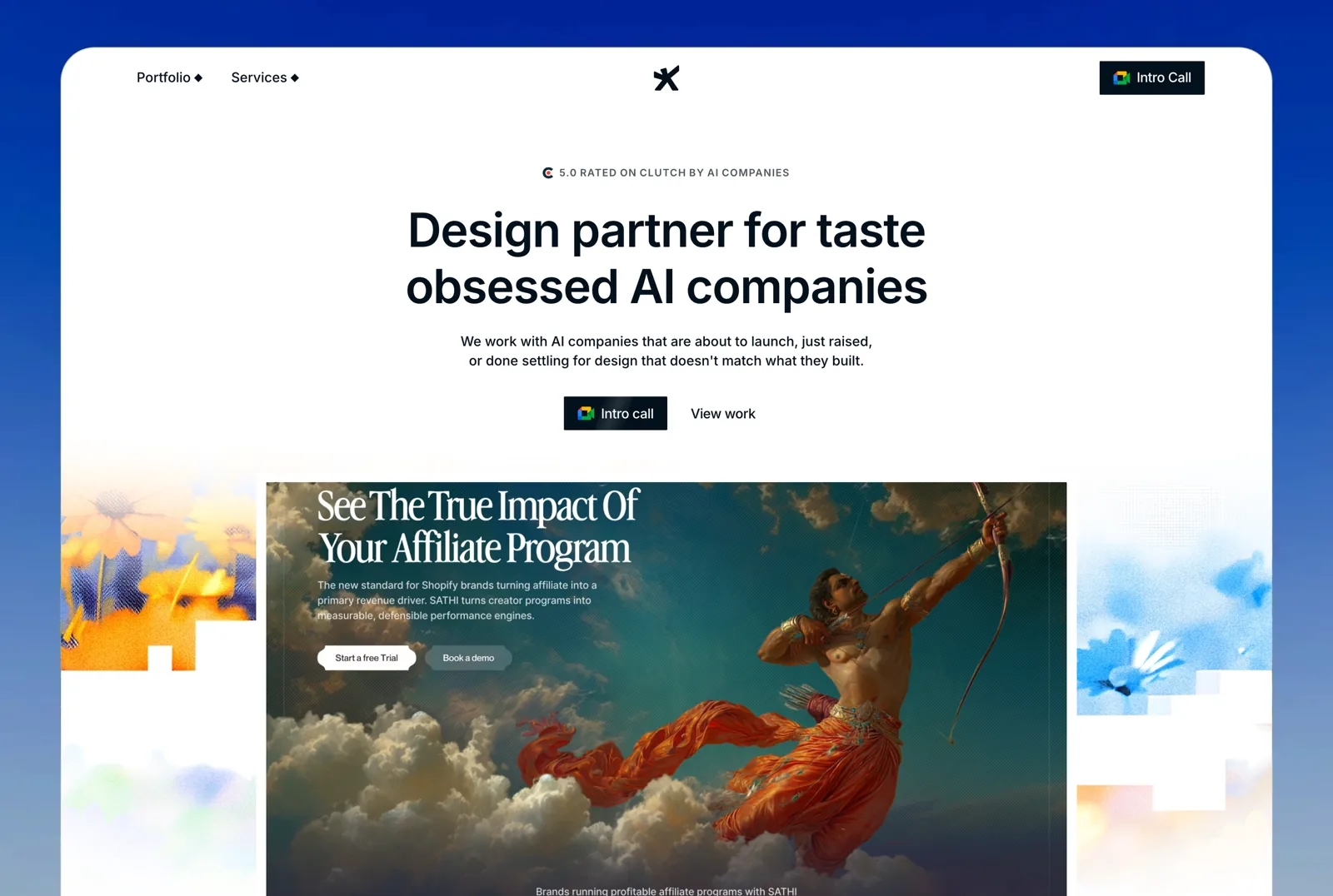
1. Studio Maydit: A Top-Rated Design Agency for AI Founders
Studio Maydit is a web and product design studio working with AI founders in the US, UK, and Europe. The studio builds websites in Framer, Webflow, and custom code, and continues into product design after the site ships.
The clearest outcome is Dualite, where design work supporting a repositioned ICP helped the product reach 100,000+ users in seven months. Recent clients include Wave, PixelFlow, Mi-VAD, and 15 other AI and SaaS teams.
Websites can be bought two ways. Fixed scope runs three to four weeks and suits teams with a launch date. Teams that keep shipping take a monthly retainer instead, covering new pages, campaigns, and product design, with no long lock-in. Fixed-scope projects end with a diagnosis of what is leaking in the product, not a handoff and goodbye.
| Check | Finding |
|---|---|
| Based in | Remote, serving US / UK / EU |
| Platform depth | Framer, Webflow, and custom code |
| AI-sector proof | Yes. AI-native clients, published outcome on Dualite |
| Pricing | Fixed scope or monthly retainer, quoted per project |
| Team shape | Founder-led, small senior team |
| Best fit | SF teams whose next buyers have no shared context with them |
Maydit is the right call if your reputation travels through people and your website has never had to work alone. Book a 30-minute call.

2. Trueform
Trueform is a Swiss studio founded in 2022 working specifically in Framer, with a published minimum and Miro, Morning Brew, Bilt Rewards, and Gather named, plus published AI client work. Being outside the bubble is the point here. A studio in Switzerland reads your draft copy the way your Ohio buyer will, and will say plainly when a sentence assumes knowledge the reader does not have.
They publish no team size, they are a small studio with limited capacity, and Switzerland to California is the widest timezone gap on this page, which slows the fast decisions Bay Area teams expect.
| Check | Finding |
|---|---|
| Based in | Wil, Switzerland |
| Founded | 2022 |
| Team size | Not published |
| Primary platform | Framer |
| AI-sector proof | Yes. Published AI client work |
| Named clients | Miro, Morning Brew, Bilt Rewards, Gather |
| Pricing | Published minimum |
| Best fit | SF teams who need an outside reader on everything they publish |
3. Clay
Clay is a San Francisco studio of 51 to 200, founded in 2016, with a published minimum and Slack, Stripe, Google, Coinbase, and Amazon named, plus published AI client work. They are local, which means no explaining and full overlapping hours, and their client list is the one most SF founders would name unprompted if asked who does this well.
They are large and premium, so an early team is a minor account, their work spans platforms rather than being Framer-first, and the cost is out of reach for most companies before a substantial round.
| Check | Finding |
|---|---|
| Based in | San Francisco, USA |
| Founded | 2016 |
| Team size | 51-200 |
| Primary platform | Mixed |
| AI-sector proof | Yes. Published AI client work |
| Named clients | Slack, Stripe, Google, Coinbase, Amazon |
| Pricing | Published minimum |
| Best fit | Well-funded SF teams who want a local studio at the top of the market |
4. Lazarev
Lazarev is a San Francisco team of 51 to 200, founded in 2015, with a published minimum and Payoneer, Peel, Elva, and Mozayix named, plus published AI client work. Payoneer is a business that operates across many countries with very different buyers, which is closer to your coming problem than a purely domestic reference is.
They are a large agency, so attention is divided across accounts, Framer is not their stated specialism, and their process suits a defined project better than a company still changing what it sells.
| Check | Finding |
|---|---|
| Based in | San Francisco, USA |
| Founded | 2015 |
| Team size | 51-200 |
| Primary platform | Mixed |
| AI-sector proof | Yes. Published AI client work |
| Named clients | Payoneer, Peel, Elva, Mozayix |
| Pricing | Published minimum |
| Best fit | SF teams selling into several countries and buyer types at once |
5. SuperSkills
SuperSkills is a small studio of 1 to 10 in Walnut Creek, California, working across platforms, with The Cut named and published AI client work. They are near enough for a same-day meeting and far enough outside the city to have kept a normal person's ear for language. The editorial background matters too, because explaining an unfamiliar idea to a general reader is exactly what publications do.
They name only one client, publish no founding year and no pricing, and a team this small takes one project at a time, so availability decides more than fit.
| Check | Finding |
|---|---|
| Based in | Walnut Creek, USA |
| Founded | Not published |
| Team size | 1-10 |
| Primary platform | Mixed |
| AI-sector proof | Yes. Published AI client work |
| Named clients | The Cut |
| Pricing | Not published |
| Best fit | SF teams who need plain writing from someone in the same timezone |
6. Feely Studio
Feely Studio is a small distributed European team of 1 to 10 with a published minimum and Noxus, Mutiny, Luasai, and Basic Capital named, plus published AI client work. A European team is a useful corrective for a San Francisco company, because they are outside your reference set and will not nod along at a claim that only sounds impressive locally.
They publish no founding year, they are very small, and a European team gives a California company an early morning window rather than a working day of overlap.
| Check | Finding |
|---|---|
| Based in | Distributed, Europe |
| Founded | Not published |
| Team size | 1-10 |
| Primary platform | Mixed |
| AI-sector proof | Yes. Published AI client work |
| Named clients | Noxus, Mutiny, Luasai, Basic Capital |
| Pricing | Published minimum |
| Best fit | SF teams whose growth is now in Europe rather than at home |
7. Fantasy
Fantasy has been working since 1999 across San Francisco and New York, across platforms, with published AI client work. Twenty-five years in this city means they have watched several waves of local certainty arrive and pass, and that memory is worth something when everyone around you is confident about the same thing at once.
They publish no client names, so their record cannot be checked from the outside, and no pricing or team size either. That is a lot of unknowns to accept when comparable studios publish more.
| Check | Finding |
|---|---|
| Based in | San Francisco and New York, USA |
| Founded | 1999 |
| Team size | Not published |
| Primary platform | Mixed |
| AI-sector proof | Yes. Published AI client work |
| Named clients | Not published |
| Pricing | Not published |
| Best fit | SF teams who value long local memory over a public track record |
8. Instrument
Instrument has been working since 2005 out of Portland, across platforms, with Nike, Microsoft, Electronic Arts, and Google named. Portland is close enough for real overlap and far enough to be immune to local consensus. Their strength is making a company look substantial, which is what a stranger in another state is actually assessing.
They publish neither pricing nor team size, their AI-sector proof is partial, and their engagements assume a client organisation with staff to run them, which a thirty-person startup does not have.
| Check | Finding |
|---|---|
| Based in | Portland, USA |
| Founded | 2005 |
| Team size | Not published |
| Primary platform | Mixed |
| AI-sector proof | Partial. Enterprise and SaaS clients, no AI case study |
| Named clients | Nike, Microsoft, Electronic Arts, Google |
| Pricing | Not published |
| Best fit | Funded SF teams who need to look established to distant buyers |
9. Push Refresh
Push Refresh is a Dallas studio of 1 to 10 working in Framer, with a published minimum and SmithRx, Synonym, and Northern National named. Dallas is a useful vantage point for this brief. It is a market where buyers are ordinary businesses rather than technology companies, so the studio's instinct is to explain rather than assume.
They publish no founding year, their AI-sector proof is partial rather than demonstrated, and a team of under ten cannot absorb a second urgent project if your launch moves.
| Check | Finding |
|---|---|
| Based in | Dallas, USA |
| Founded | Not published |
| Team size | 1-10 |
| Primary platform | Framer |
| AI-sector proof | Partial. Enterprise and SaaS clients, no AI case study |
| Named clients | SmithRx, Synonym, Northern National |
| Pricing | Published minimum |
| Best fit | SF teams selling to ordinary businesses outside the technology sector |
10. basement.studio
basement.studio works from Mar del Plata and Los Angeles, founded in 2018, 11 to 50 people, in custom code, with a published minimum and Vercel, Cursor, ElevenLabs, Harvey AI, and Scale AI named, plus published AI client work. That client list is drawn largely from your own neighbourhood, so they know the standard and the pace without needing it described.
They write custom code rather than working Framer-first, which makes small edits slower for your team, and their distinctive style suits companies that want to be noticed more than companies that want to be trusted.
| Check | Finding |
|---|---|
| Based in | Mar del Plata, Argentina and Los Angeles, USA |
| Founded | 2018 |
| Team size | 11-50 |
| Primary platform | Custom code |
| AI-sector proof | Yes. Published AI client work |
| Named clients | Vercel, Cursor, ElevenLabs, Harvey AI, Scale AI |
| Pricing | Published minimum |
| Best fit | SF teams whose peers are the audience and memorability is the goal |
How to choose between them
Sort by who you need to convince next.
Buyers outside technology who have never heard of you. Studio Maydit or Push Refresh.
Your growth is now in Europe. Feely Studio or Trueform.
Large distant organisations running a formal evaluation. Instrument or Lazarev.
Peers, investors, and engineers you want to recruit. Clay or basement.studio.
One test before signing. Give them your homepage copy and ask what a hospital procurement officer would not understand. A studio that suits this brief will return a list of specific words and unstated assumptions. One that answers with thoughts on the visual direction lives in the same bubble you do, and hiring them will make your site more attractive to exactly the people who were already going to take your call.