
Summarize with AI


The best Framer design agencies for Series A AI startups in 2026 are Studio Maydit, basement.studio, Feels Like, Foundey, Flowout, Refokus, Trueform, Edgar Allan, Digidop, and Lazarev. Studio Maydit and Trueform lead for teams who need a site a growing go-to-market team can actually use. Edgar Allan and Lazarev are the wrong fit unless your budget assumes a full marketing function.
At Series A your website acquires colleagues, and it is not ready for them.
Before the round, the site had one real job: make a stranger take the founder seriously enough to reply. It could be narrow, opinionated, and slightly incomplete, because a founder was in every important conversation anyway, filling the gaps in person.
Then you hire two account executives, a demand generation person, and a solutions engineer. Suddenly the site has four internal users with four different needs. The account executive wants something to send after a first call that survives being forwarded to a colleague. The demand generation hire wants pages to point spend at. The solutions engineer wants technical material that answers the questions they keep repeating. None of that exists, because none of it was needed a year ago.
This is why so many Series A sites get rebuilt within six months of the round, and why the rebuild is often framed as a branding exercise when the actual problem is structural. The site was designed as a statement. It now has to function as infrastructure, used daily by people who were not there when it was written.
The agencies below differ sharply in whether they build statements or systems.

How we picked these agencies
This is a teardown, not a directory listing. For each agency we read their own site and their public record, then checked five things you can verify yourself in an afternoon:
- Platform depth. Is this their main craft, or one line on a long service menu?
- AI-sector proof. Named AI clients and published work, or just the word "AI" in the copy?
- Pricing. Do they publish a minimum at all, or keep it behind a call?
- Team shape. Who actually does the work, and how many clients are they carrying at once?
- Their own site. Distinctive, or the same template as everyone else on this list?
That last one gets skipped most often. An agency's own website is the only project where nobody overruled them. No client committee, no inherited brand book. If their own site is forgettable, you have found their ceiling.
Every fact below comes from the agency's own site or a public listing. Where a number is not public, we say so rather than guessing.
What goes wrong right after the A
Three failures repeat at this stage, and each one comes from a company that grew while its site stayed still.
You found three segments and the homepage still talks to the first one. By Series A you know things you did not know at seed. There are probably two or three customer types who buy for genuinely different reasons, and one of them converts far better than the others. The homepage, however, was written for whoever you sold to first, often a friendly design partner who is now unrepresentative. Every visitor from the other segments has to translate, and most will not bother. The fix is not a broader homepage, which just dilutes everything. It is a homepage that leads with the strongest segment and dedicated pages that let the others recognise themselves within one click.
The board deck and the website describe different companies. Something odd happens in the months around a raise. The deck gets sharpened relentlessly, because it is the document that determines whether the round closes. The site does not, because nobody in that process reads it. So you end up with a crisp, well-argued account of the market in one place, and a nine-month-old approximation of it in the place your customers actually visit. The deck is usually closer to the truth. It is worth reading both side by side once a quarter, and the gap between them is normally the entire brief.
The paid budget got approved and there is nowhere to send it. Post-round, someone will be asked to spend money on demand generation. That spend needs landing pages built for a specific audience and a specific message, measurable independently, and changeable within a day when the numbers come back. Most Series A sites have exactly one destination, the homepage, so every campaign points at a page that was designed to introduce the company rather than to convert a particular intent. The money gets spent, the numbers look poor, and the conclusion drawn is that the channel does not work. Usually the channel was fine and the destination was wrong.
1. Studio Maydit: A Top-Rated Design Agency for AI Founders
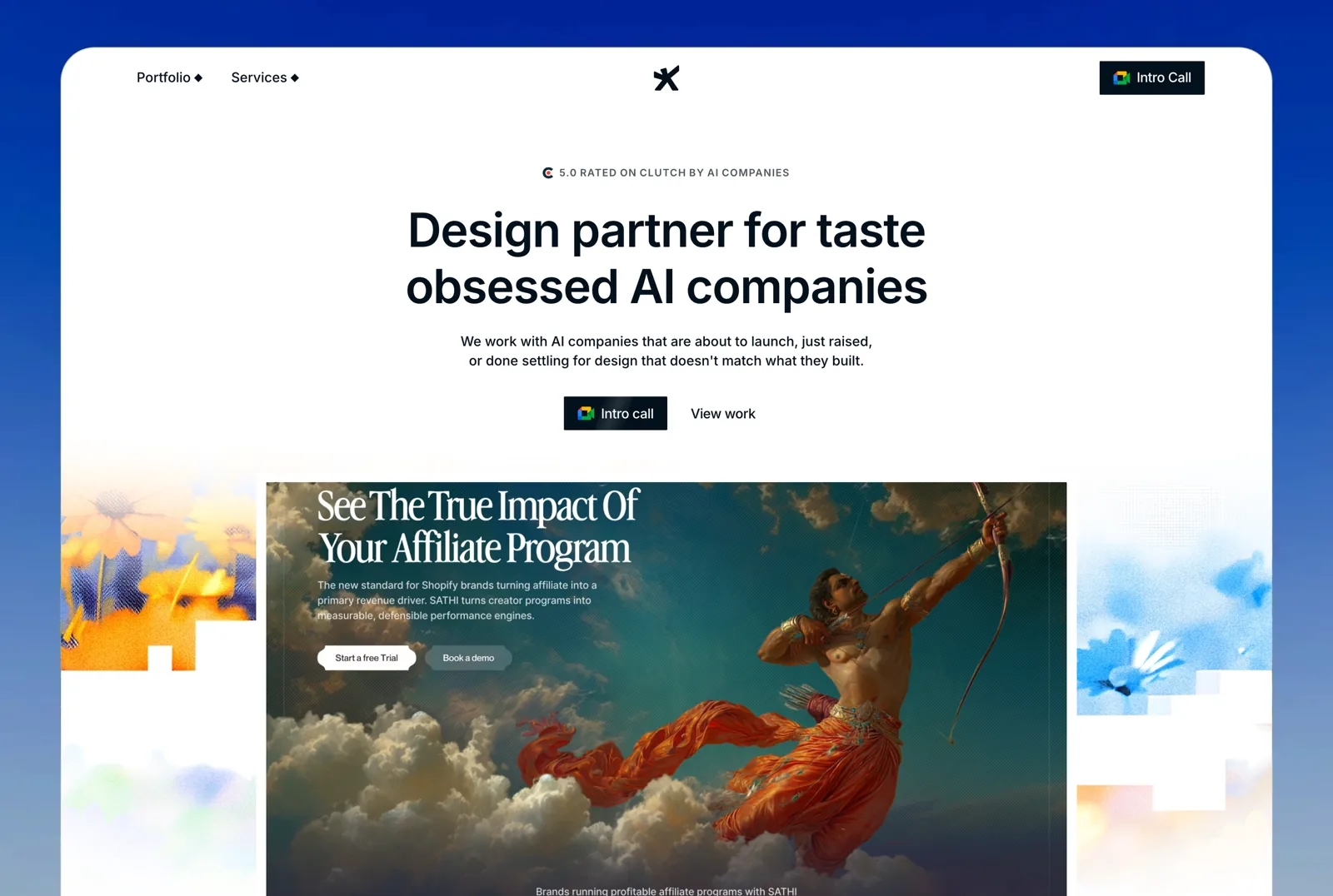
Studio Maydit is a web and product design studio working with AI founders in the US, UK, and Europe. The studio builds websites in Framer, Webflow, and custom code, and continues into product design after the site ships.
The clearest outcome is Dualite, where design work supporting a repositioned ICP helped the product reach 100,000+ users in seven months. Recent clients include Wave, PixelFlow, Mi-VAD, and 15 other AI and SaaS teams.
Websites can be bought two ways. Fixed scope runs three to four weeks and suits teams with a launch date. Teams that keep shipping take a monthly retainer instead, covering new pages, campaigns, and product design, with no long lock-in. Fixed-scope projects end with a diagnosis of what is leaking in the product, not a handoff and goodbye.
| Check | Finding |
|---|---|
| Based in | Remote, serving US / UK / EU |
| Platform depth | Framer, Webflow, and custom code |
| AI-sector proof | Yes. AI-native clients, published outcome on Dualite |
| Pricing | Fixed scope or monthly retainer, quoted per project |
| Team shape | Founder-led, small senior team |
| Best fit | Series A teams whose new go-to-market hires need pages that do not exist yet |
Maydit is the right call if your site was built for a company one size smaller than the one you now run. Book a 30-minute call.

2. basement.studio
basement.studio works across Argentina and Los Angeles with published AI client work for Vercel, Cursor, and ElevenLabs, and a published minimum. Their clients are companies that scaled quickly in this exact category, so the pattern of a site outgrowing its original scope is familiar rather than theoretical.
They are a custom code studio, which means your marketing hires will need engineering support for changes that a builder-based site would let them make alone.
| Check | Finding |
|---|---|
| Based in | Mar del Plata, Argentina and Los Angeles, USA |
| Founded | 2018 |
| Team size | 11-50 |
| Primary platform | Custom code |
| AI-sector proof | Yes. Published AI client work |
| Named clients | Vercel, Cursor, ElevenLabs, Harvey AI, Scale AI |
| Pricing | Published minimum |
| Best fit | Series A teams with engineers to spare and a high craft bar |
3. Feels Like
Feels Like is a Los Angeles studio founded in 2023 with published AI client work including Suno AI. Post-round is the moment a company gets one clean opportunity to be reintroduced to the market, and a studio with this level of craft signal makes that reintroduction land.
They publish neither pricing nor team size, they are young, and a coded build adds dependency exactly when your marketing team wants autonomy.
| Check | Finding |
|---|---|
| Based in | Los Angeles, USA |
| Founded | 2023 |
| Team size | Not published |
| Primary platform | Custom code |
| AI-sector proof | Yes. Published AI client work |
| Named clients | Google, Nike, LVMH, Suno AI |
| Pricing | Not published |
| Best fit | Series A teams treating the round as a repositioning moment |
4. Foundey
Foundey is a San Francisco studio with published AI client work including Traycer and Sero AI. They work product-first, which suits a Series A company whose growth constraint has moved from finding customers to keeping them, since the pages and the product then get designed with the same logic.
They deliver Figma files rather than a built site, so implementation sits elsewhere, and they publish neither pricing nor team size.
| Check | Finding |
|---|---|
| Based in | San Francisco, USA |
| Founded | 2021 |
| Team size | Not published |
| Primary platform | Figma-only |
| AI-sector proof | Yes. Published AI client work |
| Named clients | DemandIQ, Traycer, Sero AI |
| Pricing | Not published |
| Best fit | Series A teams whose next problem is retention rather than acquisition |
5. Flowout
Flowout runs a distributed subscription model with a published starting figure and clients including Jasper and Kajabi. A new demand generation hire generates a constant stream of landing pages, and a volume model at a known monthly cost is a sensible way to absorb that without expanding headcount.
The model suits specified requests rather than open strategic questions, and their AI-sector proof is partial.
| Check | Finding |
|---|---|
| Based in | Distributed |
| Founded | Not published |
| Team size | Not published |
| Primary platform | Webflow |
| AI-sector proof | Partial. Enterprise and SaaS clients, no AI case study |
| Named clients | Jasper, Kajabi, Riverside, Sendlane |
| Pricing | Published minimum |
| Best fit | Series A teams with a campaign calendar and a queue of landing pages |
6. Refokus
Refokus is a remote German studio of 11 to 50 with work for Mural, Spotify, and BCG. They are used to building inside an existing identity rather than replacing it, which matters at Series A when the brand has genuine equity with early customers and a full reset would cost more than it returns.
They publish no pricing, their AI-sector proof is partial, and their published clients are considerably larger than a Series A company.
| Check | Finding |
|---|---|
| Based in | Germany, remote |
| Founded | 2021 |
| Team size | 11-50 |
| Primary platform | Webflow |
| AI-sector proof | Partial. Enterprise and SaaS clients, no AI case study |
| Named clients | Mural, BASF, Spotify, Yahoo, BCG |
| Pricing | Not published |
| Best fit | Series A teams who want to grow the current identity rather than restart it |
7. Trueform
Trueform is a Swiss studio working almost entirely in Framer, with published AI client work and a published minimum. A component-built Framer site is the practical answer to the landing page problem, because a marketer can assemble a new page from existing pieces the same afternoon the campaign is approved.
They are young, founded in 2022, and they do not publish team size, so ask what happens if your account needs two people at once.
| Check | Finding |
|---|---|
| Based in | Wil, Switzerland |
| Founded | 2022 |
| Team size | Not published |
| Primary platform | Framer |
| AI-sector proof | Yes. Published AI client work |
| Named clients | Miro, Morning Brew, Bilt Rewards, Gather |
| Pricing | Published minimum |
| Best fit | Series A teams who need marketing to ship pages without engineering |
8. Edgar Allan
Edgar Allan is an Atlanta team of 51 to 200 who start with language, working with Porsche and NCR. When a company has three segments and one story, the problem is usually the words rather than the layout, and this is a team that will spend real time there before designing anything.
They publish no pricing, their AI-sector proof is partial, and their scale suits companies with an internal marketing leader already hired.
| Check | Finding |
|---|---|
| Based in | Atlanta, USA |
| Founded | 2014 |
| Team size | 51-200 |
| Primary platform | Webflow |
| AI-sector proof | Partial. Enterprise and SaaS clients, no AI case study |
| Named clients | Porsche, Duracell, NCR |
| Pricing | Not published |
| Best fit | Series A teams whose segments each need a different sentence |
9. Digidop
Digidop is a Paris studio of 1 to 10 with a published minimum and clients including Ramify and StreamNative. Direct access to the people doing the work keeps the loop short during the months after a round, when priorities change faster than any project plan survives.
At 1 to 10 people there is no redundancy, their AI-sector proof is partial, and Webflow rather than Framer is the platform.
| Check | Finding |
|---|---|
| Based in | Paris, France |
| Founded | 2021 |
| Team size | 1-10 |
| Primary platform | Webflow |
| AI-sector proof | Partial. Enterprise and SaaS clients, no AI case study |
| Named clients | TSE Energy, Ramify, StreamNative |
| Pricing | Published minimum |
| Best fit | European Series A teams who want direct access and a published figure |
10. Lazarev
Lazarev is a San Francisco team of 51 to 200 with published AI client work and a published minimum. They cover marketing and product together, which is the coverage a Series A company needs once the site and the onboarding flow have to tell one continuous story rather than two separate ones.
They work at agency scale and cost, and a company at this stage should confirm the seniority of the people actually assigned.
| Check | Finding |
|---|---|
| Based in | San Francisco, USA |
| Founded | 2015 |
| Team size | 51-200 |
| Primary platform | Mixed |
| AI-sector proof | Yes. Published AI client work |
| Named clients | Payoneer, Peel, Elva, Mozayix |
| Pricing | Published minimum |
| Best fit | Series A teams who want site and product covered by one agency |
How to choose between them
Sort by who is currently blocked.
Marketing cannot ship a page without filing a ticket. Studio Maydit or Trueform.
Sales has nothing to send after the first call. Edgar Allan.
Demand generation needs pages faster than anyone can build them. Flowout or Digidop.
The round is your one chance to be reintroduced properly. Feels Like or basement.studio.
One test before signing. Ask them who will use the site internally after launch and what each of those people needs to be able to do without help. An agency that names roles, describes what each one edits, and has an opinion about where the boundaries sit is building infrastructure. An agency that answers with a launch plan is building a statement, and you will be paying for the rebuild before the next board meeting.