
Summarize with AI


The best Framer design agencies for startups that just raised in 2026 are Studio Maydit, Edgar Allan, 8020, Lazarev, Flowout, Finsweet, Instrument, Ramotion, Pixelmatters, and Lighthouse Digital. Studio Maydit and 8020 lead for teams who need the site to match the news within weeks. Instrument and Ramotion are the wrong fit unless you have a year and a brand problem rather than a website problem.
The round closed. For about ten days, more people will look at your company than at any other point in the next twelve months.
Almost every team wastes that. The announcement goes out, the traffic arrives, and it lands on a website built by a smaller version of the company for a customer it no longer targets. Investors you did not talk to, engineers deciding where to interview, journalists deciding whether to write about you, and competitors' customers having a quick look. All of them form a view in one visit, and for most of them it is the only visit they will ever make.
The second thing that changes is what the site is actually for. Before the raise it existed to get meetings. Now the binding constraint is hiring, and the people you need most are the ones with the most options. They will read your site the way an investor did, looking for whether this company knows what it is doing, and then they will look for a careers page that treats them as adults. Most teams have neither.
There is a third pressure, and it is the one that quietly kills the quarter. Money makes ambitious projects feel affordable, so a six-month rebrand starts, and for those six months nothing ships while the window that made it worth doing closes.
Speed against ambition, with a hard deadline attached, is what separates these ten agencies.

How we picked these agencies
This is a teardown, not a directory listing. For each agency we read their own site and their public record, then checked five things you can verify yourself in an afternoon:
- Platform depth. Is Framer their main craft, or one line on a long service menu?
- AI-sector proof. Named AI clients and published work, or just the word "AI" in the copy?
- Pricing. Do they publish a minimum at all, or keep it behind a call?
- Team shape. Who actually does the work, and how many clients are they carrying at once?
- Their own site. Distinctive, or the same template as everyone else on this list?
That last one gets skipped most often. An agency's own website is the only project where nobody overruled them. No client committee, no inherited brand book. If their own site is forgettable, you have found their ceiling.
Every fact below comes from the agency's own site or a public listing. Where a number is not public, we say so rather than guessing.
What goes wrong in the weeks after the money lands
Three failures follow almost every round, and all three come from treating the raise as an ending rather than a countdown.
The spike arrives before the site is ready and is never repeated. Teams plan the announcement carefully and the website not at all, so the biggest audience the company will assemble this year meets a page describing the company as it was eighteen months ago. Traffic from a funding announcement does not come back. Nobody bookmarks a startup to check again next quarter. Whatever conclusion a visitor reaches during those ten days is the conclusion they keep, and if the page contradicts the story in the press coverage they will simply believe the page, because it looks more like evidence. The site has to be right on the day the news goes out, which means the work starts before the round is even signed.
Hiring becomes the bottleneck and the careers page is still three lines. The plan you sold your investors depends on hiring people quickly, and senior engineers and designers research a company properly before they apply. They want to know what is actually being built, who they would work with, how decisions get made, and whether the funding buys ambition or just runway. A careers page that lists roles and mentions unlimited holiday answers none of that and reads as a company that has not thought about them. This page now converts a scarcer resource than your marketing pages do, and it is almost always the least considered thing on the site.
A large rebrand starts and eats the entire window. With money in the bank, redoing everything feels responsible, and a full identity project is genuinely satisfying work. It also runs for months, during which the site cannot change because the new system is not finished, and the announcement momentum drains away. The sequencing that works is the opposite of the instinctive one. Fix the story and the pages that carry it now, while people are looking, and do the deeper identity work later from a position where you already know which parts are wrong. Almost nobody regrets shipping the fast version first.
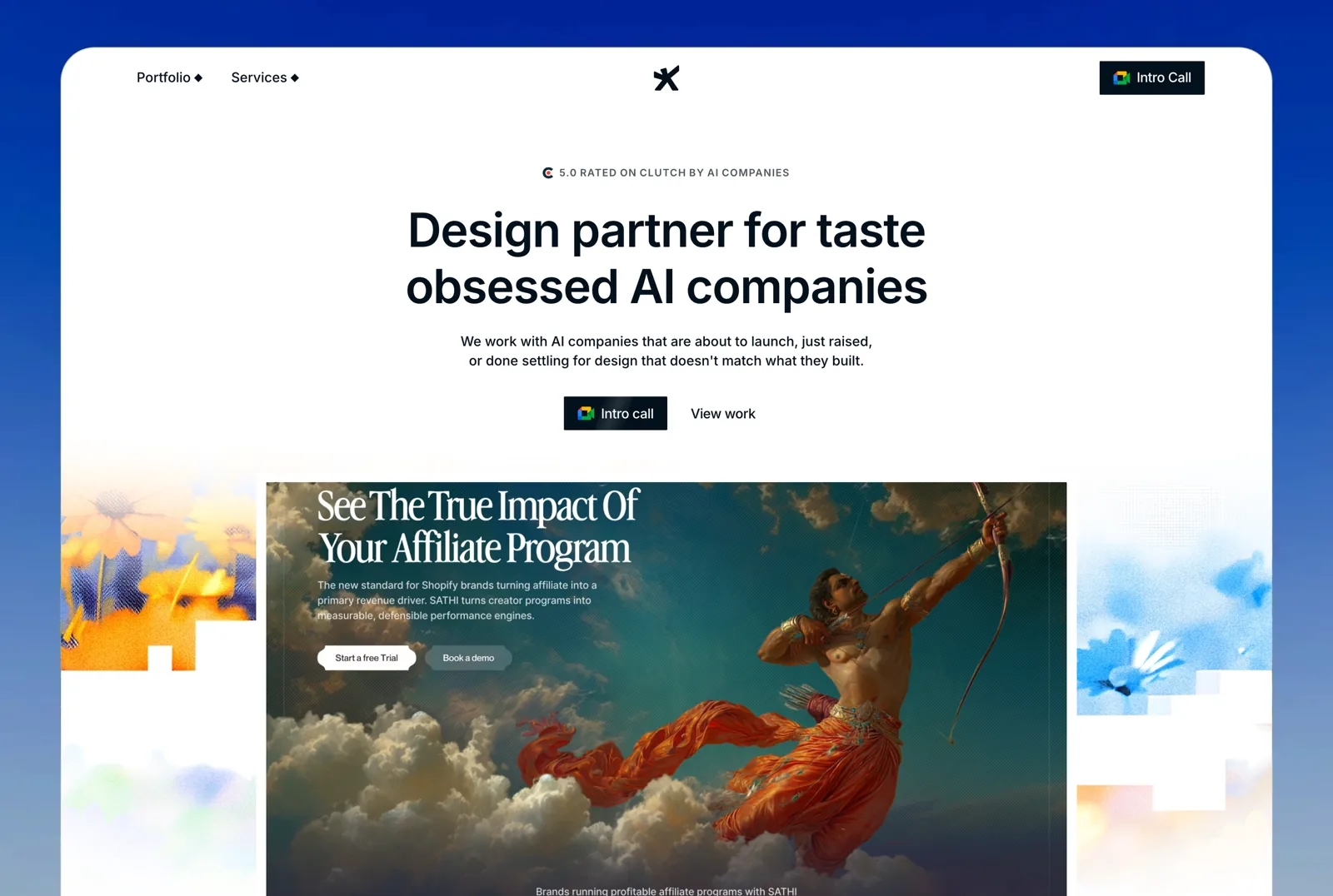
1. Studio Maydit: A Top-Rated Design Agency for AI Founders
Studio Maydit is a web and product design studio working with AI founders in the US, UK, and Europe. The studio builds websites in Framer, Webflow, and custom code, and continues into product design after the site ships.
The clearest outcome is Dualite, where design work supporting a repositioned ICP helped the product reach 100,000+ users in seven months. Recent clients include Wave, PixelFlow, Mi-VAD, and 15 other AI and SaaS teams.
Websites can be bought two ways. Fixed scope runs three to four weeks and suits teams with a launch date. Teams that keep shipping take a monthly retainer instead, covering new pages, campaigns, and product design, with no long lock-in. Fixed-scope projects end with a diagnosis of what is leaking in the product, not a handoff and goodbye.
| Check | Finding |
|---|---|
| Based in | Remote, serving US / UK / EU |
| Platform depth | Framer, Webflow, and custom code |
| AI-sector proof | Yes. AI-native clients, published outcome on Dualite |
| Pricing | Fixed scope or monthly retainer, quoted per project |
| Team shape | Founder-led, small senior team |
| Best fit | Teams with an announcement date and a site that predates it |
Maydit is the right call when the deadline is fixed and the story has changed. Book a 30-minute call.

2. Edgar Allan
Edgar Allan is an Atlanta team of 51 to 200 working since 2014, with Porsche, Duracell, and NCR named. They lead with writing, and after a raise the thing that has genuinely changed is the story rather than the layout. A studio whose first instinct is to rewrite the claim will get you further than one that redraws the page around the old one.
They publish no pricing, their AI-sector proof is partial, and a studio of that size runs a process longer than the weeks you have before the announcement.
| Check | Finding |
|---|---|
| Based in | Atlanta, USA |
| Founded | 2014 |
| Team size | 51-200 |
| Primary platform | Webflow |
| AI-sector proof | Partial. Enterprise and SaaS clients, no AI case study |
| Named clients | Porsche, Duracell, NCR |
| Pricing | Not published |
| Best fit | Teams whose story changed more than their product did |
3. 8020
8020 works out of San Francisco and New York since 2014, with Wave, Vanta, Pilot.com, and Circle named. That is the most relevant roster on this list, because every one of those companies raised and had to grow up publicly in a short space of time. A studio that has been through that cycle repeatedly knows which pages matter in the first month and which can wait.
They publish neither pricing nor team size, their AI-sector proof is partial, and Webflow rather than Framer is the platform, which matters if your team is already committed.
| Check | Finding |
|---|---|
| Based in | San Francisco and New York, USA |
| Founded | 2014 |
| Team size | Not published |
| Primary platform | Webflow |
| AI-sector proof | Partial. Enterprise and SaaS clients, no AI case study |
| Named clients | Wave, Superlist, Pilot.com, Vanta, Circle |
| Pricing | Not published |
| Best fit | Teams who need to look funded without looking corporate |
4. Lazarev
Lazarev is a San Francisco team of 51 to 200 with published AI client work, a published minimum, and Payoneer named. Published pricing is worth more than it sounds in the weeks after a round, because it removes a negotiation from a schedule that has no room in it, and their AI record means less time spent explaining what your product does.
They are large, so senior attention thins across an engagement, account management sits between you and the makers, and Framer is one option rather than the specialism.
| Check | Finding |
|---|---|
| Based in | San Francisco, USA |
| Founded | 2015 |
| Team size | 51-200 |
| Primary platform | Mixed |
| AI-sector proof | Yes. Published AI client work |
| Named clients | Payoneer, Peel, Elva, Mozayix |
| Pricing | Published minimum |
| Best fit | Teams who want the cost and scope settled in one call |
5. Flowout
Flowout is a distributed Webflow studio with a published minimum and Jasper, Kajabi, and Riverside named. Their model is built for continuous output rather than one large project, which fits the months after a raise unusually well, since what you actually need is a steady stream of new pages as hiring, launches, and campaigns arrive.
They publish neither a founding year nor a team size, their AI-sector proof is partial, and a subscription arrangement is a poor fit for a single high-stakes launch page.
| Check | Finding |
|---|---|
| Based in | Distributed |
| Founded | Not published |
| Team size | Not published |
| Primary platform | Webflow |
| AI-sector proof | Partial. Enterprise and SaaS clients, no AI case study |
| Named clients | Jasper, Kajabi, Riverside, Sendlane |
| Pricing | Published minimum |
| Best fit | Teams who will need new pages every week for six months |
6. Finsweet
Finsweet is a distributed Denver team of 51 to 200 working since 2017, with Dropbox, GitHub, and Clay named. Their strength is building sites that a growing marketing team can operate without going back to the agency, which is the difference between a site that keeps up with your hiring plan and one that becomes a bottleneck by the second quarter.
They publish no pricing, their AI-sector proof is partial, and their work is Webflow-centred and technical rather than Framer-native or brand-led.
| Check | Finding |
|---|---|
| Based in | Denver, USA, distributed |
| Founded | 2017 |
| Team size | 51-200 |
| Primary platform | Webflow |
| AI-sector proof | Partial. Enterprise and SaaS clients, no AI case study |
| Named clients | Dropbox, Clay, GitHub, Steadily |
| Pricing | Not published |
| Best fit | Teams hiring marketers who will need to ship pages themselves |
7. Instrument
Instrument is a Portland studio working since 2005, with Nike, Microsoft, and Google named. If the round was large enough that the company is genuinely changing category, this is the kind of studio that can build an identity with room to grow into. That is a real need for some teams and a distraction for most.
They publish neither pricing nor team size, their AI-sector proof is partial, Framer is not their centre, and the timeline is measured in quarters rather than weeks.
| Check | Finding |
|---|---|
| Based in | Portland, USA |
| Founded | 2005 |
| Team size | Not published |
| Primary platform | Mixed |
| AI-sector proof | Partial. Enterprise and SaaS clients, no AI case study |
| Named clients | Nike, Microsoft, Electronic Arts, Google |
| Pricing | Not published |
| Best fit | Large rounds where the company is changing category outright |
8. Ramotion
Ramotion is a San Francisco team of 11 to 50 working since 2009, with a published minimum and Mozilla, Okta, and Adobe named. Okta is the useful reference after a raise, a company that had to look established while still being chosen by people who wanted something modern. That balance is the exact tone most newly funded companies are reaching for and missing.
Their AI-sector proof is partial, Framer is not the specialism, and a brand-led engagement runs longer than the window the announcement gives you.
| Check | Finding |
|---|---|
| Based in | San Francisco, USA |
| Founded | 2009 |
| Team size | 11-50 |
| Primary platform | Mixed |
| AI-sector proof | Partial. Enterprise and SaaS clients, no AI case study |
| Named clients | Mozilla, Okta, Netflix, Adobe, Xero |
| Pricing | Published minimum |
| Best fit | Teams who need to read as established without looking dated |
9. Pixelmatters
Pixelmatters is a Porto team of 51 to 200 working since 2013, with a published minimum and Rubrik and UJET named. They design and build in one accountable team, which removes the handoff gap that usually appears when a launch date is fixed and a change agreed on Tuesday has to be live on Thursday.
Their AI-sector proof is partial, Framer is one platform among several, and at their size an early-stage team will not command the strongest people.
| Check | Finding |
|---|---|
| Based in | Porto, Portugal |
| Founded | 2013 |
| Team size | 51-200 |
| Primary platform | Mixed |
| AI-sector proof | Partial. Enterprise and SaaS clients, no AI case study |
| Named clients | Rubrik, Quantic, UJET |
| Pricing | Published minimum |
| Best fit | Teams with a fixed launch date and no room for handoffs |
10. Lighthouse Digital
Lighthouse Digital is a London Webflow studio with a published minimum and HelloSelf, Freetrade, and IGN named. Freetrade is the relevant reference, a consumer fintech that had to look substantial to customers and to regulators while still being an early company. Published pricing suits a team working against an announcement date.
They publish neither a founding year nor a team size, and they have no published AI client work, which is a real gap if your round was raised on an AI story you now have to explain.
| Check | Finding |
|---|---|
| Based in | London, UK |
| Founded | Not published |
| Team size | Not published |
| Primary platform | Webflow |
| AI-sector proof | No. No published AI client work |
| Named clients | HelloSelf, Freetrade, IGN |
| Pricing | Published minimum |
| Best fit | UK teams who need to look substantial straight after a round |
How to choose between them
Sort by what the money is supposed to buy.
The announcement is in four weeks and the site is wrong. Studio Maydit or 8020.
The story changed and nobody can write the new one. Edgar Allan.
You are hiring twenty people and the careers page is three lines. Finsweet or Flowout.
The round was big enough to change the category you are in. Instrument.
One test before signing. Tell them the announcement date and ask what they would cut to hit it. An agency that has done this before will name pages to drop and argue for shipping the homepage and careers page first. An agency that says the full scope is achievable has either not understood the date or is planning to discover the problem in week five, when you no longer have the option to change course.