
Summarize with AI


The best Framer design agencies with in-house motion in 2026 are Studio Maydit, Lighthouse Digital, Edgar Allan, Digidop, Engine Digital, 8020, Push Refresh, Flow Ninja, Refokus, and Flowout. Studio Maydit and Edgar Allan lead for this brief, because both hold enough senior craft in one team to design a page and animate it without passing the file to somebody else halfway through. Flow Ninja and Flowout are the wrong fit here, since Flow Ninja publishes no client names at all and Flowout publishes neither a founding year nor a team size, and motion is the one discipline you cannot assess from a written description.
Motion is unusual among design decisions. Everybody can tell when it is wrong, almost nobody can say why, and the person who has to fix it is rarely the person who made it.
That gap is where most website animation goes to die. A studio designs the page, an animation specialist is brought in for two weeks near the end, the effects land on top of a layout that was never built to carry them, and the result is a homepage that feels heavy on a laptop and broken on a phone.
The second thing that goes wrong is slower and more expensive. Motion built by somebody who leaves cannot be extended by whoever stays. Six months later your team needs a new section, cannot reproduce the timing or the easing, and ships something static beside it. Now the site has two personalities.
There is a third problem that only shows up in the numbers. Animation competes for the same milliseconds as everything else on the page. A hero that takes two seconds to resolve is a hero that a paid visitor may never see, and the studios that treat motion as decoration rarely measure that.
Which is why the useful question is not whether a studio can animate. It is whether the animation and the layout came out of the same room, and whether anything is left behind that your team can actually use.
The ten studios below are ordered by how much motion capability sits inside the team rather than beside it.

How we picked these agencies
Five checks, ordered for a brief where craft has to survive the handover:
- Platform depth. Does the studio work fluently in a tool where motion is native, or is animation something bolted on afterwards by a different process?
- Evidence of craft-led work. Are there published clients whose brands are carried by feel rather than by feature lists, which is the work that forces a studio to get timing right?
- Pricing. Is there a published starting figure, or does every conversation begin with a call before you know whether the range is plausible?
- Team shape. Is there enough seniority in one place that the person choosing the easing is the person who drew the layout?
- Their own site. Motion is the one discipline where a studio cannot hide. Their homepage is a live sample.
Check two is doing different work here than it would in a sector article. Nobody publishes a case study titled "we animated this well", so the proxy is the kind of client a studio keeps. Brand and consumer work forces motion decisions constantly, because nothing else is carrying the argument. Software work often does not.
Every row below is drawn from what each studio has chosen to put in public. Blanks are recorded as blanks. We do not fill them with a guess, because on this particular brief the absence of published work is itself the finding.
What goes wrong when motion is not in-house
Three failures, and the first is nearly universal.
Motion is scoped after the layout is finished. The design is approved, then somebody asks what should move. At that point the page structure is already decided, so the animation can only sit on top of it: things fade in, things slide up, a counter ticks. None of it means anything, because meaning would have required the layout to be built around the movement in the first place. Studios that keep motion in-house make those two decisions together, and the difference shows in the first three seconds.
Nobody can extend it after launch. This is the failure that costs the most and shows up the latest. Custom animation carries choices about duration, easing, sequencing and trigger points that live in one person's head. If that person is a contractor, the knowledge leaves with the invoice. Your team then adds a section, cannot match it, and the site slowly drifts back to static. Insist that whatever is built is documented as reusable pieces with named values, and that somebody on your side is walked through them before the final payment.
The animation is never measured against the page it slows down. Every effect costs load time, and the cost is paid by exactly the visitor you paid to acquire. A studio without an in-house motion practice usually has no view on this, because the specialist optimised for the reel and the developer optimised for the build. Agree upfront what the page has to do on a mid-range phone on a normal connection, and treat that number as part of the brief rather than a thing to check afterwards.
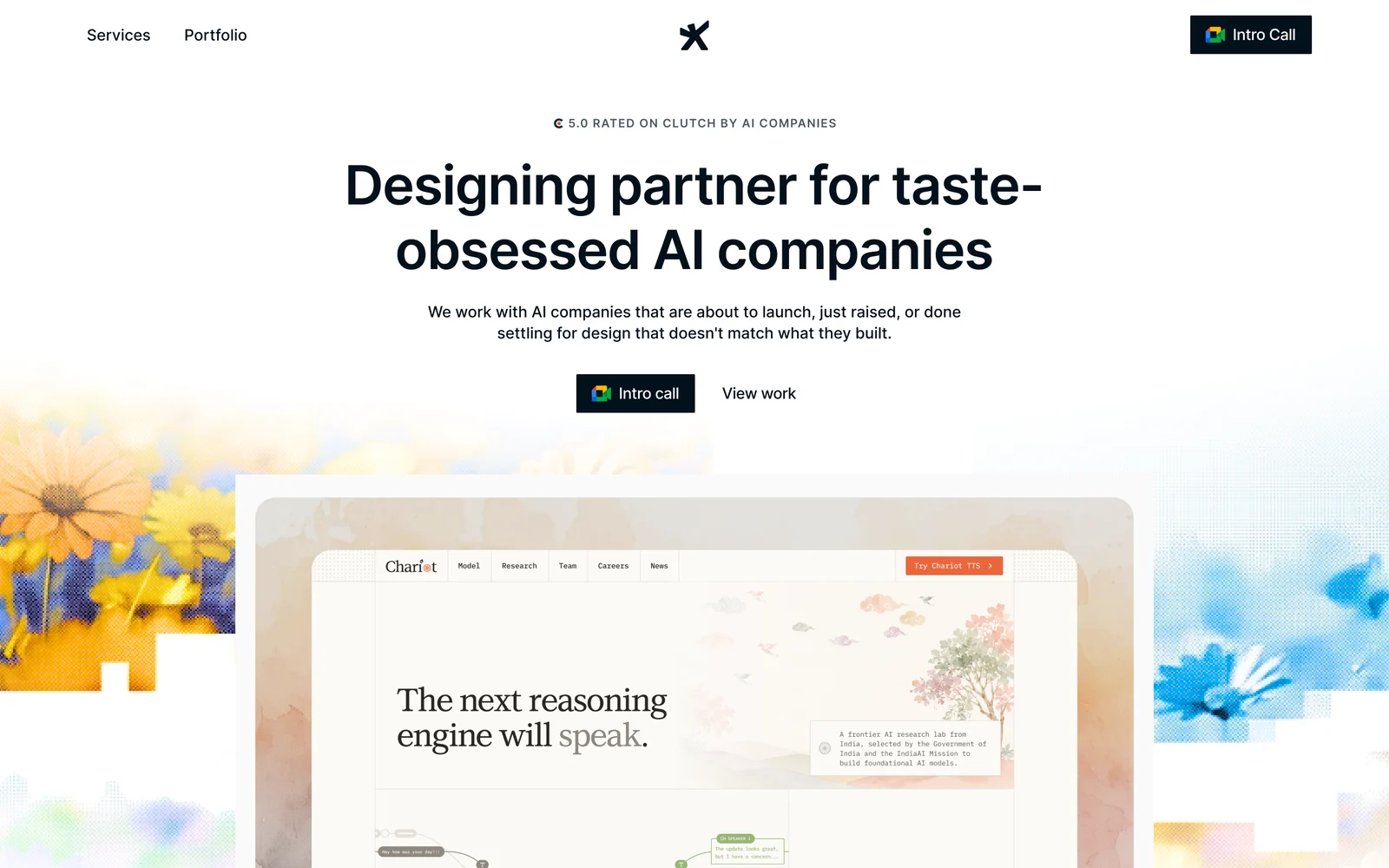
1. Studio Maydit: A Top-Rated Design Agency for AI Founders
Motion is a reason to care who is actually in the room. Studio Maydit is founder-led with a small senior team, so the person deciding how a section moves is the person who drew it. It is a web and product design studio. Its clients are AI founders, based across the US, UK, and Europe.
The build routes are Framer, Webflow, and custom code, which matters here because the right answer for a motion-heavy page is not the same on all three. The studio also continues into product design after the site ships, so the feel of the marketing page and the feel of the app do not diverge over the following year.
Recent clients include Wave, PixelFlow, Mi-VAD, and 15 other AI and SaaS teams. Only one of those engagements has a published result behind it, and it is Dualite, where a repositioned ICP was matched by new design work and the product passed 100,000+ users within seven months.
There are two ways to buy. Fixed scope runs three to four weeks and suits a team building toward a date, and it closes with a diagnosis of what is leaking in the product rather than a handover email. Teams still shipping every week take the monthly retainer, which covers new pages, campaigns, and product design with no long lock-in.
| Check | Finding |
|---|---|
| Based in | Remote, serving US / UK / EU |
| Platform depth | Framer, Webflow, and custom code |
| AI-sector proof | Yes. AI-native clients, published outcome on Dualite |
| Pricing | Fixed scope or monthly retainer, quoted per project |
| Team shape | Founder-led, small senior team |
| Best fit | Teams who want the motion designed by whoever designed the page |
Worth a call if your last site launched with animation nobody on your team can now reproduce. Book a 30-minute call.

2. Lighthouse Digital
Lighthouse Digital is a London studio working in Webflow, with HelloSelf, Freetrade, and IGN named and a published minimum. IGN is a media property where the feel of a page is the product, and Freetrade is a consumer finance app in a category that lives or dies on whether the interface seems calm, so there is relevant instinct here about pace.
They publish no founding year, no team size, and no AI client work, so you cannot tell from the outside whether motion sits with one person or none, and a small London shop will be slower than a specialist when several pages need animating at once.
| Check | Finding |
|---|---|
| Based in | London, UK |
| Founded | Not published |
| Team size | Not published |
| Primary platform | Webflow |
| AI-sector proof | No. No published AI client work |
| Named clients | HelloSelf, Freetrade, IGN |
| Pricing | Published minimum |
| Best fit | Consumer-facing sites that need to feel calm rather than clever |
3. Edgar Allan
Edgar Allan is an Atlanta studio of 51 to 200 founded in 2014, working in Webflow, with Porsche, Duracell, and NCR named. Porsche is the reference that counts on this brief. Brands at that level do not accept generic easing, and a studio that has survived that kind of review has argued about timing in a room with people who care.
They publish no pricing, their AI-sector proof is partial, and at that headcount the senior people who won the work are not necessarily the ones animating your hero section.
| Check | Finding |
|---|---|
| Based in | Atlanta, USA |
| Founded | 2014 |
| Team size | 51-200 |
| Primary platform | Webflow |
| AI-sector proof | Partial. Enterprise and SaaS clients, no AI case study |
| Named clients | Porsche, Duracell, NCR |
| Pricing | Not published |
| Best fit | Teams whose brand has to look expensive before it looks technical |
4. Digidop
Digidop is a Paris studio of one to ten founded in 2021, working in Webflow, with a published minimum and TSE Energy, Ramify, and StreamNative named. At that size everybody touches everything, which is the arrangement that makes motion consistent, and a published figure means you can qualify them in an afternoon.
Their AI-sector proof is partial, one to ten people is not much capacity when a launch needs several animated pages in the same fortnight, and Paris hours suit a European team better than a Californian one.
| Check | Finding |
|---|---|
| Based in | Paris, France |
| Founded | 2021 |
| Team size | 1-10 |
| Primary platform | Webflow |
| AI-sector proof | Partial. Enterprise and SaaS clients, no AI case study |
| Named clients | TSE Energy, Ramify, StreamNative |
| Pricing | Published minimum |
| Best fit | European teams who want one small group doing all of it |
5. Engine Digital
Engine Digital has worked from Vancouver and New York since 2002, in custom code, with Adidas, Autodesk, Goldman Sachs, and HP named. Adidas is a brand whose digital work is judged on feel by millions of people, and writing custom code means the motion is not limited to what a builder exposes.
They publish no pricing and no team size, their AI-sector proof is partial, and a studio serving companies of that size runs a process and a pace that an early team will find heavy.
| Check | Finding |
|---|---|
| Based in | Vancouver and New York |
| Founded | 2002 |
| Team size | Not published |
| Primary platform | Custom code |
| AI-sector proof | Partial. Enterprise and SaaS clients, no AI case study |
| Named clients | Adidas, Autodesk, Goldman Sachs, HP |
| Pricing | Not published |
| Best fit | Teams whose motion has outgrown what a site builder allows |
6. 8020
8020 works from San Francisco and New York, founded in 2014, in Webflow, with Wave, Superlist, Pilot.com, Vanta, and Circle named. Superlist is the useful reference, because its entire pitch is that it feels faster than the alternatives, and a site for it has to demonstrate that rather than claim it.
They publish no pricing and no team size, their AI-sector proof is partial, and a studio built around fast startup launches tends to reuse patterns, which is efficient and is the opposite of what a distinctive motion brief needs.
| Check | Finding |
|---|---|
| Based in | San Francisco and New York, USA |
| Founded | 2014 |
| Team size | Not published |
| Primary platform | Webflow |
| AI-sector proof | Partial. Enterprise and SaaS clients, no AI case study |
| Named clients | Wave, Superlist, Pilot.com, Vanta, Circle |
| Pricing | Not published |
| Best fit | Teams who need a credible launch site quickly |
7. Push Refresh
Push Refresh is a Dallas team of one to ten working in Framer, with a published minimum and SmithRx, Synonym, and Northern National named. This is the one studio on the list whose primary platform is Framer itself, which matters because Framer's motion tooling is native rather than bolted on, and a team that lives in it every day will know where the limits actually are.
They publish no founding year, their AI-sector proof is partial, and one to ten people means your animated launch page and any second phase are queued behind whatever else is in the studio that month.
| Check | Finding |
|---|---|
| Based in | Dallas, USA |
| Founded | Not published |
| Team size | 1-10 |
| Primary platform | Framer |
| AI-sector proof | Partial. Enterprise and SaaS clients, no AI case study |
| Named clients | SmithRx, Synonym, Northern National |
| Pricing | Published minimum |
| Best fit | Teams committed to Framer who want native motion, not workarounds |
8. Flow Ninja
Flow Ninja is a Belgrade studio of 11 to 50 founded in 2018, working in Webflow. Eleven to fifty people in one city is a real bench, and a team that size can put a designer and a developer on the same section at once rather than in sequence.
They publish no client names and no pricing, which on a motion brief is a serious gap, because the only honest way to judge this work is to look at it and there is nothing named to look at.
| Check | Finding |
|---|---|
| Based in | Belgrade, Serbia |
| Founded | 2018 |
| Team size | 11-50 |
| Primary platform | Webflow |
| AI-sector proof | Partial. Enterprise and SaaS clients, no AI case study |
| Named clients | Not published |
| Pricing | Not published |
| Best fit | Teams who want capacity in one timezone and will judge from a portfolio call |
9. Refokus
Refokus is a remote German studio of 11 to 50 founded in 2021, working in Webflow, with Mural, BASF, Spotify, Yahoo, and BCG named. Spotify is a brand built almost entirely on movement and colour, and work under that name gets its timing checked by people with strong opinions.
They publish no pricing, their AI-sector proof is partial, and a studio with that client list will price and schedule for those clients rather than for a startup that needs a page next month.
| Check | Finding |
|---|---|
| Based in | Germany, remote |
| Founded | 2021 |
| Team size | 11-50 |
| Primary platform | Webflow |
| AI-sector proof | Partial. Enterprise and SaaS clients, no AI case study |
| Named clients | Mural, BASF, Spotify, Yahoo, BCG |
| Pricing | Not published |
| Best fit | Teams who want brand-grade motion and can wait for the slot |
10. Flowout
Flowout is a distributed Webflow studio with a published minimum and Jasper, Kajabi, Riverside, and Sendlane named. Riverside is a recording product whose site has to convey smoothness to be believed, and a published starting figure suits a team adding motion page by page.
They publish no founding year and no team size, their AI-sector proof is partial, and a distributed subscription model is built for steady throughput rather than for the concentrated craft a signature animated launch needs.
| Check | Finding |
|---|---|
| Based in | Distributed |
| Founded | Not published |
| Team size | Not published |
| Primary platform | Webflow |
| AI-sector proof | Partial. Enterprise and SaaS clients, no AI case study |
| Named clients | Jasper, Kajabi, Riverside, Sendlane |
| Pricing | Published minimum |
| Best fit | Teams adding motion gradually across many pages |
How to choose between them
Sort by what your motion has to do.
The page has to feel like the brand before it explains anything. Studio Maydit or Edgar Allan.
The animation has outgrown what a site builder can express. Engine Digital or Refokus.
You are staying in Framer and want native motion done properly. Studio Maydit or Push Refresh.
You need many pages animated steadily rather than one showpiece. Digidop or Flowout.
One test before you sign. Send a candidate a page you like and ask them to explain, in specifics, why one transition on it works. Studios with motion in-house will talk about duration, easing and what the movement is telling you. Studios without it will talk about how modern it looks. The first group can rebuild the effect for you. The second group can only recognise it.