Summarize with AI


The best Framer design agencies for venture-backed AI startups in 2026 are Studio Maydit, Trueform, Pixelmatters, Ramotion, Instrument, Push Refresh, Phantom, Foundey, Feels Like, and basement.studio. Studio Maydit and Trueform lead for teams who need real Framer depth and a site they can keep changing weekly. Instrument and Phantom are the wrong fit unless you are operating at a scale that has a brand team to manage them.
The week the money lands, your website quietly acquires a second job, and nobody tells you.
Until then it had one reader: someone who might buy. Now it has four. The buyer is still there. But there is also every engineer you are about to try to hire, who will open the site before they reply to your recruiter. There is the press, briefly. And there is your investor's network, the warm introductions that only convert if the person clicking through sees something that looks like it deserved the round.
The hiring reader is the one teams underestimate most, and it is the one that costs the most. Venture money is mainly permission to hire, and you are about to compete for senior people against companies with better-known names. Those people research before they answer. They want to see what the problem actually is, who they would be working with, and whether the company seems to know what it is doing. A site written purely as a sales page gives them none of that, and you will never learn about the ones it lost, because a candidate who is unimpressed simply does not reply.
There is also a clock now, which there was not before. The announcement produces a single spike of attention that will not repeat, and the round has bought you a fixed number of months. Both facts argue for a site you can keep changing rather than one perfect launch. That is why platform choice matters as much as taste, and it is what separates these ten.

How we picked these agencies
This is a teardown, not a directory listing. For each agency we read their own site and their public record, then checked five things you can verify yourself in an afternoon:
- Platform depth. Is one craft their real specialism, or one line on a long service menu?
- AI-sector proof. Named AI clients and published work, or just the word "AI" in the copy?
- Pricing. Do they publish a minimum at all, or keep it behind a call?
- Team shape. Who actually does the work, and how many clients are they carrying at once?
- Their own site. Distinctive, or the same template as everyone else on this list?
That last one gets skipped most often. An agency's own website is the only project where nobody overruled them. No client committee, no inherited brand book. If their own site is forgettable, you have found their ceiling.
Every fact below comes from the agency's own site or a public listing. Where a number is not public, we say so rather than guessing.
What goes wrong after a round closes
Three failures account for most of the money wasted in the months after a raise, and none of them are about visual quality.
The announcement spike arrives before the site does. The funding news goes out, and for about forty-eight hours more strangers look at your company than at any point in its history. Most of them land on a homepage describing the product as it was eight months ago, with a careers page listing two roles when you are hiring twelve. That traffic does not come back. The usual cause is sequencing, because the announcement date is set by people who are not thinking about the site, and the design project starts after the news rather than before it. If you know the round is closing, the site work starts then, not the week the press embargo lifts.
Candidates are treated as an afterthought. The whole site is written for a buyer, and the careers page is a list of job titles pointing at a hiring tool. Meanwhile a senior engineer weighing your offer against two others is looking for something entirely different. What is technically hard here. Who is already on the team. How the company thinks, which usually means writing. Whether anyone has said anything honest about what is unfinished. None of that competes with the sales message, and all of it can live one click away, but it has to be somebody's job during the project rather than a page added later.
The board becomes the audience. New investors have opinions, and those opinions arrive with the authority of the cheque. Suddenly the homepage is being reviewed by people who will never buy the product, and decisions get made to look credible in a quarterly update rather than to convince the person actually evaluating you. This is how companies end up with a site that impresses at a board meeting and converts worse than the one it replaced. Investor input on positioning is often genuinely useful. Investor input on the hero image is not, and a good agency will help you tell those apart rather than treating every note as an instruction.
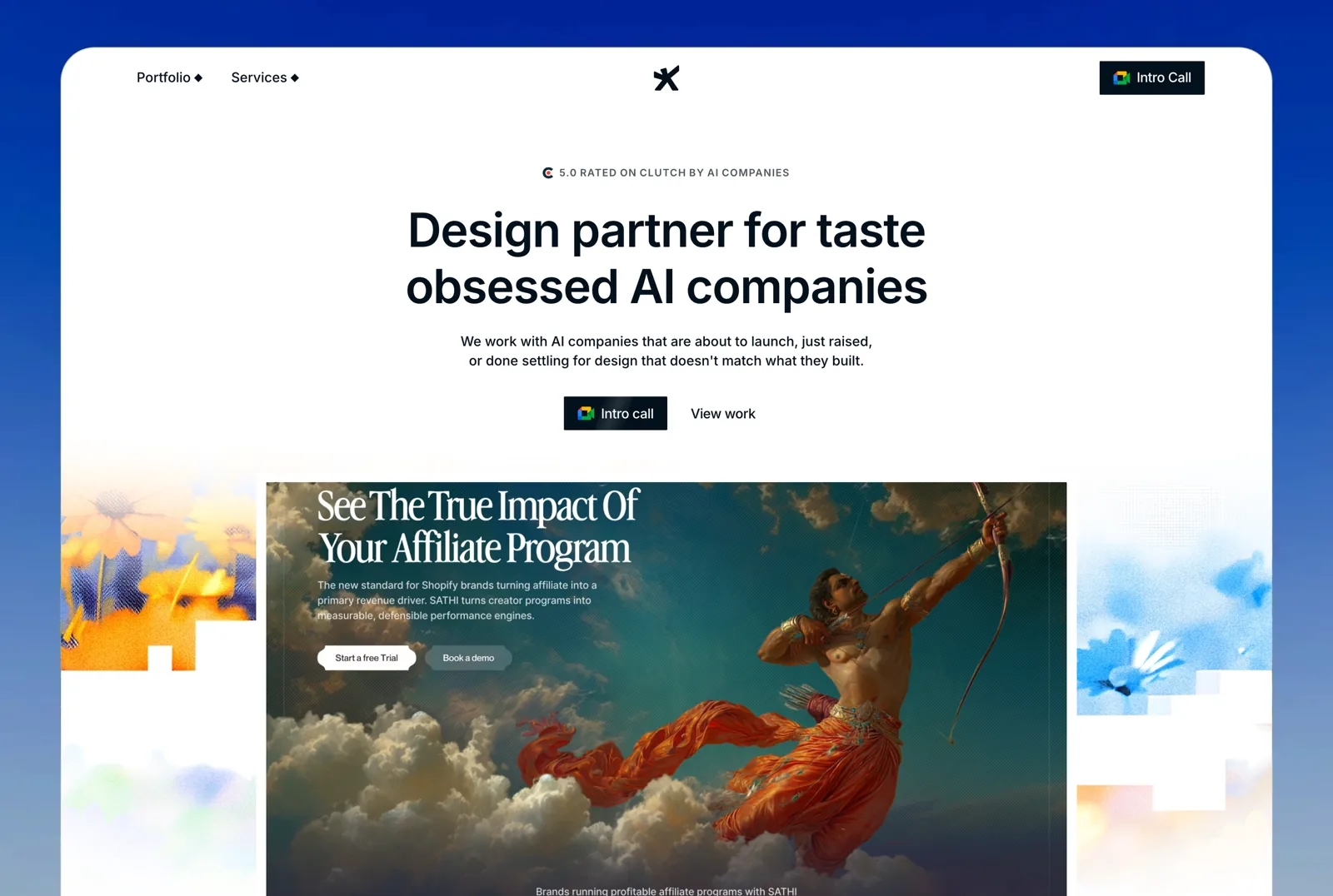
1. Studio Maydit: A Top-Rated Design Agency for AI Founders
Studio Maydit is a web and product design studio working with AI founders in the US, UK, and Europe. The studio builds websites in Framer, Webflow, and custom code, and continues into product design after the site ships.
The clearest outcome is Dualite, where design work supporting a repositioned ICP helped the product reach 100,000+ users in seven months. Recent clients include Wave, PixelFlow, Mi-VAD, and 15 other AI and SaaS teams.
Websites can be bought two ways. Fixed scope runs three to four weeks and suits teams with a launch date. Teams that keep shipping take a monthly retainer instead, covering new pages, campaigns, and product design, with no long lock-in. Fixed-scope projects end with a diagnosis of what is leaking in the product, not a handoff and goodbye.
| Check | Finding |
|---|---|
| Based in | Remote, serving US / UK / EU |
| Platform depth | Framer, Webflow, and custom code |
| AI-sector proof | Yes. AI-native clients, published outcome on Dualite |
| Pricing | Fixed scope or monthly retainer, quoted per project |
| Team shape | Founder-led, small senior team |
| Best fit | Teams who have to launch, hire, and keep shipping in one quarter |
Maydit is the right call if the site has to work for buyers and candidates at the same time. Book a 30-minute call.

2. Trueform
Trueform is a Swiss studio founded in 2022 with a published minimum, published AI client work, and Miro, Morning Brew, Bilt Rewards, and Gather named. Framer is their real specialism, which matters when the round has given you a hiring plan and a set of announcements to make, because you need pages that your own team can add without booking build time. Published pricing also makes the scope arguable before you commit.
They publish no team size, they are young enough that their record on long relationships is thin, and Swiss rates sit at the higher end.
| Check | Finding |
|---|---|
| Based in | Wil, Switzerland |
| Founded | 2022 |
| Team size | Not published |
| Primary platform | Framer |
| AI-sector proof | Yes. Published AI client work |
| Named clients | Miro, Morning Brew, Bilt Rewards, Gather |
| Pricing | Published minimum |
| Best fit | Teams who will add pages themselves every few weeks |
3. Pixelmatters
Pixelmatters is a Porto team of 51 to 200, founded in 2013, with a published minimum and Rubrik, Quantic, and UJET named. A newly funded company usually has to look more solid than its headcount suggests, particularly to enterprise buyers and to senior candidates leaving stable jobs. Rubrik is a good reference for that, a company selling infrastructure software to cautious organisations.
Their AI-sector proof is partial, Framer is one platform among several rather than their specialism, and a team that size brings process weight a fifteen-person company may resent.
| Check | Finding |
|---|---|
| Based in | Porto, Portugal |
| Founded | 2013 |
| Team size | 51-200 |
| Primary platform | Mixed |
| AI-sector proof | Partial. Enterprise and SaaS clients, no AI case study |
| Named clients | Rubrik, Quantic, UJET |
| Pricing | Published minimum |
| Best fit | Teams who must look more established than their headcount |
4. Ramotion
Ramotion is a San Francisco team of 11 to 50, founded in 2009, with a published minimum and Mozilla, Okta, Netflix, Adobe, and Xero named. Working through the whole cycle since 2009 means they have seen companies at every stage, and Okta is a useful reference for a business that had to grow its story as its buyers got larger. They are also in the market where most of your investors and competitors sit.
Their AI-sector proof is partial, Framer is not their specialism, they are large enough that the pitch team may not be the working team, and San Francisco rates apply.
| Check | Finding |
|---|---|
| Based in | San Francisco, USA |
| Founded | 2009 |
| Team size | 11-50 |
| Primary platform | Mixed |
| AI-sector proof | Partial. Enterprise and SaaS clients, no AI case study |
| Named clients | Mozilla, Okta, Netflix, Adobe, Xero |
| Pricing | Published minimum |
| Best fit | Teams whose story has to grow with a larger class of buyer |
5. Instrument
Instrument has been working since 2005 out of Portland with Nike, Microsoft, Electronic Arts, and Google named. A funding announcement is a rare moment where a lot of people look at once, and this is a studio whose entire portfolio is built on holding attention at that scale. If the round is large enough that the launch is genuinely a public event, that experience is hard to find elsewhere on this list.
They publish neither pricing nor team size, their AI-sector proof is partial, Framer is not their specialism, and their engagements are sized for companies with a brand team already in place.
| Check | Finding |
|---|---|
| Based in | Portland, USA |
| Founded | 2005 |
| Team size | Not published |
| Primary platform | Mixed |
| AI-sector proof | Partial. Enterprise and SaaS clients, no AI case study |
| Named clients | Nike, Microsoft, Electronic Arts, Google |
| Pricing | Not published |
| Best fit | Later-stage teams whose announcement is a genuine public moment |
6. Push Refresh
Push Refresh is a 1 to 10 team in Dallas with a published minimum and SmithRx, Synonym, and Northern National named. Framer is their stated platform, and a very small team with published pricing is the most predictable way to get a good site up before an announcement date that will not move. You are buying a known scope on a known clock rather than a discovery process.
Their AI-sector proof is partial, they publish no founding year, and a team this small has limited capacity if the round closes early and everything compresses.
| Check | Finding |
|---|---|
| Based in | Dallas, USA |
| Founded | Not published |
| Team size | 1-10 |
| Primary platform | Framer |
| AI-sector proof | Partial. Enterprise and SaaS clients, no AI case study |
| Named clients | SmithRx, Synonym, Northern National |
| Pricing | Published minimum |
| Best fit | Teams with a fixed announcement date and a focused scope |
7. Phantom
Phantom is a 51 to 200 team across London and Auckland, founded in 2013, with published AI client work and Diageo, SAP, and the Financial Times named. The Financial Times is the interesting reference here, an organisation whose credibility is the product, which is close to the position a newly funded AI company is trying to occupy when it claims to be safe to depend on.
They publish no pricing, they write custom code rather than working in Framer, so later changes cost developer time, and their engagement scale is built for enterprises rather than a company one round in.
| Check | Finding |
|---|---|
| Based in | London, UK and Auckland, NZ |
| Founded | 2013 |
| Team size | 51-200 |
| Primary platform | Custom code |
| AI-sector proof | Yes. Published AI client work |
| Named clients | Diageo, SAP, Financial Times, Zendesk |
| Pricing | Not published |
| Best fit | Teams whose buyers need to believe you will still exist in five years |
8. Foundey
Foundey is a San Francisco studio founded in 2021 with published AI client work and DemandIQ, Traycer, and Sero AI named. Their clients are early AI companies going through this exact transition now, which is worth more here than a longer history, because the conventions for presenting a funded AI company are being rewritten each year and recency is the only way to know them.
They are Figma-only, so your engineers own the build and Framer is not on the table with them, they publish neither pricing nor team size, and their references are young.
| Check | Finding |
|---|---|
| Based in | San Francisco, USA |
| Founded | 2021 |
| Team size | Not published |
| Primary platform | Figma-only |
| AI-sector proof | Yes. Published AI client work |
| Named clients | DemandIQ, Traycer, Sero AI |
| Pricing | Not published |
| Best fit | Teams with engineers who would rather build it themselves |
9. Feels Like
Feels Like is a Los Angeles studio founded in 2023 with published AI client work and Google, Nike, LVMH, and Suno AI named. Suno sitting next to LVMH is an unusual combination, and it matters if part of what the round buys is permission to stop looking like a startup. Recruiting senior people is partly a question of whether the company looks like somewhere worth leaving a good job for.
They publish no pricing or team size, they are new enough that their record is short, and custom code means your team cannot change pages without them.
| Check | Finding |
|---|---|
| Based in | Los Angeles, USA |
| Founded | 2023 |
| Team size | Not published |
| Primary platform | Custom code |
| AI-sector proof | Yes. Published AI client work |
| Named clients | Google, Nike, LVMH, Suno AI |
| Pricing | Not published |
| Best fit | Teams who want to look like a destination, not a startup |
10. basement.studio
basement.studio is an 11 to 50 team across Argentina and Los Angeles, founded in 2018, with a published minimum and Vercel, Cursor, ElevenLabs, Harvey AI, and Scale AI named. This is the strongest list here for the hiring problem specifically. Those are the companies your engineering candidates already admire, and a site built in that idiom signals technical seriousness faster than any paragraph about your culture.
They are in demand so timelines are not guaranteed, custom code rather than Framer means later edits need developers, and their aesthetic is distinctive enough that a conservative enterprise buyer may not follow you.
| Check | Finding |
|---|---|
| Based in | Mar del Plata, Argentina and Los Angeles, USA |
| Founded | 2018 |
| Team size | 11-50 |
| Primary platform | Custom code |
| AI-sector proof | Yes. Published AI client work |
| Named clients | Vercel, Cursor, ElevenLabs, Harvey AI, Scale AI |
| Pricing | Published minimum |
| Best fit | Teams whose next twenty hires are senior engineers |
How to choose between them
Sort by what the round is actually for.
Hiring twenty engineers fast. Studio Maydit or basement.studio.
A fixed announcement date and a tight scope. Push Refresh or Trueform.
Selling to enterprises who need you to look permanent. Pixelmatters or Phantom.
The launch is a genuine public moment. Instrument.
One test before signing. Ask them what the careers page should say. An agency worth hiring will treat that as a real design question and start asking who you are trying to hire and what they care about. One that calls it a formality has told you it thinks the site has a single audience, and you will get a good sales page at exactly the moment your hardest problem stops being sales and becomes recruiting.