Summarize with AI


The best Framer design agencies for YC-backed AI startups in 2026 are Studio Maydit, BX Studio, Foundey, Phantom, Kvalifik, Flow Ninja, Finsweet, Clay, Edgar Allan, and Lazarev. Studio Maydit and BX Studio lead for teams who need a real site quickly and expect to change it often. Phantom and Edgar Allan are the wrong fit at this stage, because both are sized for large brand programmes rather than for a company that is still deciding what it sells.
Every batch produces the same website. White background, one blue button, a row of logos, a badge near the footer, and a headline built from the same three words everyone else is using this cycle. It is not laziness. It is what happens when a hundred smart teams all optimise for the same week under the same time pressure.
The problem is that the week is not where the money is. Launch day sends a burst of traffic from people who read startup news for a living. They are curious, they are supportive, and almost none of them are your customer. They arrive, they clap, and they leave. The visitor who matters shows up in month four, alone, after a colleague mentioned you, and reads the same page with none of that context.
There is a second pressure that makes this worse. Speed is the correct instinct at this stage, so the site gets built in a weekend and marked temporary. Then the round closes, hiring starts, the first real customers arrive, and the temporary site is still there twelve months later, now describing a company that no longer exists.
Framer is the right tool for the problem, because it lets a two-person team publish something serious in days and rewrite it the week the message changes. The ten studios below are ranked on how well they suit a team at that speed, not on the size of their portfolios.

How we picked these agencies
This is a teardown, not a directory listing. For each agency we read their own site and their public record, then checked five things you can verify yourself in an afternoon:
- Platform depth. Is one craft their real specialism, or one line on a long service menu?
- AI-sector proof. Named AI clients and published work, or just the word "AI" in the copy?
- Pricing. Do they publish a minimum at all, or keep it behind a call?
- Team shape. Who actually does the work, and how many clients are they carrying at once?
- Their own site. Distinctive, or the same template as everyone else on this list?
That last one gets skipped most often. An agency's own website is the only project where nobody overruled them. No client committee, no inherited brand book. If their own site is forgettable, you have found their ceiling.
Every fact below comes from the agency's own site or a public listing. Where a number is not public, we say so rather than guessing.
What goes wrong for a batch company buying a site
Three failures show up again and again, and each one is a reasonable decision that stopped being reasonable a few months later.
Everything is aimed at one day. The page is written for the announcement, so it opens with the news rather than the problem. It says what was launched, who invested, and how new this is. That works for about seventy-two hours. After that, every visitor arrives cold, with no idea why they should care, reading a page that assumes they already do. Write for the stranger in month four. A page that works for them still works on launch day, but the reverse is never true.
The site signals the batch instead of the product. The badge, the logo wall, the familiar layout, all of it says the same thing: we are a credible startup. That signal is genuinely valuable with investors and with candidates, and worth almost nothing with a buyer, who has no opinion about accelerators and only wants to know what this does. Worse, when five companies from the same batch use the same visual language, the signal cancels itself. Keep the badge if you like. Just make sure the first screen explains the product to somebody who has never heard of any of this.
Nobody ever writes the positioning down. Iterating fast is correct, but the message changes in conversations and never gets recorded, so the site slowly becomes a record of three abandoned versions of the company. One paragraph from the first pitch, one section from the pivot, one new headline on top. Visitors feel the incoherence even when they cannot name it. Fix it with a rule rather than a redesign. Once a month, write the current one-sentence description of what you sell and who buys it, then make the homepage match it. That habit is worth more than any agency you hire.
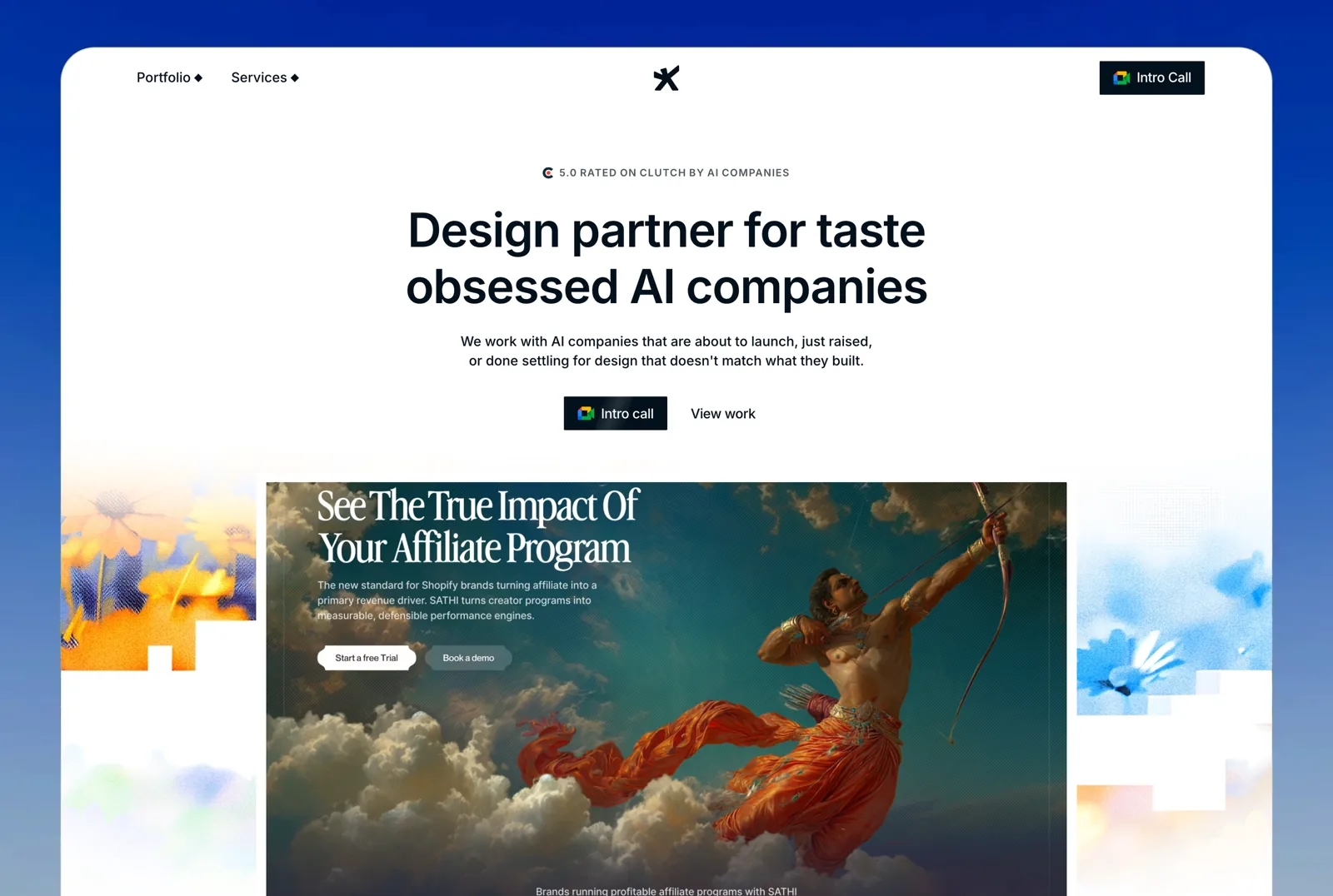
1. Studio Maydit: A Top-Rated Design Agency for AI Founders
Studio Maydit is a web and product design studio working with AI founders in the US, UK, and Europe. The studio builds websites in Framer, Webflow, and custom code, and continues into product design after the site ships.
The clearest outcome is Dualite, where design work supporting a repositioned ICP helped the product reach 100,000+ users in seven months. Recent clients include Wave, PixelFlow, Mi-VAD, and 15 other AI and SaaS teams.
Websites can be bought two ways. Fixed scope runs three to four weeks and suits teams with a launch date. Teams that keep shipping take a monthly retainer instead, covering new pages, campaigns, and product design, with no long lock-in. Fixed-scope projects end with a diagnosis of what is leaking in the product, not a handoff and goodbye.
| Check | Finding |
|---|---|
| Based in | Remote, serving US / UK / EU |
| Platform depth | Framer, Webflow, and custom code |
| AI-sector proof | Yes. AI-native clients, published outcome on Dualite |
| Pricing | Fixed scope or monthly retainer, quoted per project |
| Team shape | Founder-led, small senior team |
| Best fit | Early teams who need a real site fast and will rewrite it as they learn |
Maydit is the right call if you want to stop looking like your batch without slowing down. Book a 30-minute call.

2. BX Studio
BX Studio is a New York team of 11 to 50 with a published minimum and Reddit, Headspace, ASAPP, and Verifone named. ASAPP is an AI company selling to large enterprises, which is where a good number of batch companies end up within a year of launch. Publishing a starting price is the useful part at this stage, because it saves a founder two calls to find out whether a conversation is even possible.
They publish no founding year, and Webflow rather than Framer is their platform, so a Framer build is not their home ground.
| Check | Finding |
|---|---|
| Based in | New York, USA |
| Founded | Not published |
| Team size | 11-50 |
| Primary platform | Webflow |
| AI-sector proof | Yes. Published AI client work |
| Named clients | Reddit, Headspace, ASAPP, Verifone |
| Pricing | Published minimum |
| Best fit | Teams who want a published price and a partner used to enterprise buyers |
3. Foundey
Foundey is a San Francisco studio founded in 2021 with DemandIQ, Traycer, and Sero AI named, and published AI client work. Those are early AI companies rather than household names, which makes them the most relevant peer group on this page. A studio whose regular clients are at your exact stage will not try to sell you a brand programme you cannot use yet.
They work in Figma only, so somebody else has to build the site, they publish no pricing and no team size, and design without build means an extra handover at the point you are least able to manage one.
| Check | Finding |
|---|---|
| Based in | San Francisco, USA |
| Founded | 2021 |
| Team size | Not published |
| Primary platform | Figma-only |
| AI-sector proof | Yes. Published AI client work |
| Named clients | DemandIQ, Traycer, Sero AI |
| Pricing | Not published |
| Best fit | Teams who have a builder already and need the design thinking |
4. Phantom
Phantom works from London and Auckland, founded in 2013, a team of 51 to 200 building in custom code, with Diageo, SAP, Financial Times, and Zendesk named, and published AI client work. The Financial Times is an interesting reference, a product where dense information has to stay readable, and Zendesk shows they can handle software rather than only brands.
They publish no pricing, they are sized for large organisations, and custom code is slower to change than Framer, which is the wrong shape for a company still moving weekly.
| Check | Finding |
|---|---|
| Based in | London, UK and Auckland, NZ |
| Founded | 2013 |
| Team size | 51-200 |
| Primary platform | Custom code |
| AI-sector proof | Yes. Published AI client work |
| Named clients | Diageo, SAP, Financial Times, Zendesk |
| Pricing | Not published |
| Best fit | Funded teams whose next site has to look like an established company |
5. Kvalifik
Kvalifik is a Copenhagen team of 11 to 50, founded in 2015, with Veo, Maersk, and Relesys named, and published AI client work. Veo is the reference to look at, a computer vision product sold to amateur sports clubs, which means explaining machine learning to people with no interest in machine learning. That is close to the job most AI startups actually have.
They publish no pricing, Webflow rather than Framer is their platform, and a Danish team overlaps with US mornings only.
| Check | Finding |
|---|---|
| Based in | Copenhagen, Denmark |
| Founded | 2015 |
| Team size | 11-50 |
| Primary platform | Webflow |
| AI-sector proof | Yes. Published AI client work |
| Named clients | Veo, Maersk, Relesys |
| Pricing | Not published |
| Best fit | Teams explaining a technical product to non-technical buyers |
6. Flow Ninja
Flow Ninja is a Belgrade team of 11 to 50, founded in 2018, working in Webflow. The relevant strength here is cost per change. A company at this stage will edit its homepage twenty times in a year, and a studio whose rates make each of those edits cheap is worth more than a famous one that makes each edit a project.
They publish no client names at all, which makes their record impossible to verify from outside, no pricing, their AI-sector proof is partial, and Webflow is not Framer.
| Check | Finding |
|---|---|
| Based in | Belgrade, Serbia |
| Founded | 2018 |
| Team size | 11-50 |
| Primary platform | Webflow |
| AI-sector proof | Partial. Enterprise and SaaS clients, no AI case study |
| Named clients | Not published |
| Pricing | Not published |
| Best fit | Teams who expect to change the site constantly on a small budget |
7. Finsweet
Finsweet is a distributed team of 51 to 200 out of Denver, founded in 2017, with Dropbox, Clay, GitHub, and Steadily named. They are the most technical studio on this list, known for building tooling and components rather than one-off pages. If you want a site your own engineers can extend without calling anyone, that is a real advantage.
They publish no pricing, their AI-sector proof is partial, Webflow is their platform, and deep technical capability is a poor match for a team whose actual problem is deciding what to say.
| Check | Finding |
|---|---|
| Based in | Denver, USA, distributed |
| Founded | 2017 |
| Team size | 51-200 |
| Primary platform | Webflow |
| AI-sector proof | Partial. Enterprise and SaaS clients, no AI case study |
| Named clients | Dropbox, Clay, GitHub, Steadily |
| Pricing | Not published |
| Best fit | Teams whose engineers will maintain the site themselves |
8. Clay
Clay is a San Francisco studio of 51 to 200, founded in 2016, with a published minimum and Slack, Stripe, Google, Coinbase, and Amazon named, plus published AI work. This is the aspiration tier. Hiring them makes a young company look considerably older than it is, which can be worth real money when you are selling to a buyer who is nervous about company size.
They are premium and large, a seed-stage budget makes you a small account, their platform mix is broad rather than Framer-deep, and most teams at this stage cannot justify the spend.
| Check | Finding |
|---|---|
| Based in | San Francisco, USA |
| Founded | 2016 |
| Team size | 51-200 |
| Primary platform | Mixed |
| AI-sector proof | Yes. Published AI client work |
| Named clients | Slack, Stripe, Google, Coinbase, Amazon |
| Pricing | Published minimum |
| Best fit | Funded teams whose buyers are nervous about how young the company is |
9. Edgar Allan
Edgar Allan is an Atlanta team of 51 to 200, founded in 2014, working in Webflow, with Porsche, Duracell, and NCR named. Their strength is brand rather than product, which matters if your specific problem is that you sound exactly like every other company in your batch. Fixing sameness is a positioning job before it is a design one, and that is the work they actually do.
They publish no pricing, their AI-sector proof is partial, their references are consumer brands rather than software, and brand programmes are usually too slow and too expensive for a company at this stage.
| Check | Finding |
|---|---|
| Based in | Atlanta, USA |
| Founded | 2014 |
| Team size | 51-200 |
| Primary platform | Webflow |
| AI-sector proof | Partial. Enterprise and SaaS clients, no AI case study |
| Named clients | Porsche, Duracell, NCR |
| Pricing | Not published |
| Best fit | Teams whose real problem is sounding identical to their peers |
10. Lazarev
Lazarev is a San Francisco team of 51 to 200, founded in 2015, with a published minimum and Payoneer, Peel, Elva, and Mozayix named, plus published AI work. Their published work leans toward complicated product interfaces, so they are the better choice if what you need explained is the product itself rather than the company around it.
They are large enough for account layers between you and the designers, their strongest work is not in Framer, and a studio that size is built for longer engagements than a first site.
| Check | Finding |
|---|---|
| Based in | San Francisco, USA |
| Founded | 2015 |
| Team size | 51-200 |
| Primary platform | Mixed |
| AI-sector proof | Yes. Published AI client work |
| Named clients | Payoneer, Peel, Elva, Mozayix |
| Pricing | Published minimum |
| Best fit | Teams whose product is the hard thing to explain, not the company |
How to choose between them
Sort by what is actually stopping you.
We look like everyone in the batch. Edgar Allan or Studio Maydit.
We will rewrite this page every month. Flow Ninja or Studio Maydit.
We have a designer but nobody to build it. Foundey.
Our buyer thinks we are too small to depend on. Clay or BX Studio.
One test before signing. Ask what they would put on the homepage for a visitor who has never heard of your accelerator. A studio that fits this stage will answer with your customer's problem in their own words. One that starts talking about your funding and your momentum is planning to build the launch-day site, and that page expires in a week.