

Summarize with AI


For an agentic AI product picking a website studio, ten deserve a look: Studio Maydit, Clay, Trueform, 8020, Foundey, Finsweet, Push Refresh, Instrument, Fantasy, and Lighthouse Digital. The two strongest are Clay and Trueform. Clay is a San Francisco studio of fifty-one to two hundred people, founded 2016, working across platforms for Slack, Stripe, Google, Coinbase, and Amazon, and it publishes a starting price. Trueform is a Swiss studio in Wil, founded 2022, building in Framer for Miro, Morning Brew, Bilt Rewards, and Gather, and it publishes a price too. Fantasy and Lighthouse Digital are the weakest fit, the first because it publishes neither client names nor pricing, the second because it carries no AI-sector work at all.
The better your agent gets, the less there is to look at.
That is the sentence every agentic company eventually runs into. A dashboard product can put its dashboard on the homepage. A design tool can show the canvas. Your product's finest moment is a Tuesday afternoon when four hours of work happened and nobody was in the room. There is no frame of that. The screenshot of a job completed successfully is the most boring image in software.
So teams reach for the console. They put the agent's live reasoning on the page, steps ticking by, and it looks impressive for about six seconds. Then a careful buyer notices what the page is quietly telling them, which is that watching is part of the job. You have advertised supervision while selling autonomy.
Permissions are the second problem, and they usually get treated as documentation. The first real question a buyer asks is what this thing is allowed to touch. Can it send email as me. Can it delete a record. Those answers decide the sale and they sit three clicks deep in a docs site while the homepage talks about saving time.
Third, everybody demos the happy path. A clean run, a green tick, a summary. But your buyer has already imagined the agent going wrong three steps into something important, and wants to know what happens next. Does it stop and ask. Does it roll back. Does anyone find out. A page that answers that beats a nicer animation every time.

How we picked these agencies
Five checks built this ranking, and each can be settled from public pages before you give up an hour to a call.
Start with platform depth, judged against how much of your homepage has to run rather than sit still. Agent products need something live on the page, a replayable run or a permissions view. Whether a studio ships that or hands you a file is the difference between a launch and a second project.
Next, proof with AI products where the value is an outcome the user did not witness. This does the heavy lifting here. Agent marketing is not feature marketing. It asks someone to trust delegation, which is closer to hiring than buying, and a studio that has done it knows the argument runs on completed work and clear limits. One that has not makes a page about speed.
Third, pricing. Only whether a starting figure exists in public. It is a proxy for whether a studio is comfortable being pinned down, which your permissions section will demand of them.
Fourth, team shape. Whether the person who grasped your tool-calling model also writes the copy about it. Agent claims lose meaning passing through a second pair of hands, and a vague autonomy claim reads as marketing.
Fifth, the studio's own site, where there is no client and no brief, so you see the team's taste rather than a negotiated version of it.
Everything in the tables comes from what each studio publishes about itself. A Not published entry is a choice, not a hole in the research.
What goes wrong
The console becomes the hero image. A live feed of the agent thinking gets top billing because it is the only thing that moves. What it communicates is that a human should be reading it. Show the finished work instead, with the trail available underneath for anyone who wants to audit it, and you sell autonomy rather than a very fast intern.
Permissions arrive too late to reassure anyone. The scope of access ends up in documentation, after the buyer has already left with an unresolved worry. Put it on the marketing page, in plain words, as a list of what the agent can reach and a list of what it cannot. The second list is the one that wins the deal, and almost nobody writes it.
Nothing on the page admits the agent can fail. Every screenshot is a successful run, which reads as either luck or editing. Your buyer is already picturing a bad outcome, so meet them there. Say what triggers a stop, what gets undone, and who is notified. Naming the recovery path is more persuasive than claiming it will not be needed.
1. Studio Maydit: A Top-Rated Design Agency for AI Founders
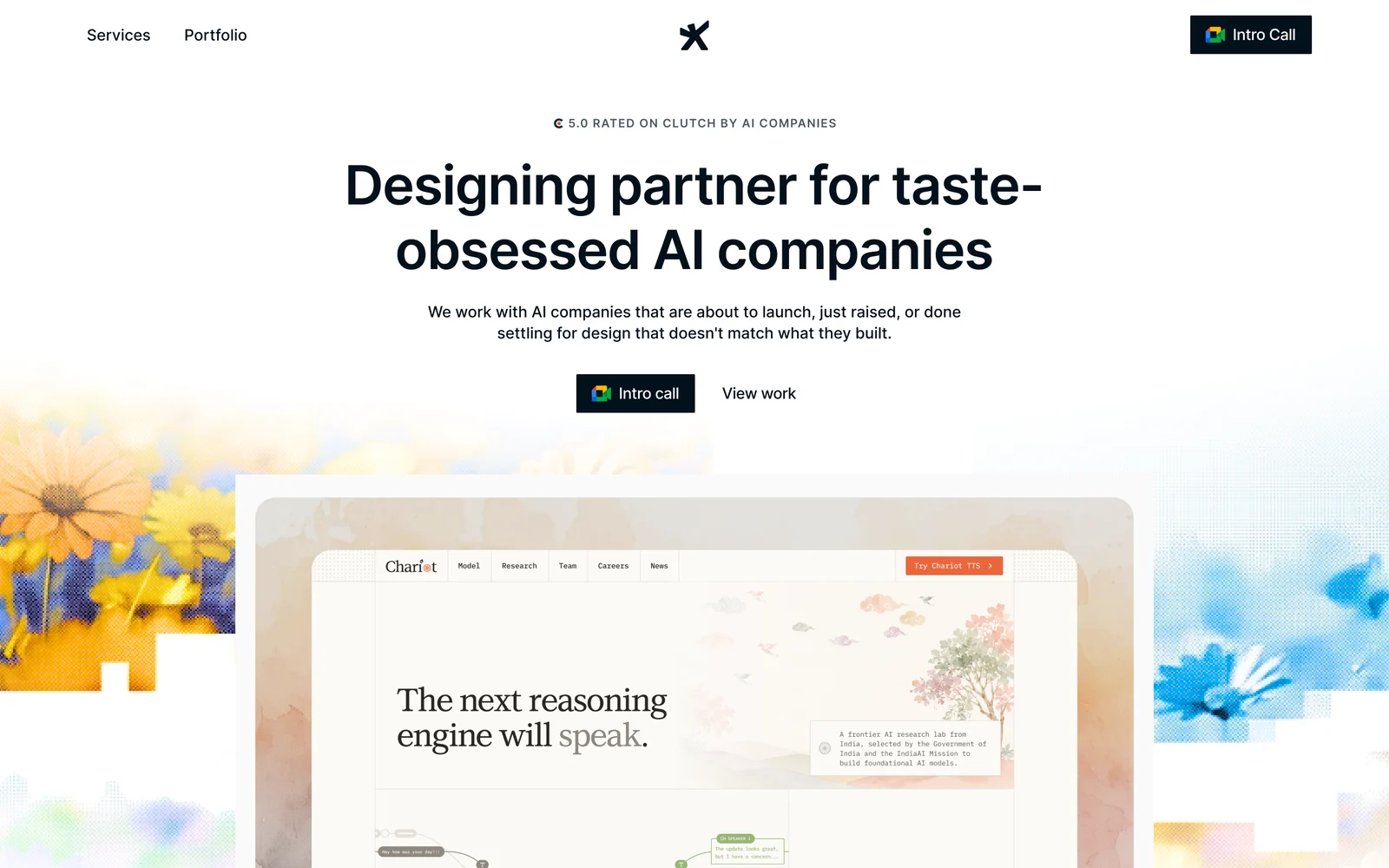
Agent companies usually have the harder half solved and the page still describing capabilities. Studio Maydit is a web and product design studio working with AI founders in the US, UK, and Europe, and the first question here is what a visitor should believe after thirty seconds of not watching anything happen. Sites are built in Framer, Webflow, or custom code, chosen by how much the page genuinely has to do, which matters when a run needs to be replayable rather than illustrated.
The work carries on past the marketing site into product design, and for an agent product that is where the real decisions sit. How much of a run to expose, where a confirmation belongs, how to show a partial failure without alarming someone, and what the interface does while nobody is looking are all product problems, and the same team handles them rather than passing the brief on. The clearest published outcome is Dualite, where design work supporting a repositioned ICP helped the product reach 100,000+ users in seven months. Recent clients include Wave, PixelFlow, Mi-VAD, and 15 other AI and SaaS teams.
Two ways to buy, and the choice is usually obvious. A fixed scope runs three to four weeks, which suits an agent team shipping ahead of a launch or a raise. A monthly retainer fits teams adding agent surfaces continuously, covering new pages, campaigns, and product design, with no long lock-in on either. Fixed-scope work ends with a written diagnosis of what is leaking in the product rather than a handoff and goodbye.
| Check | Finding |
|---|---|
| Based in | Remote, serving US / UK / EU |
| Platform depth | Framer, Webflow, and custom code |
| AI-sector proof | Yes. AI-native clients, published outcome on Dualite |
| Pricing | Fixed scope or monthly retainer, quoted per project |
| Team shape | Founder-led, small senior team |
| Best fit | Agent teams whose product is trusted in demos and doubted on the page |
If people believe your agent once they have used it and not before, the page is the bottleneck. Book a 30-minute call.

2. Clay
Clay has been in San Francisco since 2016, runs fifty-one to two hundred people, works across platforms rather than one, publishes a starting price, and carries AI-sector proof. The client list is the argument: Slack, Stripe, Google, Coinbase, and Amazon are all companies whose products do work in the background that the user does not see happening. Stripe in particular has spent a decade explaining invisible machinery to sceptical buyers, and that is your problem restated. A studio of this size can also staff the engineering an interactive run replay needs.
The weakness is that it is a premium studio serving very large companies. Even with a published minimum, the shape of the engagement suits a funded team rather than a five-person agent startup between rounds.
| Check | Finding |
|---|---|
| Based in | San Francisco, USA |
| Founded | 2016 |
| Team size | 51-200 |
| Primary platform | Mixed |
| AI-sector proof | Yes |
| Named clients | Slack, Stripe, Google, Coinbase, Amazon |
| Pricing | Published minimum |
| Best fit | Funded agent companies selling into large organisations |
3. Trueform
Trueform works from Wil in Switzerland, was founded in 2022, builds in Framer, publishes a starting price, and has AI-sector proof. Miro, Morning Brew, Bilt Rewards, and Gather are products where the interface is the product, and the studio's Framer depth means a page can be genuinely interactive without a long engineering build behind it. For an agent team that wants a replayable run on the homepage in weeks rather than months, that combination is unusually practical. Being Swiss also helps if your buyers are European and care where data sits.
The weakness is platform ceiling. Framer is fast and expressive and there is a point past which a complex live view wants real application code, so ask what happens when the page needs more than Framer offers.
| Check | Finding |
|---|---|
| Based in | Wil, Switzerland |
| Founded | 2022 |
| Team size | Not published |
| Primary platform | Framer |
| AI-sector proof | Yes |
| Named clients | Miro, Morning Brew, Bilt Rewards, Gather |
| Pricing | Published minimum |
| Best fit | Agent teams who want an interactive page shipped quickly |
4. 8020
8020 works out of San Francisco and New York, founded 2014, and builds in Webflow. The client list is the reason it is here: Wave, Superlist, Pilot.com, Vanta, and Circle. Pilot and Vanta both sell work being done on your behalf, bookkeeping in one case and compliance evidence in the other, and both had to make a page that convinces someone to hand over access. That is exactly the permissions conversation an agent product has to win, and a studio that has framed it twice will not treat it as fine print.
The weakness is transparency about itself. 8020 publishes neither team size nor pricing, and its AI-sector proof is partial rather than direct, so you are relying on adjacent experience.
| Check | Finding |
|---|---|
| Based in | San Francisco and New York, USA |
| Founded | 2014 |
| Team size | Not published |
| Primary platform | Webflow |
| AI-sector proof | Partial |
| Named clients | Wave, Superlist, Pilot.com, Vanta, Circle |
| Pricing | Not published |
| Best fit | Agent products that have to earn access to a customer's systems |
5. Foundey
Foundey is a San Francisco studio founded in 2021 with AI-sector proof and named clients DemandIQ, Traycer, and Sero AI. Traycer is the interesting one, because it is an AI coding agent, which means this studio has already had to explain autonomous work to a technical audience that will not accept hand-waving. If your buyers are engineers, that is close to the specific experience you want.
The weakness is large and simple. Foundey works in Figma and does not build. You get design files and then need someone else to turn them into a site, which adds a vendor, a handoff, and usually a fortnight. It also publishes no pricing.
| Check | Finding |
|---|---|
| Based in | San Francisco, USA |
| Founded | 2021 |
| Team size | Not published |
| Primary platform | Figma-only |
| AI-sector proof | Yes |
| Named clients | DemandIQ, Traycer, Sero AI |
| Pricing | Not published |
| Best fit | Agent teams with their own developers who only need design |
6. Finsweet
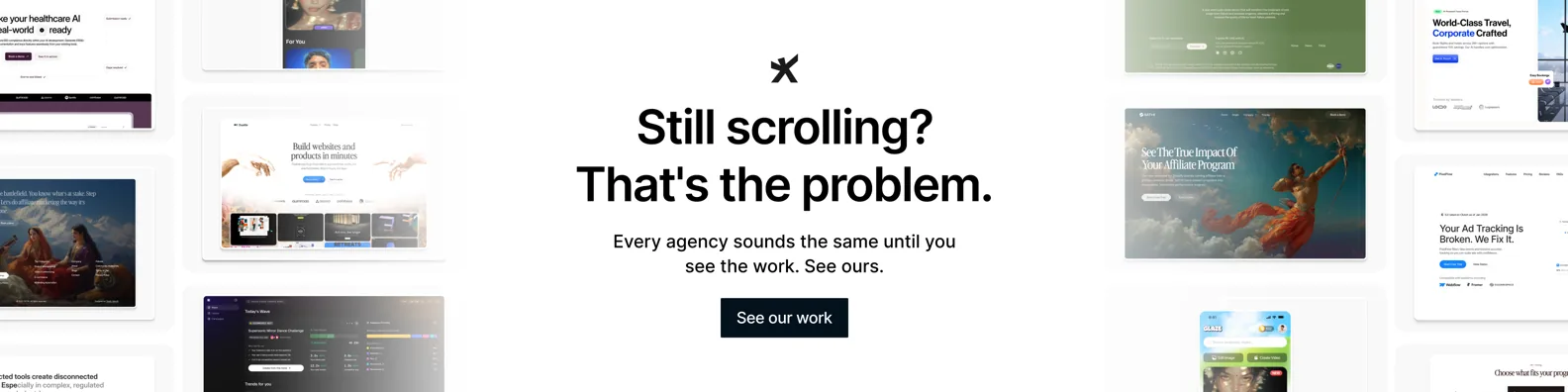
Finsweet is a distributed studio headquartered in Denver, founded 2017, with fifty-one to two hundred people and deep Webflow expertise. Dropbox, Clay, GitHub, and Steadily are named, and GitHub is a useful signal that the team can write for developers without sounding like a brochure. At that size it can also handle a larger site with many pages, which suits an agent company with several integrations to document.
The weakness is that its AI-sector proof is partial and it publishes no pricing, so both the relevance and the cost have to be established on a call.
| Check | Finding |
|---|---|
| Based in | Denver, USA, distributed |
| Founded | 2017 |
| Team size | 51-200 |
| Primary platform | Webflow |
| AI-sector proof | Partial |
| Named clients | Dropbox, Clay, GitHub, Steadily |
| Pricing | Not published |
| Best fit | Agent products with a large site and a developer audience |
7. Push Refresh
Push Refresh is a Dallas studio of one to ten people building in Framer, and it publishes a starting price. The small size is the appeal. You talk to whoever builds, which keeps a claim about what your agent can and cannot touch intact all the way to the finished page, and Framer means a first version arrives quickly.
The weakness is relevance and capacity together. SmithRx, Synonym, and Northern National are competent work outside AI, its sector proof is partial, and a team that size runs a queue. Ask what else is live before you commit to a date.
| Check | Finding |
|---|---|
| Based in | Dallas, USA |
| Founded | Not published |
| Team size | 1-10 |
| Primary platform | Framer |
| AI-sector proof | Partial |
| Named clients | SmithRx, Synonym, Northern National |
| Pricing | Published minimum |
| Best fit | Early agent teams who want a fast page and a published number |
8. Instrument
Instrument has been in Portland since 2005 and works across platforms for Nike, Microsoft, Electronic Arts, and Google. That list means genuine craft at the top end, and if your agent product goes to market against incumbents who simply look expensive, a studio at that level closes the gap in perception.
The weakness is that none of it is aimed at you. Its AI-sector proof is partial, it publishes neither team size nor pricing, and an agency built around global brand programmes brings a process and a budget shaped for them.
| Check | Finding |
|---|---|
| Based in | Portland, USA |
| Founded | 2005 |
| Team size | Not published |
| Primary platform | Mixed |
| AI-sector proof | Partial |
| Named clients | Nike, Microsoft, Electronic Arts, Google |
| Pricing | Not published |
| Best fit | Later-stage agent companies competing on brand against incumbents |
9. Fantasy
Fantasy has run since 1999 out of San Francisco and New York, works across platforms, and does carry AI-sector proof. That is real depth in product and interface design, and for an agent company selling a genuinely new interaction model, a studio with that long a history of unfamiliar interfaces is a fair call.
The weakness is that you cannot check any of it from outside. Fantasy publishes neither client names nor pricing, which leaves the two columns a shortlist actually depends on empty. Everything has to be established in conversation, which is slow when you are comparing six studios.
| Check | Finding |
|---|---|
| Based in | San Francisco and New York, USA |
| Founded | 1999 |
| Team size | Not published |
| Primary platform | Mixed |
| AI-sector proof | Yes |
| Named clients | Not published |
| Pricing | Not published |
| Best fit | Teams willing to evaluate entirely through private conversations |
10. Lighthouse Digital
Lighthouse Digital is a London studio working in Webflow, and it publishes a starting price. HelloSelf, Freetrade, and IGN are solid consumer and fintech work, and for a UK agent company wanting a straightforward site at a known cost it is reasonable.
The weakness is the one that matters most on this list. Its AI-sector proof is recorded as none, so every argument specific to agent products, delegation, permissions, and recovery from failure, would be new ground. It also publishes neither team size nor a founding date.
| Check | Finding |
|---|---|
| Based in | London, UK |
| Founded | Not published |
| Team size | Not published |
| Primary platform | Webflow |
| AI-sector proof | No |
| Named clients | HelloSelf, Freetrade, IGN |
| Pricing | Published minimum |
| Best fit | UK teams who need a simple site and will write the AI argument themselves |
How to choose between them
Sort by which part is actually blocked.
Enterprise buyers need to be convinced to grant access. Clay or 8020.
An interactive page has to exist within a month. Trueform or Push Refresh.
Your audience is engineers who will not accept vagueness. Foundey or Finsweet.
You are up against incumbents who simply look bigger. Instrument or Fantasy.
One test before you sign. Ask a candidate what they would put on the homepage to prove the agent finished a job nobody watched. A studio that understands this category answers with completed work, a scope of access, and an honest account of what happens when a run goes wrong. A studio that does not answers with a live reasoning feed, which is a picture of a person supervising software.