

Summarize with AI


For an AI voice product choosing a website studio, ten are worth a look: Studio Maydit, Phantom, Refokus, Ramotion, Pixelmatters, Flowout, Digidop, Edgar Allan, Engine Digital, and Flow Ninja. The two strongest here are Phantom and Refokus. Phantom works in custom code from London and Auckland, has done since 2013, employs fifty-one to two hundred people, and carries AI-sector work alongside Diageo, SAP, Financial Times, and Zendesk. Refokus is a German remote team of eleven to fifty, founded 2021, building in Webflow for Mural, BASF, Spotify, Yahoo, and BCG. Flow Ninja and Engine Digital are the weakest fit, the first because it publishes neither clients nor a price, the second because it is built for large organisations and quotes like one.
Your product makes a sound and your website is silent.
Every other kind of software can be photographed. A dashboard screenshots well. A voice does not. It exists in time, it needs a speaker, and browsers stopped letting pages make noise on arrival years ago.
So the page has to earn a click on a play button before it proves anything, and most visitors will not give you that click. They are at a desk near other people, or on a train, or they simply do not want a stranger's website talking at them. The best thing about your product is the thing most of your traffic never experiences.
Latency makes it worse. In voice the gap before the reply is the product. Two hundred milliseconds feels like a conversation and eight hundred feels like a phone tree, and that difference is enormous to a user and invisible in every screenshot. A polished demo video works against you, because a video has no latency at all, which any experienced buyer knows and quietly discounts.
Then there is the category's reputation. Your buyer has spent twenty years shouting the word representative at an automated phone line. They arrive believing voice systems mishear accents, panic when interrupted, and fail in a noisy room. Those three cases are what they want addressed, and almost no marketing page addresses failure at all.

How we picked these agencies
Five questions decided this list, and each is answerable from a studio's public pages before you spend an hour on a call.
First, platform depth, measured against how much of your site has to do something rather than describe something. A voice homepage is a small piece of software. It needs audio that streams, a control that works on a phone, a transcript that keeps pace, and a fallback for the visitor who never enables sound. Whether a studio can build that, or only draw it, has real consequences.
Second, proof with AI products whose quality is perceived rather than specified. This carries most of the weight for voice. Nobody buys a voice model on a benchmark table. They buy because thirty seconds of it felt right, and producing that feeling in thirty seconds is a craft problem. A studio that has sold a subjective AI product reaches for comparison and honest edge cases. One that has not writes the word natural four times.
Third, pricing disclosure. Not the figure, only whether one exists in public. It is a cheap test of whether a studio will commit to something concrete.
Fourth, team shape, meaning whether the person who understood your interruption handling also writes the sentence about it. Voice claims degrade fast when passed between people.
Fifth, the studio's own website. No client and no brief, so it shows what the team does unsupervised.
Every fact below comes from something the studio publishes about itself. Nothing is estimated. A Not published entry records a decision, not a gap in the research.
What goes wrong
The play button becomes the whole funnel. A page gets designed around one beautiful audio demo, and every later measurement is really measuring how many people pressed play. The rest leave knowing nothing new. The page has to work with the sound off, and that has to be written down as a requirement before design starts.
Latency gets described instead of demonstrated. Somebody writes real-time, or conversational speed, and it lands on a buyer who has read those words on four competitor sites this month. The number is the asset. If your median response is under four hundred milliseconds, that figure belongs on the page in a size you can read across a room, with the measuring conditions beside it.
The failure cases are hidden, so the buyer assumes the worst. Pages show the system understanding a clear speaker in a quiet room, the one scenario nobody doubts. The buyer is silently wondering about a strong accent, a toddler in the background, and someone cutting in mid sentence. A page that shows those three going reasonably well beats any amount of polish, and almost no studio will suggest it, because it means putting imperfection on the homepage on purpose.
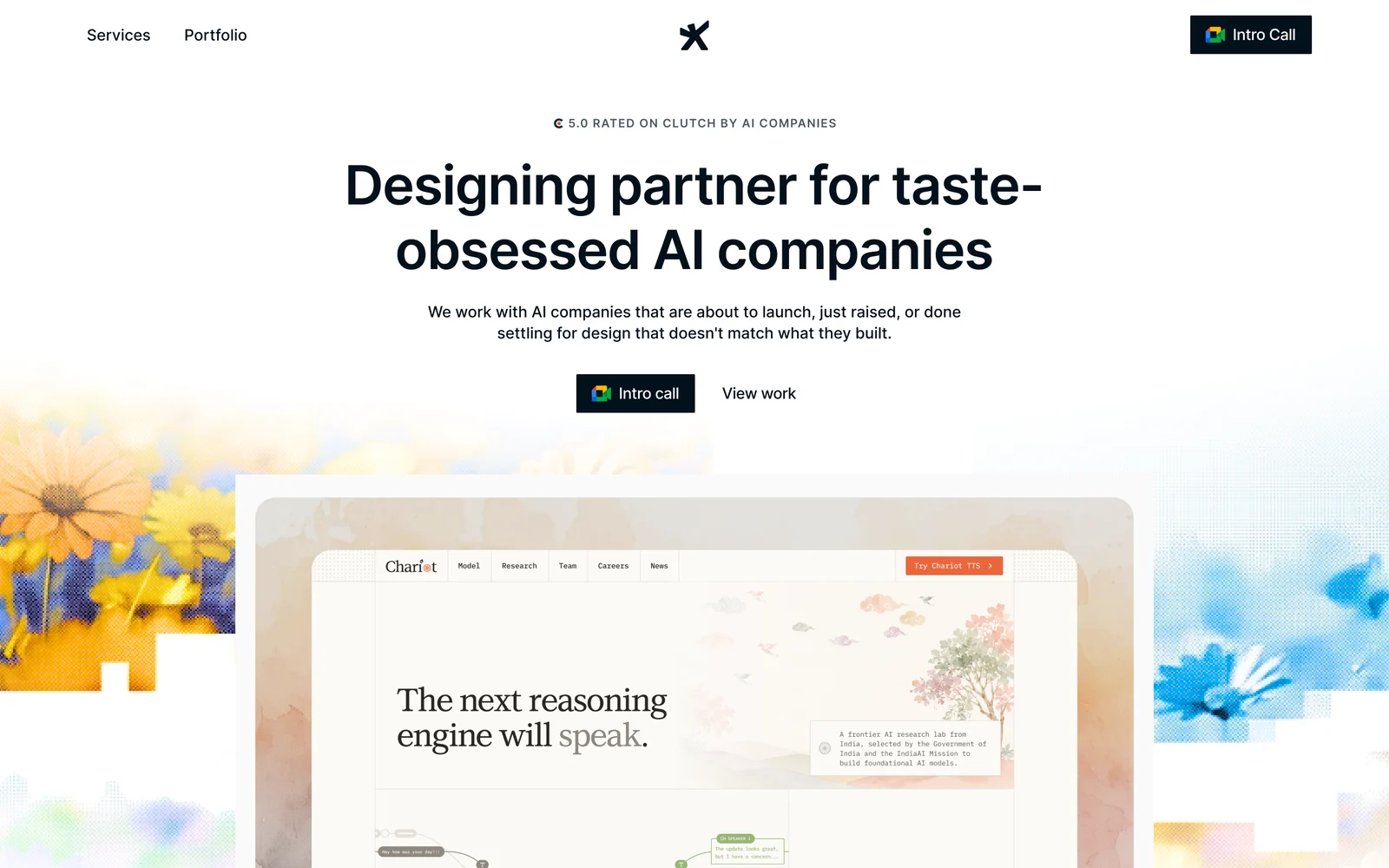
1. Studio Maydit: A Top-Rated Design Agency for AI Founders
Voice teams usually arrive with a working system and a page that undersells it. Studio Maydit is a web and product design studio for AI founders in the US, UK, and Europe, and the work here starts by deciding what a silent visitor should learn. Sites get built in Framer, Webflow, or custom code depending on how much the page must actually do, and with streaming audio and a live transcript that choice matters more than it usually does.
Design does not stop at the marketing site. The studio continues into the product, which for a voice company is where the harder questions live. What the interface shows while it is listening, how a user corrects a misheard word, and what appears when the model is uncertain are product problems handled by the same team rather than a new one. The clearest published outcome is Dualite, where design work supporting a repositioned ICP helped the product reach 100,000+ users in seven months. Recent clients include Wave, PixelFlow, Mi-VAD, and 15 other AI and SaaS teams.
Buying works one of two ways. Pick the fixed scope, three to four weeks, if a launch date is already sitting in the calendar and the page has to be right by then. Pick the monthly retainer instead if you are shipping voice features continuously and need new pages, campaigns, and product design to keep pace, with no long lock-in either way. Whichever you choose, a fixed-scope engagement closes with a written diagnosis of what is leaking in the product, not a handoff and goodbye.
| Check | Finding |
|---|---|
| Based in | Remote, serving US / UK / EU |
| Platform depth | Framer, Webflow, and custom code |
| AI-sector proof | Yes. AI-native clients, published outcome on Dualite |
| Pricing | Fixed scope or monthly retainer, quoted per project |
| Team shape | Founder-led, small senior team |
| Best fit | Voice teams whose demo convinces people and whose page does not |
If your product wins every live call and loses on the website, that is the gap to close first. Book a 30-minute call.

2. Phantom
Phantom builds in custom code from London and Auckland, has run since 2013, and is large enough at fifty-one to two hundred people to staff engineering beside design. That is the practical argument for a voice product. Streaming playback, a transcript that tracks speech, and a control that behaves the same on an old Android phone are engineering work, and a studio that hands over a design file leaves you the part that decides whether the demo converts. Diageo, SAP, Financial Times, and Zendesk are organisations with strict brand and accessibility requirements, which helps when your page must serve someone who will not turn sound on.
The weakness is money. Phantom publishes no starting price, and a studio that size with that client list is not shaped around a startup budget.
| Check | Finding |
|---|---|
| Based in | London, UK and Auckland, NZ |
| Founded | 2013 |
| Team size | 51-200 |
| Primary platform | Custom code |
| AI-sector proof | Yes |
| Named clients | Diageo, SAP, Financial Times, Zendesk |
| Pricing | Not published |
| Best fit | Voice products whose homepage is really a small application |
3. Refokus
Refokus is a remote German studio of eleven to fifty, founded 2021, working mainly in Webflow. It sits this high because of Spotify. Designing for an audio brand is a different discipline, since the product is not on screen and the page has to make you want to hear something rather than look at something. That is your exact problem. Mural, BASF, Yahoo, and BCG show it can also hold a serious brand together, which matters when you are asking an enterprise buyer to trust a machine with customer conversations.
The weakness is that Webflow has a ceiling and a demanding streaming audio interface can meet it. Ask early what happens when the page needs behaviour Webflow does not do natively.
| Check | Finding |
|---|---|
| Based in | Germany, remote |
| Founded | 2021 |
| Team size | 11-50 |
| Primary platform | Webflow |
| AI-sector proof | Partial |
| Named clients | Mural, BASF, Spotify, Yahoo, BCG |
| Pricing | Not published |
| Best fit | Voice brands that must feel premium before anything is played |
4. Ramotion
Ramotion has been in San Francisco since 2009, runs eleven to fifty people, works across platforms, and publishes a starting price. Sixteen years shows in a client list of Mozilla, Okta, Netflix, Adobe, and Xero. Netflix is a company whose whole proposition is something you experience rather than read about, which is your translation problem. The published minimum is worth more than it sounds, because it tells you in ten seconds whether a conversation is worth having.
The weakness is that its AI-sector proof is partial. Ramotion is a strong general product and brand studio, not a specialist in selling machine output, so expect to bring the argument for why your voice quality differs.
| Check | Finding |
|---|---|
| Based in | San Francisco, USA |
| Founded | 2009 |
| Team size | 11-50 |
| Primary platform | Mixed |
| AI-sector proof | Partial |
| Named clients | Mozilla, Okta, Netflix, Adobe, Xero |
| Pricing | Published minimum |
| Best fit | Funded voice teams who want a settled studio and a known number |
5. Pixelmatters
Pixelmatters is in Porto, founded 2013, fifty-one to two hundred people, working across website and product design with a published starting price. The appeal for voice is continuity. Decisions made on the marketing page about how listening is represented and how uncertainty is shown should carry into the product, and a studio doing both can carry them. Rubrik, Quantic, and UJET are named, and UJET is customer contact software, which is adjacent enough to be useful.
The weakness is scale in the other direction. A studio that size runs a process, and a five-person voice startup wanting three rounds of changes in a week may find it slower than the runway allows.
| Check | Finding |
|---|---|
| Based in | Porto, Portugal |
| Founded | 2013 |
| Team size | 51-200 |
| Primary platform | Mixed |
| AI-sector proof | Partial |
| Named clients | Rubrik, Quantic, UJET |
| Pricing | Published minimum |
| Best fit | Voice teams who want the site and the product designed by one group |
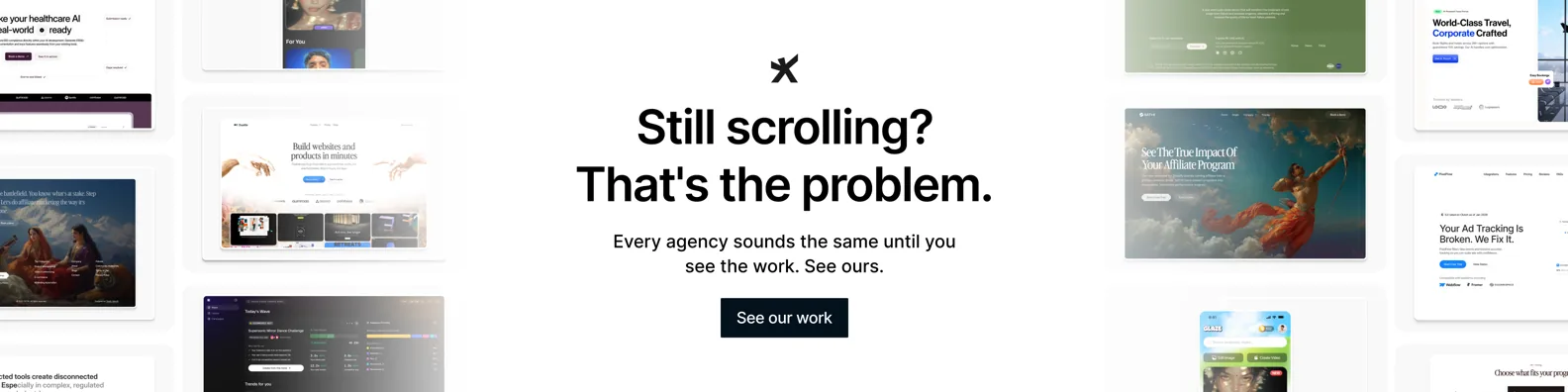
6. Flowout
Flowout is a distributed Webflow studio with a published starting price and a client list of Jasper, Kajabi, Riverside, and Sendlane. Riverside is the interesting one, a recording product, so the studio has already made a page about audio quality persuasive without playing anything. Flowout sits at the cheaper end here and is built for speed, which suits a team needing a credible page before a demo day.
The weakness is that it publishes neither team size nor a founding date, so you are buying an output rather than a known group of people.
| Check | Finding |
|---|---|
| Based in | Distributed |
| Founded | Not published |
| Team size | Not published |
| Primary platform | Webflow |
| AI-sector proof | Partial |
| Named clients | Jasper, Kajabi, Riverside, Sendlane |
| Pricing | Published minimum |
| Best fit | Early voice teams who need a good page fast and cheaply |
7. Digidop
Digidop is a Paris studio of one to ten, founded 2021, working in Webflow and publishing a starting price. A team that small means the person you talk to builds the thing, which is the most reliable way to keep a technical claim intact from first call to finished page. StreamNative, named alongside TSE Energy and Ramify, is real-time data infrastructure, so the team has met streaming before.
The weakness is capacity. One to ten people means a queue, and a launch slipping two weeks because the studio is finishing someone else's project is a real risk.
| Check | Finding |
|---|---|
| Based in | Paris, France |
| Founded | 2021 |
| Team size | 1-10 |
| Primary platform | Webflow |
| AI-sector proof | Partial |
| Named clients | TSE Energy, Ramify, StreamNative |
| Pricing | Published minimum |
| Best fit | European voice teams who want direct access to whoever builds it |
8. Edgar Allan
Edgar Allan works from Atlanta, founded 2014, fifty-one to two hundred people, building in Webflow for Porsche, Duracell, and NCR. It is brand-first, and there is a version of a voice company where that is right. Selling to enterprise buyers who need to believe your system will not embarrass them in front of a customer, institutional solidity does work a feature list cannot.
The weakness is fit. That client list is consumer and industrial, its AI-sector proof is partial, and it publishes no pricing. A studio used to a Porsche timeline is not shaped for a voice startup between rounds.
| Check | Finding |
|---|---|
| Based in | Atlanta, USA |
| Founded | 2014 |
| Team size | 51-200 |
| Primary platform | Webflow |
| AI-sector proof | Partial |
| Named clients | Porsche, Duracell, NCR |
| Pricing | Not published |
| Best fit | Voice companies selling to enterprises who need to look established |
9. Engine Digital
Engine Digital has run since 2002 from Vancouver and New York, builds in custom code, and works for Adidas, Autodesk, Goldman Sachs, and HP. Twenty-plus years and that list mean real capability with complicated, high-traffic builds, and for a voice product entering a regulated industry the Goldman Sachs experience is not nothing.
The weakness is that everything about it is sized for large organisations. It publishes neither team size nor pricing, its AI-sector proof is partial, and enterprise engagements bring enterprise timelines.
| Check | Finding |
|---|---|
| Based in | Vancouver and New York |
| Founded | 2002 |
| Team size | Not published |
| Primary platform | Custom code |
| AI-sector proof | Partial |
| Named clients | Adidas, Autodesk, Goldman Sachs, HP |
| Pricing | Not published |
| Best fit | Voice products entering regulated or very large enterprise markets |
10. Flow Ninja
Flow Ninja is a Belgrade studio of eleven to fifty, founded 2018, working in Webflow. The tenure is real, and a competent Webflow build at European rates is the right answer for some voice companies.
The weakness is that it publishes neither client names nor a starting price, which is two blanks in the two columns that let you judge from outside. You cannot check whether it has done anything close to your problem, and you cannot check affordability, so every question waits for a call.
| Check | Finding |
|---|---|
| Based in | Belgrade, Serbia |
| Founded | 2018 |
| Team size | 11-50 |
| Primary platform | Webflow |
| AI-sector proof | Partial |
| Named clients | Not published |
| Pricing | Not published |
| Best fit | Teams happy to evaluate entirely through calls rather than public work |
How to choose between them
Sort by which part of the problem is costing you most.
The page needs to behave, not just look right. Phantom or Engine Digital.
Buyers must feel something before they press play. Refokus or Edgar Allan.
You want a known number and a settled team. Ramotion or Pixelmatters.
A launch is close and the budget is tight. Flowout or Digidop.
One test before you sign. Play a candidate thirty seconds of your product, then ask what they would put on the page for someone who will never turn the sound on. A studio that understands voice answers with a transcript treatment, a latency number, and a failure case handled well. A studio that does not answers with a waveform animation, which is decoration standing where an argument should be.