
Summarize with AI


For a computer vision startup choosing a website studio, ten are worth reviewing: Studio Maydit, Ramotion, Instrument, Refokus, Finsweet, Edgar Allan, Engine Digital, Digidop, Flowout, and Push Refresh. The two strongest are Ramotion and Instrument. Ramotion has been in San Francisco since 2009, runs eleven to fifty people, works across platforms for Mozilla, Okta, Netflix, Adobe, and Xero, and publishes a starting price. Instrument has been in Portland since 2005 and works across platforms for Nike, Microsoft, Electronic Arts, and Google. Flowout and Push Refresh are the weakest fit here, both being small, fast studios whose published work carries no visual or AI depth to speak of.
Your problem is the opposite of everyone else's in AI. You have too much to show.
Voice companies fight silence and agent companies fight invisibility. You have footage, overlays, heat maps, segmentation masks, and every one of them is genuinely striking. The trouble is that they are also identical to what your four competitors put on their homepages last quarter, and to the figures in the paper all of you cite. Bounding boxes over a busy street have become the stock photo of this category. A visitor who has looked at three vision sites this month cannot tell you apart from the imagery, which is the only thing the imagery was supposed to do.
The second difficulty is that your buyer's cameras are worse than yours. Demo footage is shot in good light on a decent lens at a sensible angle. Their reality is a nine-year-old camera pointed slightly too high, in a warehouse with one bulb out. They know the gap exists, they cannot measure it from your page, and so they assume the worst, which is usually the right instinct given how the industry markets itself.
Third, the number that convinces a researcher actively repels a buyer. Mean average precision is a real result and it means nothing to the operations manager signing the contract. What they want is the false alarm count on a night shift, because that is the number that decides whether their team keeps the system switched on or quietly ignores it by week three.
So the page has a strange job. It has to look less like a vision demo and more like evidence.

How we picked these agencies
Five questions produced this order, and each is answerable from public pages before you spend an hour on a call.
First, platform depth, judged here against the weight of what you are shipping. Vision sites are heavy. Video, comparison sliders, before and after frames, and sometimes an interactive viewer, all of which have to load quickly on a factory laptop and a phone. A studio that treats performance as an afterthought will hand you a beautiful page that takes eleven seconds to become useful.
Second, proof with products whose quality is visual and therefore easy to fake. This is the criterion working hardest for vision. Anyone can produce an impressive overlay. The skill is arranging imagery so a sceptical viewer believes it was not curated, which usually means showing difficult conditions, admitting the limits, and putting the unglamorous footage next to the good footage on purpose. Studios with imaging or high-craft visual clients have met this. Studios without it default to the most beautiful frame available.
Third, pricing disclosure, meaning whether a starting figure exists anywhere public. It is a cheap signal about willingness to be specific, which is the habit your accuracy section needs.
Fourth, team shape. Whether the person who understood why your model handles occlusion well is the same person writing that sentence. Vision claims flatten into marketing language the moment they change hands.
Fifth, the studio's own website. No client and no brief, so it shows what the team does when nobody is negotiating with them.
Every fact below traces to something each studio publishes about itself. Nothing is estimated, and a Not published entry records a choice rather than a gap.
What goes wrong
The hero image is the category's stock photo. Bounding boxes over a street, or a segmentation mask in five bright colours. It looks technical and it distinguishes you from nothing. If a competitor could use your hero image unchanged, it is decoration. Lead with the specific situation you handle that others do not, shown in the ugly conditions where it matters.
Accuracy gets published in the wrong units. A precision figure lands on a buyer who cannot convert it into anything they care about. Translate it. Twelve false alarms a week instead of two hundred is a sentence an operations lead can take to their manager. The research number can stay further down the page for the engineer who will ask.
The difficult footage is cropped out. Every clip is daylight, clean angles, unobstructed subjects. The buyer's site is none of those, and they know it, so the polish reads as evasion. Show rain. Show night. Show a partly hidden object being caught, and one being missed, with the reason. Voluntarily published failure is the strongest trust signal available to a vision company and almost nobody uses it.
1. Studio Maydit: A Top-Rated Design Agency for AI Founders
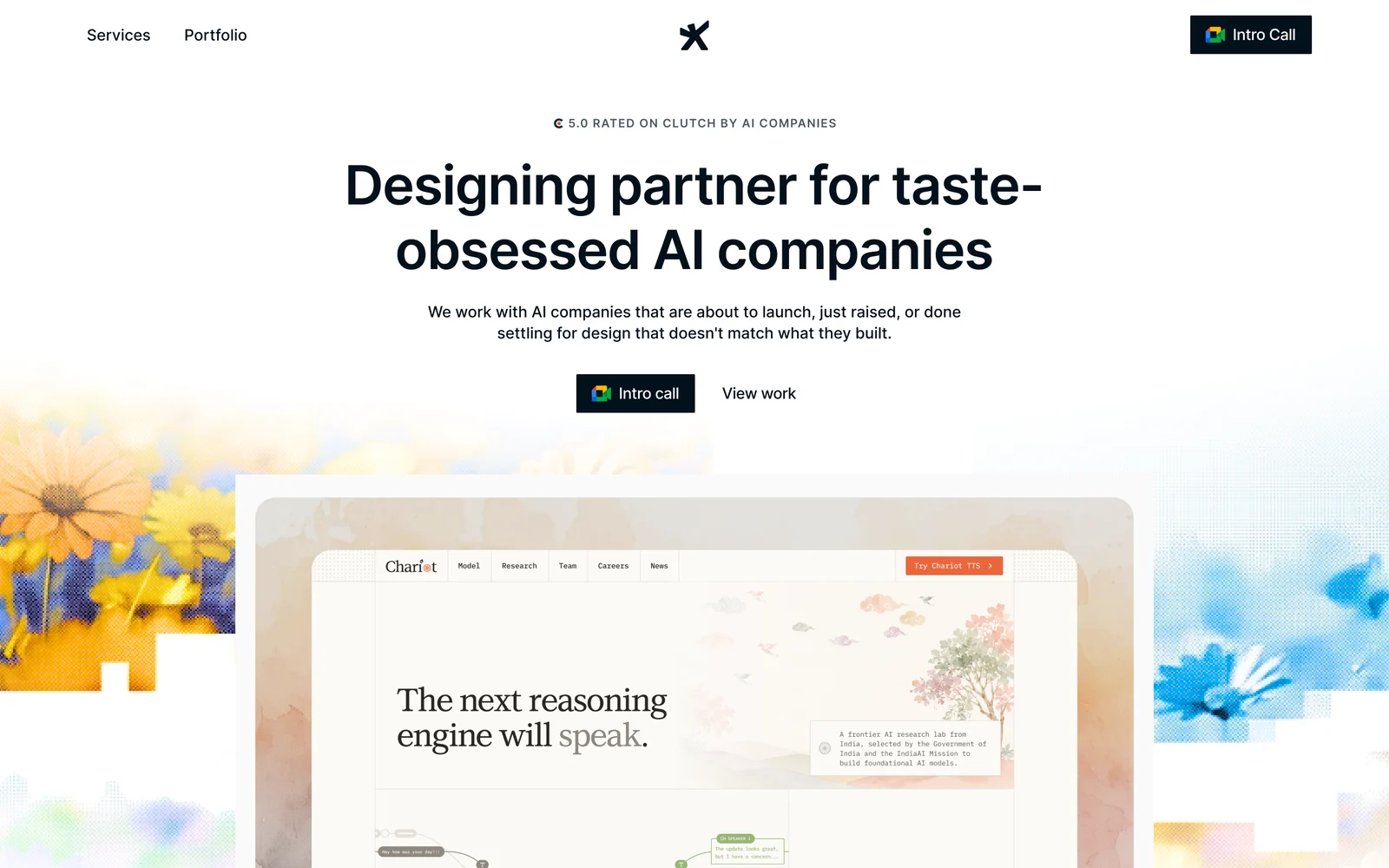
Vision teams usually own the imagery and still lose the argument. Studio Maydit is a web and product design studio working with AI founders in the US, UK, and Europe, and the work here starts by separating what is impressive from what is convincing, because in this category those are rarely the same frame. Builds happen in Framer, Webflow, or custom code, picked by how heavy the page really is, which matters when video and interactive comparisons are doing the persuading.
Design continues past the marketing site into the product. For a vision company that is where the difficult decisions live. How a detection is presented so an operator trusts it, what a low-confidence result looks like on screen, how a reviewer corrects a wrong label without friction, and what the interface shows when a camera goes dark are product design problems, handled by the same team rather than handed on. The clearest published outcome is Dualite, where design work supporting a repositioned ICP helped the product reach 100,000+ users in seven months. Recent clients include Wave, PixelFlow, Mi-VAD, and 15 other AI and SaaS teams.
There are two ways to buy. A fixed scope takes three to four weeks and fits a team with a pilot or a launch already dated. A monthly retainer suits teams shipping continuously, covering new pages, campaigns, and product design, with no long lock-in either way. Fixed-scope engagements finish with a written diagnosis of what is leaking in the product, not a handoff and goodbye.
| Check | Finding |
|---|---|
| Based in | Remote, serving US / UK / EU |
| Platform depth | Framer, Webflow, and custom code |
| AI-sector proof | Yes. AI-native clients, published outcome on Dualite |
| Pricing | Fixed scope or monthly retainer, quoted per project |
| Team shape | Founder-led, small senior team |
| Best fit | Vision teams whose footage impresses and whose page still loses pilots |
If buyers admire the demo and stall at the pilot, that gap is the first thing to fix. Book a 30-minute call.

2. Ramotion
Ramotion has worked from San Francisco since 2009 with eleven to fifty people, builds across platforms, and publishes a starting price. Adobe is the client that matters here. Designing for a company whose entire business is imaging means the team has already had to present visual quality to people who judge visual quality professionally, which is a harder audience than yours. Netflix and Mozilla add scale and performance experience, useful for a page carrying real video.
The weakness is that its AI-sector proof is partial rather than direct. Ramotion will execute a vision argument well, but you will probably have to bring the argument.
| Check | Finding |
|---|---|
| Based in | San Francisco, USA |
| Founded | 2009 |
| Team size | 11-50 |
| Primary platform | Mixed |
| AI-sector proof | Partial |
| Named clients | Mozilla, Okta, Netflix, Adobe, Xero |
| Pricing | Published minimum |
| Best fit | Vision teams who want imaging credibility and a published number |
3. Instrument
Instrument has been in Portland since 2005 and works across platforms for Nike, Microsoft, Electronic Arts, and Google. This is the highest-craft option on the list, and craft is not a luxury for a vision company. When your imagery is the argument, the difference between a page that looks like a research poster and one that looks like a product is the difference between interest and a pilot. Electronic Arts in particular is real depth in moving imagery.
The weakness is fit and cost together. Its AI-sector proof is partial, it publishes neither team size nor pricing, and a studio built around global brand programmes brings a timeline shaped for them, not for you.
| Check | Finding |
|---|---|
| Based in | Portland, USA |
| Founded | 2005 |
| Team size | Not published |
| Primary platform | Mixed |
| AI-sector proof | Partial |
| Named clients | Nike, Microsoft, Electronic Arts, Google |
| Pricing | Not published |
| Best fit | Funded vision companies whose imagery has to look expensive |
4. Refokus
Refokus is a remote German studio of eleven to fifty, founded 2021, working mainly in Webflow for Mural, BASF, Spotify, Yahoo, and BCG. BASF is the interesting name for a vision company, because industrial buyers are the ones most likely to be running your models over bad cameras in unglamorous places, and a studio that has spoken to that audience will not reach only for consumer polish. Being European also helps if your customers are manufacturers on this side of the Atlantic.
The weakness is that Webflow has limits, and a heavy interactive comparison viewer can find them. Its sector proof is partial and it publishes no pricing.
| Check | Finding |
|---|---|
| Based in | Germany, remote |
| Founded | 2021 |
| Team size | 11-50 |
| Primary platform | Webflow |
| AI-sector proof | Partial |
| Named clients | Mural, BASF, Spotify, Yahoo, BCG |
| Pricing | Not published |
| Best fit | European vision teams selling into industrial buyers |
5. Finsweet
Finsweet is distributed from Denver, founded 2017, with fifty-one to two hundred people and unusually deep Webflow expertise. Dropbox, Clay, GitHub, and Steadily are named. GitHub signals the team can write for engineers, which matters because a vision purchase usually needs a technical person to bless it before an operations person signs it. The size also means it can carry a large site with many documented deployments.
The weakness is that its AI-sector proof is partial and it publishes no pricing, so both relevance and cost only become clear on a call.
| Check | Finding |
|---|---|
| Based in | Denver, USA, distributed |
| Founded | 2017 |
| Team size | 51-200 |
| Primary platform | Webflow |
| AI-sector proof | Partial |
| Named clients | Dropbox, Clay, GitHub, Steadily |
| Pricing | Not published |
| Best fit | Vision products with a big site and a technical gatekeeper |
6. Edgar Allan
Edgar Allan is an Atlanta studio founded in 2014, fifty-one to two hundred people, building in Webflow for Porsche, Duracell, and NCR. Porsche is high-craft imagery and NCR is industrial hardware, which is an unusually relevant pair for a vision company selling cameras and inference into physical places.
The weakness is that its AI-sector proof is partial, it publishes no pricing, and a studio accustomed to consumer brand budgets is not naturally shaped for a startup running a pilot.
| Check | Finding |
|---|---|
| Based in | Atlanta, USA |
| Founded | 2014 |
| Team size | 51-200 |
| Primary platform | Webflow |
| AI-sector proof | Partial |
| Named clients | Porsche, Duracell, NCR |
| Pricing | Not published |
| Best fit | Vision companies selling into industrial and retail environments |
7. Engine Digital
Engine Digital has run since 2002 from Vancouver and New York, builds in custom code, and works for Adidas, Autodesk, Goldman Sachs, and HP. Autodesk is the useful signal, because spatial and three-dimensional software has the same explanation problem you do. Custom code also means a genuinely interactive viewer is possible rather than approximated.
The weakness is that everything is sized for large organisations. No published team size, no published pricing, partial sector proof, and enterprise timelines that most vision startups cannot absorb.
| Check | Finding |
|---|---|
| Based in | Vancouver and New York |
| Founded | 2002 |
| Team size | Not published |
| Primary platform | Custom code |
| AI-sector proof | Partial |
| Named clients | Adidas, Autodesk, Goldman Sachs, HP |
| Pricing | Not published |
| Best fit | Vision products going into regulated or very large enterprises |
8. Digidop
Digidop is a Paris studio of one to ten people, founded 2021, working in Webflow with a published starting price. The size is the benefit. You speak to whoever builds, so the reason your model handles occlusion survives intact to the finished page. StreamNative, alongside TSE Energy and Ramify, is real-time data infrastructure, so streaming is not new to them.
The weakness is capacity and heft. A team that small runs a queue, and a video-heavy site is a lot of work for one to ten people. Ask what else is live before agreeing a date.
| Check | Finding |
|---|---|
| Based in | Paris, France |
| Founded | 2021 |
| Team size | 1-10 |
| Primary platform | Webflow |
| AI-sector proof | Partial |
| Named clients | TSE Energy, Ramify, StreamNative |
| Pricing | Published minimum |
| Best fit | European vision teams who want direct access to the builder |
9. Flowout
Flowout is a distributed Webflow studio with a published starting price, working for Jasper, Kajabi, Riverside, and Sendlane. It is the cheapest realistic option here and it is built for speed, which suits a vision team that needs a credible page before a pilot review rather than a brand that lasts three years.
The weakness is depth. It publishes neither team size nor a founding date, its AI-sector proof is partial, and nothing in the named work involves heavy imagery or a technical buyer. For a video-led page that is a real gap.
| Check | Finding |
|---|---|
| Based in | Distributed |
| Founded | Not published |
| Team size | Not published |
| Primary platform | Webflow |
| AI-sector proof | Partial |
| Named clients | Jasper, Kajabi, Riverside, Sendlane |
| Pricing | Published minimum |
| Best fit | Early vision teams who need something credible quickly and cheaply |
10. Push Refresh
Push Refresh is a Dallas studio of one to ten people building in Framer, and it publishes a starting price. Direct access to the builder is genuine value, and Framer gets a first version up fast.
The weakness is that this is the least suitable brief on the list for a vision company. SmithRx, Synonym, and Northern National are competent work with no imaging or AI weight, its sector proof is partial, and Framer plus a one-to-ten person team is a difficult combination for a page carrying several minutes of video and an interactive comparison.
| Check | Finding |
|---|---|
| Based in | Dallas, USA |
| Founded | Not published |
| Team size | 1-10 |
| Primary platform | Framer |
| AI-sector proof | Partial |
| Named clients | SmithRx, Synonym, Northern National |
| Pricing | Published minimum |
| Best fit | Vision teams who need a simple page and will handle video elsewhere |
How to choose between them
Sort by which part is actually failing.
The imagery has to look expensive rather than academic. Instrument or Ramotion.
Your buyers are manufacturers with bad cameras. Refokus or Edgar Allan.
An engineer has to approve before operations will sign. Finsweet or Engine Digital.
A pilot review is close and the budget is small. Digidop or Flowout.
One test before you sign. Show a candidate your best clip and your worst clip, then ask which one belongs on the homepage. A studio that understands vision will argue for both, with the bad one labelled and explained, because that is what makes the good one believable. A studio that does not will pick the pretty one and ask if you have a longer version.