

Summarize with AI


Ten studios are worth an AI agent startup's time when it comes to a website: Studio Maydit, Trueform, Lazarev, Kvalifik, Push Refresh, Pixelmatters, Phantom, Instrument, Flow Ninja, and Foundey. The two at the front are Trueform and Lazarev. Trueform builds in Framer out of Wil in Switzerland, has done so since 2022 for Miro, Morning Brew, Bilt Rewards, and Gather, and puts a starting figure on its own site. Lazarev is a fifty-one to two hundred person team in San Francisco, founded 2015, working across platforms for Payoneer, Peel, Elva, and Mozayix, and it publishes a floor too. Both hold AI-sector proof. At the other end, Flow Ninja names no clients and no price, and Foundey does not build websites at all, only designs them.
Your product works while nobody is watching, and that is the hardest thing you will ever have to show.
A dashboard can be photographed. A chat interface can be recorded. An agent goes away, does forty steps over two hours, and comes back with a result. The interesting part happened somewhere the visitor cannot see, and the screenshot of a completed task looks like a row in a table. So the homepage ends up showing a diagram of boxes and arrows, which explains the architecture to people who already understand it and nothing to anyone else.
The second difficulty is speed of change. Agent capability is moving faster than any other part of software right now. What your product could not do in June it does in September. The site written around June's limits is now underselling you, and rewriting it means finding someone who can edit copy without a deploy, which most agent startups did not think about when they picked a stack.
Then there is the question underneath the whole sale. Buyers are not asking whether the agent works. They are asking what happens the time it is wrong, whether they will find out, and whether it can be undone. Almost no site in this category answers that, and the ones that do close faster, because it is the objection everyone has and nobody raises on a call.

How we picked these agencies
Five checks decided this order, and each of them can be answered from public pages before a call is booked.
Platform depth, weighed against how often an agent company rewrites its own claims. This is the criterion that moves studios up and down this particular list. If a capability shipped on Tuesday cannot reach the homepage until an engineer has a free afternoon, the site will permanently describe a weaker product than the one you actually sell.
Proof with AI products specifically, and with autonomous ones where possible. The design problem here is not decoration, it is making an invisible process legible and making delegation feel safe. A studio that has solved it before starts from a position. One that has not will ask you for screenshots, and you do not have any that mean anything.
Pricing. Whether a starting figure is published at all rather than what it is. It is a proxy for whether a studio has decided who it is not for, which tells you how the first call will go.
Team shape. Whether the senior person who grasped what your agent does is still there when the copy is written. On a product this hard to explain, an internal handoff is where a precise sentence turns into a vague one.
Their own website. Nobody else's budget, nobody else's opinion, so it shows the studio at full strength rather than at its average.
Nothing in the tables below has been inferred or estimated. Each row points at something the studio itself publishes, which is why a Not published entry is a decision on their side rather than a gap on ours.
What goes wrong for AI agent startups
Three failures come up again and again, and the first one is nearly universal in this category.
The homepage becomes an architecture diagram. Boxes, arrows, a loop labelled reasoning. It is accurate and it is aimed at the wrong reader. Buyers do not want to know how the agent decides, they want to know what lands in their inbox on Thursday and what it saves them. Diagrams feel like proof to a founder who built the system and read like homework to everyone else.
The site freezes at the capability you had when it was built. Six weeks after launch the product does something materially better and the page does not mention it, because changing that page needs a pull request. Your sales team starts saying things the website contradicts, prospects notice, and the site quietly becomes something you apologise for on calls rather than something that sells for you.
Nothing on the page addresses being wrong. The whole product asks a customer to hand over a decision. The natural, unspoken question is what the failure looks like, whether there is a log, and whether a human can step in. Sites that skip this read as either naive or evasive, and both readings cost the same. Naming the guardrails is not a weakness on the page, it is the thing that makes the confidence elsewhere believable.
1. Studio Maydit: A Top-Rated Design Agency for AI Founders
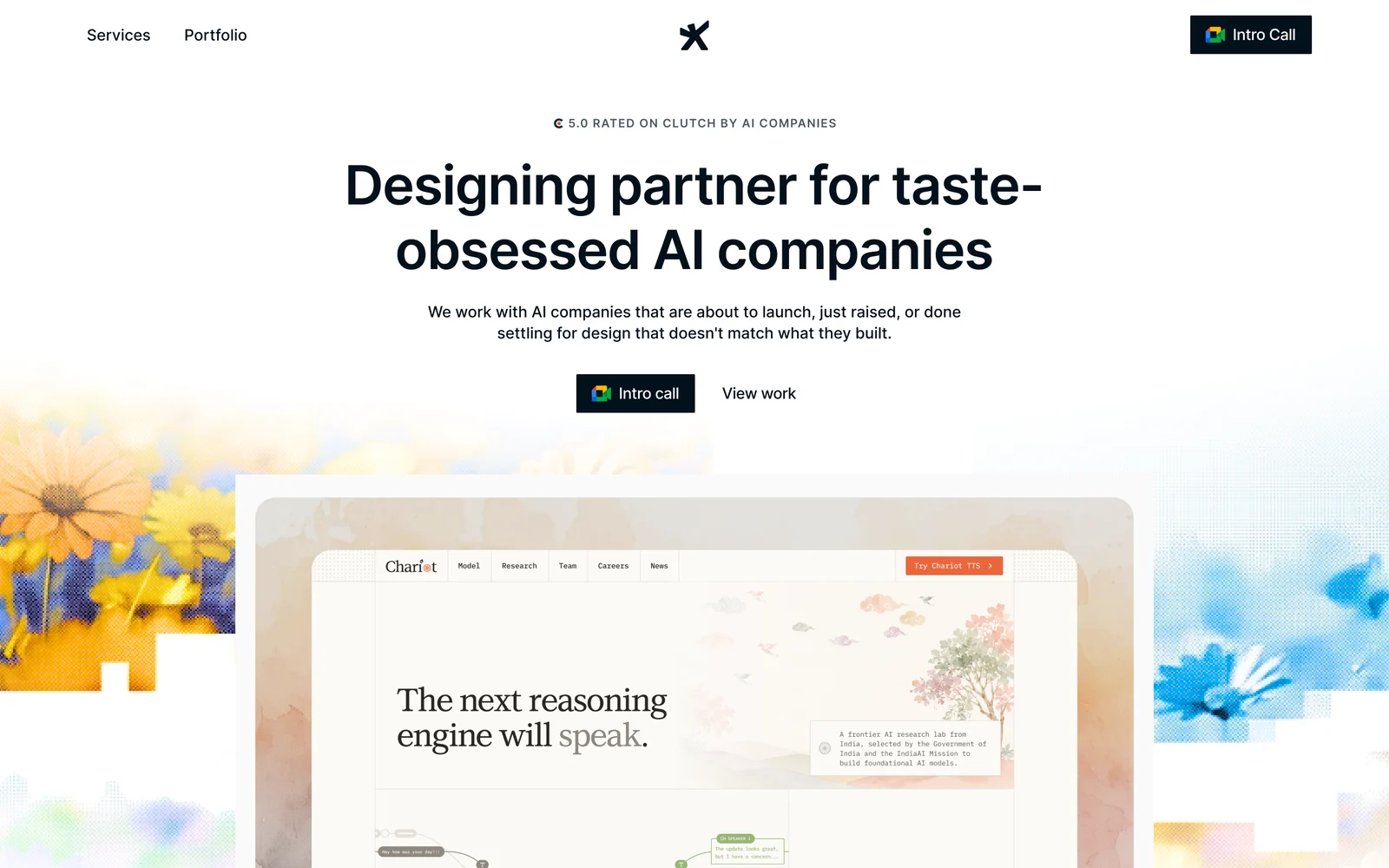
Speed of change is the deciding factor for an agent company, and it shapes how Studio Maydit picks a platform. Framer where the claims move weekly and a founder wants to edit at midnight, Webflow where a marketing hire needs their own keys, custom code where the product will not sit inside either. It is a web and product design studio, its clients are AI founders, and they are based in the US, UK, and Europe.
Because the same team carries on into product design after the site is live, the explanation does not have to be invented twice. On an agent product that join matters more than usual: the marketing page sells a delegated outcome, and the first screen after signup asks the user to configure something. If those two do not agree, the signup was wasted.
The published outcome is Dualite. A repositioned ICP came first. The design was then built for the narrower group that decision created. 100,000+ users arrived across the following seven months. For an agent startup the useful part is the discipline of naming a smaller buyer, because a product that can technically do anything will describe itself as doing everything, and that is the fastest way to be remembered by nobody.
The commercial choice usually follows your release cadence. Fixed scope, three to four weeks, suits a team with a launch or a demo day already in the calendar. A monthly retainer suits a team whose capability keeps outrunning its own copy, since it covers new pages, campaigns, and product design continuously and carries no long lock-in. Either way a fixed-scope build ends with a diagnosis of what is leaking in the product rather than a handoff and goodbye. Recent clients include Wave, PixelFlow, Mi-VAD, and 15 other AI and SaaS teams.
| Check | Finding |
|---|---|
| Based in | Remote, serving US / UK / EU |
| Platform depth | Framer, Webflow, and custom code |
| AI-sector proof | Yes. AI-native clients, published outcome on Dualite |
| Pricing | Fixed scope or monthly retainer, quoted per project |
| Team shape | Founder-led, small senior team |
| Best fit | Agent startups whose product has outgrown the site describing it |
Show the outcome, then show the guardrails. Book a 30-minute call.

2. Trueform
Trueform has worked from Wil in Switzerland since 2022 in Framer, publishes a starting price, and holds AI-sector proof through Miro, Morning Brew, Bilt Rewards, and Gather. Framer is why it leads here. An agent startup that ships new capability monthly needs the homepage to be editable by whoever is awake, and this is the studio on the page built around exactly that.
The weakness is ceiling rather than craft. Framer will not carry a genuinely unusual interactive demo, and if showing the agent working turns out to require custom engineering, you would be adding a second supplier.
| Check | Finding |
|---|---|
| Based in | Wil, Switzerland |
| Founded | 2022 |
| Team size | Not published |
| Primary platform | Framer |
| AI-sector proof | Yes |
| Named clients | Miro, Morning Brew, Bilt Rewards, Gather |
| Pricing | Published minimum |
| Best fit | Agent teams who will rewrite their own claims every few weeks |
3. Lazarev
Lazarev has worked from San Francisco since 2015 with fifty-one to two hundred people across mixed platforms, holds AI-sector proof, and publishes a starting price. Its portfolio sits in complex software rather than simple marketing sites, which is the right experience for a product whose value only becomes clear once someone understands a process they cannot see.
The weakness is the cost of scale. A studio this size staffs a team, and there is no guarantee the person who understood your agent in the first meeting is the person writing the sentence that has to explain it.
| Check | Finding |
|---|---|
| Based in | San Francisco, USA |
| Founded | 2015 |
| Team size | 51-200 |
| Primary platform | Mixed |
| AI-sector proof | Yes |
| Named clients | Payoneer, Peel, Elva, Mozayix |
| Pricing | Published minimum |
| Best fit | Agent products with a real interface that needs explaining, not just a claim |
4. Kvalifik
Kvalifik has worked from Copenhagen since 2015 with eleven to fifty people in Webflow, and holds AI-sector proof. Veo, Maersk, and Relesys are operational products where the buyer is measuring an outcome rather than admiring a design, which is close to how an agent buyer thinks.
The weakness is disclosure and distance. No starting price is published, so budget fit surfaces in conversation, and a US agent startup gets one overlap window a day with a Copenhagen team.
| Check | Finding |
|---|---|
| Based in | Copenhagen, Denmark |
| Founded | 2015 |
| Team size | 11-50 |
| Primary platform | Webflow |
| AI-sector proof | Yes |
| Named clients | Veo, Maersk, Relesys |
| Pricing | Not published |
| Best fit | European agent startups selling into operational teams |
5. Push Refresh
Push Refresh is a one to ten person Framer studio in Dallas that publishes a starting price, with work for SmithRx, Synonym, and Northern National. Small and Framer-based means two things an agent startup values: you brief the person who builds, and the result stays editable when the product moves next month.
The weakness is proof and capacity. AI-sector proof is partial rather than direct, and a team this size runs one substantial project at a time, so availability rather than fit may decide it.
| Check | Finding |
|---|---|
| Based in | Dallas, USA |
| Founded | Not published |
| Team size | 1-10 |
| Primary platform | Framer |
| AI-sector proof | Partial |
| Named clients | SmithRx, Synonym, Northern National |
| Pricing | Published minimum |
| Best fit | Early agent teams wanting a published price and direct access |
6. Pixelmatters
Pixelmatters has worked from Porto since 2013 with fifty-one to two hundred people across mixed platforms, and publishes a starting price. Rubrik, Quantic, and UJET are substantial software products, so this is a team comfortable with a build that has to hold up rather than just launch well.
The weakness is sector distance. AI-sector proof is partial, so the specific problem of making an autonomous process legible would be worked out on your project, and European hours limit live overlap with a US team.
| Check | Finding |
|---|---|
| Based in | Porto, Portugal |
| Founded | 2013 |
| Team size | 51-200 |
| Primary platform | Mixed |
| AI-sector proof | Partial |
| Named clients | Rubrik, Quantic, UJET |
| Pricing | Published minimum |
| Best fit | Agent startups who need a durable build more than a fast one |
7. Phantom
Phantom has worked from London and Auckland since 2013 in custom code with fifty-one to two hundred people, and holds AI-sector proof. Diageo, SAP, the Financial Times, and Zendesk are accounts where the work had to pass several kinds of review, and custom code means an interactive demo of your agent is technically within reach.
The weakness is pace and disclosure. No starting price is published, and a custom-code build slows exactly the fast copy changes an agent company needs most.
| Check | Finding |
|---|---|
| Based in | London, UK and Auckland, NZ |
| Founded | 2013 |
| Team size | 51-200 |
| Primary platform | Custom code |
| AI-sector proof | Yes |
| Named clients | Diageo, SAP, Financial Times, Zendesk |
| Pricing | Not published |
| Best fit | Funded agent companies who need a genuinely custom demo built |
8. Instrument
Instrument has worked from Portland since 2005 across mixed platforms for Nike, Microsoft, Electronic Arts, and Google. Two decades of practice at that level buys you people who have launched things under real scrutiny, which is worth something if your agent product is about to get a lot of attention.
The weakness is shape. AI-sector proof is partial, no team size or starting price is published, and the process assumes a client with marketing staff, which an eight-person agent startup does not have.
| Check | Finding |
|---|---|
| Based in | Portland, USA |
| Founded | 2005 |
| Team size | Not published |
| Primary platform | Mixed |
| AI-sector proof | Partial |
| Named clients | Nike, Microsoft, Electronic Arts, Google |
| Pricing | Not published |
| Best fit | Later-stage agent companies operating as a consumer brand |
9. Flow Ninja
Flow Ninja has worked from Belgrade since 2018 with eleven to fifty people in Webflow. European rates at that team size is a practical combination if you need a lot of pages built competently rather than one showpiece, and Webflow keeps the site editable afterwards.
The weakness is that there is very little to check. No named clients, no published price, and only partial AI-sector proof, so nearly all of your assessment has to happen in conversation.
| Check | Finding |
|---|---|
| Based in | Belgrade, Serbia |
| Founded | 2018 |
| Team size | 11-50 |
| Primary platform | Webflow |
| AI-sector proof | Partial |
| Named clients | Not published |
| Pricing | Not published |
| Best fit | Agent teams needing page volume at European rates |
10. Foundey
Foundey has worked from San Francisco since 2021 and holds AI-sector proof through DemandIQ, Traycer, and Sero AI. Those are early AI companies, so the team genuinely understands your stage, which is not common on a list like this.
The weakness decides it for a website brief. Foundey is Figma-only. It will design your pages and someone else has to build them, which means a second supplier, a second contract, and a seam where the timeline usually slips.
| Check | Finding |
|---|---|
| Based in | San Francisco, USA |
| Founded | 2021 |
| Team size | Not published |
| Primary platform | Figma-only |
| AI-sector proof | Yes |
| Named clients | DemandIQ, Traycer, Sero AI |
| Pricing | Not published |
| Best fit | Agent teams with in-house engineers who only need the design |
How to choose between them
Sort by what is actually broken.
If the site is already behind the product, buy editability first and treat craft as secondary. Trueform or Push Refresh.
If nobody understands what the agent actually does, buy a studio used to explaining complex software. Lazarev.
If the thing that would sell it is watching the agent work, you need custom engineering. Phantom.
If you need many pages built properly on a tight budget, buy capacity at European rates. Flow Ninja.
One test before you sign. Ask each studio how they would put your agent's failure case on the page. A studio that treats that as a design opportunity has understood what buyers are actually worried about. A studio that suggests leaving it out has understood your product as a feature list, and the objection will keep surfacing in week three of every deal.