
Summarize with AI


An AI copilot company weighing up website studios has ten worth its attention: Studio Maydit, basement.studio, Trueform, Feely Studio, BX Studio, Feels Like, Phantom, SuperSkills, Foundey, and Lighthouse Digital. Leading the list are basement.studio and Trueform. basement.studio works in custom code from Mar del Plata and Los Angeles, has done since 2018, and its clients include Cursor, which is a copilot, alongside Vercel, ElevenLabs, Harvey AI, and Scale AI. Trueform builds in Framer from Wil in Switzerland, founded 2022, for Miro, Morning Brew, Bilt Rewards, and Gather. Both publish a starting price and both hold AI-sector proof. Foundey and Lighthouse Digital fit least well, one because it does not build sites and the other because it has no AI-sector proof.
Most of the screenshots you need are of somebody else's product.
A copilot does not have a home of its own. It appears inside an editor, a CRM, a document, a terminal, and the moment that makes it valuable is a small one happening in the corner of an interface you did not design. Photograph the whole screen and your product is a sidebar. Crop to your product and it is a text box with no context. Neither image sells anything, and this is the first thing a studio without copilot experience will get wrong.
The second problem is that you are selling an upgrade to a habit. Your buyer already does this task. They are not looking for a new tool, they are being asked to change how they do something they are already competent at, which is a much higher bar than adoption of a genuinely new capability. The page has to show the same task twice, before and after, or the value stays theoretical.
Then there is the word itself. Copilot now belongs to a very large company in most people's heads, and the search results around it are crowded with a product you are not. Leaning on the category term buys you traffic that bounces and comparisons you lose by default. The companies doing well here name the job rather than the category.

How we picked these agencies
Five checks produced the order below, and every one can be settled from public pages before a call is arranged.
Platform depth, weighed against how tightly the site has to imitate a real interface. Copilot marketing usually needs a convincing in-context demonstration, and how far a studio can go with that is decided by the platform as much as by talent. A studio that only builds standard marketing layouts will hand you a screenshot in a rounded rectangle.
Proof with AI products, and ideally with assistive ones. This is the criterion doing the heavy lifting, and it is narrower than it looks. The specific skill is showing a product that has no surface of its own, which almost nothing else in software requires. A studio that has done it has already solved your hardest page.
Pricing. Whether a starting figure is public rather than what it is. It tells you whether the studio has drawn a line about who it works with, which is the same clarity you are trying to buy for your own page.
Team shape. Whether the senior person who understood where your copilot sits stays through the copy. On a product this contextual, an internal handoff usually costs you the one precise sentence you were paying for.
Their own website. It is built with no client and no compromise, so it shows the studio's ceiling rather than its average.
Every row in the tables below traces to something a studio publishes about itself. None of it was estimated, so where the table says Not published, the studio chose not to say.
What goes wrong for AI copilot products
Three failures repeat across this category, and the first one is visible on almost every copilot site.
The hero image shows a sidebar and nothing else. A narrow panel with some text in it, floating on a gradient. It is technically your product and it communicates nothing, because the value of a copilot is entirely in what it saved the person from doing, and the panel does not show the task. Sites that work here show the work, then show the panel doing it, in that order.
The page never shows the before. Without the old version of the task, an improvement is just an assertion. The reader has no reference point, so a claim like ten times faster lands as marketing rather than as arithmetic. Showing the previous way of doing something feels like giving space to the competitor. It is actually the only way to make the comparison concrete enough to believe.
The site markets a category instead of a job. Copy leans on copilot, assistant, and pair, which are all now generic and all now associated with a much bigger product. You inherit its comparisons and none of its brand. Naming the specific task instead, in the words the person doing it would use, is narrower and considerably more effective, and it is resisted because it feels like shrinking the market.
1. Studio Maydit: A Top-Rated Design Agency for AI Founders
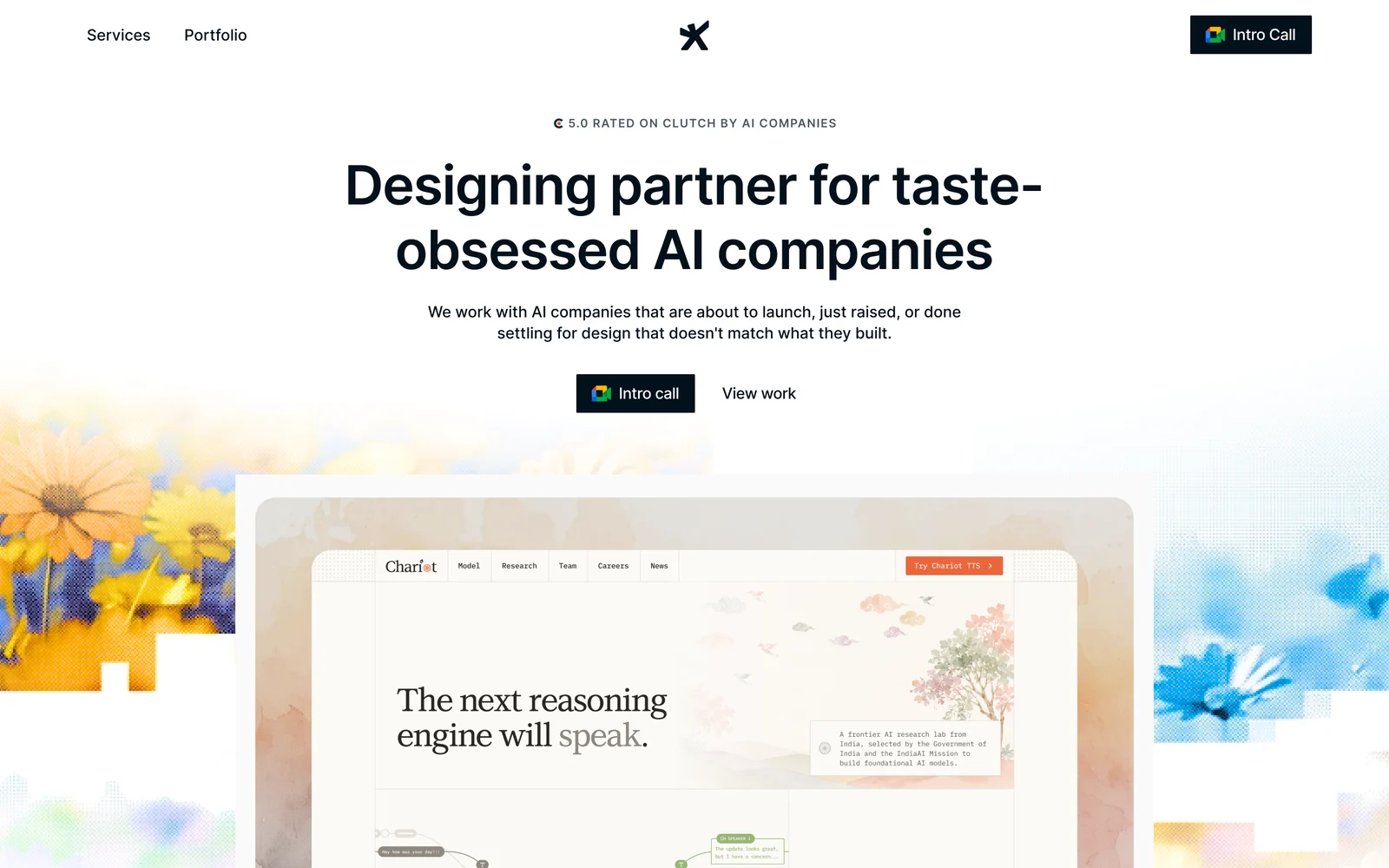
For a copilot, the marketing site and the product are unusually close together, and that is the reason Studio Maydit continues into product design after a site ships rather than stopping at launch. The task shown on the homepage is the same task a new user meets in the first session, and if those two disagree the trial ends early. It is a web and product design studio, its clients are AI founders, and it works across the US, UK, and Europe.
Platform follows need. Framer where the positioning is still moving weekly. Webflow where a marketing hire owns publishing. Custom code where a page has to imitate a live interface closely enough to be convincing, which for a copilot is a real possibility rather than an indulgence.
Seven months is how long Dualite took to reach 100,000+ users, and the sequence started with a repositioned ICP rather than with design. That order is the useful part for a copilot company, because the temptation is to claim the whole category and the thing that works is naming one job for one kind of person. Recent clients include Wave, PixelFlow, Mi-VAD, and 15 other AI and SaaS teams.
Two commercial shapes exist and the right one depends on how settled the product is. Fixed scope runs three to four weeks and suits a team with a launch date already committed. A monthly retainer suits a copilot still finding which task it is best at, since it covers new pages, campaigns, and product design as that answer changes, and carries no long lock-in. Every fixed-scope engagement finishes with a diagnosis of what is leaking in the product rather than a handoff and goodbye.
| Check | Finding |
|---|---|
| Based in | Remote, serving US / UK / EU |
| Platform depth | Framer, Webflow, and custom code |
| AI-sector proof | Yes. AI-native clients, published outcome on Dualite |
| Pricing | Fixed scope or monthly retainer, quoted per project |
| Team shape | Founder-led, small senior team |
| Best fit | Copilots whose homepage shows a panel instead of the work |
Name the job, not the category. Book a 30-minute call.

2. basement.studio
basement.studio has worked from Mar del Plata in Argentina and Los Angeles since 2018 with eleven to fifty people in custom code, and publishes a starting price. Cursor is on its client list, which is the single most relevant reference on this page, and Vercel, ElevenLabs, Harvey AI, and Scale AI show a practice built almost entirely around AI products.
The weakness is ongoing cost. Custom code means changing a claim needs an engineer, and copilot companies revise their claims often as the model underneath them improves.
| Check | Finding |
|---|---|
| Based in | Mar del Plata, Argentina and Los Angeles, USA |
| Founded | 2018 |
| Team size | 11-50 |
| Primary platform | Custom code |
| AI-sector proof | Yes |
| Named clients | Vercel, Cursor, ElevenLabs, Harvey AI, Scale AI |
| Pricing | Published minimum |
| Best fit | Copilots for technical users, where the site must look engineered |
3. Trueform
Trueform has worked from Wil in Switzerland since 2022 in Framer, publishes a starting price, and holds AI-sector proof through Miro, Morning Brew, Bilt Rewards, and Gather. Framer earns it this position: a copilot that keeps discovering which task it is best at needs a site somebody can rewrite the same day.
The weakness is the ceiling on demonstration. If selling your copilot really requires an interactive imitation of the host application, Framer will run out of room and you will need engineering help alongside it.
| Check | Finding |
|---|---|
| Based in | Wil, Switzerland |
| Founded | 2022 |
| Team size | Not published |
| Primary platform | Framer |
| AI-sector proof | Yes |
| Named clients | Miro, Morning Brew, Bilt Rewards, Gather |
| Pricing | Published minimum |
| Best fit | Copilot teams still narrowing the job and rewriting the page often |
4. Feely Studio
Feely Studio is a distributed European team of one to ten people across mixed platforms, with AI-sector proof and a published starting price. Noxus, Mutiny, Luasai, and Basic Capital are the kind of accounts where the founder speaks to whoever is designing, which matters when the brief is really about choosing one task out of five.
The weakness is throughput. One to ten people means work runs in sequence, so a large page set or a tight launch window may not fit their calendar.
| Check | Finding |
|---|---|
| Based in | Distributed, Europe |
| Founded | Not published |
| Team size | 1-10 |
| Primary platform | Mixed |
| AI-sector proof | Yes |
| Named clients | Noxus, Mutiny, Luasai, Basic Capital |
| Pricing | Published minimum |
| Best fit | Early copilot teams who need the positioning argument won first |
5. BX Studio
BX Studio runs eleven to fifty people from New York in Webflow, publishes a starting price, and holds AI-sector proof. ASAPP is an assistive AI product used by large operations teams, which is close to your shape, and Reddit, Headspace, and Verifone show it building at scale.
The weakness is that Webflow limits how far an in-context demonstration can go, and the portfolio leans consumer, so a developer or analyst audience would be a register the studio adapts to rather than repeats.
| Check | Finding |
|---|---|
| Based in | New York, USA |
| Founded | Not published |
| Team size | 11-50 |
| Primary platform | Webflow |
| AI-sector proof | Yes |
| Named clients | Reddit, Headspace, ASAPP, Verifone |
| Pricing | Published minimum |
| Best fit | Copilot companies needing a marketing team to publish independently |
6. Feels Like
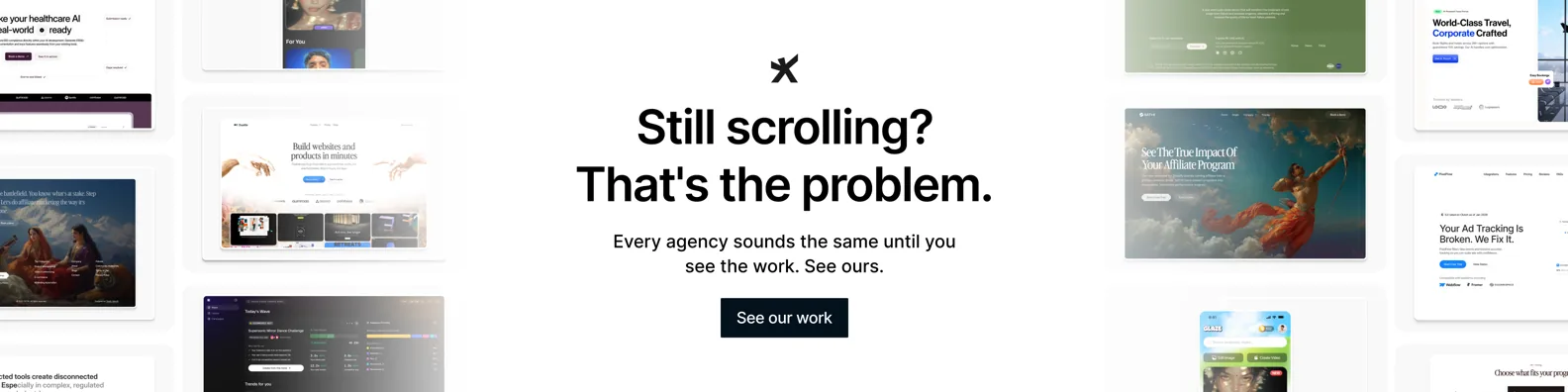
Feels Like has worked from Los Angeles since 2023 in custom code, with AI-sector proof through Suno AI and brand work for Google, Nike, and LVMH. In a category where every site uses the same panel-on-a-gradient composition, this is the studio most likely to produce something that does not look like the rest.
The weakness is unknowns. Neither team size nor a starting price is published, and the strength is brand rather than product explanation, so the in-context demonstration problem would be new ground.
| Check | Finding |
|---|---|
| Based in | Los Angeles, USA |
| Founded | 2023 |
| Team size | Not published |
| Primary platform | Custom code |
| AI-sector proof | Yes |
| Named clients | Google, Nike, LVMH, Suno AI |
| Pricing | Not published |
| Best fit | Consumer or creative copilots that need to feel like a brand |
7. Phantom
Phantom has worked from London and Auckland since 2013 in custom code with fifty-one to two hundred people, and holds AI-sector proof. Zendesk and SAP are products where assistive features sit inside a larger workflow, and custom code means a genuinely interactive demonstration is achievable.
The weakness is the engagement shape. No starting price is published, and a practice built around enterprise clients runs a process that a small copilot team has to staff from its own side.
| Check | Finding |
|---|---|
| Based in | London, UK and Auckland, NZ |
| Founded | 2013 |
| Team size | 51-200 |
| Primary platform | Custom code |
| AI-sector proof | Yes |
| Named clients | Diageo, SAP, Financial Times, Zendesk |
| Pricing | Not published |
| Best fit | Funded copilot companies needing a built, interactive demonstration |
8. SuperSkills
SuperSkills is a one to ten person team in Walnut Creek working across mixed platforms, with AI-sector proof. The benefit is directness. There is no account layer, so the person who hears your explanation is the person who has to render it.
The weakness is the thin public record. One named client, no founding date, no team detail, and no published price, which leaves you assessing almost entirely on a conversation.
| Check | Finding |
|---|---|
| Based in | Walnut Creek, USA |
| Founded | Not published |
| Team size | 1-10 |
| Primary platform | Mixed |
| AI-sector proof | Yes |
| Named clients | The Cut |
| Pricing | Not published |
| Best fit | Small budgets that want direct access more than verifiable history |
9. Foundey
Foundey has worked from San Francisco since 2021 with AI-sector proof through DemandIQ, Traycer, and Sero AI. Traycer in particular is an assistive developer product, so the team has thought about this exact problem before, which is genuinely rare.
The weakness is what it does not do. Foundey works Figma-only, so it designs the pages and a separate supplier builds them. For a copilot site where the demonstration is the hard part, that seam sits precisely where the difficulty is.
| Check | Finding |
|---|---|
| Based in | San Francisco, USA |
| Founded | 2021 |
| Team size | Not published |
| Primary platform | Figma-only |
| AI-sector proof | Yes |
| Named clients | DemandIQ, Traycer, Sero AI |
| Pricing | Not published |
| Best fit | Copilot teams whose own engineers will build the front end |
10. Lighthouse Digital
Lighthouse Digital works from London in Webflow, publishes a starting price, and has shipped for HelloSelf, Freetrade, and IGN. Those are consumer-facing products with real user numbers, and Webflow leaves the site editable by a non-engineer afterwards.
The weakness is the criterion this page is sorted by. There is no AI-sector proof at all, so the problem of showing a product that lives inside someone else's interface would be encountered for the first time on your project.
| Check | Finding |
|---|---|
| Based in | London, UK |
| Founded | Not published |
| Team size | Not published |
| Primary platform | Webflow |
| AI-sector proof | No |
| Named clients | HelloSelf, Freetrade, IGN |
| Pricing | Published minimum |
| Best fit | UK teams with the demonstration already solved in house |
How to choose between them
Sort by what is actually broken.
If the site cannot show the copilot doing anything, buy a studio that has solved that for a copilot already. basement.studio.
If you are still working out which task you are best at, buy speed of rewriting over polish. Trueform.
If every competitor site looks identical and yours is one of them, buy distinctiveness instead. Feels Like.
If the sale genuinely requires an interactive imitation of the host application, that is engineering. Phantom.
One test before you sign. Ask each studio to describe the hero section without using the word copilot. A studio that answers with a task and a person has understood what you sell. A studio that reaches for the category word has just told you it would ship the same page as everyone else in your market.