Summarize with AI


For an AI cybersecurity startup, the ten studios worth reviewing are Studio Maydit, Trueform, SuperSkills, BX Studio, Kvalifik, Feely Studio, Fantasy, Foundey, Clay, and Lazarev. Clay and BX Studio lead this list. Clay has designed from San Francisco since 2016 for Slack, Stripe, Google, Coinbase, and Amazon, with a published starting price and fifty-one to two hundred people, and Coinbase in particular is a buyer whose customers assume everything is a scam until proven otherwise. BX Studio works in Webflow from New York with a published figure, for Reddit, Headspace, ASAPP, and Verifone. Fantasy and Foundey are the wrong fit. Fantasy publishes no clients, price, or team size, and Foundey is Figma-only, so you would need a separate supplier to build anything.
Your buyer has been lied to professionally, for years, by people who look exactly like you.
That is the constraint nobody warns founders about. Security buyers spend their working lives assessing claims made by vendors, and the reflex transfers to your homepage instantly. A page that looks expensive does not read as credible to them. It reads as a company that spent the round on marketing rather than on detection, and the more polished it is, the louder that signal gets.
The word AI makes it worse right now. Every security vendor on the exhibition floor added it last year, most of it means a classifier somebody bolted on, and buyers have learned to discount the phrase entirely. If your model genuinely does something the previous generation could not, saying so in the usual words gets you filed with everyone else.
There is also the two-reader problem. A practitioner evaluates you and an executive signs. The practitioner wants detection logic, false positive rates, and a docs link. The executive wants risk reduced and a name they can defend. Most sites pick one and lose the other.

How we picked these agencies
Five checks, all answerable from public pages before you spend a call on anyone.
Platform depth. Security products publish constantly: advisories, research posts, compliance updates, integration pages. So the question is who publishes in month five and how fast. If every update needs the agency, your research output slows to whatever their queue allows, and in this market research output is a large part of how you get known.
Proof with sceptical, high-trust buyers. Has this studio built for companies whose customers audit them. Finance, health, infrastructure, payments, and security all count. It is the criterion carrying the most weight here, because the skill you are buying is restraint under pressure to oversell, and it is rare. A studio that has only worked on consumer launches will reach for excitement, which is the one register that hurts you.
Pricing. Is there a public starting figure. It matters more than usual for a security company, because your own buyers are about to judge you on transparency and you may as well apply the same test upward.
Team shape. Headcount tells you how many people your technical explanation passes through before it becomes a sentence on a page. Every extra layer costs precision, and in this category imprecision is read as dishonesty.
Their own site. Look for whether they can be plain. A studio that writes about itself in superlatives will write about you in superlatives, and your buyer stops reading at the first one.
An extra probe worth running here. Ask how they would write a homepage that a hostile practitioner could not dismiss in ten seconds. A studio that has sold into this market talks about evidence, specificity, and what you choose not to claim. One that has not will talk about trust badges.
Nothing in the tables below has been estimated or averaged. Each row repeats what the studio states publicly, and an unpublished value means the studio decided not to say.
What goes wrong for AI cybersecurity startups
Three failures, and the first is the one that feels like success while it is happening.
The site is too polished for the audience. A gorgeous launch page reassures your investors and quietly alarms your buyers. Practitioners associate heavy production with vendors who sell hard and detect little, so the beautiful hero animation is actively working against you with the person who will run the evaluation. This does not mean build something ugly. It means spend the craft on clarity and evidence rather than on spectacle.
The AI claim is generic, so it is discounted entirely. AI-powered threat detection is now a phrase with no information in it. If the model does something specific, say the specific thing: what it sees that rules miss, what the false positive rate looked like against a named dataset, where it fails. A precise limited claim outperforms a broad confident one with this audience every single time, because it is the shape of a claim that can be checked.
There is no trust surface, so the practitioner leaves to find one. No security page, no compliance status, no architecture overview, no docs, no way to see the product without a call. Every one of those absences sends an evaluator somewhere else, usually to a competitor who published theirs. This is the cheapest of the three failures to fix and the one most often left until after launch.
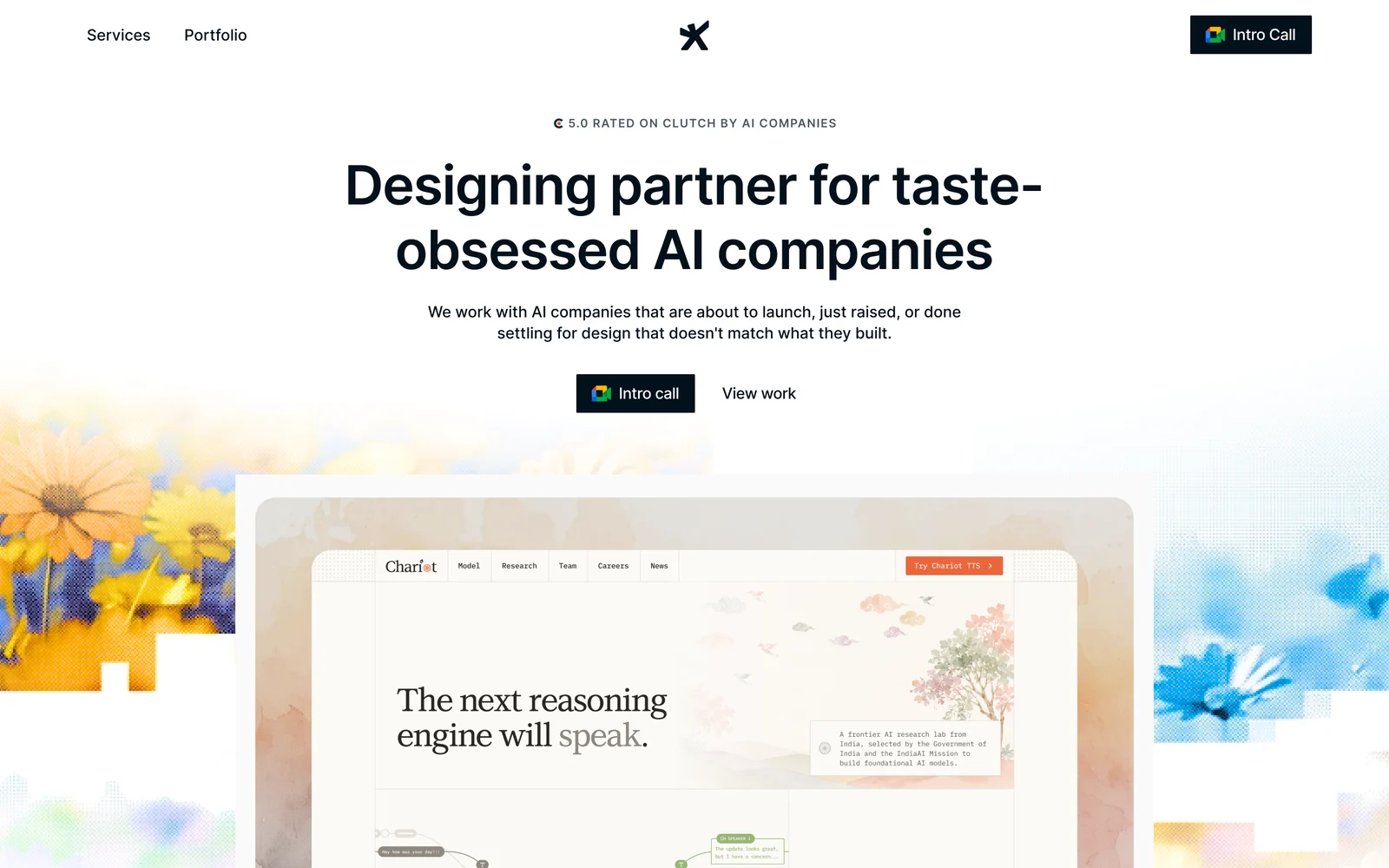
1. Studio Maydit: A Top-Rated Design Agency for AI Founders
Narrowing is the move that makes a security site legible, and it is the one Dualite made first. The team settled on a repositioned ICP, and only then was the product designed for the smaller group that decision defined rather than for everyone who might plausibly buy. 100,000+ users followed across seven months. Security startups face an unusually strong pull the other way, because the threat surface is wide enough to justify claiming almost any buyer, and claiming all of them is what makes a homepage sound like every other vendor.
Studio Maydit is a web and product design studio. Its clients are AI founders, working across the US, UK, and Europe. Platform follows who has to publish: Framer when advisories and research go out weekly, Webflow when a marketing hire owns the site, custom code when the product will not fit either. The work carries on into product design after launch, which matters here because the console is where a practitioner decides whether the detection is any good. Recent clients include Wave, PixelFlow, Mi-VAD, and 15 other AI and SaaS teams.
Fixed scope runs three to four weeks and suits a team with a conference or a launch to hit, and it closes with a written diagnosis of what is leaking in the product rather than a handover call. For a security company that is often the more valuable half, because the leak is usually between the demo and the trial. The other route is a monthly retainer with no long lock-in, covering new pages, campaigns, and product design, which fits a company publishing research on a schedule.
| Check | Finding |
|---|---|
| Based in | Remote, serving US / UK / EU |
| Platform depth | Framer, Webflow, and custom code |
| AI-sector proof | Yes. AI-native clients, published outcome on Dualite |
| Pricing | Fixed scope or monthly retainer, quoted per project |
| Team shape | Founder-led, small senior team |
| Best fit | Security teams whose site sounds like every other AI vendor |
If a hostile practitioner could dismiss your homepage in ten seconds, start there. Book a 30-minute call.

2. Clay
Clay has designed from San Francisco since 2016 with fifty-one to two hundred people and a published starting price, for Slack, Stripe, Google, Coinbase, and Amazon. Stripe and Coinbase both sell into environments where a single credibility failure is fatal, so this is a studio that has had to make careful claims look confident rather than timid.
The engagements are scaled for companies with internal brand teams to receive them, and the platform is mixed, so a small security startup may be buying a process built for someone much larger.
| Check | Finding |
|---|---|
| Based in | San Francisco, USA |
| Founded | 2016 |
| Team size | 51-200 |
| Primary platform | Mixed |
| AI-sector proof | Yes |
| Named clients | Slack, Stripe, Google, Coinbase, Amazon |
| Pricing | Published minimum |
| Best fit | Funded teams selling into enterprise security procurement |
3. BX Studio
BX Studio is a New York Webflow team of eleven to fifty people with a published starting price, for Reddit, Headspace, ASAPP, and Verifone. Verifone is payments infrastructure and ASAPP is an AI company selling automation into large operations, so both halves of your problem show up in that list.
The founding year is not published, and at that size several accounts run at once, so confirm who is actually assigned to yours.
| Check | Finding |
|---|---|
| Based in | New York, USA |
| Founded | Not published |
| Team size | 11-50 |
| Primary platform | Webflow |
| AI-sector proof | Yes |
| Named clients | Reddit, Headspace, ASAPP, Verifone |
| Pricing | Published minimum |
| Best fit | Teams who want a Webflow site their own researchers can update |
4. Lazarev
Lazarev has worked from San Francisco since 2015 with fifty-one to two hundred people, publishes a starting price, and carries AI-sector proof, for Payoneer, Peel, Elva, and Mozayix. Payoneer is regulated financial infrastructure, which is the closest thing on this page to a compliance-heavy buyer.
The platform is mixed rather than fixed, and at this size the senior people in the pitch may not be the ones drawing your pages.
| Check | Finding |
|---|---|
| Based in | San Francisco, USA |
| Founded | 2015 |
| Team size | 51-200 |
| Primary platform | Mixed |
| AI-sector proof | Yes |
| Named clients | Payoneer, Peel, Elva, Mozayix |
| Pricing | Published minimum |
| Best fit | Teams needing scale and a published floor at the same time |
5. Trueform
Trueform has worked from Wil in Switzerland since 2022 in Framer with a published starting price, for Miro, Morning Brew, Bilt Rewards, and Gather. Framer plus a published number is the fastest start on this page, and a Swiss base reads well with European buyers who care about where data and suppliers sit.
The team size is not published, the record is shorter than most here, and the client list is software and media rather than security.
| Check | Finding |
|---|---|
| Based in | Wil, Switzerland |
| Founded | 2022 |
| Team size | Not published |
| Primary platform | Framer |
| AI-sector proof | Yes |
| Named clients | Miro, Morning Brew, Bilt Rewards, Gather |
| Pricing | Published minimum |
| Best fit | European teams who need a credible site quickly |
6. Kvalifik
Kvalifik has worked from Copenhagen since 2015 with eleven to fifty people in Webflow, for Veo, Maersk, and Relesys. Maersk is critical infrastructure with real operational risk attached, so the studio has worked where consequences are concrete rather than theoretical.
No pricing is published, and the client list is Nordic enterprise rather than early security software, so the reference points sit at a different stage from yours.
| Check | Finding |
|---|---|
| Based in | Copenhagen, Denmark |
| Founded | 2015 |
| Team size | 11-50 |
| Primary platform | Webflow |
| AI-sector proof | Yes |
| Named clients | Veo, Maersk, Relesys |
| Pricing | Not published |
| Best fit | Teams selling into European operations and infrastructure |
7. Feely Studio
Feely Studio is a distributed European team of one to ten people with a published starting price and AI-sector proof, for Noxus, Mutiny, Luasai, and Basic Capital. Basic Capital is financial and Noxus is AI-native, so the studio has written for buyers who read carefully.
Capacity is the obvious limit at that size, no founding year is published, and there is no security client on the list.
| Check | Finding |
|---|---|
| Based in | Distributed, Europe |
| Founded | Not published |
| Team size | 1-10 |
| Primary platform | Mixed |
| AI-sector proof | Yes |
| Named clients | Noxus, Mutiny, Luasai, Basic Capital |
| Pricing | Published minimum |
| Best fit | Early teams wanting AI-native peers and a known price |
8. SuperSkills
SuperSkills is a one to ten person team in Walnut Creek working across platforms, with AI-sector proof and The Cut as its named client. The value here is directness: the person you brief is the person who writes, which protects a technical claim from being softened on its way to the page.
Only one client is named, no pricing is published, and there is no evidence of security work, so you are buying largely on the conversation.
| Check | Finding |
|---|---|
| Based in | Walnut Creek, USA |
| Founded | Not published |
| Team size | 1-10 |
| Primary platform | Mixed |
| AI-sector proof | Yes |
| Named clients | The Cut |
| Pricing | Not published |
| Best fit | Founders who want to explain the product once, to one person |
9. Foundey
Foundey has designed from San Francisco since 2021 for DemandIQ, Traycer, and Sero AI, and it carries AI-sector proof. All three are early AI companies, so the stage match is closer than most of this page.
It is Figma-only. You get design and no build, which means engineering time on your side or a second supplier, and neither team size nor pricing is published.
| Check | Finding |
|---|---|
| Based in | San Francisco, USA |
| Founded | 2021 |
| Team size | Not published |
| Primary platform | Figma-only |
| AI-sector proof | Yes |
| Named clients | DemandIQ, Traycer, Sero AI |
| Pricing | Not published |
| Best fit | Teams with engineers who only need the design half |
10. Fantasy
Fantasy has run from San Francisco and New York since 1999 across platforms, with AI-sector proof. Twenty-six years of interface work is the longest record here, and the strategic depth is real when a company is big enough to use it.
Everything else is private. No named clients, no team size, no price. For a startup that needs to check evidence before spending, that is a hard place to begin.
| Check | Finding |
|---|---|
| Based in | San Francisco and New York, USA |
| Founded | 1999 |
| Team size | Not published |
| Primary platform | Mixed |
| AI-sector proof | Yes |
| Named clients | Not published |
| Pricing | Not published |
| Best fit | Larger companies buying strategy alongside design |
How to choose between them
Sort by what is actually broken.
If enterprise procurement is where deals stall, buy the credibility signal. Clay or Lazarev, both of which have built for companies that get audited by their customers.
If your researchers publish and the site cannot keep up, that is a publishing problem. BX Studio on Webflow, with your own team owning the CMS.
If the homepage sounds like every other vendor at the same conference, the fix is the claim rather than the layout. SuperSkills or Feely Studio, briefed on what you refuse to say.
If European buyers are asking where everything sits, a European studio helps more than you would expect. Kvalifik or Trueform.
One test before you sign. Ask them to name the sentence on your current homepage a sceptical practitioner would mock. If they cannot find one, they are not reading the way your buyer reads.