

Summarize with AI


For an AI data platform, the ten studios worth reviewing are Studio Maydit, SuperSkills, Lighthouse Digital, basement.studio, Trueform, Clay, Phantom, Foundey, Fantasy, and Lazarev. basement.studio and Clay lead this list. basement.studio writes custom code, publishes a starting price, and has built for Vercel, Cursor, ElevenLabs, Harvey AI, and Scale AI, which includes both developer infrastructure and a data company. Clay has designed from San Francisco since 2016 with a published figure and fifty-one to two hundred people, for Slack, Stripe, Google, Coinbase, and Amazon. Fantasy and Lighthouse Digital are the wrong fit. Fantasy publishes no clients, price, or team size, and Lighthouse Digital has no AI-sector proof and a consumer and media client list.
Your product is plumbing, and plumbing is judged on where it sits, not on how it looks.
A data engineer landing on your homepage is doing one thing in the first ten seconds: placing you in a stack they already have a picture of. Are you the warehouse, the layer above it, the thing that moves rows between them, the store the model reads from at inference. If the page does not answer that immediately, they cannot tell whether you replace something, sit beside it, or add a dependency, and the cheapest response to that confusion is to close the tab.
The vocabulary makes it harder. Lakehouse, feature store, vector database, pipeline, data platform, and semantic layer all now describe overlapping things, and different companies use them to mean different things on purpose. Choosing the honest word costs you some search traffic and buys you a reader who understands you.
There is also the pricing problem. This category runs on bottom-up adoption, where an engineer tries the thing on a Thursday and asks for budget the following month. A contact-us page interrupts that at the exact point where interest is highest and nobody has authority to spend yet.

How we picked these agencies
Five checks, all settled from public pages before you book time with anyone.
Platform depth, meaning how the marketing site and the documentation live together. Data platforms publish constantly: connectors, benchmarks, migration notes, changelogs. If the site and the docs are separate worlds with different navigation and different type, readers feel the seam and trust drops. Ask how they have handled that boundary before.
Proof with infrastructure and developer-facing products. Has this studio written for an audience that reads carefully and dislikes being marketed to. It is the criterion doing the most work on this page, because the register is the whole game. Developer tooling, security, payments, and platform companies all count. Consumer launches, however beautiful, do not transfer.
Pricing. Is a starting figure published. You are about to have an internal argument about whether to publish your own pricing, so it is instructive to notice which studios have already had that argument with themselves.
Team shape. Headcount tells you how many people sit between the engineer who explains the architecture and the person who writes the sentence. In this category every layer costs technical precision, and technical precision is the credibility.
Their own site. Read it as a specimen of technical writing rather than as design. If they cannot describe their own process without adjectives, they will not describe your ingestion path without them either.
An extra probe worth running. Ask them to explain, after one call, where your product sits relative to a warehouse. A studio that can do it has understood the brief. A studio that cannot will produce a homepage of abstractions.
Nothing in the tables below is estimated. Every row repeats what the studio publishes about itself, and an unpublished value means silence was the studio's choice.
What goes wrong for AI data platforms
Three failures, and the first is a positioning failure that looks like a copywriting one.
The stack position is never stated. The homepage says unify your data, accelerate your AI, unlock insight, and an engineer still cannot tell whether you replace their warehouse or read from it. Every one of those phrases is true of forty companies. Name the layer, name what you sit next to, and name what you do not do. Being precise about your boundaries loses nobody worth having and immediately earns the reader's attention.
Pricing is hidden for a product bought from the bottom up. The engineer who wants to try you has no budget authority and no appetite for a sales call, so contact-us ends the evaluation. Usage-based pricing genuinely is hard to display, and that is not a reason to hide it. Publish the unit, publish an example workload with a number attached, and let people estimate. Companies in this category that publish consistently outperform those that do not on qualified pipeline.
The site shows architecture diagrams instead of evidence. Boxes and arrows are easy to draw and prove nothing. What persuades this reader is a benchmark with the method described, a quickstart they can finish in ten minutes, an honest page about limits and failure modes, and a real changelog. One reproducible number is worth a page of diagrams, because a diagram is a claim and a number is a test.
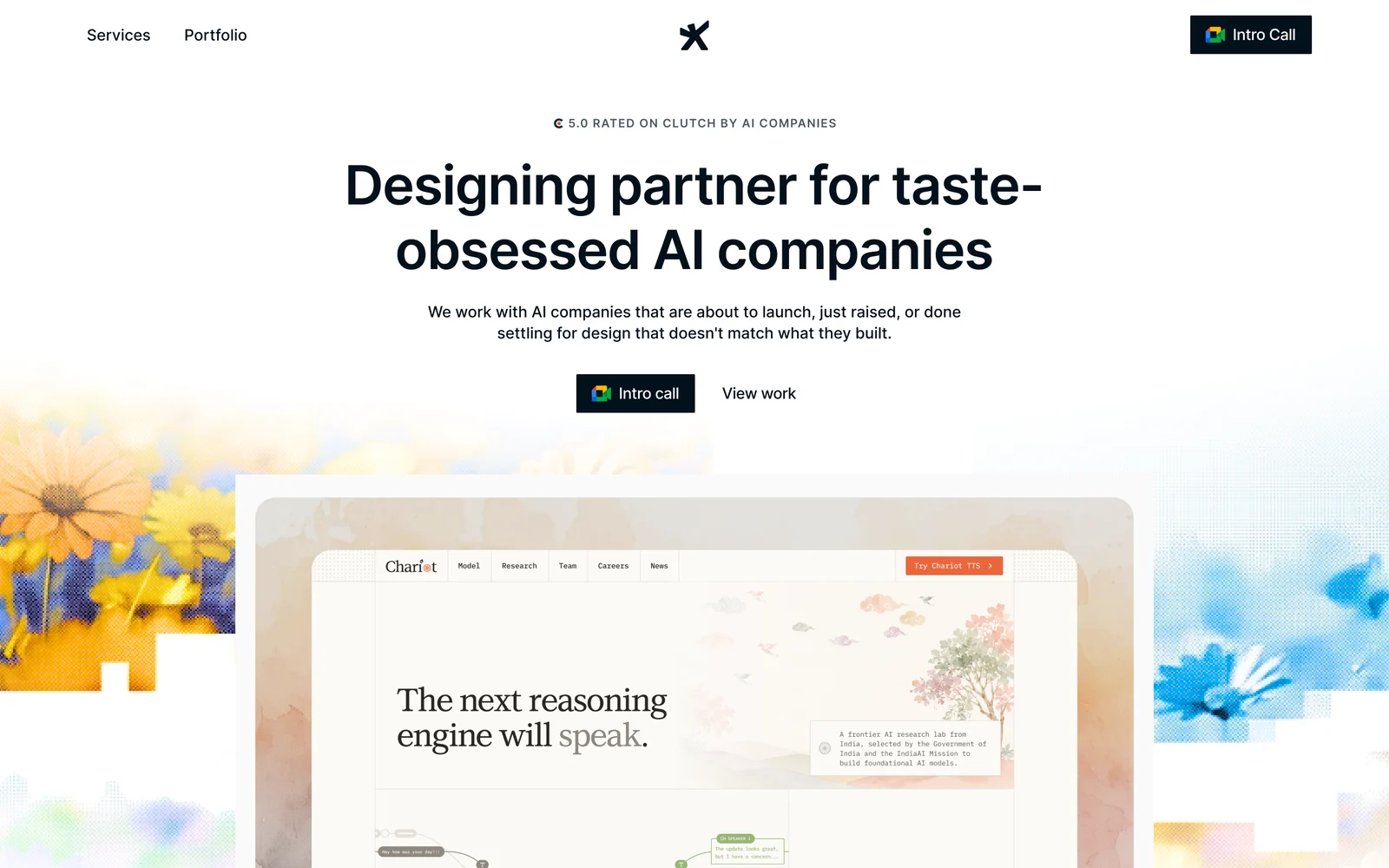
1. Studio Maydit: A Top-Rated Design Agency for AI Founders
Recent clients include Wave, PixelFlow, Mi-VAD, and 15 other AI and SaaS teams. Studio Maydit is a web and product design studio, and its clients are AI founders spread across the US, UK, and Europe. Platform is decided by publishing pattern rather than preference: Framer where pages change weekly, Webflow where a growing library of connector and benchmark pages needs an owner who is not an engineer, and custom code where the product genuinely will not fit either. After the site ships the work continues into product design, which for a data platform is usually where the difficult surfaces are.
One decision preceded the design at Dualite: a repositioned ICP, agreed before anything was drawn. The pages then spoke to the narrower group that choice created rather than to everyone the product could technically serve, and 100,000+ users arrived over seven months. Infrastructure companies feel this pull acutely, because the technology really is general and every adjacent use case looks addressable, which is how a data platform homepage ends up saying unify your data and nothing else.
Which of the two buying options fits depends on whether the documentation is the real site. Fixed scope, three to four weeks, works when there is a launch or a conference date, and it closes with a written diagnosis of what is leaking in the product instead of a handover call. A monthly retainer, with no long lock-in, covers new pages, campaigns, and product design, and it is the honest answer when connectors and benchmarks ship continuously.
| Check | Finding |
|---|---|
| Based in | Remote, serving US / UK / EU |
| Platform depth | Framer, Webflow, and custom code |
| AI-sector proof | Yes. AI-native clients, published outcome on Dualite |
| Pricing | Fixed scope or monthly retainer, quoted per project |
| Team shape | Founder-led, small senior team |
| Best fit | Data platforms whose homepage never names the layer they sit in |
If an engineer cannot place you in the stack in ten seconds, nothing else on the page matters. Book a 30-minute call.

2. basement.studio
basement.studio has worked from Mar del Plata and Los Angeles since 2018, eleven to fifty people, in custom code, with a published starting price, for Vercel, Cursor, ElevenLabs, Harvey AI, and Scale AI. Scale AI is a data company and Vercel is developer infrastructure, so this is the closest match on the page to both your buyer and your category.
Custom code means the docs and marketing site can be genuinely unified, and it also means every connector page routes back through a developer.
| Check | Finding |
|---|---|
| Based in | Mar del Plata, Argentina and Los Angeles, USA |
| Founded | 2018 |
| Team size | 11-50 |
| Primary platform | Custom code |
| AI-sector proof | Yes |
| Named clients | Vercel, Cursor, ElevenLabs, Harvey AI, Scale AI |
| Pricing | Published minimum |
| Best fit | Platforms whose site and docs should feel like one product |
3. Clay
Clay has designed from San Francisco since 2016 with fifty-one to two hundred people and a published starting price, for Slack, Stripe, Google, Coinbase, and Amazon. Stripe in particular is the benchmark for developer-facing documentation and pricing clarity, which is exactly the problem you are solving.
The engagements are scaled for companies with internal teams to receive them, and the platform is mixed, so an early data platform may be buying a process built for someone much larger.
| Check | Finding |
|---|---|
| Based in | San Francisco, USA |
| Founded | 2016 |
| Team size | 51-200 |
| Primary platform | Mixed |
| AI-sector proof | Yes |
| Named clients | Slack, Stripe, Google, Coinbase, Amazon |
| Pricing | Published minimum |
| Best fit | Funded platforms selling into enterprise data teams |
4. Lazarev
Lazarev has worked from San Francisco since 2015 with fifty-one to two hundred people, publishes a starting price, and carries AI-sector proof, for Payoneer, Peel, Elva, and Mozayix. Payoneer moves money at volume, so the studio has designed around real operational constraints rather than marketing surfaces alone.
The platform is mixed rather than fixed, and at this size the people in the pitch may not be the people on the project.
| Check | Finding |
|---|---|
| Based in | San Francisco, USA |
| Founded | 2015 |
| Team size | 51-200 |
| Primary platform | Mixed |
| AI-sector proof | Yes |
| Named clients | Payoneer, Peel, Elva, Mozayix |
| Pricing | Published minimum |
| Best fit | Teams wanting scale and a published floor together |
5. Phantom
Phantom has run from London and Auckland since 2013 with fifty-one to two hundred people in custom code, with AI-sector proof, for Diageo, SAP, Financial Times, and Zendesk. SAP is enterprise software with genuine information density, which is a rarer reference than it sounds.
No pricing is published, the clients are large organisations, and a build at that scale takes longer than an early platform usually wants to wait.
| Check | Finding |
|---|---|
| Based in | London, UK and Auckland, NZ |
| Founded | 2013 |
| Team size | 51-200 |
| Primary platform | Custom code |
| AI-sector proof | Yes |
| Named clients | Diageo, SAP, Financial Times, Zendesk |
| Pricing | Not published |
| Best fit | Dense, complex sites with several stakeholders to satisfy |
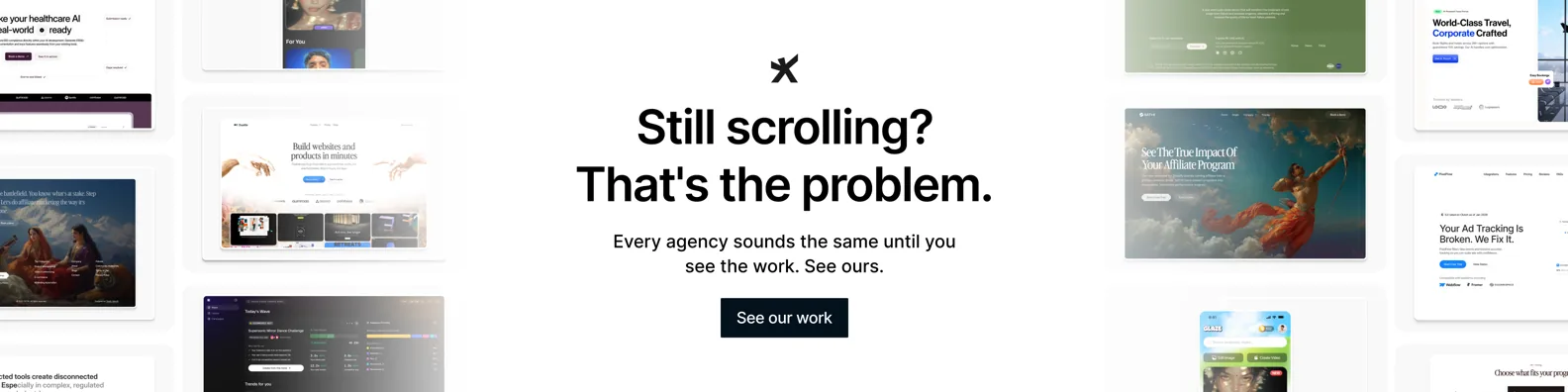
6. Trueform
Trueform has worked from Wil in Switzerland since 2022 in Framer with a published starting price, for Miro, Morning Brew, Bilt Rewards, and Gather. Framer plus a published number is the fastest route on this page, and a Swiss base reads well with European buyers asking where data and suppliers sit.
The team size is not published, the record is short, and the client list is software and media rather than infrastructure.
| Check | Finding |
|---|---|
| Based in | Wil, Switzerland |
| Founded | 2022 |
| Team size | Not published |
| Primary platform | Framer |
| AI-sector proof | Yes |
| Named clients | Miro, Morning Brew, Bilt Rewards, Gather |
| Pricing | Published minimum |
| Best fit | Teams who need a credible marketing site quickly |
7. Foundey
Foundey has designed from San Francisco since 2021 for DemandIQ, Traycer, and Sero AI, with AI-sector proof. All three are early AI companies, so the stage match is close and the studio is used to products that are still being defined.
It is Figma-only, which means design without build, so you need engineering on your side or a second supplier, and neither team size nor pricing is published.
| Check | Finding |
|---|---|
| Based in | San Francisco, USA |
| Founded | 2021 |
| Team size | Not published |
| Primary platform | Figma-only |
| AI-sector proof | Yes |
| Named clients | DemandIQ, Traycer, Sero AI |
| Pricing | Not published |
| Best fit | Platforms whose engineers will build whatever is designed |
8. SuperSkills
SuperSkills is a one to ten person team in Walnut Creek working across platforms, with AI-sector proof and The Cut as a named client. The advantage for a technical product is the short chain: the person who hears your architecture explanation is the person who writes the page, so nothing gets softened in translation.
Only one client is named, no pricing is published, and there is no infrastructure work on show, so evaluation rests on the conversation.
| Check | Finding |
|---|---|
| Based in | Walnut Creek, USA |
| Founded | Not published |
| Team size | 1-10 |
| Primary platform | Mixed |
| AI-sector proof | Yes |
| Named clients | The Cut |
| Pricing | Not published |
| Best fit | Founders who want to explain the architecture exactly once |
9. Lighthouse Digital
Lighthouse Digital is a London Webflow studio with a published starting price, for HelloSelf, Freetrade, and IGN. Freetrade is regulated fintech, so claims had to be careful, and the published number means the budget conversation starts immediately.
There is no AI-sector proof, no published founding year or team size, and nothing infrastructure-shaped in the portfolio, so the technical register would be new ground.
| Check | Finding |
|---|---|
| Based in | London, UK |
| Founded | Not published |
| Team size | Not published |
| Primary platform | Webflow |
| AI-sector proof | No |
| Named clients | HelloSelf, Freetrade, IGN |
| Pricing | Published minimum |
| Best fit | UK teams who want a known number before the first call |
10. Fantasy
Fantasy has run from San Francisco and New York since 1999 across platforms, with AI-sector proof. Twenty-six years of interface work is the longest record here and the strategic depth is genuine.
Nothing else is public. No client list, no team size, no price. For a company that will spend the next year insisting its own numbers be verifiable, that is an awkward place to start.
| Check | Finding |
|---|---|
| Based in | San Francisco and New York, USA |
| Founded | 1999 |
| Team size | Not published |
| Primary platform | Mixed |
| AI-sector proof | Yes |
| Named clients | Not published |
| Pricing | Not published |
| Best fit | Larger companies buying strategy alongside design |
How to choose between them
Sort by what is actually broken.
If the docs and the marketing site feel like two different companies, that is one problem and it should lead. basement.studio, where the build is in code and the seam can genuinely disappear.
If deals stall inside enterprise data teams, buy the credibility signal. Clay or Lazarev.
If nobody outside engineering can explain where you sit in the stack, shorten the chain. SuperSkills, and put your architect on the calls.
If you need a working site before a conference next month, buy speed at a published number. Trueform.
One test before you sign. Ask them to name the layer you occupy after reading your homepage once. If the answer is a paraphrase of your tagline, the tagline is the problem and they have just proved it.