
Summarize with AI


The ten studios an AI devtool company should consider for its website are Studio Maydit, Clay, Finsweet, 8020, Kvalifik, Digidop, Refokus, Fantasy, Flow Ninja, and Engine Digital. Clay and Finsweet come first. Clay has been working from San Francisco since 2016, runs fifty-one to two hundred people across mixed platforms, publishes a starting price, and holds AI-sector proof with Slack, Stripe, Google, Coinbase, and Amazon on its client list. Finsweet is the deepest Webflow practice here, distributed from Denver since 2017 at fifty-one to two hundred people, and its work for GitHub, Dropbox, Clay, and Steadily is the closest developer-facing evidence on this page. Flow Ninja and Engine Digital fit least well, the first publishing neither clients nor price, the second built for enterprise estates.
Your homepage is probably the last page a developer visits, not the first.
Developer adoption runs backwards compared to every other kind of software. Someone sees your tool in a colleague's terminal, or a link on Hacker News, or a repository. They go straight to the README or the docs, try it, and form an opinion. Only later, if they need to convince someone or check whether you are a real company, do they open the homepage. A site designed as an entrance is optimised for a journey your users are not taking.
The second problem is friction. A developer evaluating your tool wants to run it inside two minutes, and any obstacle in the way reads as a signal about the product rather than about the marketing. A prominent book a demo button on a devtool site does more damage than a plain page ever could, because it says the company expects a sales process, and a developer who expects a sales process closes the tab.
Then there is the credibility contest you are running against yourself. Your README is specific, honest about limitations, and written by someone who uses the thing. Your homepage is smoother, vaguer, and written to persuade. Developers read both, notice the difference immediately, and trust the README. The marketing site loses that comparison every time it tries to be more polished rather than more precise.

How we picked these agencies
Five checks decided the order below, and every one is answerable from public pages before booking a call.
Platform depth, judged against a page set that keeps growing. Devtool companies publish changelogs, integration pages, comparison pages, and launch posts continuously, and most of that gets written by engineers rather than marketers. If publishing needs a design review, it will not happen, and the pages that would have earned your search traffic never get made.
Proof with developer-facing products. This is the criterion that decides most of the order here, and it is not the same as general software experience. Writing for developers means keeping the specifics that another audience would find cluttered, and knowing that an honest limitation earns more trust than a confident claim. Studios without that experience smooth exactly the wrong things.
Pricing. Whether a floor appears in public rather than what the floor is. It is a small test of whether a studio is willing to be concrete, which is the quality you most need from it.
Team shape. Whether the senior person who understood your tool writes the words, or hands the brief to somebody who has not used it. On a devtool the difference shows up in a single sentence and developers spot it.
Their own site. Nobody to blame, nobody to please, so it is the clearest available sample of what the studio actually believes.
None of the rows here were inferred. Each one points at something the studio publishes about itself, so a Not published entry reflects a deliberate choice on their part.
What goes wrong for AI devtools
Three failures recur, and the first one quietly costs you the developers you most want.
The site is written for a buyer who does not exist yet. Enterprise language, a demo request, a page about security posture, and nothing that lets somebody try the tool. That page set is right for a company two years further along and wrong now, when adoption depends on individual developers who will never speak to a salesperson. The install command belongs above the fold, and it is nearly always three scrolls down instead.
Marketing contradicts the docs. The site claims broad support, the docs list four supported runtimes. The site says it works with your existing setup, the docs describe a required configuration step. Developers cross-check as a habit, find the gap in minutes, and conclude the company is careless. Nobody wrote either page dishonestly. They were written by different people, and nobody owned the join.
Polish gets mistaken for progress. A studio doing conventionally good work will simplify the language, remove the version numbers, and replace a code sample with an illustration. Every one of those choices improves the page for a general audience and damages it for yours. The result is a site that looks more professional and converts fewer developers, which is a hard failure to diagnose because everything about it appears to be an improvement.
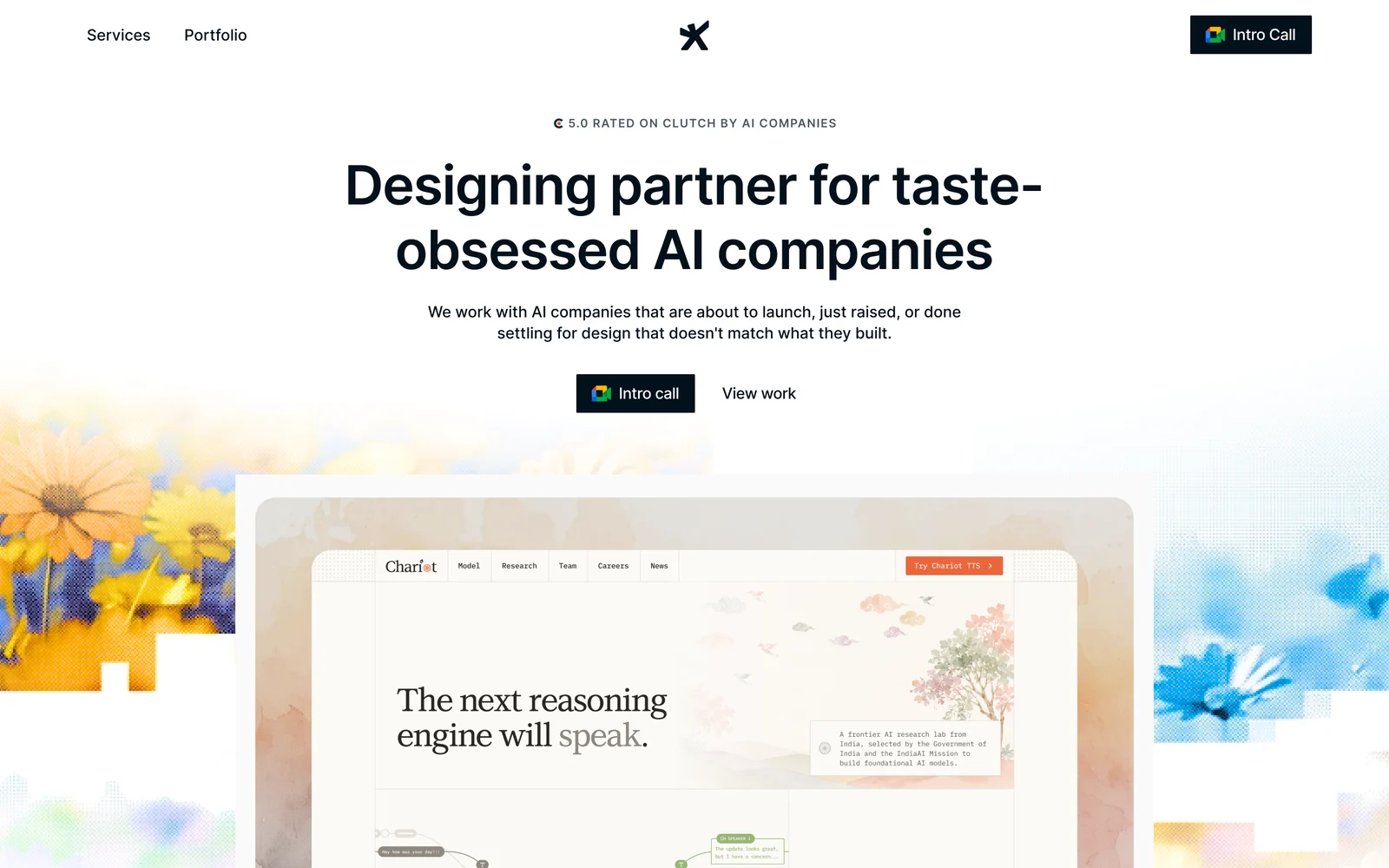
1. Studio Maydit: A Top-Rated Design Agency for AI Founders
Studio Maydit is a web and product design studio whose clients are AI founders, working across the US, UK, and Europe. For a devtool the relevant part is that the studio does not stop at the marketing site: it continues into product design afterwards, and on a developer tool the first-run experience does more selling than any page ever will.
Platform choice follows who publishes. Framer suits a founder still editing the pitch personally. Webflow suits a company where engineers and a developer relations hire both need to ship pages without a design review. Custom code suits a site with genuinely unusual interaction requirements, which for a devtool sometimes means a live playground.
The published outcome is Dualite: a repositioned ICP first, then design built for the narrower group that decision defined, and 100,000+ users inside seven months. What transfers to a devtool is the narrowing rather than the number, because a tool that works for every language and every stack will describe itself so generally that no specific developer sees their own problem in it. Recent clients include Wave, PixelFlow, Mi-VAD, and 15 other AI and SaaS teams.
The two buying options split along how often you ship. A fixed scope of three to four weeks fits a team with a launch or a conference already in the calendar. A monthly retainer fits a devtool shipping continuously, absorbing new pages, campaigns, and product design at the rate the changelog moves, with no long lock-in. Fixed-scope work closes with a diagnosis of what is leaking in the product rather than a handoff and goodbye.
| Check | Finding |
|---|---|
| Based in | Remote, serving US / UK / EU |
| Platform depth | Framer, Webflow, and custom code |
| AI-sector proof | Yes. AI-native clients, published outcome on Dualite |
| Pricing | Fixed scope or monthly retainer, quoted per project |
| Team shape | Founder-led, small senior team |
| Best fit | Devtools whose marketing site is losing a credibility contest to their own docs |
Put the install command above the fold. Book a 30-minute call.

2. Clay
Clay has worked from San Francisco since 2016 with fifty-one to two hundred people across mixed platforms, publishes a starting price, and holds AI-sector proof. Stripe, Google, and Coinbase are companies whose developer-facing surfaces are studied as reference material, and a studio that has worked at that level understands that technical credibility is a design output rather than a copy exercise.
The weakness is stage. This is a premium practice sized for clients with internal brand teams, so an early devtool company will be its smallest account and will pay premium rates for the privilege.
| Check | Finding |
|---|---|
| Based in | San Francisco, USA |
| Founded | 2016 |
| Team size | 51-200 |
| Primary platform | Mixed |
| AI-sector proof | Yes |
| Named clients | Slack, Stripe, Google, Coinbase, Amazon |
| Pricing | Published minimum |
| Best fit | Funded devtools that need to look established to enterprise buyers |
3. Finsweet
Finsweet has worked from Denver since 2017, distributed, with fifty-one to two hundred people, and is the deepest pure Webflow practice on this page. It builds and maintains tooling other Webflow developers depend on, which makes it a devtool company itself, and GitHub on its client list is the single most relevant reference here.
The weakness is that AI-sector proof is partial and no starting price is published, so the AI framing would be adapted from adjacent work rather than repeated from experience.
| Check | Finding |
|---|---|
| Based in | Denver, USA, distributed |
| Founded | 2017 |
| Team size | 51-200 |
| Primary platform | Webflow |
| AI-sector proof | Partial |
| Named clients | Dropbox, Clay, GitHub, Steadily |
| Pricing | Not published |
| Best fit | Devtools whose site must let engineers publish without a design review |
4. 8020
8020 works from San Francisco and New York in Webflow, with a client list that reads like a developer's toolbar: Vanta, Pilot.com, Superlist, Wave, and Circle. Vanta in particular sells a technical product bottom-up before enterprise ever gets involved, which is the motion you are running.
The weakness is disclosure. Neither team size nor a starting price is published, and AI-sector proof is partial, so what you can verify before a conversation is limited.
| Check | Finding |
|---|---|
| Based in | San Francisco and New York, USA |
| Founded | 2014 |
| Team size | Not published |
| Primary platform | Webflow |
| AI-sector proof | Partial |
| Named clients | Wave, Superlist, Pilot.com, Vanta, Circle |
| Pricing | Not published |
| Best fit | Devtools moving from bottom-up adoption toward a first sales motion |
5. Kvalifik
Kvalifik has worked from Copenhagen since 2015 with eleven to fifty people in Webflow, and holds AI-sector proof. Veo and Relesys are products judged on whether they work rather than on how they look, which is the right instinct for a developer audience.
The weakness is disclosure and overlap. No starting price is published, and a US devtool team gets one working window a day with a Copenhagen studio, which slows the fast iteration a launch usually needs.
| Check | Finding |
|---|---|
| Based in | Copenhagen, Denmark |
| Founded | 2015 |
| Team size | 11-50 |
| Primary platform | Webflow |
| AI-sector proof | Yes |
| Named clients | Veo, Maersk, Relesys |
| Pricing | Not published |
| Best fit | European devtools that want direct AI proof over developer references |
6. Digidop
Digidop has worked from Paris since 2021 as a one to ten person Webflow team, publishes a starting price, and counts StreamNative among its clients, which is developer infrastructure and therefore genuinely close to your brief.
The weakness is capacity and language. A team this size takes few projects at once, and English technical copy from a French-first studio is worth testing on a sample before committing a launch to it.
| Check | Finding |
|---|---|
| Based in | Paris, France |
| Founded | 2021 |
| Team size | 1-10 |
| Primary platform | Webflow |
| AI-sector proof | Partial |
| Named clients | TSE Energy, Ramify, StreamNative |
| Pricing | Published minimum |
| Best fit | European devtools wanting a small senior team with infrastructure work behind it |
7. Refokus
Refokus works remotely from Germany with eleven to fifty people in Webflow, for Mural, BASF, Spotify, Yahoo, and BCG. That is an unusually strong list for the size, and the Webflow build means your developer relations hire can publish without waiting on anyone.
The weakness is orientation. AI-sector proof is partial, no starting price is published, and a portfolio weighted toward large enterprise brands suggests a process built for organisations with marketing departments rather than for a devtool with four engineers and a founder.
| Check | Finding |
|---|---|
| Based in | Germany, remote |
| Founded | 2021 |
| Team size | 11-50 |
| Primary platform | Webflow |
| AI-sector proof | Partial |
| Named clients | Mural, BASF, Spotify, Yahoo, BCG |
| Pricing | Not published |
| Best fit | Devtools that want enterprise-grade craft while keeping Webflow editing |
8. Fantasy
Fantasy has worked from San Francisco and New York since 1999 across mixed platforms and holds AI-sector proof. A practice that has run through several technology cycles brings a long view, which can be steadying when your own category redefines its vocabulary every few months.
The weakness is that a developer audience values evidence, and there is very little to examine. No client list, no team size, and no starting price are published, which sits awkwardly against the buying instincts of the people you serve.
| Check | Finding |
|---|---|
| Based in | San Francisco and New York, USA |
| Founded | 1999 |
| Team size | Not published |
| Primary platform | Mixed |
| AI-sector proof | Yes |
| Named clients | Not published |
| Pricing | Not published |
| Best fit | Teams happy to assess a studio entirely through conversation |
9. Flow Ninja
Flow Ninja has worked from Belgrade since 2018 with eleven to fifty people in Webflow. European rates at that team size suits a devtool that needs a large page set built competently, since integration and comparison pages tend to multiply quickly.
The weakness is the absence of public evidence. No named clients, no published price, and partial AI-sector proof, so every question you would normally answer beforehand has to be asked on a call.
| Check | Finding |
|---|---|
| Based in | Belgrade, Serbia |
| Founded | 2018 |
| Team size | 11-50 |
| Primary platform | Webflow |
| AI-sector proof | Partial |
| Named clients | Not published |
| Pricing | Not published |
| Best fit | Devtools needing many pages built at European rates |
10. Engine Digital
Engine Digital has worked from Vancouver and New York since 2002 in custom code, for Adidas, Autodesk, Goldman Sachs, and HP. Autodesk is a genuinely technical product, and two decades of complex builds means the studio can carry a project through many stakeholders without it falling apart.
The weakness is nearly total mismatch with a bottom-up devtool. Custom code makes routine publishing expensive, no team size or price is published, and the client list describes enterprise engagements rather than a company whose users arrive from a repository link.
| Check | Finding |
|---|---|
| Based in | Vancouver and New York |
| Founded | 2002 |
| Team size | Not published |
| Primary platform | Custom code |
| AI-sector proof | Partial |
| Named clients | Adidas, Autodesk, Goldman Sachs, HP |
| Pricing | Not published |
| Best fit | Large technical estates with internal teams and long approvals |
How to choose between them
Sort by what is actually broken.
If developers do not believe you are serious, buy a studio that has built developer-facing surfaces at scale. Clay or Finsweet.
If engineers cannot publish a page without asking a designer, that is a build problem rather than a design one. Finsweet.
If you are adding a sales motion on top of bottom-up adoption, buy proof from a company that made that exact transition. 8020.
If you need thirty integration pages rather than one beautiful homepage, buy volume at sensible rates. Flow Ninja.
One test before you sign. Send each studio your README and ask what they would change on the homepage to match it. A studio that proposes moving specifics onto the site has understood your audience. A studio that proposes softening the README has it exactly backwards, and would spend your budget making the honest half of your writing worse.