

Summarize with AI


For an AI fintech startup, the ten studios worth reviewing are Studio Maydit, SuperSkills, Lazarev, Push Refresh, Lighthouse Digital, Clay, Fantasy, Feely Studio, BX Studio, and Foundey. Lazarev and Clay lead this list. Lazarev has worked from San Francisco since 2015 with fifty-one to two hundred people, a published starting price, and AI-sector proof, for Payoneer, Peel, Elva, and Mozayix. Clay has designed from San Francisco since 2016 at the same headcount with a published figure, for Slack, Stripe, Google, Coinbase, and Amazon, which includes the two most studied payment products in the market. Fantasy and Foundey fit least well. Fantasy publishes no clients and no price, and Foundey hands over Figma files with nothing built.
Two people read your website, and one of them is looking for a reason to say no.
The first reader is the person who wants the product. They arrive quickly, they want to know what it does, and they will move on if the page takes too long to say it. The second reader arrives later, sent by the first, and works in risk, compliance, or finance. Their job is to find the thing that makes this a bad idea.
Most fintech sites are built entirely for the first reader and then fail with the second, who cannot find where money is held, who is regulated, what happens to data, or which parts are automated. That silence reads as evasion, whether or not it is.
Add a model to the product and the pressure doubles. Every claim about what the system decides is a claim somebody may later have to defend, and vague confidence is the most expensive kind.

How we picked these agencies
Five checks, all answerable from public pages before a call is scheduled.
Platform depth, judged against how often your claims will change. Fintech copy is not static. A new licence, a new market, a change in what the model does, and half a dozen pages need updating the same week. Ask what that week looks like, and whether anyone outside the studio can do it.
Proof on money products, or on anything a risk team has reviewed. This is the criterion doing the most work on this page. Designing for a product where somebody could lose money is a different discipline from designing for one where they lose an afternoon. It shows up in how carefully claims are worded and in whether the disclosures were designed or dumped at the bottom.
Pricing. Is a starting figure published. It also functions as a small integrity check, since a studio comfortable putting a number in public is unlikely to be shy about the rest.
Team shape. Size predicts who reviews the copy. In regulated categories the specific wording matters, and a large studio's production team may not be the people who understood why a sentence was phrased that way.
Their own site. It is the brief where nobody could overrule them, so read it for how precisely they say things, not for how it looks.
An extra question worth asking on the first call: how do they handle a claim that legal wants softened. A studio that has done this before treats it as normal editing. One that has not will treat it as a creative loss.
Nothing in the tables that follow has been inferred. Each row states only what a studio itself puts on the record, and where one reads unpublished, that studio simply does not disclose it. In a category where your own buyers will verify every claim you make, compiling the list any other way seemed indefensible.
What goes wrong for AI fintech startups
Three failures, and the first one is the most expensive to undo.
The homepage makes claims your compliance review will delete. Eliminates fraud. Guaranteed approval. Ninety-nine percent accurate, with no source and no definition of accurate. These get written because they are the strongest version of the sentence, then removed in review, and what replaces them is usually weaker than an honest specific claim would have been. Write the honest number first, with what it measures, and you keep both the strength and the sentence.
Nobody can find who holds the money or where the data goes. These sit in a footer link, or nowhere, because they feel like small print rather than content. For your second reader they are the whole page. Give the banking partner, the regulatory position, the data handling, and the human override a real page with plain answers, and link to it from the places evaluation actually happens.
The site looks exactly like every other fintech site. The same gradients, the same floating card, the same invented dashboard screenshot showing numbers nobody could have earned. The dashboard is the worst of these, because a technical buyer can tell it is fake within seconds and everything after it becomes suspect. Show real output, even if it is less pretty, and the credibility gained is worth more than the polish lost.
1. Studio Maydit: A Top-Rated Design Agency for AI Founders
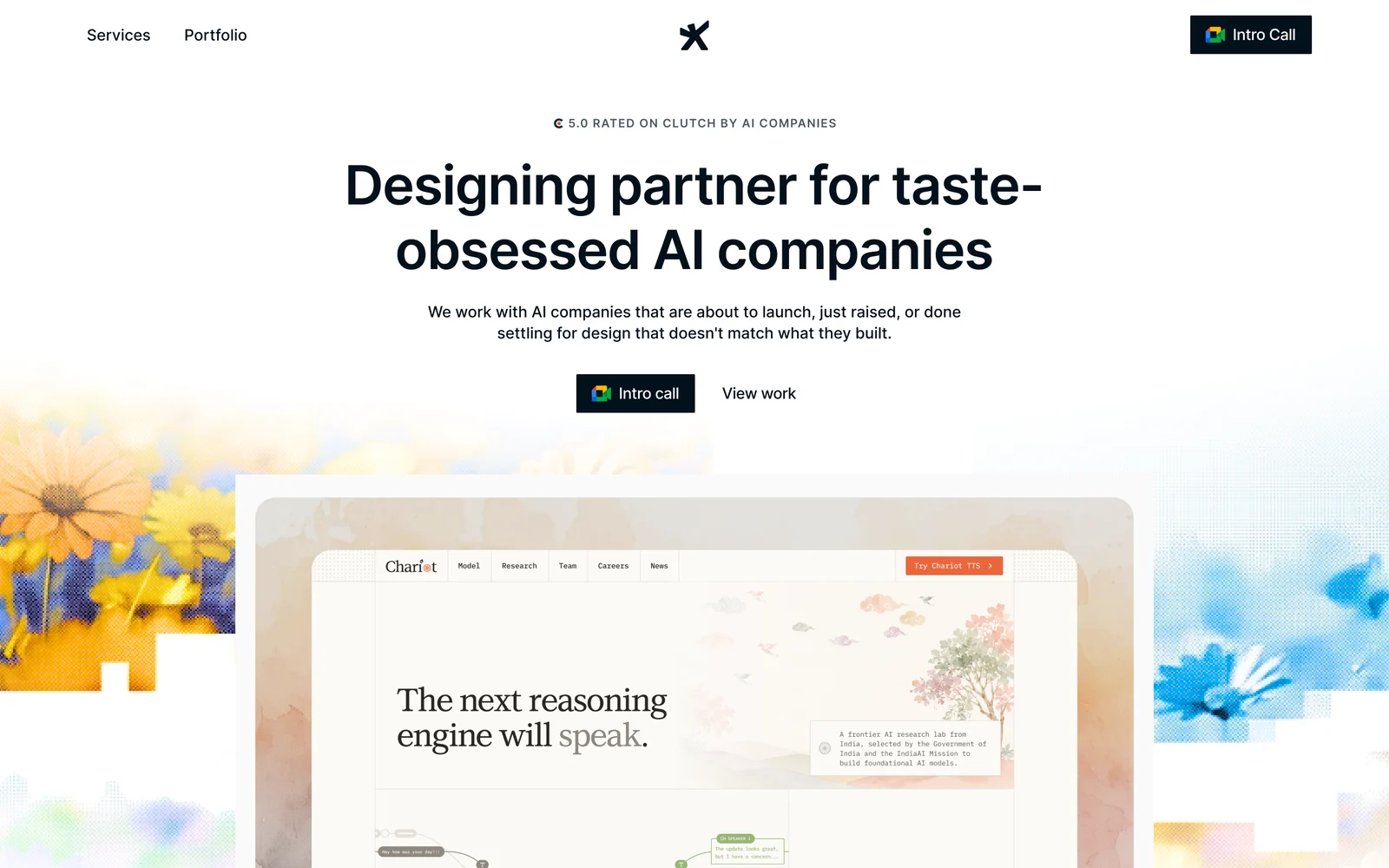
The hardest surface in a fintech product is usually not the marketing page but the moment a user is asked to trust an automated decision, and that moment lives inside the product. Studio Maydit carries on into product design once the site ships, so the two halves of that trust problem get answered by the same people. It is a web and product design studio. Its clients are AI founders, across the US, UK, and Europe. Platform follows the work: Framer where claims and pages change often, Webflow where a marketing team runs its own calendar, and custom code where the page has to show something real from the product.
The Dualite work is the clearest published outcome. A repositioned ICP came first. The product was then designed for the narrower group that decision defined. 100,000+ users arrived over seven months. For a fintech team that ordering matters more than usual, because the temptation is to describe a platform that serves consumers, businesses, and partners at once, and a page written for three regulated audiences reassures none of them. Recent clients include Wave, PixelFlow, Mi-VAD, and 15 other AI and SaaS teams.
There are two ways to buy. Fixed scope runs three to four weeks and fits a launch, a licence announcement, or a funding date, and it ends with a written diagnosis of what is leaking in the product. The monthly retainer suits a company whose claims and markets keep changing, covering new pages, campaigns, and product design, with no long lock-in, which matters when nobody can predict what the next regulatory update will require.
| Check | Finding |
|---|---|
| Based in | Remote, serving US / UK / EU |
| Platform depth | Framer, Webflow, and custom code |
| AI-sector proof | Yes. AI-native clients, published outcome on Dualite |
| Pricing | Fixed scope or monthly retainer, quoted per project |
| Team shape | Founder-led, small senior team |
| Best fit | Fintech teams whose site has to satisfy a buyer and a risk reviewer |
Bring the sentence your lawyer keeps changing. That is where the work starts. Book a 30-minute call.

2. Lazarev
Lazarev has worked from San Francisco since 2015 with fifty-one to two hundred people, a published starting price, and AI-sector proof, for Payoneer, Peel, Elva, and Mozayix. Payoneer moves money across borders under several regulators at once, which is close to the hardest version of your problem, and the studio's strength is making dense products legible.
The price band is premium, the platform is mixed rather than fixed, and at that headcount you should confirm who reviews the copy.
| Check | Finding |
|---|---|
| Based in | San Francisco, USA |
| Founded | 2015 |
| Team size | 51-200 |
| Primary platform | Mixed |
| AI-sector proof | Yes |
| Named clients | Payoneer, Peel, Elva, Mozayix |
| Pricing | Published minimum |
| Best fit | Fintech teams with a genuinely complicated product to explain |
3. SuperSkills
SuperSkills is a one to ten person team in Walnut Creek working across platforms, with AI-sector proof and The Cut as a named client. The value here is the short chain: you explain a regulated product once, to the person writing the page, and the careful wording survives to the final draft instead of being paraphrased by three people.
Only one client is named, no price is published, there is no fintech reference, and capacity limits the scope.
| Check | Finding |
|---|---|
| Based in | Walnut Creek, USA |
| Founded | Not published |
| Team size | 1-10 |
| Primary platform | Mixed |
| AI-sector proof | Yes |
| Named clients | The Cut |
| Pricing | Not published |
| Best fit | Teams who want one person carrying the wording end to end |
4. Push Refresh
Push Refresh is a one to ten person Dallas team working in Framer with a published starting price, for SmithRx, Synonym, and Northern National. SmithRx operates in healthcare, which shares fintech's habit of having every sentence reviewed, and Framer means a compliance-driven copy change can go live the same afternoon.
The AI-sector proof is partial, no founding year is published, and a team that size cannot run several pages at once.
| Check | Finding |
|---|---|
| Based in | Dallas, USA |
| Founded | Not published |
| Team size | 1-10 |
| Primary platform | Framer |
| AI-sector proof | Partial |
| Named clients | SmithRx, Synonym, Northern National |
| Pricing | Published minimum |
| Best fit | Teams who need wording changes live within hours |
5. Lighthouse Digital
Lighthouse Digital is a London Webflow studio with a published starting price, for HelloSelf, Freetrade, and IGN. Freetrade is a regulated UK consumer investment product that had to explain risk clearly while still persuading people to sign up, which is the exact balance this brief needs.
There is no AI-sector proof at all, and neither the founding year nor the team size is published.
| Check | Finding |
|---|---|
| Based in | London, UK |
| Founded | Not published |
| Team size | Not published |
| Primary platform | Webflow |
| AI-sector proof | No |
| Named clients | HelloSelf, Freetrade, IGN |
| Pricing | Published minimum |
| Best fit | UK fintech teams who want a regulated consumer reference |
6. Clay
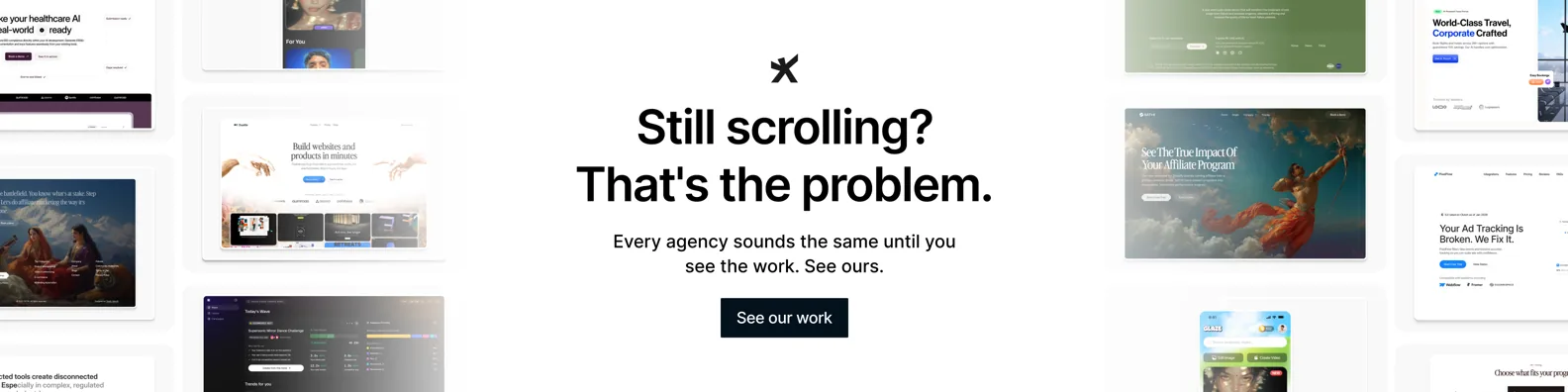
Clay has worked from San Francisco since 2016 with fifty-one to two hundred people, a published starting price, and AI-sector proof, for Slack, Stripe, Google, Coinbase, and Amazon. Stripe and Coinbase are the two most examined money products on the internet, and both had to make complicated financial mechanics feel routine. That is the reference the rest of this page is measured against.
The band is premium, the platform is mixed, and a studio at that scale will not treat an early fintech site as its largest project.
| Check | Finding |
|---|---|
| Based in | San Francisco, USA |
| Founded | 2016 |
| Team size | 51-200 |
| Primary platform | Mixed |
| AI-sector proof | Yes |
| Named clients | Slack, Stripe, Google, Coinbase, Amazon |
| Pricing | Published minimum |
| Best fit | Funded fintech teams buying at the top of the market |
7. Fantasy
Fantasy has worked from San Francisco and New York since 1999, with AI-sector proof. Twenty-six years spans several complete changes in how financial software looks, and that perspective is genuinely rare.
Nothing is verifiable. No clients, no price, no headcount. In a category where your own buyers will check every claim you make, choosing a partner you cannot check is a harder argument than usual.
| Check | Finding |
|---|---|
| Based in | San Francisco and New York, USA |
| Founded | 1999 |
| Team size | Not published |
| Primary platform | Mixed |
| AI-sector proof | Yes |
| Named clients | Not published |
| Pricing | Not published |
| Best fit | Companies buying a long record rather than a checkable list |
8. Feely Studio
Feely Studio is a distributed European team of one to ten with a published starting price and AI-sector proof, for Noxus, Mutiny, Luasai, and Basic Capital. Basic Capital is a financial product, so there is a direct reference here, and a small European team stretches a budget further than the equivalent American quote.
One to ten people limits how much can run at once, no founding year is published, and the time zone overlap with the US is partial.
| Check | Finding |
|---|---|
| Based in | Distributed, Europe |
| Founded | Not published |
| Team size | 1-10 |
| Primary platform | Mixed |
| AI-sector proof | Yes |
| Named clients | Noxus, Mutiny, Luasai, Basic Capital |
| Pricing | Published minimum |
| Best fit | European fintech teams wanting a small senior team |
9. BX Studio
BX Studio is a New York Webflow team of eleven to fifty with a published starting price and AI-sector proof, for Reddit, Headspace, ASAPP, and Verifone. Verifone is payments infrastructure, which is a real fintech reference, and Webflow keeps a compliance-driven wording change inside your own team rather than in a queue.
No founding year is published, and the rest of the client list is consumer rather than regulated.
| Check | Finding |
|---|---|
| Based in | New York, USA |
| Founded | Not published |
| Team size | 11-50 |
| Primary platform | Webflow |
| AI-sector proof | Yes |
| Named clients | Reddit, Headspace, ASAPP, Verifone |
| Pricing | Published minimum |
| Best fit | Fintech teams who want to own edits after launch |
10. Foundey
Foundey has worked from San Francisco since 2021 with AI-sector proof, for DemandIQ, Traycer, and Sero AI. All three are AI companies at an early stage, and the practice is design-led, which suits a team that wants to think hard about the interface before building anything.
Foundey stops at Figma, so somebody on your side builds it. No team size or pricing is published, there is no fintech reference, and an engineering team in a regulated company rarely has spare capacity for a marketing site.
| Check | Finding |
|---|---|
| Based in | San Francisco, USA |
| Founded | 2021 |
| Team size | Not published |
| Primary platform | Figma-only |
| AI-sector proof | Yes |
| Named clients | DemandIQ, Traycer, Sero AI |
| Pricing | Not published |
| Best fit | Teams with engineers who will build the design themselves |
How to choose between them
Sort by what is actually broken.
If buyers understand the pitch and then stall in review, the missing thing is the trust page. Lazarev, or Lighthouse Digital for a UK consumer product.
If the product is genuinely hard to describe without a diagram, that is information design. Clay.
If copy keeps changing because legal keeps changing it, buy for publishing speed. Push Refresh on Framer, or BX Studio on Webflow.
If the careful wording keeps getting lost between people, keep the team small. SuperSkills, or Feely Studio.
One test before you sign. Ask them to rewrite one claim from your current homepage so it survives a compliance review without losing force. A studio that fits this brief will hand back something sharper. A studio that does not will hand back something hedged.