Summarize with AI


For an AI healthtech startup, the ten studios worth reviewing are Studio Maydit, Feely Studio, Foundey, basement.studio, Feels Like, BX Studio, Finsweet, Lighthouse Digital, Clay, and Fantasy. BX Studio and Clay lead this list. BX Studio works in Webflow from New York with eleven to fifty people, a published starting price, and AI-sector proof, for Reddit, Headspace, ASAPP, and Verifone, and Headspace is a consumer health product that had to be careful about what it promised. Clay has worked from San Francisco since 2016 with fifty-one to two hundred people, a published starting price, and AI-sector proof, for Slack, Stripe, Google, Coinbase, and Amazon. Foundey and Lighthouse Digital fit least well. Foundey hands over Figma files with nothing built, and Lighthouse Digital publishes no AI work at all.
Health software is the one category where a good headline can become a regulatory problem.
Every other kind of startup can overstate slightly and correct later. You cannot. The sentence that describes what your model does is read by a clinician deciding whether to trust it, a compliance officer deciding whether it is a medical claim, and eventually possibly by a regulator deciding what you were implying.
Most healthtech sites solve this by saying almost nothing. They fill the homepage with soft language about empowering care teams and transforming outcomes, and the reader leaves without learning what the product does.
That is the trap. Vagueness feels safe and is expensive, because your actual buyer is a specialist who can tell the difference between careful and evasive.
There is also a second audience nobody designs for. The clinician who will use this daily is not the person who signs the contract, and if the site never speaks to them, your champion has nothing to circulate internally. For how to fix that without inflating a claim, see our guide to earning clinical trust on a healthtech website.

How we picked these agencies
Five things decided the order, and each of them can be checked from public pages before you book anything.
Platform depth, judged by how often your wording will need to change. Health claims get revised after legal review, after a study reads out, and after a regulator publishes new guidance. If a copy change needs a developer and a deploy, those revisions get delayed, and delayed revisions are the ones that cause problems.
Clinical and regulated-sector proof, which is the criterion weighted most heavily here. General AI experience is not enough. What matters is whether a studio has designed for a product where a claim had to survive review by someone whose job is to reject claims. Health, financial, and legal work all build that habit.
Pricing. Is a starting figure published. Your own buyers are institutions that expect transparent commercial terms, and there is a consistency argument for partners who behave the same way.
Team shape. Size predicts who writes the load-bearing sentence. In healthtech one clause can turn a wellness product into a regulated device in the reader's mind, and that clause should be written by someone senior enough to understand the difference.
Their own site. It is the one project with no client to blame, so read it for precision rather than polish.
An extra question worth putting on the first call: ask how they would describe a model's output without implying a diagnosis. That is the hardest sentence on your website, and their answer tells you almost everything.
Everything in these tables traces to a public page. Where a figure is missing, it is missing because the studio has not disclosed it, not because we could not find it.
What goes wrong for AI healthtech startups
Three failures, and the first is the one that quietly makes you a regulated product.
The homepage implies a diagnosis nobody meant to claim. Detects disease earlier. Identifies at-risk patients. Knows before symptoms appear. Each of those reads to a clinician as a diagnostic claim, which is a category with its own approval pathway. The fix is not to say less, it is to say what the system actually outputs and who acts on it. A model that flags records for review is a genuinely useful product, and describing it precisely makes it sound more credible rather than less.
Everything is written for the buyer and nothing for the clinician. The site addresses a chief medical officer or a head of operations, in the language of efficiency and cost per case. The person who will actually open this software forty times a shift never appears. That is a sales problem, not just a courtesy one, because health software is bought by committee and killed by the users who tried it and hated it. Give them a page about what their day looks like with this running.
There is no page explaining what the model was trained on. In this category that is the first serious question, and it arrives early. What data, from where, with what consent, validated against which population, and where does patient information go. If those answers live only in a security questionnaire your team fills in by hand, every deal slows at the same point and you learn nothing about which deals were never going to close.
1. Studio Maydit: A Top-Rated Design Agency for AI Founders
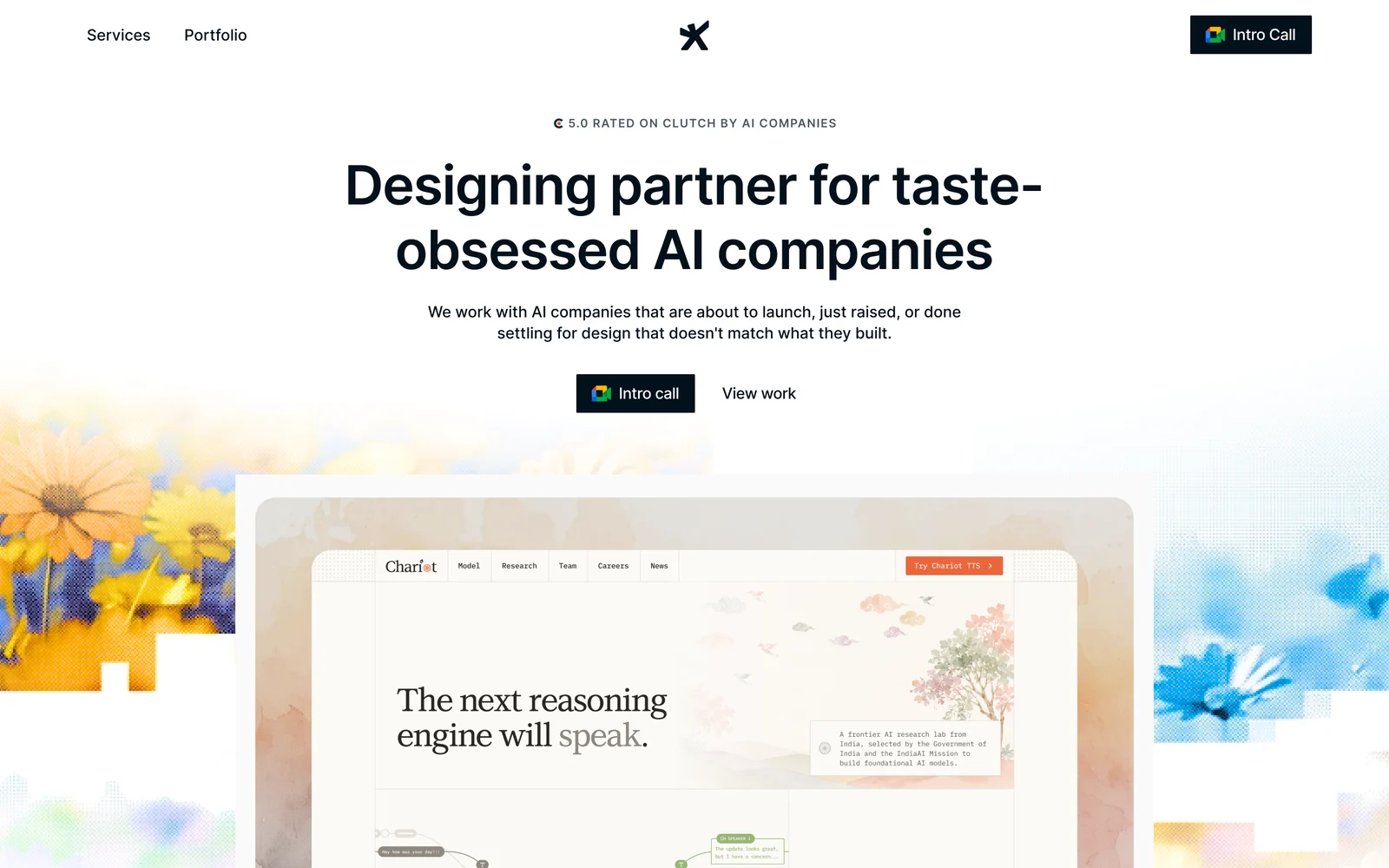
The most consequential screen in health software is inside the product, at the moment a clinician is shown a flag and has to decide what to do with it. Studio Maydit continues into product design after the site ships, so the promise made on the marketing page and the interface that has to honour it are drawn by the same team rather than by two suppliers who never spoke. It is a web and product design studio working with AI founders across the US, UK, and Europe.
Framer, Webflow, and custom code are all live options, and in this category the choice usually follows how often your wording will move. Framer when claims are still being revised after review. Webflow when a marketing team runs its own calendar. Custom code when a page has to show something real from the product rather than a picture of it.
The Dualite outcome is the published one, and the order of events is what transfers. A repositioned ICP came first. The product was then designed for the narrower group that decision created, and 100,000+ users arrived across seven months. Healthtech pulls hard the other way, because illness is universal and it is tempting to address every care setting at once. Recent clients include Wave, PixelFlow, Mi-VAD, and 15 other AI and SaaS teams. Fixed scope runs three to four weeks and suits a team with a launch or a study readout to hit, ending with a written diagnosis of what is leaking in the product. A monthly retainer suits teams whose claims keep changing, covering new pages, campaigns, and product design, with no long lock-in.
| Check | Finding |
|---|---|
| Based in | Remote, serving US / UK / EU |
| Platform depth | Framer, Webflow, and custom code |
| AI-sector proof | Yes. AI-native clients, published outcome on Dualite |
| Pricing | Fixed scope or monthly retainer, quoted per project |
| Team shape | Founder-led, small senior team |
| Best fit | Healthtech teams whose page must satisfy a clinician and a reviewer |
Write the sentence a clinician would defend to a colleague. Book a 30-minute call.

2. BX Studio
BX Studio works in Webflow from New York with eleven to fifty people, a published starting price, and AI-sector proof, for Reddit, Headspace, ASAPP, and Verifone. Headspace is the useful reference: a health-adjacent consumer product that had to be warm without promising clinical outcomes, which is the exact tonal problem your homepage has. Verifone adds work in a category with real compliance weight.
The studio does not publish a founding year, and none of the named clients is a regulated clinical product, so the deepest medical review experience is not evidenced here.
| Check | Finding |
|---|---|
| Based in | New York, USA |
| Founded | Not published |
| Team size | 11-50 |
| Primary platform | Webflow |
| AI-sector proof | Yes |
| Named clients | Reddit, Headspace, ASAPP, Verifone |
| Pricing | Published minimum |
| Best fit | Healthtech teams who need warmth without a clinical promise |
3. Clay
Clay has worked from San Francisco since 2016 with fifty-one to two hundred people, a published starting price, and AI-sector proof, for Slack, Stripe, Google, Coinbase, and Amazon. Stripe and Coinbase are both products where a single imprecise sentence carries financial and regulatory consequences, and that discipline transfers directly to health claims. At this size brand and product work can run together.
This is the most expensive option on the page, and a studio serving clients of that scale will expect a decision process most early healthtech teams have not built yet.
| Check | Finding |
|---|---|
| Based in | San Francisco, USA |
| Founded | 2016 |
| Team size | 51-200 |
| Primary platform | Mixed |
| AI-sector proof | Yes |
| Named clients | Slack, Stripe, Google, Coinbase, Amazon |
| Pricing | Published minimum |
| Best fit | Funded healthtech teams buying brand and product together |
4. basement.studio
basement.studio works in custom code from Mar del Plata and Los Angeles since 2018, with eleven to fifty people, a published starting price, and AI-sector proof, for Vercel, Cursor, ElevenLabs, Harvey AI, and Scale AI. Harvey AI is the closest analogue on this page: a model applied inside a profession where being wrong has consequences and the buyers are trained sceptics.
The client list is developer and enterprise AI rather than healthcare, and a custom-code build means marketing changes go through engineering, which is awkward when a claim needs revising after review.
| Check | Finding |
|---|---|
| Based in | Mar del Plata, Argentina and Los Angeles, USA |
| Founded | 2018 |
| Team size | 11-50 |
| Primary platform | Custom code |
| AI-sector proof | Yes |
| Named clients | Vercel, Cursor, ElevenLabs, Harvey AI, Scale AI |
| Pricing | Published minimum |
| Best fit | Teams selling AI into a profession that audits its own decisions |
5. Feels Like
Feels Like is a custom-code studio in Los Angeles founded in 2023, with AI-sector proof, for Google, Nike, LVMH, and Suno AI. The strength is craft, and craft matters more in health than founders expect, because a product that looks improvised is not trusted with patient data. Suno AI shows recent work with a generative product.
No pricing and no team size are published, the studio is young, and none of the named clients operates in a regulated clinical setting.
| Check | Finding |
|---|---|
| Based in | Los Angeles, USA |
| Founded | 2023 |
| Team size | Not published |
| Primary platform | Custom code |
| AI-sector proof | Yes |
| Named clients | Google, Nike, LVMH, Suno AI |
| Pricing | Not published |
| Best fit | Healthtech teams whose product reads as unfinished |
6. Finsweet
Finsweet works in Webflow from Denver as a distributed team with fifty-one to two hundred people, for Dropbox, Clay, GitHub, and Steadily. This is the deepest Webflow engineering on the page. For a healthtech site that will grow evidence pages, integration pages, and a set of documents for procurement, a properly modelled CMS is worth more than a striking homepage.
No pricing is published, AI-sector proof is only partial, and this is a build-quality studio rather than a narrative one, so the hard sentences about your model will still be yours to write.
| Check | Finding |
|---|---|
| Based in | Denver, USA, distributed |
| Founded | 2017 |
| Team size | 51-200 |
| Primary platform | Webflow |
| AI-sector proof | Partial |
| Named clients | Dropbox, Clay, GitHub, Steadily |
| Pricing | Not published |
| Best fit | Teams whose site will grow a large evidence and compliance section |
7. Feely Studio
Feely Studio is a distributed European team of one to ten people with a published starting price and AI-sector proof, for Noxus, Mutiny, Luasai, and Basic Capital. A very small senior team means the person who understands your regulatory constraint is the person writing the page, with no handoff in between, and European work brings familiarity with strict data expectations.
The named clients are AI and finance rather than health, and a team this size cannot run a site build and a product design workstream at the same time.
| Check | Finding |
|---|---|
| Based in | Distributed, Europe |
| Founded | Not published |
| Team size | 1-10 |
| Primary platform | Mixed |
| AI-sector proof | Yes |
| Named clients | Noxus, Mutiny, Luasai, Basic Capital |
| Pricing | Published minimum |
| Best fit | European healthtech teams wanting senior attention on the wording |
8. Fantasy
Fantasy has worked from San Francisco and New York since 1999 with AI-sector proof. A studio with this much history has designed through several eras of health interface convention, and that perspective is useful when deciding how much clinical formality your product should adopt.
No clients, no team size, and no pricing are published, which makes this the hardest studio here to evaluate before a call, and there is no published evidence of regulated health work.
| Check | Finding |
|---|---|
| Based in | San Francisco and New York, USA |
| Founded | 1999 |
| Team size | Not published |
| Primary platform | Mixed |
| AI-sector proof | Yes |
| Named clients | Not published |
| Pricing | Not published |
| Best fit | Teams wanting a senior view on how formal to appear |
9. Foundey
Foundey has worked from San Francisco since 2021 with AI-sector proof, for DemandIQ, Traycer, and Sero AI. All three are AI companies, so the category is familiar and the studio will not need your model explained twice.
Foundey works in Figma only, so nothing gets built. You will need a separate development partner, which adds a handoff at exactly the point where a claim gets rewritten, and no pricing or team size is published.
| Check | Finding |
|---|---|
| Based in | San Francisco, USA |
| Founded | 2021 |
| Team size | Not published |
| Primary platform | Figma-only |
| AI-sector proof | Yes |
| Named clients | DemandIQ, Traycer, Sero AI |
| Pricing | Not published |
| Best fit | Teams who already have developers and only need design |
10. Lighthouse Digital
Lighthouse Digital builds in Webflow from London with a published starting price, for HelloSelf, Freetrade, and IGN. HelloSelf is the relevant one, a UK mental health service where the tone had to be careful and the claims measured, which is close to the problem a healthtech homepage has.
No AI-sector work is published at all, and neither team size nor founding year is on record, so this is the least verifiable option for a product whose difficulty is the model.
| Check | Finding |
|---|---|
| Based in | London, UK |
| Founded | Not published |
| Team size | Not published |
| Primary platform | Webflow |
| AI-sector proof | No |
| Named clients | HelloSelf, Freetrade, IGN |
| Pricing | Published minimum |
| Best fit | UK health teams who want a careful tone over technical depth |
How to choose between them
Sort by what is actually broken.
If deals stall at the security and data questionnaire, the missing thing is a training-data and privacy page. basement.studio, or Clay for institutional buyers.
If the homepage sounds either alarming or empty, that is a wording problem. BX Studio.
If your site will carry evidence, studies, and procurement documents, buy CMS engineering. Finsweet.
If the product looks unfinished next to competitors, that is craft. Feels Like.
One test before you sign. Ask them to rewrite your strongest claim so a clinician would repeat it to a colleague without adding a caveat. A studio that fits this brief returns something narrower and more convincing. A studio that does not returns something softer and emptier, which is the failure mode this whole category falls into.